
Remote Online Notarization
Remote online notarization (RON) is a notarial act performed over live audio-video by a notary commissioned in a RON-authorized state — and it is the notary's commissioning state, not the signer's location, that governs whether the act is valid. USA Notary charges $25 per document, serves signers in all 50 states, 24/7, and most sessions take 15–30 minutes.
Published July 9, 2026 · Last updated: August 8, 2026 · By Andrew Ray Yon, MBA, ChFC — CEO & Founder, USA Notary
What is remote online notarization?
Remote online notarization is a notarial act in which the signer appears before a commissioned notary over live, recorded audio-video instead of in the same room. The notary verifies the signer's identity, watches the signature happen, applies an electronic notarial seal, and keeps a recording of the session. Everything a traditional notarization produces — an acknowledgment or jurat, a seal, a journal entry — a remote online notarization produces too.
The authority behind the act comes from one place: the notary's commission. A notary is commissioned by a single state, and that state's law is what authorizes them to notarize remotely. The National Association of Secretaries of State reports that "47 states and the District of Columbia have a law that allows for remote e-notarization" (retrieved August 8, 2026). You can see which states authorize RON, state by state. Our 2026 report on how far RON adoption actually goes sets that legal authority against the 2.5% of 2022 closings that were fully digital.
Which state's law governs when the signer and the notary are in different states?
The notary's commissioning state governs. A notary performs the act under the law of the state that commissioned them, and RON statutes are written on the assumption that the signer may be somewhere else — that is the entire point of the technology. This is why USA Notary serves signers in all 50 states, including states that have not authorized their own notaries to notarize remotely: the signer's location is not what the statute regulates.
Your own state's rules still matter for a different question — whether an institution in your state accepts the finished document. That is a separate gate, and it is covered in the recorder and court section below.
Can a notary commissioned in a non-RON state perform one?
No. A notary commissioned in a state that has not authorized remote online notarization cannot perform one, because their commission does not carry that authority — and in most states a separate registration as an online notary is required on top of the ordinary commission. A notary who notarizes over video without that authorization has not performed a valid notarial act, whatever the technology showed on screen.
For signers this is invisible: the platform routes your session to a notary who holds the authorization. For notaries it is the whole career question — see how to get commissioned in your state and how the online registration sits on top of it.
How does RON differ from a traditional in-person notarization?
Both produce a legally valid notarial act. The difference is how the signer appears before the notary, and what evidence the process leaves behind afterwards.
| Traditional (in-person) notary | Remote online notary (RON) | |
|---|---|---|
| How the signer appears | In person, in the same room | On a live, recorded audio-video call from anywhere |
| Hours & availability | Office hours, by appointment | On demand, available 24/7 |
| Identity verification | Visual check of a physical ID | Government-ID check, credential analysis, and knowledge-based authentication (KBA) |
| Recording & audit trail | Paper journal entry; the session is not recorded | Full session recording plus a complete digital audit trail |
| What survives afterwards | A journal line and the signed paper | The signed document, the electronic journal, and the session video — retained for 10 years on USA Notary |
| Cost | State-set per-signature fee, plus any travel | $25 per document (see pricing) |
How does a RON session actually run, start to finish?
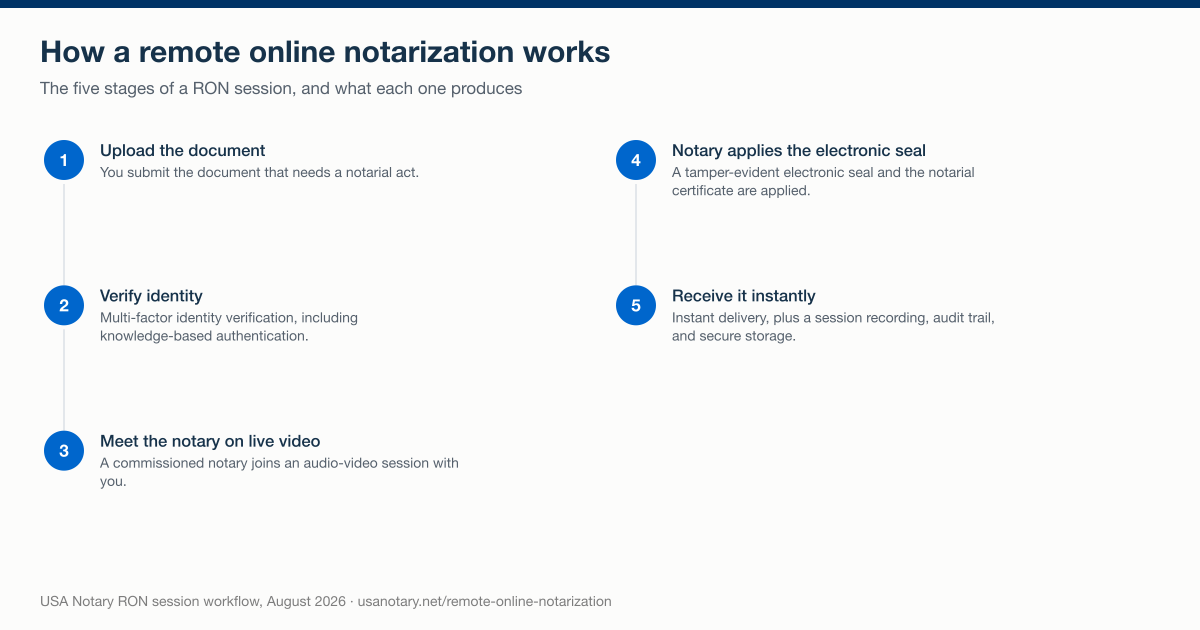
A RON session runs in five steps and takes most signers 15–30 minutes — and it cannot proceed past identity verification, which is where sessions that fail, fail. Nothing is notarized before the notary is satisfied the signer is who they claim to be.
- 1
Upload the document. The complete document goes up first, in its final form, with the notarial certificate wording already on it. A notary cannot choose a certificate for you.
- 2
Prove your identity. Two checks run before the notary appears: credential analysis of your government photo ID, and knowledge-based authentication — a short quiz drawn from public and commercial records about your own history.
- 3
Meet the notary on live video. The recording starts here. The notary confirms your ID on camera, checks that you understand what you are signing, and that you are signing willingly.
- 4
Sign, then the notary seals. You sign electronically while the notary watches, and the notary completes the notarial certificate and applies the electronic seal — in that order, never before.
- 5
Download, with the audit trail attached. The finished document is tamper-evident sealed and carries a complete audit trail of every step above.
The step-by-step walkthrough of a RON session covers what each screen asks for, and how the session data is secured and stored covers what happens to it afterwards.
What happens if identity verification fails?
The session stops before any notarial act occurs. Knowledge-based authentication is run by a third-party identity-verification service, not by the notary — the notary cannot see the questions, cannot coach you through them, and cannot wave a failed check through. That is the design: the notary's own commission is at risk if identity is not properly established, so a failed check is a hard stop rather than a judgment call.
Failures are usually mundane. KBA questions are generated from public and commercial records about your financial history, so signers who have recently moved, who share a name with a relative, who have little credit history, or who are answering about a mortgage they refinanced years ago are the ones who most often get tripped up — not impostors.
USA Notary does not publish a fixed retry limit or a billing rule for a session that ends at identity verification — the retry behaviour is set by the identity-verification provider and can differ by case. If your ID or your records are likely to be a problem, ask before you start: contact the team or call 804-767-7500. When remote identity verification cannot be completed at all, an in-person notary is the fallback — where to get something notarized in person lists the options.
Which documents can't be notarized online?
Two different rules exclude documents from remote online notarization, and they are worth keeping apart — the binding limit is usually the receiving party's acceptance policy, not the state's RON statute. Far more documents are legally eligible for RON than are practically accepted by the institution at the other end.
Which documents does the law exclude?
Federal law draws the first line. The ESIGN Act's electronic-records rules do not apply to several categories of document, listed at 15 U.S.C. § 7003(a) (retrieved August 8, 2026):
- Law "governing the creation and execution of wills, codicils, or testamentary trusts."
- State law "governing adoption, divorce, or other matters of family law."
- The Uniform Commercial Code as in effect in any state, "other than sections 1–107 and 1–206 and Articles 2 and 2A."
State law draws the second. Individual RON statutes carve out their own exclusions on top of the federal ones, and the carve-outs differ — which is why a document a notary in one state may handle remotely may be off-limits a state line away. Wills are the case that catches people out most often; our guide to whether a will can be notarized online works through what is actually permitted, and whether a will needs to be notarized at all answers the question behind it.
Which documents does the recipient commonly reject even when RON is legal?
The second gate is the one nobody warns you about: a bank, a lender, a foreign consulate, a registrar, or a title underwriter can insist on a wet-ink notarization even where state law plainly authorizes the remote one. That is a policy decision on their side, not a legal defect on yours — but it produces the same outcome, which is a document that comes back.
The categories where a receiving party most often sets its own rule:
- Documents going overseas. An apostille chain, a foreign ministry, or an embassy may require an original paper notarization — see what an apostille is.
- Bank and brokerage forms. Some institutions require their own notary or a medallion signature guarantee, which is not a notarization at all. Ask first — will my bank accept an online notarization?
- Loan packages. The lender and the title underwriter both have to approve a remote closing before it is scheduled — see real estate notarization.
One question asked before the session saves the whole thing: do you accept a remotely notarized document? The full list of what USA Notary handles is on the online notarization services page.
Will a county recorder or court reject my document because it was notarized online?
Rarely — and where a recorder cannot take the electronic file, the law in most states supplies a second route rather than a rejection. Every competitor page answers is RON legal; the question a signer actually worries about is whether the office at the other end will take the document, which is a different question with a different answer.
For land records there are two established paths. A county that participates in e-recording takes the electronic original directly. A paper-only county takes a certified paper printout of the electronic document — "papering out" — under a statute written for exactly this situation. Texas is the clearest example: Tex. Prop. Code § 12.0013 says a county clerk "shall record a paper or tangible copy of an electronic record that is otherwise eligible under state law to be recorded in the real property records" where a notary attaches a declaration, under penalty of perjury, that it "is a true and correct copy of an electronic record printed by me or under my supervision" (retrieved August 8, 2026).
The practical rule that follows: the variable is the county, not the notarization. Title and escrow teams confirm the county's path before the signing is scheduled rather than after the signed deed comes back — our guide to recording a remotely notarized deed walks through both routes and what the recorder's office is actually looking at.
Courts and agencies work the same way as any other receiving party: they are looking at the notarial certificate and the seal, not at how the signer appeared. If a clerk queries an unfamiliar electronic seal, the audit trail and the session record are the evidence — which is the next question.
What happens to your notarized document if the notary's commission is later revoked, or the platform shuts down?
The notarization stands. A notarial act is judged by whether the notary held a valid commission at the moment the act was performed — a commission that expires or is revoked afterwards does not reach back and undo notarizations already completed. This is the same rule that governs paper notarizations, and it is why the date on the certificate matters.
What a challenge years later needs is evidence, and this is where a remote online notarization is in a stronger position than a paper one. A paper notarization leaves a line in a journal a stranger now controls. A remote session leaves the video, the identity-verification results, and the timestamped audit trail. On USA Notary, the audio-video recording and the electronic journal are retained for 10 years, or longer where state law requires — the state-floor caveat matters because some statutes set their own minimums above that.
Bank-level encryption and secure data transmission protect that evidence, and every document, for as long as it is held — how we handle security and privacy sets out the controls in full.
Keep your own copy of the sealed document regardless: it is the tamper-evident artifact, and it does not depend on anyone's retention schedule. How USA Notary handles retention and compliance sets out what is kept and for how long, and whether a notarized document expires answers the question underneath this one.
What does a RON notarization cost?
A remote online notarization costs $25 per document on USA Notary, covering identity verification, the live session, the electronic seal, the tamper-evident certificate, and delivery. Notaries who take assigned signings pay a monthly membership instead — the full pricing breakdown covers both sides, and what a notary costs in each state shows the statutory fee caps a traditional notary works under.
Is a RON notarization accepted everywhere in the U.S.?
A properly performed remote online notarization is a valid notarial act, and USA Notary's consumer service reaches signers in all 50 states — including states whose own notaries cannot yet notarize remotely, because the notary's commissioning state is what governs. The map below is built from this site's own state-by-state research, not from a headline count.
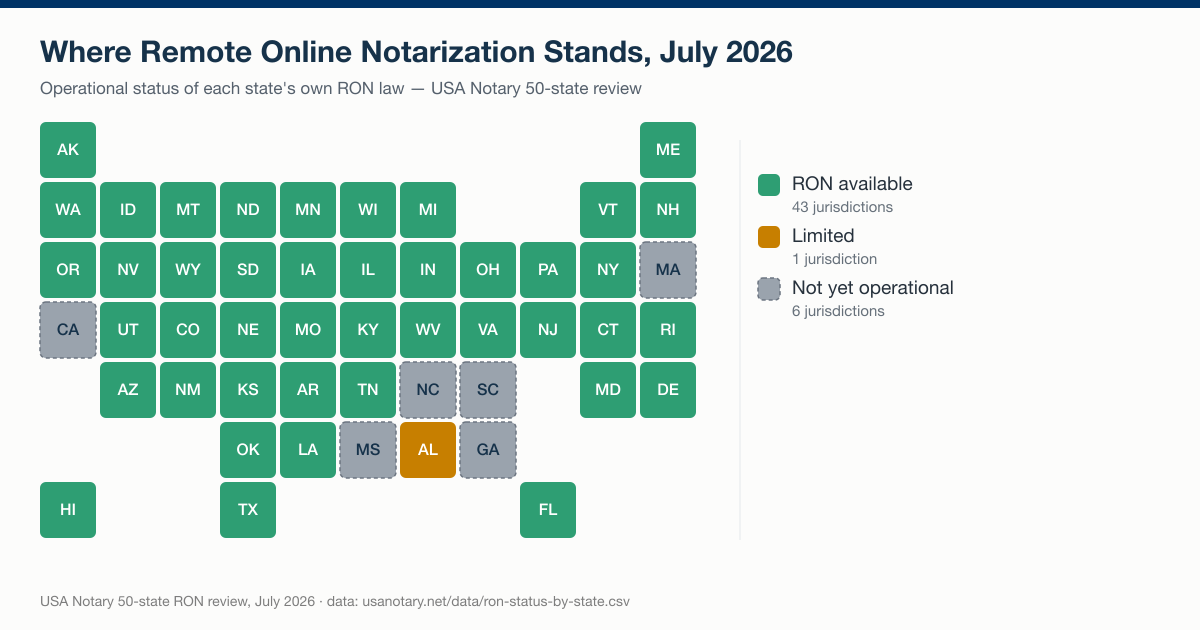
Acceptance by the party receiving the document is the separate gate covered above. Notarizing on behalf of an organization? USA Notary supports title, legal, financial and healthcare teams.
Ready to notarize online?
Have your government photo ID and the complete document ready, and a session takes 15–30 minutes. Not sure where your document fits? Browse every notarization service we offer.
Frequently Asked Questions
Can a notary notarize a document online?
Yes. In states that authorize remote online notarization (RON), a commissioned notary notarizes over a live, recorded video session instead of in person — you appear on camera, verify your identity, and sign electronically. Per the National Association of Secretaries of State, 47 states and DC authorize RON.
Is online notarization legit and legally valid?
Yes. A remote online notarization performed by a properly commissioned notary is a legally valid notarial act — recorded, tamper-evident sealed, and backed by an audit trail. USA Notary's consumer service is valid in all 50 states; confirm the party receiving your document accepts a remotely notarized version.
How much does an online notary cost?
USA Notary charges a flat $25 per document — all-inclusive of identity verification, the electronic seal, a tamper-evident certificate, and instant delivery. Several states set a separate online-notary fee cap (for example, Texas $25 and Ohio $30), so platform prices commonly land around $25.
Is there a free online notary?
No genuinely free online notary exists — notaries may charge up to the fee their state sets for an online notarization. The lowest predictable option is a flat rate like USA Notary's $25. Truly free notarization (at a bank or library) is in-person only and usually limited to customers or members.
Which states allow online notarization?
Per the National Association of Secretaries of State, 47 states and the District of Columbia authorize remote online notarization. Because a notary commissioned in a RON state can serve a signer located anywhere, USA Notary's consumer service reaches signers in all 50 states.
What documents can't be notarized online?
Most personal and business documents can be, but some states exclude certain documents — commonly wills and some estate or family-law documents — from remote online notarization. Confirm both that your state authorizes RON for your document type and that the receiving party accepts a remote notarization.
Does DocuSign act as a notary?
DocuSign offers online notarization aimed mainly at businesses with higher-volume needs. For an individual document, USA Notary connects you with a live, commissioned notary over video for a flat $25 — no enterprise plan or subscription required.
Sources
- Remote Electronic Notarization — National Association of Secretaries of State (NASS) — retrieved August 8, 2026
- 15 U.S.C. § 7003 — Specific exceptions (ESIGN Act), Cornell Legal Information Institute — retrieved August 8, 2026
- Tex. Prop. Code § 12.0013 — Paper or tangible copy of an electronic record — retrieved August 8, 2026
This page explains how remote online notarization works and is general information, not legal advice. RON statutes change; confirm current rules with your state's notary authority, and confirm with the party receiving your document that it accepts a remotely notarized version.
About the author
Andrew Ray Yon, MBA, ChFC
CEO & Founder, USA Notary Services LLC
Andrew Ray Yon is the founder and CEO of USA Notary Services LLC and the architect of the SharpNote remote online notarization platform. A Certified Notary Signing Agent since 2005, he has handled mortgage and title loan signings for two decades — personally completing more than 10,000 notarizations — and holds an MBA and the ChFC (Chartered Financial Consultant) designation. Based in Virginia’s Greater Richmond region, he leads the company’s strategy, compliance, and platform development.
Connect on LinkedIn