
Remote Online Notarization for Title & Escrow Companies
Title and escrow teams use USA Notary to close with out-of-state and out-of-hours signers without rescheduling. Sessions run 24/7 for signers in all 50 states and take 15–30 minutes. Pricing is $25 per document, with volume pricing for regular closing files. Every signing returns a tamper-evident seal, a recorded session, and a complete audit trail.
Operational Challenges We Solve
Delayed Closings
The Problem: Scheduling in-person notarizations can cause delays that push back closing dates, frustrate clients, and jeopardize transactions.
The Solution: Remote Online Notarization allows signers to complete notarizations immediately when documents are ready, eliminating scheduling delays and keeping closings on track.
Signer Availability
The Problem: Coordinating schedules between buyers, sellers, and notaries is difficult, especially when multiple parties have conflicting availability.
The Solution: Signers can complete notarizations at their convenience from any location, dramatically increasing scheduling flexibility and reducing coordination challenges.
Geographic Challenges
The Problem: When signers are located out of state or in remote areas, arranging for in-person notarization can be costly, time-consuming, or impossible.
The Solution: Remote Online Notarization eliminates geographic barriers entirely, allowing you to serve clients regardless of their physical location.
Last-Minute Document Changes
The Problem: Document revisions right before closing can require rescheduling notary appointments, causing additional delays and costs.
The Solution: Updated documents can be notarized remotely the same day, often within hours, preventing delays caused by last-minute changes.
How RON Supports Faster, Compliant Closings
Speed
Complete notarizations in minutes rather than days. Same-day service available when time is critical.
Compliance
Full adherence to state RON laws, recording requirements, and industry standards for real estate transactions.
Audit Trails
Complete documentation and recording of every session provides transparency and meets recordkeeping requirements.
Security
Bank-level encryption and tamper-evident seals protect sensitive transaction documents.
Client Satisfaction
Offer convenience and flexibility that modern clients expect while maintaining professional standards.
Efficiency
Reduce administrative overhead and streamline your closing process with digital workflow.
Will the County Recorder Accept a RON-Notarized Deed?
County recorders accept RON-notarized deeds through one of two paths — and confirming which path a county uses is a pre-session step, not a post-closing surprise. This is the first question most title agents ask, and the answer decides whether a file is a fit for a remote closing at all.
Path 1: E-Recording
Counties that participate in e-recording accept the electronic original directly: the RON-notarized deed, still carrying its electronic notarial certificate and tamper-evident seal, goes to the land records through an e-recording submitter the same way any other electronic document does. For these counties, a remote closing changes nothing about the recording step — the deed records on the timeline your e-recording vendor already delivers.
Path 2: Papering Out
Paper-only counties are handled by "papering out": an authorized person — typically a notary — supervises printing of the electronic document, attaches a certificate affirming the printout is a true and complete copy, and submits the certified paper copy for recording. Proof's survey of papering-out laws documents that many states now allow recording entities, at their discretion, to record a true and complete paper printout of an electronic document. Certification language and who may supervise the printing vary by state, so the certificate is prepared to the recording state's rules.
Recorder acceptance sits on top of broad legal authority: the American Land Title Association reports that 48 states and the District of Columbia have either passed a RON law or issued an executive order pertaining to remotely notarizing documents, and ALTA's survey data show fully digital or hybrid closings increased to 10% of all transactions in 2022 compared to 7% in 2021. Interstate Our State of RON 2026 statistics report tracks the same gap through a second indicator — eNotes reached 15.19% of MERS-registered loans in January 2026 (ICE). recognition matters here too — a deed notarized under another state's RON law is still entitled to recording, a topic we cover in depth in whether remote notarization is valid out of state. The defects that actually stop deeds at the recorder's desk — missing legal descriptions, wrong margins, name mismatches — are the same ones that stop paper deeds, covered in our guide to notarizing a deed.
The Pre-Session Recorder Checklist
Title agents run this check once per county, then reuse it for every file in that county:
- 1 Confirm whether the county e-records, and through which submitters — if yes, the electronic original goes straight through.
- 2 If the county is paper-only, confirm the state's papering-out procedure: who must certify the printout and what the certificate must say.
- 3 Check the property state's deed-execution rules — witness requirements are the usual catch (see the witness-state table below).
- 4 Confirm your title underwriter's RON requirements for the file (see the evidence pack).
- 5 Only then schedule the session — the signer link goes out after the recording path is known, never before.
Document Guides for Title & Escrow Companies
The recorder, witness, and seller-signature questions on this page each have a dedicated deep-dive. These guides walk your closers through the documents a remote closing turns on:
Recording a remotely notarized deed
The two paths a county recorder accepts a RON deed — e-recording and a certified paper copy — and what the title agent confirms before the session.
Which states require deed witnesses
Statute-checked witness rules for Florida, Georgia, South Carolina, Louisiana, and Connecticut — and how a witness signs remotely where the law allows it.
How a mail-away closing works
The print-ship-notarize-courier loop, its fees and failure points, and the 15–30 minute remote session that replaces it.
When a spouse must sign closing documents
Homestead and community-property states that require a non-titled spouse on the deed or mortgage — though not the promissory note.
Does a FIRPTA affidavit need notarizing?
The IRS doesn't require it — title forms add the sworn block. The 15% rule, who signs, and how a foreign seller completes it online.
Witness-State Closings: Florida, South Carolina, Louisiana, Connecticut — and Georgia
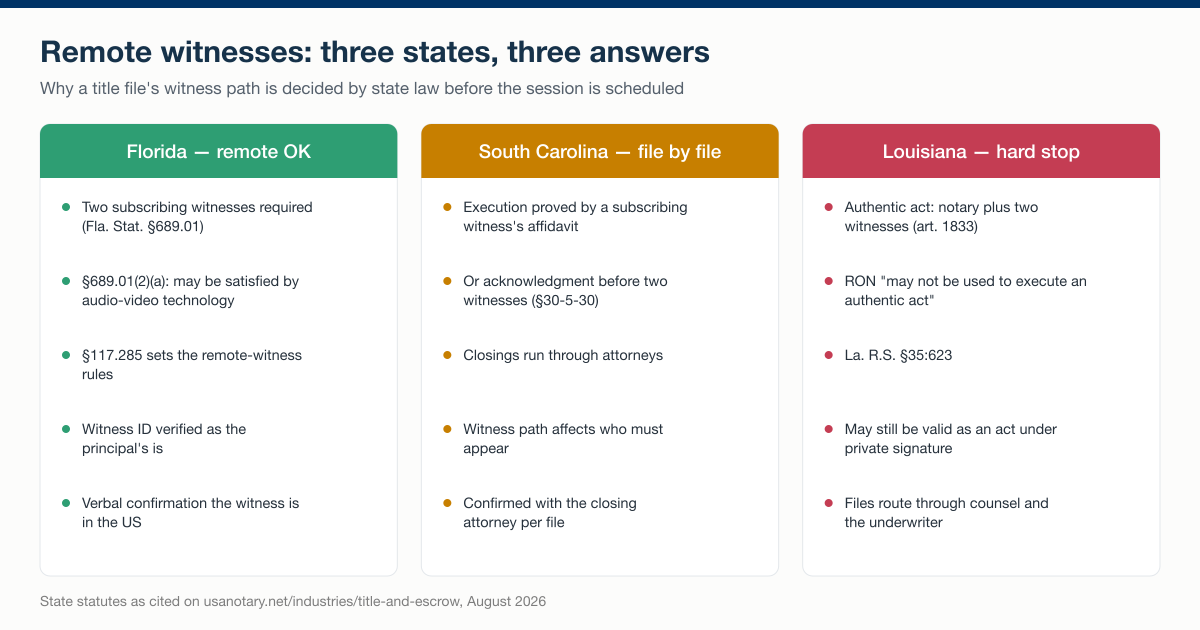
Witness requirements are the second hard blocker on remote seller packages, after recorder acceptance. Most states record a deed on the grantor's notarized signature alone. A handful require witnesses on the deed itself — and each of those states treats remote signings differently. The table below summarizes the statutes; every row links to the law it cites.
| State | What the statute requires | How it plays in a remote closing |
|---|---|---|
| Florida | Conveyances must be executed in the presence of two subscribing witnesses (Fla. Stat. §689.01). | The friendliest witness state for RON: §689.01(2)(a) says the two-witness requirement "may be satisfied by witnesses being present and electronically signing by means of audio-video communication technology," and Fla. Stat. §117.285 sets the remote-witness rules: identity verified the same way as the principal's, plus a verbal confirmation on the recording that the witness is a resident of and physically located within the United States. |
| South Carolina | To record, execution must be proved either by the affidavit of a subscribing witness or by the grantor's acknowledgment made in the presence of two witnesses (S.C. Code §30-5-30). | Witness handling is confirmed file-by-file with the closing attorney — South Carolina closings run through attorneys, and the witness path chosen affects who must appear in the session. |
| Louisiana | An authentic act is executed before a notary in the presence of two witnesses (La. Civ. Code art. 1833). | The hard stop: Louisiana law says remote online notarization "may not be used to execute an authentic act" (La. R.S. §35:623). The same statute notes an act executed by RON may still be valid as an act under private signature or an acknowledged act — so Louisiana property files route through counsel and the underwriter before any remote session is scheduled. |
| Connecticut | Conveyances must be attested to by two witnesses with their own hands and acknowledged (Conn. Gen. Stat. §47-5). | Two attesting witnesses must be arranged for the deed; how they may appear in a remote session is confirmed against current Connecticut practice for the specific document before scheduling. |
| Georgia | A deed must be attested by an officer and by one other witness (O.C.G.A. §44-5-30). | The Georgia problem is bigger than witnesses: Georgia had not enacted a permanent RON law as of July 2026 — remote-notarization bills such as Georgia House Bill 289 were still pending in the legislature — so Georgia deed packages generally stay on paper or in-person channels for now. |
Remote witnesses are supported in our sessions where state law and the document's rules permit: the witness joins the same live video session as the signer, appears on the recording, and signs electronically. Who can serve as a witness, and when a notary may double as one, follows the rules covered in our guide to when a notarization needs a witness. For witness states, the practical sequence is: identify the witness requirement at file opening, confirm the remote path for that state, and line up the witnesses before the signer link goes out.
Statutes summarized above were reviewed against the linked sources in July 2026. This is general information for settlement professionals, not legal advice — confirm execution requirements for a specific file with your underwriter or counsel.
Full RON, Hybrid, or Mail-Away: A Title-File Decision Matrix
Not every file belongs in a remote session, and pretending otherwise is how RON programs die in their first quarter. The matrix below maps the six file types title teams actually see to the closing format that usually fits — with the reason, so your closers can defend the call. For the definitions behind the formats, see our comparison of RON, hybrid, IPEN, and RIN closings.
| File type | Usual best format | Why |
|---|---|---|
| Cash sale, out-of-state seller | Full RON seller package | No lender to approve anything; the seller side is deed, affidavits, and transfer documents — all notarization-heavy and all RON-eligible in most property states. This is the file type where RON replaces the courier loop outright. |
| Purchase, buyer side with lender | Hybrid, or full RON if the lender approves | The lender decides. Many lenders eSign the bulk of the package and keep the note wet; others approve full RON. The buyer side follows lender instructions — the seller side of the same transaction can still go full RON independently. |
| Refinance | Lender-driven: hybrid or full RON | One signing party, one lender, standardized package — operationally the easiest full-RON candidate once the lender signs off. Which loan documents carry notarizations is covered in our mortgage-document guide. |
| Seller package, witness-state property (e.g., Florida) | Full RON with remote witnesses | Florida expressly allows the deed's two subscribing witnesses to appear by audio-video technology (see the witness-state table); the witnesses are scheduled into the session like additional participants. |
| Louisiana immovable / Georgia property | Paper: mail-away, mobile notary, or in-office | Louisiana bars RON for authentic acts; Georgia lacks a permanent RON law. Honest RON programs route these files to paper channels instead of forcing a format the recording jurisdiction may reject. |
| Foreign seller (FIRPTA file) | RON where the property state and document rules permit | The seller signs from abroad in a scheduled video session instead of finding a U.S. consulate appointment — details in the FIRPTA section below. |
The matrix earns its keep at file opening: the processor tags the file's format when title work is ordered, not the week of closing. Files tagged full-RON get the recorder check and witness lineup immediately; hybrid files get the lender's instructions in writing; paper files go to the courier calendar with honest lead time. Teams that decide the format late are the ones that end up rescheduling closings — the delay RON was supposed to remove.
Replacing the Seller Mail-Away Package with a 15–30 Minute Session
The mail-away package is where remote notarization pays for itself first. Every title team knows the loop: print the seller package, overnight it, hope the seller finds a competent local notary, hope every acknowledgment comes back clean, and burn a re-sign cycle when one doesn't. The same package, run as a remote session, collapses that loop into a single scheduled event.
The Courier Loop
- 1 Print and assemble the seller package; overnight it to the seller.
- 2 Seller locates a notary — bank branch, shipping store, or a mobile notary at their own fee.
- 3 Seller signs unsupervised by your team; nobody catches a missed initial or a defective acknowledgment.
- 4 Package couriers back — a second overnight leg, and days lost in transit each way.
- 5 Any defect restarts the loop — and the closing date moves.
The Remote Session
- 1 Your closer uploads the package as a PDF and schedules the session — staff-initiated, so the file never waits on the seller to figure out a website.
- 2 The seller joins by secure link at the scheduled time — sessions run 24/7, so a seller three time zones away signs after their workday.
- 3 The platform verifies identity, then the notary walks the seller through every signature and acknowledgment on live video — defects get caught in the session, not next week.
- 4 The session produces a tamper-evident notarized PDF and a complete audit trail, delivered back to your team the same day — 15–30 minutes, no courier legs.
The mail-away loop's real cost is rarely the courier invoice — it is the days the file sits in transit and the re-sign cycles nobody budgets for. A remote session removes both failure modes: transit time drops to zero because there is nothing to ship, and re-signs drop because the notary supervises every page while your closer can monitor the session. Mail-away still has a place — Louisiana authentic acts, Georgia property, lender-refused files — which is exactly what the decision matrix above is for.
What the Title Underwriter Gets: The Evidence Pack
Title underwriters insure RON closings on evidence, and a remote session produces more of it than any signing table ever did. When a claim surfaces years later — a forgery allegation, a capacity challenge, a "that's not my signature" — the underwriter's file contains a recording of the signing itself. Here is what every session produces:
Audio-Video Recording
The full session is recorded and retained, together with the notary's electronic journal, for 10 years — or longer where state law requires. The recording shows the signer, the ID review, and every acknowledgment as it happened.
Identity Verification Results
A third-party identity-verification service runs credential analysis on the signer's government-issued ID and knowledge-based authentication before the notary ever sees the signer — stronger evidence than a glance at a driver's license across a table.
Tamper-Evident Document
The notarized PDF carries a tamper-evident seal: any alteration after notarization is detectable on inspection. The paper equivalent — proving a page wasn't swapped — has no counterpart at all.
Complete Audit Trail
Every event in the session — who joined, when, what was signed, what was verified — is logged. Our explainer on what an audit trail contains walks through the record line by line.
Underwriter approval is a real gate, and honest RON programs clear it before the first file: national underwriters publish RON requirements and approved-vendor policies — First American, for example, approves its listed vendors and any vendor on the MISMO RON Certified Providers list, subject to state law and its underwriting guidelines. Ask your underwriter for its current RON bulletin, and bring the evidence list above to that conversation — it maps one-to-one to what underwriters ask for.
FIRPTA and Foreign-Seller Signings
FIRPTA withholding under IRC section 1445 requires the buyer to withhold 15% of the amount realized when a foreign person disposes of a U.S. real property interest. The IRS carves out a residence exception — withholding is not required when the buyer acquires the property as a residence and the amount realized is $300,000 or less — and a reduced 10% rate applies where the property is acquired for use as a residence and the amount realized is more than $300,000 but not more than $1 million (IRS Instructions for Form 8288). The seller's certification of non-foreign status is what takes a domestic seller out of the withholding machinery, which is why escrow chases that affidavit on every file where the seller's status isn't obvious.
The operational problem is never the form — it's the signer. FIRPTA files disproportionately involve sellers who are overseas, and an overseas seller's traditional options are a U.S. consulate notarization appointment (booked weeks out) or an international courier loop with all the failure modes of a domestic mail-away, multiplied. A remote session replaces both: the seller joins the video session from abroad at a scheduled time, the platform verifies identity, and the affidavit — along with the deed and the rest of the seller package — comes back the same day. How overseas signers appear in a session, and what they need, is covered in our guide to notarizing documents from overseas; the sworn-statement mechanics are in how to notarize an affidavit online.
Whether a specific FIRPTA certification must be notarized is a matter of the form used and underwriter practice — confirm with your underwriter. Tax consequences of FIRPTA are for the parties' tax advisors; this page covers the signing logistics only.
Pricing a RON Closing File: The Honest Math
Pricing is $25 per notarized document, with volume pricing for teams sending regular closing files. Most platforms in this industry make you book a demo to learn a number; we publish ours, because closers budget files, not vibes. Here is what the math looks like on a typical seller package:
| Cost line | Mail-away seller package | RON seller package |
|---|---|---|
| Notarization | Seller's local or mobile notary, at whatever that market charges | $25 per notarized document — a four-document seller package is $100 at list, before volume pricing |
| Shipping | Two overnight courier legs, out and back | None — nothing ships |
| Calendar time | Days in transit each way, plus the seller's scheduling | One 15–30 minute session, schedulable 24/7 |
| Defect risk | Unsupervised signing; a defect restarts the whole loop | Notary-supervised on live video; defects caught in session |
| Staff time | Print, assemble, ship, track, chase, receive, review | Upload PDF, schedule, receive the notarized file same day |
We deliberately don't print invented courier or mobile-notary dollar figures — those vary by market and change constantly. What doesn't vary: the mail-away column has three cost lines RON deletes entirely (shipping, transit days, the re-sign loop), and the RON column has one flat, published number. Run the comparison against your own courier invoices from last quarter — that's the honest version of this table, and it's the one your CFO will believe.
See How We Support Title & Escrow Teams
Schedule a conversation with our team to discuss your closing workflows, compliance requirements, and how Remote Online Notarization can reduce delays and improve client satisfaction.
We'll show you exactly how it works for your specific processes.
Learn about compliance, integration, and rollout support
Title & Escrow RON: Frequently Asked Questions
Ready to Get Started?
Discover how Remote Online Notarization can support your title and escrow operations and improve client service.
Closings rarely sit in one lane. Firms that send us title work often also route legal documents from outside counsel and lender-side paperwork. See every industry we notarize for, or the underlying real estate notarization service.
Questions? Contact our team or call 804-767-7500
Last updated July 17, 2026 · Reviewed by Andrew Ray Yon, MBA, ChFC — CEO & Founder, certified Notary Signing Agent since 2005, 10,000+ notarizations completed