
Your three routes to a notarized document from overseas
Being outside the United States doesn’t stop you from getting a document notarized for use back home. Three routes exist, and the right one turns on where you are, what the document is, and how fast you need it:
- A U.S. embassy or consulate — a consular officer notarizes in person, by appointment, for $50 per consular seal.
- Remote online notarization (RON) — a U.S.-commissioned notary notarizes over live video while you stay wherever you are, for $25 per document on USA Notary.
- A local notary in your host country — followed by authentication, a path the State Department itself suggests for countries in the Hague Apostille Convention.
The embassy route is the traditional path; RON is the faster one when the notary’s state allows it; the local-notary route mostly fits documents that will also be used abroad. “Overseas” here means you, the signer, are physically outside the United States — the document itself is usually headed to a U.S. bank, court, agency, or title company. Here is exactly how each route works, what it costs, and the edge cases that trip people up.
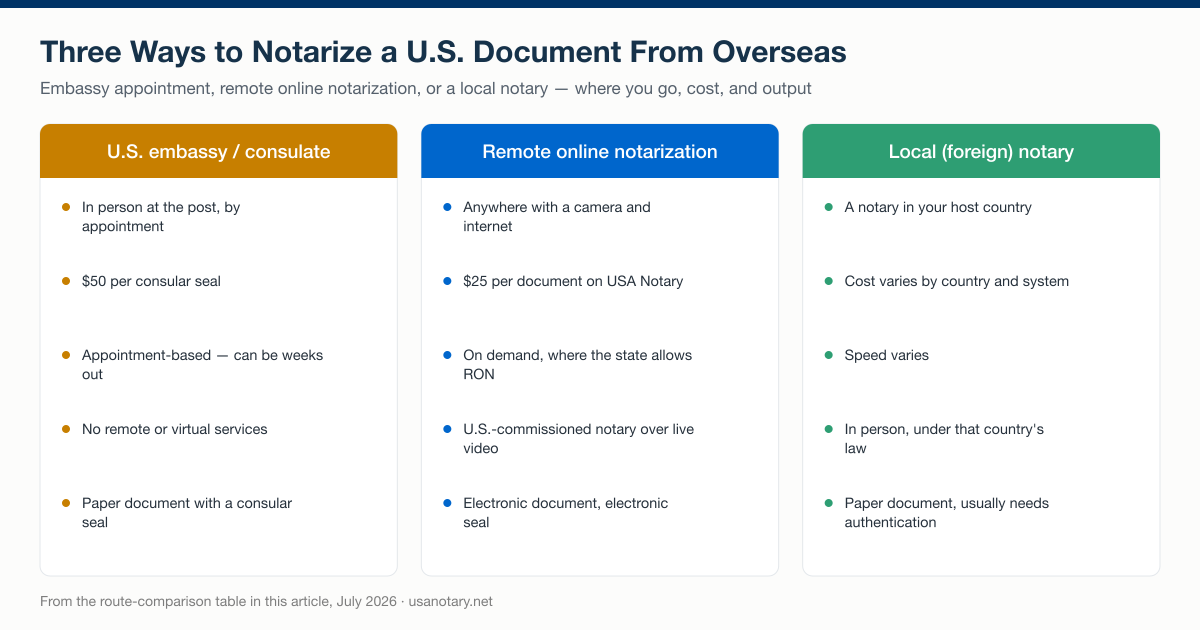
The three overseas notarization routes compared, from the sourced route table in this article, July 2026.
Option 1: notarize at a U.S. embassy or consulate
U.S. embassies and consulates “provide notarial services like a notary public in the United States,” and, as the U.S. Department of State explains, “a notary is someone who witnesses you sign a document.” These appointments are available for customers of all nationalities, not just U.S. citizens — a point that matters for foreign spouses, business partners, and green-card holders living abroad.
How the consular appointment works
Appointments are booked through the individual embassy or consulate, so check that post’s website for scheduling — there is no central State Department booking system for notarial services. The State Department’s own rules for the visit are short and strict:
- You must appear in person “so we can verify your identity and document.” There is no phone, mail-in, or video alternative at a consulate.
- Do not sign the document before your appointment. The consular officer must watch you sign — a pre-signed document defeats the purpose of the notarization.
- You may need to bring someone to witness your signature in front of the U.S. consular officer. If your document requires one or two witnesses beyond the notarization itself, arrange them before you book.
- The fee is $50 for each consular seal placed on a document, payable on the day of your appointment. Each post sets its own accepted forms of payment, so confirm whether the cashier takes local currency, U.S. dollars, or card.
Note the per-seal pricing: a package with three documents that each need a seal costs $150, not $50. If a single document needs both a notarization and a separate certification, each seal is billed.
When the embassy route breaks down
One limit matters most for planning: embassies and consulates “do not offer remote or virtual services.” The in-person requirement is a hard stop. If the nearest post is a long flight away, if appointment backlogs run weeks, or if you’re managing a time-sensitive transaction — a closing date, a court deadline, a passport application window — waiting for a consular slot can cost you the deal or the deadline.
The State Department also points signers in a different direction depending on the country. In countries that are part of the Hague Apostille Convention, its guidance is to “get your document notarized by a local notary” and then have the document authenticated for use in the United States — skipping the U.S. post entirely. In countries not in the Hague Convention, U.S. embassies and consulates may authenticate documents themselves. Both points come from the same travel.state.gov notarial-services page, which was last updated April 18, 2024.
Option 2: remote online notarization from abroad
Remote online notarization solves the distance problem outright: the notary’s authority comes from the U.S. state that commissioned them, and the signer can be located elsewhere — including in another country. The notary stays inside their commissioning state and follows its rules; you appear on live video from wherever you are.
Even the State Department acknowledges this route. Its notarial-services page notes: “Some U.S. states may allow you to get a document notarized remotely,” adding the sensible caution to “check with the U.S. state and foreign country to see if this is okay.” That caution is exactly what the rest of this section unpacks.
The two location rules that make overseas RON work
The National Notary Association’s location guidance sets out two rules:
- The notary must be physically present in the commissioning state. With the possible exception of Virginia, every state with a permanent remote-notarization law requires the notary to be within the borders of the state that commissioned them. A Texas online notary performs the act while sitting in Texas — not while traveling abroad.
- The signer usually does not have to be in that state. In most cases the signer can be “located either inside or outside the state when the remote notarization takes place — or even in a different country.”
That second rule is what lets someone in Tokyo or Lisbon use a U.S. notary without ever visiting an embassy. And the legal footprint behind it is broad: per the National Association of Secretaries of State, 47 states and the District of Columbia currently have a law that allows remote e-notarization. Virginia authorized it first in 2011, followed by Montana in 2015 and Nevada and Texas in 2017; the rest of the map filled in over the following decade.
Keep two ideas distinct here, because they confuse almost everyone. RON is legally valid in all 50 states as a consumer service — a signer anywhere can use it, because what matters is the notary’s state. Notary commissioning law is per-state — a few states still do not authorize their own notaries to perform RON, which is why the notary who serves you may be commissioned in a different state than the one your document is headed to. Whether that cross-state result holds up is a fair question with a well-settled answer — see is a remote notarization valid out of state.
What an overseas RON session looks like, step by step
Online notarization on USA Notary costs $25 per document, and the session runs the same way from Berlin as it does from Boston:
- Upload your document — unsigned, just as the embassy would require.
- Verify your identity. NASS’s national e-notarization standards require “multiple means of verifying the signer’s identity,” such as knowledge-based authentication and credential analysis — an automated check of your government-issued photo ID.
- Appear on live video. You join a live audio-video session; the personal-appearance requirement is met over the live feed. You sign electronically while the notary watches.
- The notary completes the act and seals electronically. You download the finished, electronically sealed document — no international courier required.
See how an online notarization session works for the platform walkthrough, or start when you’re ready to notarize online from abroad.
Two practical notes for overseas signers. First, U.S.-commissioned notaries work on U.S. hours, so a signer in Asia or Europe should expect the most availability during their own evening or early morning — see our guide to notaries available around the clock. Second, you need a stable internet connection for the video session and a current government-issued photo ID that the platform can verify — check the ID requirements before you book rather than mid-session.
The overseas edge case most guides miss: the “nexus” rule
There is a catch for signers physically outside the United States that generic guides skip. States that have adopted the Revised Uniform Law on Notarial Acts (RULONA) provisions for remotely located individuals add two conditions when the signer is abroad:
- The record must have a “nexus” with the United States — for example, it relates to a matter before a U.S. court or government entity, or to property in a U.S. jurisdiction.
- The notarial act must not be prohibited in the jurisdiction where you are located at the time.
Per the National Notary Association, Washington, Pennsylvania, and Idaho apply this nexus requirement. In practice, the nexus condition is easy to satisfy for the documents people actually notarize from overseas — a power of attorney for a U.S. real estate closing, an affidavit for a U.S. court, a consent form for a U.S. federal agency all plainly relate to a U.S. matter. The second condition is the one to check: a handful of countries restrict who may perform notarial acts on their soil, so confirm your host country doesn’t prohibit the act before you book.
State-rule exceptions at a glance
| State | Special rule for remote notarization location |
|---|---|
| Washington, Pennsylvania, Idaho | Signer outside the U.S.: record must have a nexus with the United States, and the act must not be prohibited where the signer is located (RULONA provisions) |
| Colorado | The notary must not have knowledge that the remote notarization is prohibited in the signer’s jurisdiction |
| West Virginia | Remote “ink” notarization only for a signer located in West Virginia; a signer outside the state requires an out-of-state commissioner of deeds |
| Virginia | The possible exception to the rule that the notary must be physically inside the commissioning state |
All four rows come from the NNA’s location guidance. The practical takeaway: the answer to “can a U.S. notary notarize for me overseas?” depends on the notary’s state, not on where you happen to be standing — a platform routes you to a notary whose state permits serving a signer abroad.
Option 3: a local notary in your host country
A foreign notary is the third route, and it fits a narrower set of cases. In Hague Apostille Convention countries, the State Department’s guidance for documents headed to the U.S. is to have a local notary notarize the document and then have it authenticated for use in the United States. Two cautions before you choose this path:
- Civil-law notaries are a different profession. In much of Europe and Latin America, a “notary” is a trained legal professional whose role is broader than a U.S. notary public’s. Expect a different process and fee scale.
- The receiving party decides. A U.S. bank, title company, or court may specifically require a U.S.-form notarial certificate. Ask the recipient whether a foreign notarization plus authentication is acceptable before paying for one.
This route makes the most sense when the document will also be used in your host country, or when the recipient has confirmed it accepts an authenticated foreign notarization.
Embassy vs. RON vs. local notary: which route fits
| U.S. embassy / consulate | Remote online notarization | Local (foreign) notary | |
|---|---|---|---|
| Where you go | To the post, in person, by appointment | Anywhere with a camera and internet | To a notary in your host country |
| Who notarizes | U.S. consular officer | U.S.-commissioned notary over live video | A notary under that country’s law |
| Typical cost | $50 per consular seal | $25 per document on USA Notary | Varies by country and notarial system |
| Speed | Appointment-based; can be weeks out | On demand, where the state allows RON | Varies |
| Remote option? | No — “we do not offer remote or virtual services” | Yes, that’s the point | In person |
| Who can use it | Customers of all nationalities | Any signer the notary’s state may serve | Anyone in that country |
| Output | Paper document with a consular seal | Electronic document with an electronic seal | Paper document under local law, usually needing authentication |
| Best when | The recipient requires an in-person, paper notarization | You want speed and no travel | You’re in a Hague country and the recipient accepts it |
What U.S. law says about a notarization performed while you’re abroad
Federal law removes one worry up front: under the ESIGN Act, 15 U.S.C. § 7001, an electronic signature or record “may not be denied legal effect, validity, or enforceability solely because it is in electronic form.” A remotely notarized document is not second-class merely for being electronic.
The rules that actually govern the notarization itself are state rules. The notary’s commissioning state controls how identity is verified, how the audio-video session runs, and whether the notary may serve a signer located abroad — which is why the RULONA nexus provisions above vary state by state. There is no federal RON statute: the SECURE Notarization Act (H.R.1777), which would set nationwide rules for remote notarization, has been introduced in Congress but not enacted. Until that changes, the state-by-state framework — 47 states plus D.C. per NASS — is the law of the land.
For the receiving end, the long-standing practice of interstate recognition applies: a notarization properly performed under one state’s law is generally recognized in the others. The mechanics and the exceptions are covered in our guide to whether a remote notarization is valid in another state.
Documents people most often notarize from overseas
NASS lists healthcare directives, affidavits, powers of attorney, wills, and real estate documents as the records that typically require notarization. From overseas, a few of these come up constantly:
- Power of attorney. The classic expat document — you’re abroad, your property, closing, or bank account is in the U.S., and someone stateside needs signing authority. The nexus rule is easily met: the property or matter is in a U.S. jurisdiction.
- DS-3053 passport consent. A parent abroad while the other parent applies for a child’s U.S. passport needs this consent form notarized — our DS-3053 notarization guide covers the form’s specific rules.
- PS Form 1583. Expats setting up a U.S. mailbox or mail-forwarding service must have this USPS form notarized — see the Form 1583 notarization walkthrough, and for the broader setup, keeping a U.S. address from abroad.
- Affidavits and court documents. Sworn statements for U.S. litigation or agencies. These take a jurat: you swear the contents are true and sign in front of the notary, on video or at the consulate.
- Real estate and estate documents. Deeds, closing packages, and trust documents tied to U.S. property. Confirm with the title company or recorder that it accepts an electronically notarized document before the closing date.
One eligibility caution: a few states carve specific record types out of remote notarization eligibility, so confirm with the platform or the receiving party that your document type qualifies before you book — especially for wills and other estate documents.
Before you rely on any of these
- Confirm your document type is eligible for the route you pick — the receiving party or the notary platform can tell you whether your record qualifies for RON in the notary’s state.
- Check whether the U.S. recipient accepts a remotely notarized or embassy-notarized document, especially a court, county recorder, or specific agency.
- Ask whether authentication is needed. Many documents for use abroad require an apostille or embassy authentication — a separate step from, and in addition to, the notarization itself.
- Match the act to the document. An acknowledgment means you acknowledge signing; a jurat means you swear the contents are true and sign in front of the notary. The recipient usually specifies which one they need.
- Do not sign in advance. Both the consular officer and the online notary must watch you sign — a pre-signed document will be turned away at the embassy and rejected on the video session alike.
USA Notary provides remote online notarization; a provider does not decide whether a foreign government or U.S. recipient will accept the finished document — confirm that with the receiving party before you rely on it.