
Is a remote notarization valid in another state?
Generally, yes. A notarization is tied to the notary’s authority, and a notary’s authority comes from the state that commissioned them — not from where you happen to be sitting. A DocuSign whitepaper published through the National Association of Secretaries of State states the rule plainly: “as long as RON has been completed in accordance with all laws in the state in which the notary public is seated and commissioned, the remotely and digitally notarized document is legally admissible, like traditionally notarized documents — and should be recognized as such anywhere in the country.”
The state-by-state picture is messier than one number suggests: our breakdown of the disagreeing RON state counts shows NASS counting 47 states plus DC, ALTA 48, and the MBA 45.
That interstate recognition isn’t new or exotic. The same whitepaper notes that even the few states that have not fully adopted remote online notarization “at least have statutes that recognize out-of-state notarial acts.” Notarization is a high-volume, well-settled process: over a billion documents are notarized each year in the United States, and the machinery for honoring an act performed under another state’s law has existed for as long as people have moved across state lines. Paper notarizations cross state lines constantly — a Florida court doesn’t reject an affidavit because a Georgia notary stamped it — and a remote online notarization rides on the same recognition principles.
So if you’re wondering whether an online notarization done by a notary in Texas holds up in Florida — or whether you can notarize online in all 50 states while the notary sits somewhere else — the short answer is that a properly executed RON travels with you. The rest of this guide covers who has to be where, which law governs, how many states have their own RON statutes (and why published counts differ), and the one place where validity and acceptance genuinely diverge.
Who has to be where — the notary vs. the signer
This is the part that trips people up, because the two participants follow opposite location rules. According to the National Notary Association, with the possible exception of Virginia, every state with permanent RON laws requires the notary to be physically present within the borders of the commissioning state during the notarization — exactly as they would be for a pen-and-paper act. The signer faces no such limit:
- The notary must be commissioned and physically located in their own state, following that state’s RON rules.
- You, the signer, can be located inside that state, in a different state, or even in another country — with narrow exceptions for signers abroad (see edge cases below).
- The connection between you is made over live, two-way audio-video, which is what satisfies the personal-appearance requirement.
In the NNA’s own example, a Texas online notary can perform a remote notarization while physically located in Texas, but “if the Notary travelled to another state or country, the Notary could not perform remote notarizations outside the borders of Texas.” The signer, meanwhile, can be anywhere.
The Virginia caveat is narrower than it sounds: the NNA notes that Virginia grants its notaries jurisdiction beyond state borders only for documents intended to be used in Virginia or by the U.S. government — and even then advises Virginia notaries to notarize remotely only while physically inside Virginia. For a consumer, the practical rule is universal: your notary works from inside their own state, and you appear on live video from wherever you are. If you’ve ever wondered whether the whole thing is legitimate to begin with, our explainer on whether online notarization is legit walks through the safeguards.
Whose law governs — at a glance
| Question | Answer |
|---|---|
| Who must be commissioned? | The notary, in their home state |
| Where must the notary physically be? | Inside their commissioning state (possible exception: Virginia) |
| Whose law applies to the act? | The notary’s commissioning state |
| Where can the signer be? | Any state — or, with limits, another country |
| Is the document recognized elsewhere? | Generally yes, if done per the notary’s state law |
| What federal law backs it? | ESIGN Act of 2000, 15 U.S.C. § 7001 (with UETA at the state level) |
| Is there a federal RON law? | Not yet — the SECURE Notarization Act of 2025 (S.1561) is only introduced |
Why an out-of-state RON holds up: the legal foundation
Three layers of law stack up to make interstate recognition work:
- ESIGN Act of 2000 (federal). 15 U.S.C. § 7001 provides that, for transactions in interstate or foreign commerce, “a signature, contract, or other record relating to such transaction may not be denied legal effect, validity, or enforceability solely because it is in electronic form.” The statute addresses notarization directly: under § 7001(g), a requirement that a signature be notarized is satisfied when the electronic signature of the person authorized to perform the notarial act, together with all other required information, is attached to or logically associated with the record. The NASS whitepaper summarizes ESIGN the same way — it “grants e-signatures and records the same legal effect as handwritten signatures and paper documents for most consumer and commercial transactions, and permits a notary to sign electronically.” ESIGN’s state-level counterpart, the Uniform Electronic Transactions Act (UETA), does the same job inside each state.
- State RON statutes. Each state that authorizes RON writes its own rules for how the act is performed — identity verification, audio-video standards, recording, and journaling. This is why notary-commissioning law is genuinely per-state even though the finished document is honored nationwide.
- Model uniform law (RULONA). The Revised Uniform Law on Notarial Acts (2021), published by the Uniform Law Commission, “authorizes remote online notarization and remote ink notarization through the use of audio-visual recording and identity-proofing technology,” giving states a common framework instead of fifty unrelated inventions. And as the NASS whitepaper notes, even states that haven’t adopted RON maintain statutes recognizing out-of-state notarial acts — the interstate glue predates the technology.
One precision point that matters for validity: the type of act follows the notary’s state, too. An acknowledgment is a notarization where the signer acknowledges signing; a jurat is one where the signer swears the contents are true and signs in front of the notary. Whichever your document needs, the notary applies their own state’s certificate wording — and that certificate is what a receiving party in another state reads and accepts. The statutory basis behind all of this is collected on our page covering why remote online notarization is legal.
How many states allow RON — and why the counts differ
Search results quote different numbers — 45, 47, 49 — and the discrepancy confuses people into thinking the law is murkier than it is. The counts differ because they measure different things:
| Count | Who publishes it | What it actually measures |
|---|---|---|
| 47 states + DC | National Association of Secretaries of State | States with a law that allows remote e-notarization in any form |
| 45 states + DC | Mortgage Bankers Association | States that enacted RON laws specifically permitting RON in real estate financial transactions |
| Higher counts elsewhere | Various RON platforms | Often include states with temporary orders, limited authorizations, or laws not yet operative |
Two details inside those numbers are worth knowing. First, the MBA notes that Connecticut enacted its RON law with an exclusion for real estate transactions — a state can authorize RON generally while carving out a document type. Second, adoption has been building for over a decade: NASS records Virginia as the first RON state in 2011, followed by Montana in 2015 and Nevada and Texas in 2017. The MBA and the American Land Title Association (ALTA) published a model RON bill in 2017, and most subsequent state laws draw on that model or on RULONA.
None of this changes the consumer answer. Because the notary’s commissioning state governs the act, remote online notarization is legally valid in all 50 states as a consumer service — what varies per state is whether that state’s own notaries may perform it.
Recognition vs. acceptance: the real limit
Being legally valid and being accepted by a specific recipient are not identical, and this is where an out-of-state RON most often runs into friction. Most parties honor a properly notarized document without a second thought. But acceptance practices vary by recipient type:
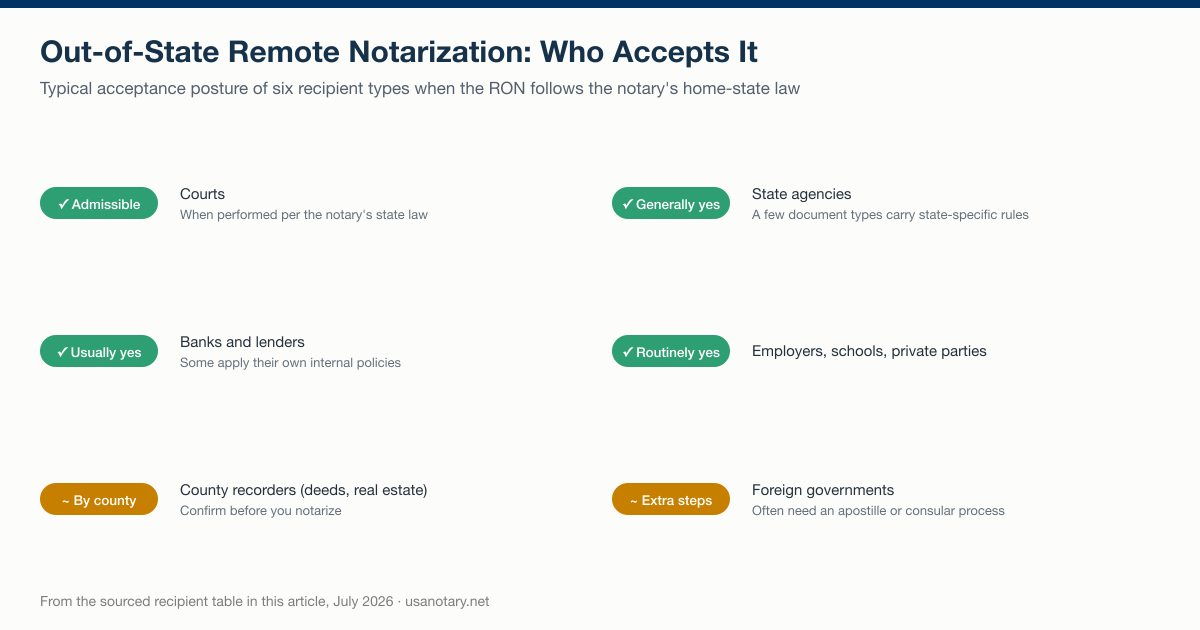
Typical acceptance posture of six recipient types toward an out-of-state RON, from the sourced table in this guide, July 2026.
| Recipient | Typical posture toward an out-of-state RON |
|---|---|
| Courts | Admissible when the RON was performed per the notary’s state law |
| Banks and lenders | Usually accepted; some institutions apply their own internal policies |
| County recorders (deeds, real estate) | Varies by county — confirm before you notarize |
| State agencies | Generally accepted; a few document types carry state-specific rules |
| Employers, schools, private parties | Routinely accepted |
| Foreign governments | Often require an apostille or consular process on top of notarization |
Legal recognition and a specific recipient’s acceptance aren’t always the same thing, especially for documents recorded with a county, which can have their own rules. Even the National Notary Association, asked whether a New York client could use a Texas online notary for a document filed in New York, answered that the notarization itself was proper but advised contacting “the agency that will be receiving the document to ask if they will accept” it. The practical rule: if your document will be recorded or filed, confirm the recipient’s requirements before you notarize. For a real estate transaction specifically, our guide to online notarization for a real estate closing covers the recording wrinkle in more detail, and for a private recipient like a lender, see will my bank accept an online notarization?
State edge cases worth knowing
RON adoption is broad but not universal, and a handful of situations call for a closer look:
- Signers outside the U.S. In states that have enacted RULONA’s remote provisions, a notary may only notarize for a signer abroad if the matter has a “nexus” with the United States (for example, it relates to a U.S. court, government entity, or U.S. property), and only if the act isn’t prohibited where the signer is located. The NNA lists Washington, Pennsylvania, and Idaho among states with these provisions; in Colorado, the notary must not have knowledge that the act is prohibited in the signer’s jurisdiction.
- States without their own RON law. A signer in one of these states can generally still be served by a notary commissioned in a RON state — the notarization is governed by, and valid under, the notary’s home-state law.
- States phasing RON in. California has enacted RON legislation (SB 696), but it does not take effect until the Secretary of State certifies that its online-notarization technology system is complete or January 1, 2030, whichever is earlier, unless the Secretary of State notifies the Legislature and Governor in writing by January 1, 2029 that the project will not be completed. A signer with California documents can typically still use a notary commissioned elsewhere in the meantime; the NNA’s own guidance confirms nothing prohibits a California signer from requesting a remote notarization performed by a notary authorized in a different state.
- Remote ink notarization (RIN) quirks. Not every “remote” notarization is a RON. In West Virginia, the NNA notes a notary can only perform a remote ink notarization for a signer located inside West Virginia — a reminder that RIN, where you sign a paper document on camera, follows different location rules than RON.
- Document-type carve-outs. Some states restrict RON for particular documents. Connecticut’s exclusion of real estate transactions is the clearest verified example; other states apply their own limits to specific instruments, so always verify the current rule in the state where the document will be used.
Will Congress make interstate recognition automatic?
A federal floor has been proposed repeatedly but never enacted. The current version, the SECURE Notarization Act of 2025 (S.1561), was introduced by Senator Kevin Cramer on May 1, 2025 and referred to the Senate Judiciary Committee, where it currently sits with the status “Introduced.” According to the Congressional Research Service summary, the bill would require U.S. courts and states to recognize notarizations — including remote notarizations — “that occur in or affect interstate commerce and are performed by a notary public commissioned under the laws of other states,” and would allow notaries to serve signers located outside the United States.
The idea has history: the NASS whitepaper records that the U.S. House of Representatives passed a 2022 version of the SECURE Notarization Act on July 27, 2022, and a 2023 Senate version (H.R.1777) was likewise introduced without becoming law. Until a federal statute passes, day-to-day validity rests on each state’s own RON statute plus the interstate-recognition principles above — which, in practice, already deliver the nationwide result the bill would formalize.
Three real cross-state scenarios
These are the fact patterns people actually ask about — each answered by the National Notary Association on the location-rules page cited throughout this guide:
- Signer in Tennessee, notary in Virginia. A Tennessee signer used an online notary commissioned in Virginia and asked whether that was allowed. The NNA’s answer: yes — authorized Virginia notaries may notarize remotely for a signer located outside Virginia, so long as the notary is physically located in Virginia during the act.
- Signer in California, notary in Kentucky. California has not yet made its own RON law operative, but the NNA confirms a Kentucky notary may serve a California signer: the notary must be physically located in Kentucky, and “there is nothing prohibiting a CA signer from requesting a remote notarization performed by a Notary authorized in a different state.”
- Signer in Thailand, property settlement in Pennsylvania. A signer living in Thailand needed documents for a Pennsylvania house settlement. The NNA’s answer: Pennsylvania notaries authorized for remote notarization can notarize for signers in any location, as long as the notary is physically inside Pennsylvania — the U.S.-property connection supplies the nexus that RULONA-style laws require for signers abroad.
The pattern across all three: the question is never “is the signer in the right state?” It’s “is the notary commissioned, authorized for RON, and physically inside their own state?”
How it works when you and the notary are in different states
On USA Notary, the mechanics are the same whether the notary is one state over or across the country. You upload your document, verify your identity, and the signer appears on live video with a commissioned notary who is seated in their own state. Online notarization on USA Notary costs $25 per document in all 50 states. Because the act is governed by the notary’s commissioning state, you don’t need to find a notary licensed in your state — you just need one authorized for RON. The finished document carries the notary’s electronic seal and certificate under their state’s law, which is exactly what makes it recognizable when it lands in yours. If you want to see the session flow before you start, how it works walks through it step by step — or get a document notarized online right now.