
Is online notarization legit?
Yes. Remote online notarization (RON) is a legally recognized notarial act in the states that authorize it — not a shortcut or a gray area. A commissioned notary verifies your identity and witnesses your signature while you appear on live video, then applies an electronic seal. According to the National Association of Secretaries of State, 47 states and the District of Columbia have a law that allows for remote e-notarization — and their national standards require “multiple means of verifying the signer’s identity” for it.
Adoption lags that legal authority: our 2026 State of RON report found only 2.5% of 2022 real-estate closings were fully digital (ALTA), even though 47 states plus DC have a RON law (NASS).
“Legit” is really two questions in one, and they have different answers. Is it legal is a statutory question — the answer depends on where the notary is commissioned, and we cover it in detail in our guide on whether online notarization is legal. Is it trustworthy is about the process itself: whether the identity checks, video, and recordkeeping actually hold up. This page answers the second question, and the short version is that a proper RON is often held to a higher evidentiary bar than the notarization you’d get across a counter.
The law behind online notarization
Online notarization isn’t an invention of the platform you use — it runs on statute. Each state regulates its own notaries, so RON is authorized state by state, many drawing on model legislation such as the Uniform Law Commission’s Revised Uniform Law on Notarial Acts (RULONA), which in its 2021 revision expressly “authorizes remote online notarization and remote ink notarization using audio-visual recording and identity-proofing technology.” Florida, an early-adopter state, defines the act in plain statutory language: an “online notarization” is “the performance of a notarial act using electronic means in which the principal or any witness appears before the notary public by means of audio-video communication technology.”
The legal groundwork was laid over more than a decade, not overnight. The NASS record of the movement reads like a steady march:
- 2011 — Virginia becomes the first state to authorize remote e-notarization.
- 2015 — Montana follows.
- 2017 — Nevada and Texas authorize remote e-notarization.
- 2018 — NASS adopts its Revised National Electronic Notarization Standards and Remote Online Notarization Standards, requiring multiple means of identity verification.
- 2019 — Florida enacts its online-notarization statute (ch. 2019-71), one of a wave of permanent RON laws.
- Today — 47 states and the District of Columbia have a remote e-notarization law on the books, per NASS.
Two federal-and-state frameworks make the electronic part durable. Under the federal ESIGN Act, a signature, contract, or record “may not be denied legal effect, validity, or enforceability solely because it is in electronic form” — and state enactments of the Uniform Electronic Transactions Act (UETA) apply the same principle at the state level. That rule is why the electronic seal and signature on a RON document carry the same weight as ink on paper.
One piece of the legal picture is still pending, and it’s worth knowing about because scammy marketing sometimes overstates it: the federal SECURE Notarization Act (H.R.1777), which would require U.S. courts and states to recognize remote notarizations affecting interstate commerce, was introduced in the Senate in April 2023 but has not been enacted. It remains proposed legislation — RON’s legal footing today rests on state statutes plus ESIGN/UETA, which is already solid ground. USA Notary provides notary services in all 50 states, and online notarization is legally valid for the consumer service nationwide — even though the underlying commissioning law is per-state and a handful of states have not yet authorized their own notaries to perform RON.
Didn’t online notarization start as a COVID workaround?
No — and the distinction matters for how much trust the format deserves. Remote online notarization predates the pandemic by nearly a decade: Virginia authorized it in 2011, and Montana, Nevada, and Texas followed years before 2020. What the pandemic changed was the pace of adoption, not the legal concept.
The National Notary Association describes what happened next: in response to the COVID-19 health emergency, a number of states issued emergency measures allowing notaries to perform remote online notarizations during the crisis — and most states have since let those measures expire or replaced them with permanent remote notarization laws. That second half is the part skeptics miss. Legislatures that watched RON operate at scale during the emergency didn’t quietly retire it; they wrote it into permanent statute, with the identity-proofing and recording requirements described on this page. A format that survives the transition from emergency order to permanent law — through 47 state legislatures, per NASS — has been vetted more heavily than almost any other consumer legal service.
Online notarization vs. electronic notarization: not the same thing
“Online notarization” gets used loosely, and pinning the terms down matters when you’re judging whether a service is legitimate. The National Notary Association draws the line clearly: electronic notarization — also called eNotarization or in-person electronic notarization (IPEN) — uses electronic documents and electronic signatures, but “all other elements of a traditional, paper notarization apply,” including the requirement that the signer physically appear before the notary. Remote online notarization goes a step further: the transaction is conducted online, and the signer appears on live video instead of standing in the same room.
| Format | Documents | Signer appearance | Where authorized |
|---|---|---|---|
| Traditional notarization | Paper | In person | All states |
| Electronic notarization (IPEN) | Electronic | In person | States with e-notarization laws |
| Remote online notarization (RON) | Electronic | On live video | States with RON statutes |
| Paper remote notarization | Paper only | On live video | Edge case — e.g., Alabama and Connecticut |
That last row is an edge case most guides skip: per the NNA, Alabama and Connecticut have enacted permanent remote notarization laws, but those laws allow remote notarization with paper documents only — one of the traits that distinguishes true RON is that it uses electronic documents and signatures. So a state can permit a form of remote notarization without technically having a “RON law.” When you see state counts differ between guides, this definitional line is usually why.
Why a proper online notarization is trustworthy
A well-run RON isn’t less rigorous than an in-person notarization — in several ways it’s more. Statutes like Florida’s require layered identity proofing and audio-video technology that lets the notary see, hear, and communicate with you in real time, so the notary isn’t relying on a single glance at an ID card:
| Safeguard | What it does | Where it’s defined |
|---|---|---|
| Remote presentation | You transmit an image of your government-issued ID of sufficient quality for the notary to identify you | Fla. Stat. §117.201(15) |
| Credential analysis | A third party affirms the validity of your government-issued ID through review of public or proprietary data sources | Fla. Stat. §117.201(3) |
| Knowledge-based authentication | Identity proofing through a set of questions formulated from public or proprietary data sources | Fla. Stat. §117.201(8) |
| Live audio-video | Real-time, two-way communication in which the notary and signer “see, hear, and communicate with one another” | Fla. Stat. §117.201(2) |
| Session recording | Creates a retained audit trail of the act — RULONA-based laws pair RON with “audio-visual recording” | RULONA (2021 revision) |
That combination is the whole point. An in-person notarization typically leaves a single paper journal line and the notary’s memory. A RON leaves a recorded video, logged identity-check results, and an audit trail that can be reviewed if the act is ever questioned. If you want the mechanics of the ID step specifically, our explainer on how credential analysis works walks through it. National standards adopted by NASS reinforce the same design, calling for both identity verification and “measures to ensure the security and privacy of the audio-video communication” — the same layered posture behind how USA Notary protects session data.
It also helps to know what act you’re actually getting. In an acknowledgment, the signer acknowledges signing the document; in a jurat, the signer swears the contents are true and signs in front of the notary. RON supports both — the appearance is by live video, but the legal substance of the notarial act is unchanged. For more questions like this one, see our answers to common RON questions.
Four myths about online notarization — and one real caveat
Skepticism about RON usually traces back to one of a few recurring myths. Each one dissolves against the actual statutes and standards.
Myth 1: “Online notarization is less secure than meeting a notary in person.” The opposite is closer to the truth. NASS’s national standards require multiple means of verifying the signer’s identity — knowledge-based authentication and credential analysis — where an in-person notarization rests on one human looking at one card. Add the recorded session and you have an act that leaves far more evidence behind, not less.
Myth 2: “Electronically notarized documents aren’t really recognized by law.” The ESIGN Act settles this at the federal level: a record “may not be denied legal effect, validity, or enforceability solely because it is in electronic form.” Layer on 47 states’ remote e-notarization laws and RULONA’s model framework, and “not recognized” simply isn’t the legal reality.
Myth 3: “Anyone with a webcam can call themselves an online notary.” Not under the statutes. In Florida, an “online notary public” is a commissioned notary who “has registered with the Department of State to perform online notarizations” — and the platform itself is defined separately as a “RON service provider” that supplies the audio-video technology and related services. The commission performs the notarial act; the technology only facilitates it. Florida law even defines the errors and omissions insurance an online notary or RON service provider maintains — a marker of how regulated this space actually is.
Myth 4: “A document notarized online won’t be accepted outside the notary’s state.” A notarial act valid where the notary is commissioned is generally recognized in other states — the details, and how to confirm them, are in our guide on out-of-state validity of remote notarization.
The real caveat: acceptance and validity aren’t the same thing. As the NNA plainly puts it, “each individual recipient of any document can reject a RON notarization for any reason they wish.” That isn’t a legitimacy problem — it’s a recipient-preference problem, and the fix is a phone call before you sign, not a different kind of notary.
How to tell a legitimate service from a scam
The technology is legitimate; the way to protect yourself is to vet the provider. A real, compliant online notarization has all of these:
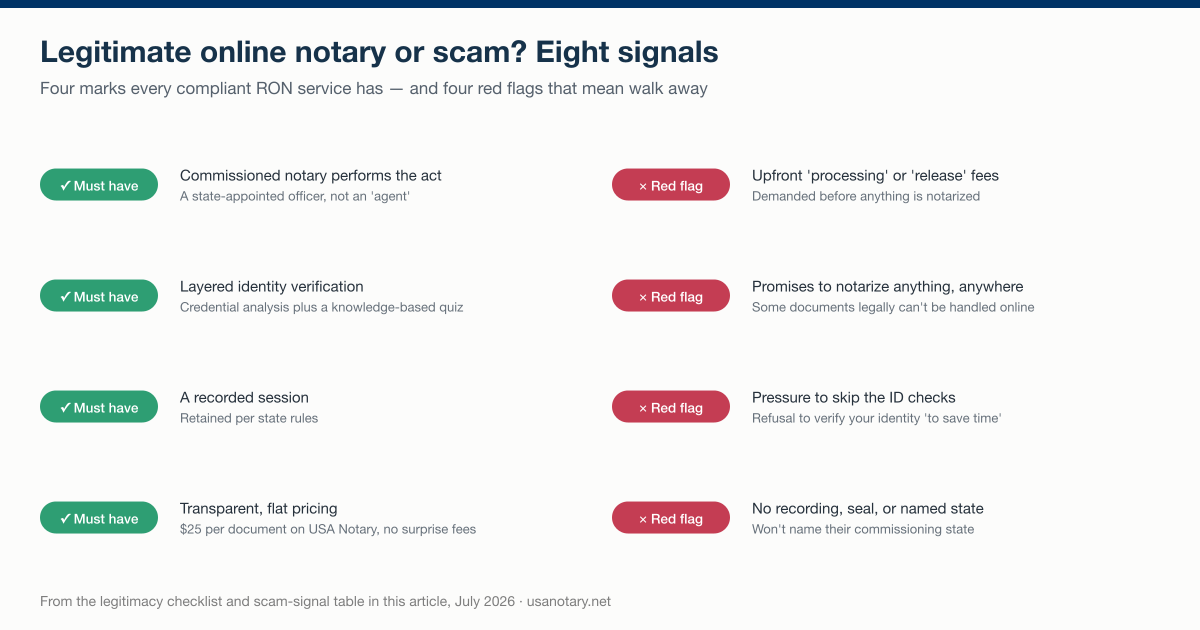
The legitimacy checks and scam red flags described in this guide, July 2026.
- A commissioned notary performs the act — a state-appointed officer, not an anonymous “agent.”
- Real identity verification — credential analysis plus a knowledge-based quiz, not just a selfie.
- A recorded session, retained per state rules.
- Transparent, flat pricing — on USA Notary, $25 per document, no surprise fees.
- Honest limits — a legitimate service tells you when a document can’t be notarized online, rather than promising to do it anyway.
Set the two side by side and the difference is stark:
| Signal | Legitimate RON service | Scam pattern |
|---|---|---|
| Who notarizes | A named, commissioned notary who states their commissioning state | An anonymous “agent” or “processor” |
| Identity checks | Credential analysis + knowledge-based authentication, on live video | Skipped, or “waived to save time” |
| Fees | Flat, disclosed before you start — $25 per document on USA Notary | Upfront “processing,” “release,” or “fund-transfer” fees |
| Recording | Session recorded and retained | No recording, no seal, no records |
| Document limits | Tells you when RON isn’t allowed for your document | Promises to notarize anything, anywhere |
Red flags that signal a scam rather than a notary:
- Requests for upfront “processing,” “release,” or “fund-transfer” fees before anything is notarized.
- Promises to notarize documents that legally can’t be handled online in the relevant state.
- Any refusal to verify your identity, or pressure to skip the ID checks “to save time.”
- No recorded session, no seal, or a “notary” who won’t name the state they’re commissioned in.
If a service passes the first checklist and trips none of the second, you’re dealing with a genuine notarial act — see exactly how a USA Notary session runs and how online notarization stays secure. Choosing between legitimate providers is a separate question of price and fit — our side-by-side of seven online notary services’ published pricing covers that.
How to verify an online notary yourself
You don’t have to take any platform’s word for it — a notary’s authority is a public fact you can check. Five steps, before or after your session:
- Ask for the notary’s name and commissioning state. Every legitimate notary states both; the notarial certificate on your finished document will show them too.
- Confirm the commission with that state’s notary authority. Notary commissions are issued and tracked by state government — in Florida, for example, an online notary must be registered with the Department of State before performing online notarizations. Contact or search the commissioning state’s notary office to confirm the commission is active.
- Expect the layered ID checks. A compliant session includes remote presentation of your government-issued ID, credential analysis, and knowledge-based authentication. If a provider skips these, that’s not convenience — it’s noncompliance.
- Confirm the session is recorded. RULONA-based laws pair remote notarization with audio-visual recording; a provider that doesn’t record isn’t following the model.
- Check the completed document. A proper RON output carries the notary’s electronic signature and seal, and the electronic record’s validity is protected by ESIGN — a recipient can verify all of it after the fact.
When in-person notarization still makes sense
Legitimate doesn’t mean universal. Online notarization is the right tool most of the time, but three situations still point to in-person:
- Your recipient has a hard rule. If a bank, agency, or court specifically won’t accept RON, its legality is beside the point — call ahead. Our guide on whether your bank will accept an online notarization covers how to confirm.
- The document type is excluded. Some states carve certain records out of RON eligibility; verify your document qualifies where the notary is commissioned.
- You can’t complete the identity checks. Knowledge-based authentication requires answering questions drawn from data records about you; a signer with a thin data footprint may not pass, and in-person notarization sidesteps the quiz entirely.
The bottom line
Online notarization is legitimate wherever it’s authorized, and a properly performed session — commissioned notary, layered ID checks, live video, recorded audit trail — is as valid as an in-person one, and often better documented. The law behind it is real and specific: 47 states plus D.C. with remote e-notarization laws, RULONA as the model framework, and ESIGN guaranteeing that the electronic record can’t be rejected just for being electronic. Vet the provider against the checklist above, verify the commission if you want certainty, and confirm your recipient accepts the format. Online notarization on USA Notary is $25 per document in all 50 states; here’s how online notarization stays secure.