
How Much Does a Notary Cost?
Online notarization on USA Notary costs $25 per document. In person, notary fees are capped by state law, from $2 to $25; 11 states set no cap. Full state-by-state table below.
Last updated: October 1, 2026 · Fee caps checked 2026-10-01 · By Andrew Ray Yon, MBA, ChFC — CEO & Founder, USA Notary
How much a notary costs, at a glance
| Where | Typical cost |
|---|---|
| Bank / credit union (customer) | Often free |
| In-person notary (per act) | $2–$25 (state statutory cap); 11 states set no cap |
| The UPS Store (per signature) | Up to the state cap (NotaryLive estimates $5–$15) |
| Online notary (RON) | $25 flat at USA Notary |
| Mobile notary (travels to you) | State fee + a separate travel fee (set by agreement or by state rule) |
The notarization fee itself is small and fixed by law. What changes the total is where you go: a bank is free but customer-only, a mobile notary is convenient but adds travel, and online is a flat, predictable rate anywhere. If cost is the deciding factor, start with the places to get a notary for free.
Why notary fees vary: state caps
Every state sets a maximum a notary may charge per notarial act, written into statute. A notary can charge less, but never more. That's why a walk-in notarization is inexpensive and remarkably consistent — the price is legislated, not set by the market. The differences you see between states are the caps themselves, and the differences between places come from convenience fees layered on top (travel, appointment, or an online platform's flat rate).
Many states also set a separate, higher cap for online notarization, because it includes identity-proofing technology and a recorded video session — for example, Texas caps online notarization at $25 (Gov't Code § 406.111) and Ohio at $30 (R.C. § 147.08). Platform prices cluster at that $25 mark, but the add-on fees differ widely — see our comparison of what seven online notary services publish.
Notary fees by state
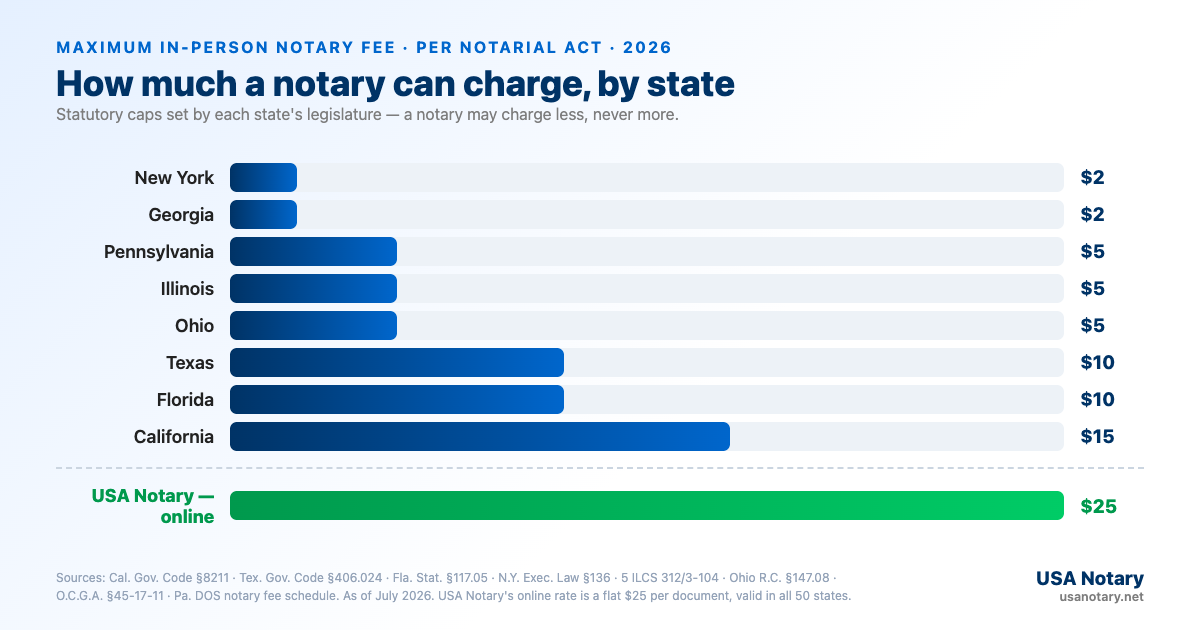
Here is the maximum a notary can legally charge in every state — the answer no retail notary page will give you. The in-person column is the per-act cap; the online column is the separate cap many states set for remote notarization. The source column links the statute, state rule or state agency page we read on October 1, 2026 for 26 of the 51 rows, including every state whose in-person cap is $10 or more or $3 or less; the other rows follow the National Notary Association's fee chart and are marked NNA.
None listed = no remote-notarization fee is listed for the state (RON not authorized, not yet operative, or no cap published) · No cap = the notary sets the fee
| State | Max in-person (per act) | Max online (RON) | Source (read 2026-10-01) |
|---|---|---|---|
| Alabama | $10 | $10 (paper only) | Ala. Code § 36-20-74 online column: NNA |
| Alaska | No cap | No cap | NNA |
| Arizona | $10 | $10 | A.R.S. § 41-316; AZ SoS fee schedule (R2-12-1102) online column: NNA |
| Arkansas | No cap | No cap | NNA |
| California | $15 | None listed | Cal. Gov. Code § 8211 |
| Colorado | $15 | $25 | C.R.S. § 24-21-529 |
| Connecticut | $10 | $10 (paper only) | Conn. P.A. 26-81 (fee increase) online column: NNA |
| Delaware | $5 | $25 | NNA |
| District of Columbia | $5 | None listed | NNA |
| Florida | $10 | $25 | Fla. Stat. § 117.05(2)(a) online column: NNA |
| Georgia | $2 | None listed | GSCCCA, Georgia Notary Law |
| Hawaii | $5 | $25 | NNA |
| Idaho | $5 | $5 | NNA |
| Illinois | $5 | $25 | 5 ILCS 312/3-104 |
| Indiana | $10 | $25 | Ind. Code § 33-42-14-1; § 33-42-17-9 |
| Iowa | No cap | No cap | NNA |
| Kansas | No cap | No cap | NNA |
| Kentucky | No cap | No cap | NNA |
| Louisiana | No cap | No cap | NNA |
| Maine | No cap | No cap | NNA |
| Maryland | $8 | $30 | NNA |
| Massachusetts | No cap | None listed | NNA |
| Michigan | $10 | $10 | MCL § 55.285(7) online column: NNA |
| Minnesota | $5 | $5 | NNA |
| Mississippi | $5 | None listed | NNA |
| Missouri | $5 | $5 + fee | NNA |
| Montana | $10 | $10 + tech | MCA § 1-5-626(1) online column: NNA |
| Nebraska | $5 (jurat $2) | $25 + fee | NNA |
| Nevada | $15 +$7.50 add’l | $25 | NRS § 240.100 online column: NNA |
| New Hampshire | $10 | $25 | RSA 455:11 |
| New Jersey | $2.50 (real estate: $15 grantors, $25 mortgagors) | $2.50–$25 | NJ Notary Public Manual, ch. 11 online column: NNA |
| New Mexico | $5 | $5 + $25 tech | NNA |
| New York | $2 | $25 | N.Y. Exec. Law § 136 online column: NNA |
| North Carolina | $10 | $25 | N.C.G.S. § 10B-31 |
| North Dakota | $5 | $5 + tech | NNA |
| Ohio | $5 | $30 + tech | Ohio R.C. § 147.08 |
| Oklahoma | $5 | $25 | NNA |
| Oregon | $10 | $25 | ORS § 194.400 |
| Pennsylvania | $5 (+$2 name) | $20 + fee | 4 Pa. Code § 167.3 (PA Dept. of State) |
| Rhode Island | $25 | $25 | R.I. Gen. Laws § 42-30.1-20.1 |
| South Carolina | $5 | None listed | NNA |
| South Dakota | No cap | No cap | NNA |
| Tennessee | No cap | $25 | NNA |
| Texas | $10 +$1 add’l | $25 + fee | Tex. Gov't Code §§ 406.024, 406.111 |
| Utah | $10 | $25 | Utah Code § 46-1-12 |
| Vermont | No cap | No cap | NNA |
| Virginia | $10 | $25 | Va. Code § 47.1-19 |
| Washington | $15 | $25 | WAC 308-30-220 |
| West Virginia | $10 | $10 | W. Va. Code § 39-4-30 online column: NNA |
| Wisconsin | $5 | $5 + tech | NNA |
| Wyoming | $10 | $10 + tech | Wyo. Stat. § 32-3-126 online column: NNA |
Fee caps checked 2026-10-01. Rows with a source link: the cap was read from that statute, state rule or state agency page on October 1, 2026 (26 of 51 rows, covering every state whose in-person cap is $10 or more or $3 or less). Rows marked NNA were not independently checked against a statute: they follow the National Notary Association "Notary Fees by State" chart (page last updated Sep 16, 2026, retrieved 2026-10-01). Fees are per notarial act or signature, and a notary may charge less than the cap; separately permitted charges such as travel or an online-platform technology fee are not part of it. Confirm your state before relying on a figure.
Cap vs. what you actually pay
Here's the confusion no notary page explains: if your state caps the fee at $2, why did The UPS Store or a mobile notary charge you more — and is that legal? Yes, it's legal. The statutory cap applies only to the notarial act itself. Other, separately permitted charges can stack on top of it:
| Charge | Capped by the state fee law? |
|---|---|
| The notarial act (the stamp) | Yes — capped per act/signature by your state |
| Mobile travel fee | No — separate; regulated differently by state |
| Online/RON technology fee | Often a separate cap (e.g., Ohio $30 + up to $10 tech) |
| Printing, copies, shipping | No — retail services, not a notarial fee |
So a Georgia notary can only charge $2 to notarize — but a mobile notary who drives to you may add a travel fee, and a shipping store may add a service markup. That's why the same notarization can cost $2 at your bank and $25 online: you're paying for convenience, not a higher stamp. USA Notary folds it all into one flat $25, so there's nothing to stack.
Mobile notary travel fees
A mobile notary charges the state's statutory act fee plus a separate travel fee. There is no single national travel price, because the travel fee is regulated differently from state to state. Nevada, for example, caps the additional travel fee at $15 per hour for travel between 6 a.m. and 7 p.m. and $30 per hour overnight (NRS 240.100), while Washington (WAC 308-30-220) and Oregon (ORS 194.400) require the notary and the customer to agree on the travel fee in advance and the notary to explain that it is in addition to the notarial fee. Statutes read October 1, 2026.
Mobile service is worth it when the signer can't travel. For everyone else, online standard document notarization offers the same "comes to you" convenience at a flat rate, with no travel fee.
What UPS, banks & the post office charge
- The UPS Store charges per signature, up to the state cap — NotaryLive, a third-party notary service, says "most UPS Store locations charge $5 to $15 per signature, based on your state's maximum fee" — and the store can copy and ship the document too.
- Banks are free at some banks for customers — Bank of America states it "does not charge a fee for notary services."
- The post office (USPS) charges nothing — because it does not notarize at all.
- FedEx Office offers online notary starting at $25, with add-ons that vary at checkout.
Online notary cost
Several states set a separate online-notarization cap: Texas allows up to $25 (Gov't Code § 406.111), Ohio up to $30 (R.C. § 147.08), and Illinois up to $25 per electronic act (5 ILCS 312/3-104), while Pennsylvania lets electronic or remote notaries add up to $20 on top of the standard fee (4 Pa. Code § 167.3). USA Notary's online notarization is a flat $25 per document — ID verification, the electronic seal, a tamper-evident certificate, and instant delivery included, in all 50 states.
Because it's one predictable price with no travel and no per-seal surprises, online is often the best value once you account for the time and mileage of an in-person visit. To total your own documents before you book, use the notarization cost estimator.
Comparing platforms on advertised price alone is harder than it looks. Our October 1, 2026 re-check of seven platforms' published pricing found that all seven print $25 as the entry price, recorded three different billing units — per seal, per document, and per session — and found published add-on fees running from no extra charge to $79 for a signer without a U.S. Social Security number. Check which unit a platform bills in before comparing its entry price to another's.
How to pay less
- 1
Check your bank first. Some banks notarize at no charge — Bank of America states it does not charge a fee for notary services — but policies differ by bank, so book an appointment and ask.
- 2
Count your signatures. Per-signature pricing adds up — know how many acts your document needs before you go.
- 3
Skip the travel fee. Choose online notarization over a mobile notary unless the signer truly can't travel.
- 4
Value your time. A flat $25 online often beats a "cheap" in-person fee once mileage and waiting are counted.
Frequently Asked Questions
How much does a notary cost in the US?
Online notarization on USA Notary costs $25 per document. For in-person notarization, each state's statute sets a maximum per signature or per notarial act: caps run from $2 (Georgia and New York) to $25 (Rhode Island), and 11 states set no statutory cap. 36 of the 40 jurisdictions (states and D.C.) that set a cap fall between $5 and $15, and a notary may charge less than the cap. Fee caps checked October 1, 2026.
Which state has the lowest notary fee?
Georgia and New York have the lowest statutory cap at $2 per notarial act. Georgia also lets a notary charge an additional $2 for a Clerk of Superior Court certificate on request. New Jersey is $2.50 per act, with higher caps for real-estate transactions ($15 for grantors, $25 for mortgagors in a financing). At the other end, Rhode Island caps the fee at $25 per document or notarization, and 11 states — including Alaska, Iowa, Kansas, and Massachusetts — set no statutory maximum, per the National Notary Association's chart, leaving the fee to the notary.
Is the notary fee per signature or per document?
It depends on the state's wording. California charges $15 per signature and Texas $10 for the first signature plus $1 for each additional, while Florida and Ohio cap the fee per notarial act. A document that needs several notarized signatures can therefore cost several times the single-act cap.
How much can a notary legally charge per signature?
A notary may charge up to the cap in the state of the notarization, and less. Georgia allows $2 and New York $2 (Exec. Law § 136), while California allows $15 for each signature taken (Gov. Code § 8211). States with no statutory cap leave the fee to the notary. Fee caps checked October 1, 2026.
How much does a mobile notary charge to travel to me?
A mobile notary charges the state's statutory act fee plus a separate travel fee, and no single national figure applies because states treat travel differently. Nevada caps the additional travel fee at $15 per hour for travel between 6 a.m. and 7 p.m. and $30 per hour overnight (NRS 240.100), while Washington and Oregon require the notary and customer to agree on the travel fee in advance and the notary to explain it is in addition to the notarial fee.
How much does an online notary cost?
Online notarization on USA Notary costs $25 per document. The seven online notary platforms in our October 1, 2026 pricing study all print $25 as their entry price, but they bill in three different units (per seal, per document, per session) and add fees for extras, so compare the unit before comparing the price. State caps for online notarization are set separately from in-person caps and are listed in the table above.
Can I get a document notarized for free?
Often, yes. Bank of America states that it does not charge a fee for notary services. Other banks, public libraries, and AAA branches set their own rules, so a fee can apply to non-customers, non-members, and independent or mobile notaries — see our guide to getting a notary for free.
About the author
Andrew Ray Yon, MBA, ChFC
CEO & Founder, USA Notary Services LLC
Andrew Ray Yon is the founder and CEO of USA Notary Services LLC and the architect of the SharpNote remote online notarization platform. A Certified Notary Signing Agent since 2005, he has handled mortgage and title loan signings for two decades — personally completing more than 10,000 notarizations — and holds an MBA and the ChFC (Chartered Financial Consultant) designation. Based in Virginia’s Greater Richmond region, he leads the company’s strategy, compliance, and platform development.
Connect on LinkedInOne flat price, no surprises
Notarize online for a flat $25 per document — all-inclusive, all 50 states, in about 15 minutes. The flat rate covers every document type in our online notarization services.
See where to get something notarized or our full pricing.