
Where to Get Something Notarized
You can get a document notarized at The UPS Store, a bank or credit union (often free for account holders), AAA, some public libraries, a county clerk's office, or a mobile notary who travels to you. The fastest option is online — you appear on live video and finish in about 15 minutes, in all 50 states, 24/7.
Last updated: October 1, 2026 · By Andrew Ray Yon, MBA, ChFC — CEO & Founder, USA Notary
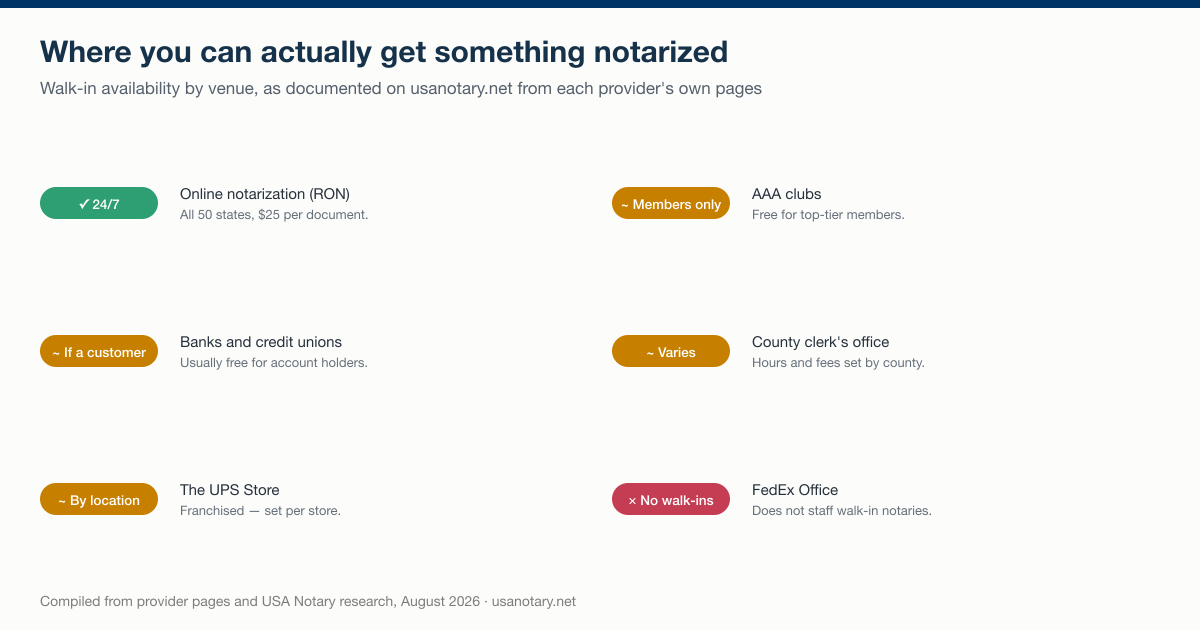
Where can you get something notarized?
Seven kinds of places notarize documents for the public. What separates them is cost, whether you need an appointment, and how far you have to travel. Here is the honest comparison — each option is covered in detail below.
| Where | Typical cost | Appointment? | Best for |
|---|---|---|---|
| Online (RON) | $25 flat (USA Notary) | No — 24/7 on demand | Speed; no travel; any state |
| Bank / credit union | Often free for customers | Book ahead where offered | Account holders; free |
| The UPS Store | Up to the state cap (≈$5–$15) | Walk-in or online booking | Notarize + copy + ship in one stop |
| FedEx Office | Online only, from $25 | No — online by video | Printing a notarized copy in-store |
| AAA / library / county clerk | Free to a few dollars | Varies by location | Members / simple documents |
| Mobile notary | State fee + travel fee | Yes — scheduled | Homebound signers; large signings |
The in-person notarization fee itself is capped by your state's law, so a walk-in notary is inexpensive — the real differences are convenience and whether the place serves non-customers.
What does "notarized" actually mean?
A notarization is an official act performed by a state-commissioned notary public: the notary checks your government-issued photo ID, watches you sign the document (or administers an oath, depending on the certificate type), and then completes a notarial certificate with their own signature and seal. The agency receiving your paperwork gets independent confirmation that the right person signed it — that's the entire point. Our guides on what "notarized" means and jurat vs. acknowledgment cover the mechanics.
Here's what matters for choosing a venue: the notarial act is the same whether the notary sits behind a bank desk, a UPS Store counter, or a webcam. Any commissioned notary can perform it — see who can notarize a document — so the decision about where to get something notarized comes down to cost, hours, and how far you're willing to travel. If the answer to that last one is "not at all," you can complete the same act by live video from your couch.
The UPS Store
The UPS Store provides notary services at participating locations. Its official notary page states that "The UPS Store locations offer notary services to help make life easier," and that online appointment scheduling is available at more than 3,900 locations nationwide. Because each store is independently owned, availability and price vary — call ahead.
The fee is charged per signature and is bounded by your state's statutory cap. See does the UPS Store notarize, cost and how it works for the full walkthrough.
Banks & credit unions
Banks and credit unions are the most common free option. Bank of America states its notary services are available at no cost in many of its financial centers, and many banks provide notary services free to their own account holders. Non-customers may be charged or turned away, so it pays to use your own bank and schedule ahead.
Full details, including which major banks confirm notary services, are on do banks have notaries.
FedEx Office
FedEx Office is different from the UPS Store: it does not market a walk-in notary. Instead it offers FedEx Office Online Notary with Notarize, a remote online notarization service that starts at $25 and runs 24/7/365. You can then print the finished document in-store with self-service Print & Go.
See FedEx notary — online or walk-in? for how it works and what it costs.
The post office (USPS)
The post office does not notarize. The U.S. Postal Service is a federal agency, and notary commissions are issued by states, so postal clerks cannot perform notarizations. This trips a lot of people up because USPS Form 1583 (for renting a mailbox) needs to be notarized — but by an outside notary, not by USPS.
Full explanation of why the post office counter cannot notarize
AAA, libraries & county clerks
- AAA branches. Some AAA clubs offer free notarization to top-tier members (often capped at a few signatures per day), with lower tiers and non-members paying a per-signature fee — at Auto Club Enterprises, for example, non-members pay $15. Pricing and availability are set club-by-club, so confirm with your local branch.
- Public libraries. Some public libraries notarize simple documents for free, usually by appointment — for example, Brooklyn Public Library and St. Louis County Library. Availability is local, and libraries won't handle complex instruments.
- County & court clerks. Some county clerk offices notarize documents for the public for a small statutory fee; others only administer notary commissions and don't serve the general public. Availability varies by county — verify locally before you go.
Law offices, courthouses & other places with a notary on staff
If you're asking "where can I get something notarized near me" and none of the big-name options is close, the pool is wider than most people realize. AAA's own notary guide notes that "you can find notary publics in banks, law offices, government agencies, schools, and at AAA branches," and the National Notary Association tells the public it can "usually find notarial services at banks, libraries, and mailbox/photocopy shops."
- Law offices. Attorneys' offices routinely keep a commissioned notary on staff because so much of their paperwork requires one. They're a sensible stop for complex instruments — but availability to walk-in non-clients varies office by office, so call first.
- Courthouses. Per Superior Notary Services, "you can always get something notarized at the courthouse during business hours" because many courthouse clerks double as notaries — though they also advise calling ahead to confirm.
- Paper-heavy local businesses. The same Superior Notary Services roundup lists tax-preparation offices, real-estate offices, insurance offices, printing and office-supply stores, and courier services as places that commonly have a notary on staff. None of them guarantees one at every location — a 30-second phone call beats a wasted trip.
Whatever venue you land on, the notarization fee itself can't exceed your state's statutory fee cap — the venue only changes what you pay in convenience, membership, or travel charges around that fee.
Mobile notary
A mobile notary travels to you — your home, office, a hospital, or a care facility. Mobile notaries charge the state-capped notarization fee plus a separate travel fee. The National Notary Association notes that some states set a maximum travel fee (Nevada, for example, caps daytime travel at $15 per hour), while others let the notary set a reasonable amount agreed in advance.
A mobile notary is the right call when the signer genuinely can't travel. For everyone else, online notarization delivers the same "notary comes to you" convenience — faster and usually cheaper.
Online — the no-trip option
Online notarization — remote online notarization (RON) — lets you appear on live, recorded video with a commissioned notary instead of driving anywhere. You upload the document, verify your ID, meet the notary by video, and download the finished file in about 15 minutes. USA Notary does it for a flat $25 per document, available to signers in all 50 states, 24/7.
Per the National Association of Secretaries of State, 47 states and the District of Columbia have a law authorizing remote online notarization; that per-state commissioning law governs where a notary holds a RON commission, while USA Notary's consumer service is available to signers in all 50 states. Confirm whether online notarization is legal in your state. The State of RON 2026 report shows how the state counts are tallied.
Need it notarized today, tonight, or on a weekend?
Every walk-in option on this page runs on two clocks: the venue's business hours, and whether a commissioned notary happens to be on duty when you arrive. That's why searching for the nearest notary at 9 p.m. — or on a Sunday, or the day a deadline lands — mostly turns up places that are closed. When the timing is tight, you have three realistic moves:
- Notarize online right now. USA Notary's video notarization runs 24/7 for a flat $25 per document — no appointment, and the nearest notary becomes the one on your screen. Most sessions finish in about 15 minutes.
- Find after-hours in-person help. Our 24-hour notary guide walks through the late-night and weekend options — including mobile notaries who take evening appointments, typically with a travel fee on top of the state-capped notarization fee.
- Wait for the free option. If the document can wait until tomorrow's business hours, a free notary at your own bank, a AAA branch, or a participating library costs nothing but the trip.
One caution for deadline situations: confirm what the receiving agency needs delivered. If they require a wet-ink original by mail, build shipping time into the plan; if they accept an electronic document, an online notarization gets the finished file into your inbox the same night.
How to prepare: what to bring to the notary
Most failed notarization attempts aren't about finding a notary — they're about showing up unprepared and getting sent home. Run this checklist before you leave (or before you log on):
- 1
Bring the complete document — unsigned. The notary has to watch you sign, so don't sign in advance. Bring every page, not just the signature page.
- 2
Bring a valid government-issued photo ID. A driver's license, state ID, or passport is what the notary uses to verify you're the person named in the document.
- 3
Get every signer in front of the notary. If more than one person must sign, each of them has to appear with their own ID — one person can't sign "for" an absent spouse or partner.
- 4
Check whether your document needs witnesses. Some documents require witnesses in addition to the notary — our guide to when notarization needs a witness explains which ones. For online sessions, USA Notary supports remote witnesses where state law and the document's rules permit them.
- 5
Call ahead and confirm the fee. At banks, libraries, AAA, and pack-and-ship stores, a notary isn't guaranteed to be on duty. Confirm one is available and ask the per-signature price — it's capped by state law, but caps differ by state.
- 6
Going online instead? You need the same valid photo ID plus a device with a camera. Identity verification happens digitally before the video session — here's the step-by-step.
Where to get a document notarized, by document type
The best venue often depends on what you're notarizing. A one-page consent letter is a different errand than a real-estate closing. Here's where each common document type usually gets handled, with a full guide for each:
| Document | Practical route | Full guide |
|---|---|---|
| USPS Form 1583 (mailbox / virtual address) | Online — the post office itself cannot notarize it | PS Form 1583 notarization |
| Power of attorney | Your bank (often free), a law office, or online | Notarize a power of attorney |
| Affidavit / sworn statement | Any commissioned notary — walk-in or online | Notarize an affidavit |
| Vehicle title / bill of sale | Check your state's DMV rules before signing anything | How to sign over a car title |
| Will / living will | Rules vary by state — confirm what yours requires first | Does a will need to be notarized? |
| Real-estate closing documents | Handled through your title/escrow company; online closings where your lender permits | Online real-estate closings |
| Child travel consent letter | Any venue works — online is the fastest before a trip | Child travel consent |
One rule beats every row in this table: the receiving agency's instructions win. If the court, bank, or agency that wants the document specified how it must be notarized or delivered, bring those instructions with you — to the counter or to the video session. Our blog has more notarization guides covering document types beyond this table.
How to choose
- 1
Want it free and you have a bank account? Book a notary appointment at your own bank or credit union.
- 2
Need to ship or copy the document too? The UPS Store notarizes and handles the copies and shipping in one stop.
- 3
Homebound or need a large signing on-site? Book a mobile notary who travels to you.
- 4
Want it done now, without leaving home? Notarize online by live video — available 24/7, the fastest option for most documents.
Frequently Asked Questions
Where can I get a document notarized for free?
Banks and credit unions are the most common free option — Bank of America provides notary services at no cost in many of its financial centers, and many banks offer it free to their account holders. Some public libraries also notarize simple documents for free, and at some AAA clubs top-tier members get free notarizations at branch offices. Call ahead to confirm a notary is on duty.
Do UPS and FedEx notarize documents?
The UPS Store offers in-person notary services at participating locations, by walk-in or online appointment. FedEx Office does not staff walk-in notaries; it offers an online notary service through Notarize, starting at $25. If you want the fastest option, online notarization by live video is available 24/7.
Does the post office notarize documents?
No. The U.S. Postal Service does not provide notary services at any post office. Notary commissions are issued by states, and USPS is a federal agency, so postal clerks cannot notarize. Use a bank, The UPS Store, a county clerk, an online notary, or a mobile notary instead.
Can a notary come to me?
Yes. A mobile notary travels to your home, office, hospital, or care facility. Mobile notaries charge the state-capped notarization fee plus a separate travel fee, so the total is higher than a walk-in visit — but it saves you the trip. Online notarization is a faster, lower-cost alternative for most documents.
What is the fastest way to get something notarized?
Online notarization is the fastest — you appear on live video with a commissioned notary, verify your ID, and download the notarized document in about 15 minutes, without an appointment or travel. USA Notary offers it for a flat $25 per document to signers in all 50 states, 24/7.
What do I need to bring to get a document notarized?
Bring the complete, unsigned document and a valid government-issued photo ID. Wait to sign until you are in front of the notary. If more than one person must sign, everyone has to be present with their own ID. For online notarization, you need the same ID plus a device with a camera.
Can you just walk into a bank and get something notarized?
Often, yes — but it isn't guaranteed. Many banks provide notary services free to their own account holders, and Bank of America offers them at no cost in many of its financial centers, but the notary has to be on duty that day and non-customers may be charged or turned away. Call your branch first and ask whether an appointment is recommended.
How much does it cost to get something notarized?
In person, the per-signature fee is capped by your state's law — for example $15 in California, $10 in Florida and $2 in New York. Banks and credit unions are often free for account holders, some AAA clubs notarize free for top-tier members, and mobile notaries add a separate travel fee on top of the state-capped fee. Online notarization through USA Notary is a flat $25 per document, available to signers in all 50 states, 24/7.
About the author
Andrew Ray Yon, MBA, ChFC
CEO & Founder, USA Notary Services LLC
Andrew Ray Yon is the founder and CEO of USA Notary Services LLC and the architect of the SharpNote remote online notarization platform. A Certified Notary Signing Agent since 2005, he has handled mortgage and title loan signings for two decades — personally completing more than 10,000 notarizations — and holds an MBA and the ChFC (Chartered Financial Consultant) designation. Based in Virginia’s Greater Richmond region, he leads the company’s strategy, compliance, and platform development.
Connect on LinkedInSkip the trip
Notarize your document online in about 15 minutes — a flat $25, available to signers in all 50 states, no appointment needed. Check your document type against the online notarization services we cover.
Questions? Contact our team or call 804-767-7500