
How do you notarize a power of attorney?
Notarizing a power of attorney (POA) means a notary confirms that the principal — the person granting authority to an attorney-in-fact — signed the document. The notarial act is almost always an acknowledgment: the principal appears before the notary, proves their identity, and acknowledges that they executed the POA. Per the California Secretary of State’s Notary Public Handbook, in a certificate of acknowledgment the notary certifies three things: that the signer personally appeared before the notary on the date and in the county indicated, to the identity of the signer, and that the signer acknowledged executing the document. Personal appearance is not optional — the handbook states that an acknowledgment “cannot be affixed to a document mailed or otherwise delivered to a notary public whereby the signer did not personally appear before the notary public, even if the signer is known by the notary public.”
A POA notarized with an acknowledgment can typically be signed before the appointment; the principal just has to appear and acknowledge the signature as their own. No oath is involved — that separates an acknowledgment from a jurat, where the signer swears the contents are true and signs in front of the notary. If the terminology is new, start with what “notarized” actually means and the types of power of attorney — general, limited, durable, and medical POAs all reach the notary the same way, but what happens after signing differs. For the motor-vehicle variety, see the vehicle-specific POA guide.
Does a power of attorney legally have to be notarized?
That depends on your state and on what the accepting party will honor, but notarization is the norm because it makes the document hard to challenge. Many states have adopted the Uniform Power of Attorney Act (UPOAA), a model statute drafted by the Uniform Law Commission. Under the Act as enacted in New Hampshire (RSA 564-E:105), a power of attorney “must be signed… by the principal or in the principal’s conscious presence by another individual directed by the principal to sign the principal’s name” and “must be acknowledged before a notary public or other individual authorized by law to take acknowledgments.” The same section grants a powerful benefit: “A signature on a power of attorney is presumed to be genuine if the principal acknowledges the signature before a notary public.”
That presumption of genuineness is the practical reason banks, title companies, and agencies expect a notarized POA — the acknowledgment shifts the burden onto anyone who later disputes the signature. The statute goes further for the people asked to rely on the document: under RSA 564-E:119, a person who in good faith accepts an acknowledged power of attorney “without actual knowledge that the signature is not genuine may presume that the signature is genuine.” In plain terms, the notarization is what lets a bank officer accept the POA at the counter instead of sending it to legal review.
Note the drafting detail in RSA 564-E:105 as well: the principal does not always have to hold the pen. A POA can be signed by another individual at the principal’s direction, in the principal’s conscious presence — a provision that matters when illness or injury makes signing physically difficult. Execution mechanics like this are state-specific, so confirm your state’s requirements — and whether your bank or agency has its own POA form — before you sign.
Power of attorney notarization at a glance
| Element | What applies |
|---|---|
| Notarial act | Acknowledgment (in most cases) |
| Who appears | The principal (grantor) |
| Identity | Government-issued photo ID / satisfactory evidence |
| Oath required | No (that is a jurat, used for affidavits) |
| Witnesses | Varies by state — some require one or two |
| Legal effect of notarization | Signature presumed genuine (UPOAA states) |
| Online option | Yes, where the state authorizes RON |
Acknowledgment vs. jurat: which notarial act applies
A power of attorney takes an acknowledgment, not a jurat — and the difference matters because the two acts certify different things. In an acknowledgment, the principal proves their identity and acknowledges that they signed; the notary is not attesting to the truth of anything in the document. In a jurat, by contrast, the signer swears the contents are true and signs in front of the notary — California’s statutory jurat wording, for instance, records that the document was “subscribed and sworn to (or affirmed)” before the notary. Jurats belong on affidavits and sworn declarations — see how a sworn affidavit gets notarized for that process.
California’s required certificate wording also states the limit of the notary’s role in either act: the notary “verifies only the identity of the individual who signed the document to which this certificate is attached, and not the truthfulness, accuracy, or validity of that document.” Putting the wrong certificate on a POA can invalidate the notarization, so the notary selects the act the document (or the accepting party) calls for — and a well-drafted POA arrives with the acknowledgment certificate already printed on its signature page.
Do you need witnesses in addition to a notary?
A notary and a witness are not the same role, and some states require both. Where witnesses are required, they attest that they watched the principal sign; the notary separately certifies identity and the acknowledgment. Some states also require the witnesses to be present at signing and to be disinterested (not the agent, and often not a relative or beneficiary). Because these rules are state-specific — and because a remote session handles witnesses differently from an in-person one — read when a document needs independent witnesses and confirm the exact requirement for your state before you sign. If the POA will be used out of state, check the destination state’s expectations too: the accepting institution there may hold the document to its own execution standards regardless of where it was signed.
Can you notarize a power of attorney online?
In states that authorize remote online notarization, you can notarize a POA over a live video session instead of in person. On USA Notary, online notarization is $25 per document and available in all 50 states; the signer appears on live video and the notary applies an electronic notarial certificate. The steps:
- Upload your power of attorney and choose the acknowledgment (the notary confirms the correct certificate).
- Verify your identity — the notary reviews your government-issued photo ID through credential analysis and knowledge-based authentication.
- Appear on live video, acknowledge that you signed, and the notary completes the electronic acknowledgment.
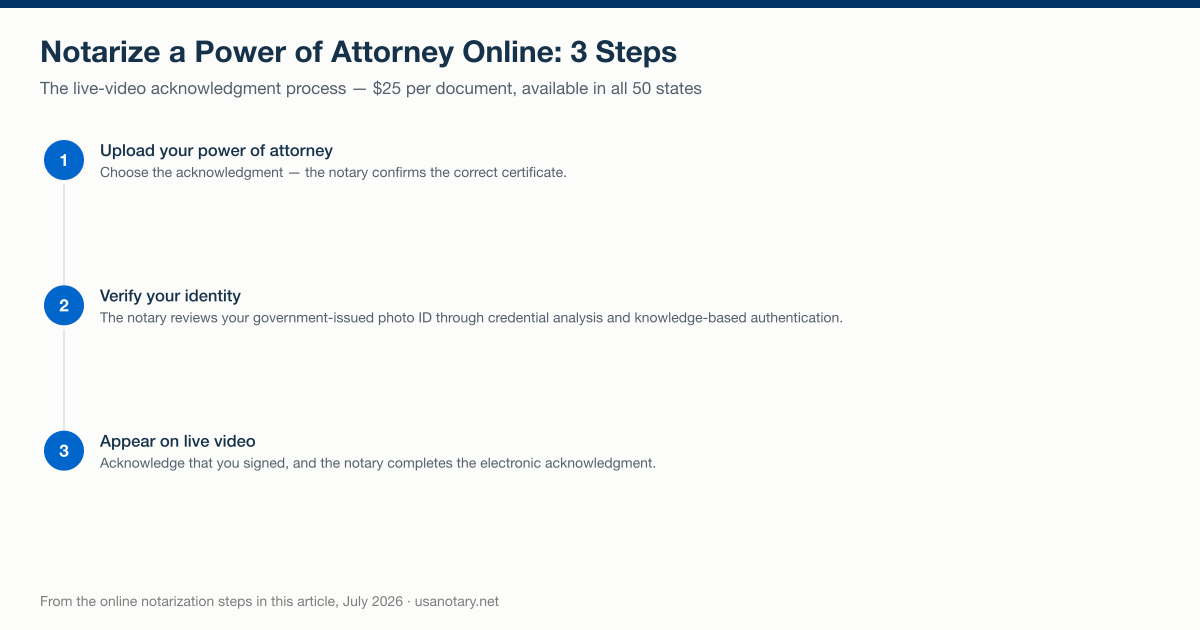
The three-step online notarization process for a power of attorney described in this guide, July 2026.
The legal footing for the electronic version is settled at the federal level for the signature itself: under the ESIGN Act (15 U.S.C. § 7001), a signature or record “may not be denied legal effect, validity, or enforceability solely because it is in electronic form.” State RON statutes — many modeled on the Uniform Law Commission’s Revised Uniform Law on Notarial Acts (RULONA) — supply the notarial-appearance rules on top of that. A federal floor for remote notarization, the SECURE Notarization Act (H.R.1777), has been introduced in Congress but has not been enacted, so as of 2026 the authorizing law remains state-by-state.
Two cautions are specific to powers of attorney:
- Confirm RON is permitted for your document in your state. The consumer service reaches all 50 states, but notary commissioning law is per-state, and some states have not yet authorized their own notaries to perform RON for every document type. See whether online notarization is legally recognized.
- Check that the accepting party takes a remote POA. A bank, title company, or agency can impose its own execution and witness rules, so confirm they will honor a remotely notarized version before your session.
To see the workflow end to end, read how an online notarization session works.
Online, mobile, or walk-in: which route fits your situation?
Powers of attorney get signed under time pressure more often than most documents — before a deployment, a hospitalization, a closing, or an overseas move. For hospital and care-facility signings, see our healthcare and senior-care notary support. The right notarization route depends on where the principal is and what the accepting party demands:
| Situation | Best route | Why |
|---|---|---|
| Principal is mobile, document is standard | Online (RON) | Fastest; the signer appears on live video from anywhere with ID and a camera |
| Principal is abroad or relocating | Online (RON) | No embassy appointment needed where RON is permitted for the document |
| Principal is hospitalized or homebound | Mobile notary | An in-person notary travels to the bedside; capacity and willingness are assessed face to face |
| Accepting party demands wet-ink or in-person execution | Walk-in or mobile notary | Some institutions and recording offices still require a paper original |
| POA needs witnesses your state requires at signing | Confirm first | Witness logistics differ between remote and in-person sessions — verify before booking |
If the principal cannot appear on video — or a bank insists on paper — in-person power of attorney notarization covers the same acknowledgment through a traditional appointment.
What about signing as the attorney-in-fact later?
Notarizing the POA itself is step one. Months or years later, the agent — the attorney-in-fact, who need not be an attorney at law — will sign documents on the principal’s behalf, and those signatures often need notarization too. The National Notary Association confirms that “a signer with power of attorney is authorized to sign the principal’s name and have that signature notarized without the principal being present.”
At that later notarization, practices vary by state: the agent commonly signs in a dual-name format (the principal’s name, by the agent as attorney-in-fact), some states require the notary to see proof of the agent’s authority while others do not, and an attorney-in-fact generally cannot swear an oath on the principal’s behalf — which is one more reason POA-related documents ride on acknowledgments rather than jurats. Two takeaways for the principal at signing time: name the agent exactly (the name on the POA should match the agent’s ID), and make sure the agent will be able to produce the document — or a certified copy — whenever they act under it.
When does a notarized power of attorney take effect?
Notarization fixes who signed; the document’s own wording fixes when it works. Under the UPOAA as enacted in New Hampshire, RSA 564-E:109 provides that “a power of attorney is effective when executed unless the principal provides in the power of attorney that it becomes effective at a future date or upon the occurrence of a future event or contingency.” A POA that activates on a future event — commonly the principal’s incapacity — is often called a springing power of attorney, and the statute lets the principal authorize someone to determine in writing that the triggering event has occurred.
Durability is the same kind of drafting question. Under RSA 564-E:104, “a power of attorney created under this chapter is durable unless it expressly provides that it is terminated by the incapacity of the principal” — durability is the default in UPOAA states, not something the notary stamp adds. Other states set different defaults, so confirm yours. If the effective date, durability, or scope of authority is what you actually need answered, that is a drafting question for an attorney, not a notarization question.
What red flags will the notary watch for?
A POA hands one person legal control over another’s affairs, which makes it a known target for elder abuse and coercion — and notaries are trained accordingly. The Colorado Secretary of State runs a dedicated eLearning course just on notarizing powers of attorney, training notaries to recognize POA documents, protect themselves from liability, and “look for red flags when notarizing power of attorney documents.”
In practice, expect the notary to confirm three things beyond identity:
- Willingness — the principal is signing of their own accord, not under visible pressure from a family member or the named agent.
- Awareness — the principal can communicate what the document is and what it does at the moment of signing.
- The signer is the principal — the person granting authority is the one appearing, not the agent signing on their behalf.
A notary who doubts any of these can decline the notarization. What the notary does not assess is whether the POA is legally sufficient for your purpose — remember the California certificate wording: identity only, “not the truthfulness, accuracy, or validity of that document.”
Certifying a copy of a notarized power of attorney
Once a POA is notarized, you may need certified copies for different institutions — a bank may keep one on file, a brokerage another. In some states a notary can certify that a copy matches the original. California authorizes this specifically for powers of attorney under Probate Code section 4307, even though it prohibits notarial copy certification of most other documents: the certifying person states that they have “examined the original power of attorney and the copy and that the copy is a true and correct copy,” and the certified copy then “has the same force and effect as the original power of attorney.” Under that section a copy may be certified by an attorney licensed in the state, a notary public, or an authorized government official.
Copy-certification rules differ sharply by state, so confirm what your state allows rather than assuming the option exists. Where notarial copy certification is unavailable, the recording office or the institution itself may offer an alternative — ask the accepting party what form of copy it will honor.
What you need to notarize a power of attorney
- The completed power of attorney (unsigned or already signed — an acknowledgment allows either).
- A valid government-issued photo ID for the principal.
- A device with a camera and microphone for an online session.
- Any witnesses your state requires (confirm this before the appointment).
- The agent’s full legal name spelled exactly as it appears on their ID.
After the notarization: originals, copies, and acceptance
The notarized POA only works if the right people can rely on it, so close the loop after the appointment:
- Store the original safely and accessibly. The agent must be able to produce it when acting — a safe-deposit box only the principal can open defeats the purpose.
- Give the accepting parties what they ask for. Some institutions photocopy the original and hand it back; others want a certified copy; a few insist on their own POA form entirely. Ask each one.
- Ask about recording if real estate is involved. When a POA will be used to sign deeds or closing documents, the county recorder or title company may have its own requirements for the executed original — confirm with them before closing day.
- Revisit the document after major life changes. A move to another state, a new marriage, or a changed relationship with the agent are all reasons to have an attorney review whether the POA still says what you want.
Before you sign
A notary verifies identity and willingness — not whether the POA is legally sufficient for your purpose. Some states also add safeguards specific to POAs; California, for instance, requires the signer’s thumbprint in the notary’s journal for a power of attorney. For questions about scope, durability, springing triggers, or which type of POA you need, confirm your state’s rules or consult an attorney. When the document is drafted and you are ready to execute it, notarize your POA online in a live video session — or book an in-person appointment if your accepting party requires one.