
What is an attorney-in-fact?
An attorney-in-fact is an agent authorized to act for another person under a power of attorney. The Cornell Legal Information Institute defines it as “an agent authorized to act on behalf of another person but not necessarily authorized to practice law; e.g., a person authorized to act by a power of attorney.” The person who grants the authority — through a power of attorney — is the principal; the person who receives it is the attorney-in-fact, also called the agent. The two terms mean the same thing, and state statutes use them interchangeably.
The National Notary Association uses the same vocabulary: “A person granted power of attorney to sign documents for someone else is typically referred to as an ‘attorney in fact’ or ‘agent,’ and the individual represented is referred to as a ‘principal.’”
One more distinction clears up most confusion: the power of attorney is the document, and the attorney-in-fact is the person. Cornell LII describes a power of attorney as “an agreement between two parties: a principal and an attorney in fact.” You cannot “be someone’s power of attorney” in the strict legal sense — you hold power of attorney, and the title that comes with it is attorney-in-fact.
Attorney-in-fact vs. attorney-at-law
The word “attorney” causes most of the confusion here. An attorney-in-fact is not a lawyer. Cornell LII is explicit: “The attorney in fact need not be an attorney at law (a lawyer).” In legal usage, “attorney” simply means someone appointed to act for another — an attorney-at-law is appointed to represent clients in legal matters and must hold a bar license, while an attorney-in-fact is appointed for practical affairs (“in fact”) and needs no license at all. The role is one of trust, not legal training — an attorney-in-fact is very often a spouse, adult child, or close friend named to handle someone’s affairs.
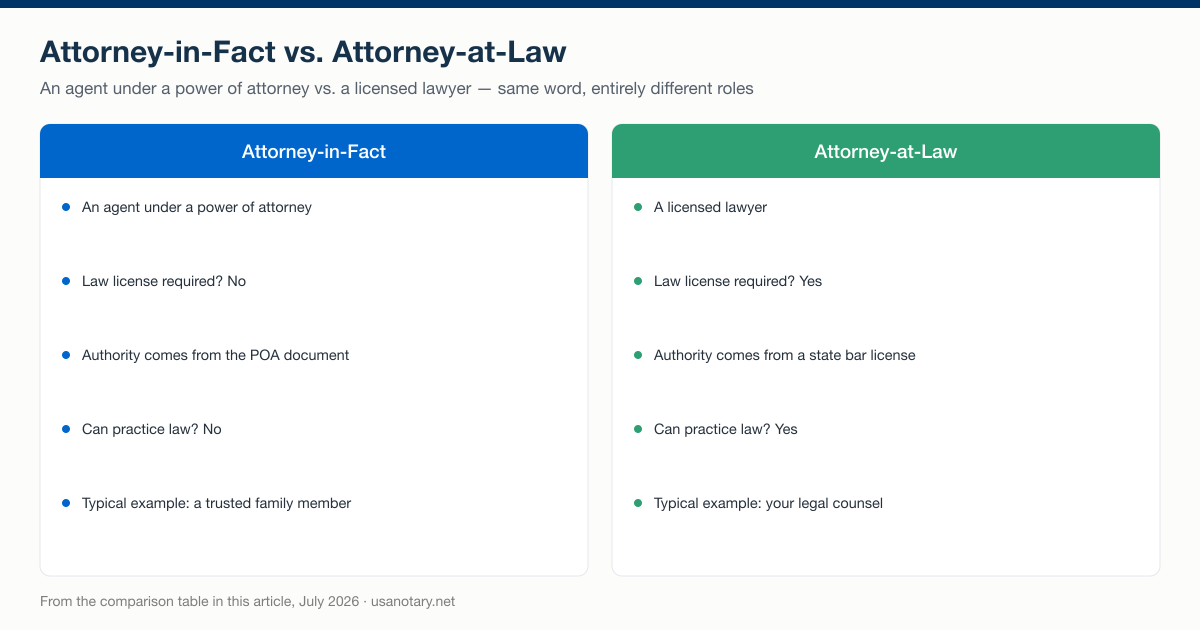
The attorney-in-fact vs. attorney-at-law comparison from this article’s table, July 2026.
| Attorney-in-fact | Attorney-at-law | |
|---|---|---|
| What they are | An agent under a power of attorney | A licensed lawyer |
| Law license required? | No | Yes |
| Authority comes from | The POA document | A state bar license |
| Can practice law? | No | Yes |
| Typical example | A trusted family member | Your legal counsel |
Who can be an attorney-in-fact?
Almost any competent adult can serve. Cornell LII describes the attorney-in-fact as “a pure fiduciary” who needs no “special qualifications” and is commonly “a friend or family member.” Because the attorney-in-fact holds the principal’s money and signs in their place, the choice is about trustworthiness, not credentials. If you’re stepping into the role for a parent, our guide to POA for an elderly parent walks through that setup.
A principal is not limited to one agent, either. Under Section 111 of the Uniform Power of Attorney Act (2006) — the Uniform Law Commission’s model law on which many states’ POA statutes are based — a principal “may designate two or more persons to act as coagents,” and unless the document says otherwise, “each coagent may exercise its authority independently.” The principal can also name one or more successor agents to step in if the first agent resigns, dies, becomes incapacitated, or declines to serve; by default a successor “has the same authority as that granted to the original agent” and may not act until every predecessor is out of the picture. Naming a successor is the cheap insurance most POA documents skip — without one, the document dies with the agent’s availability.
What powers does an attorney-in-fact have?
An attorney-in-fact can do only what the power of attorney document allows — no more. There are no inherent powers; the agent has exactly what the principal grants in writing. Cornell LII notes that “powers of attorney may be general, limited or special”:
- General power of attorney — broad authority to act in the principal’s place across financial and legal matters (banking, real estate, taxes, business operations).
- Limited (or special) power of attorney — authority confined to specific acts or a single transaction, such as selling one property or signing at one closing.
- Durable power of attorney — either of the above, drafted to survive the principal’s incapacity (covered in detail below).
Even a broad grant has statutory guardrails. Under UPOAA Section 201, certain high-risk powers exist only if the power of attorney expressly grants them — the agent cannot infer them from general language. That express-grant list includes the authority to:
- create, amend, revoke, or terminate a living (inter vivos) trust;
- make a gift of the principal’s property;
- create or change rights of survivorship or beneficiary designations;
- delegate authority granted under the power of attorney; and
- waive the principal’s right to survivor benefits under an annuity or retirement plan.
Section 201 adds a self-dealing brake: unless the document says otherwise, an agent who is not the principal’s ancestor, spouse, or descendant “may not exercise authority under a power of attorney to create in the agent … an interest in the principal’s property, whether by gift, right of survivorship, beneficiary designation, disclaimer, or otherwise.”
And some acts are off-limits no matter what the document says. According to SmartAsset, an attorney-in-fact “cannot create or amend your will, alter the terms of a trust or change the beneficiaries on accounts, such as life insurance policies or retirement plans” absent express authority — and their “authority ends at your death.” Because the document defines the boundaries, reading the POA itself is the only reliable way to know exactly what an attorney-in-fact may do.
Fiduciary duties: what the role legally demands
Fiduciary status carries real legal weight — an attorney-in-fact must act in the principal’s best interest, not their own. UPOAA Section 114 makes three duties mandatory for every agent who accepts the appointment, “notwithstanding provisions in the power of attorney”: act in accordance with the principal’s reasonable expectations (and otherwise in the principal’s best interest), act in good faith, and act only within the scope of authority the document grants. Unless the document provides otherwise, the agent must also act loyally for the principal’s benefit, avoid conflicts of interest, act “with the care, competence, and diligence ordinarily exercised by agents in similar circumstances,” keep a record of all receipts, disbursements, and transactions, and attempt to preserve the principal’s known estate plan.
Nolo’s WillMaker guidance translates the same duties into plain practice: the attorney-in-fact must “handle your property honestly and prudently,” “avoid conflicts of interest,” “keep your property completely separate from their own,” and “keep adequate records.”
The liability standard is more forgiving than many volunteer agents fear. Per WillMaker, a typical power of attorney makes the attorney-in-fact liable “only for losses resulting from intentional wrongdoing or extreme carelessness — not for a well-meaning decision that turns out badly.” Good-faith mistakes are not breaches; self-dealing and sloppy commingling are.
Durable vs. non-durable vs. springing
What happens if the principal loses capacity is the single most important drafting question. A durable power of attorney, per Cornell LII, “remains valid even in the event the principal is unable to make personal decisions due to incapacity” — but Cornell adds that in many states this durability “must be explicitly stated” in the document. A non-durable POA ends when the principal becomes incapacitated, which is exactly when many families discover they needed a durable one.
State default rules split on this point, which is why the document’s wording matters. The UPOAA flips the older default: under Section 104, “a power of attorney created under this [act] is durable unless it expressly provides that it is terminated by the incapacity of the principal.” In states that have not adopted that rule, the traditional default runs the other way — the POA must state its durability. Either way, an explicit durability clause removes the doubt.
A springing power of attorney only takes effect once a stated condition — usually the principal’s incapacity — occurs. Springing powers are the minority preference in practice: in the National Durable Power of Attorney Survey conducted for the Uniform Law Commission (2002), 61% of attorney respondents reported that their clients preferred immediately effective powers, versus 23% whose clients preferred springing powers. The catch with a springing POA is proving the trigger: someone must formally determine the principal is incapacitated before the agent can act, which can delay urgent decisions.
When does an attorney-in-fact’s authority end?
Termination rules are spelled out in UPOAA Section 110. A power of attorney terminates when any of the following occurs:
- the principal dies;
- the principal becomes incapacitated, if the power of attorney is not durable;
- the principal revokes the power of attorney;
- the document provides its own termination date or event;
- the purpose of the power of attorney is accomplished; or
- the agent dies, becomes incapacitated, or resigns, and no successor agent is named.
One edge case surprises people: under Section 110, an agent’s authority also terminates when “an action is filed for the dissolution or annulment of the agent’s marriage to the principal or their legal separation, unless the power of attorney otherwise provides.” In UPOAA states, filing for divorce cuts off a spouse-agent automatically — no revocation paperwork needed.
Section 110 also protects the other side of the transaction: termination “is not effective as to the agent or another person that, without actual knowledge of the termination, acts in good faith under the power of attorney.” A bank that honors a POA it has no reason to doubt is not penalized if the principal quietly revoked it the day before.
Attorney-in-fact vs. executor vs. trustee
These three roles are easy to confuse because each lets one person act for another, but they operate at different times and draw authority from different documents.
| Role | Source of authority | When they act | Acts for |
|---|---|---|---|
| Attorney-in-fact | Power of attorney | While the principal is alive | A living principal |
| Executor | A will (confirmed by a court) | After the principal dies | A deceased person’s estate |
| Trustee | A trust document | Whenever the trust is in effect | A trust and its beneficiaries |
The clean line: an attorney-in-fact’s power stops at death, and the executor’s begins there. SmartAsset states it directly: “Once you pass away, only the executor named in your will or appointed by the court has the legal right to manage your estate.” A trustee, meanwhile, manages only the assets placed inside a trust, under that trust’s terms. One person can hold all three roles for the same family — but each role needs its own document.
Do attorneys-in-fact get paid?
Compensation depends on the document and state law, but the modern default allows it. Under UPOAA Section 112, “unless the power of attorney otherwise provides, an agent is entitled to reimbursement of expenses reasonably incurred on behalf of the principal and to compensation that is reasonable under the circumstances.” In practice, family agents commonly serve without pay and claim only out-of-pocket expenses, while professional agents (accountants, fiduciary companies) charge fees. A principal who wants an unpaid arrangement should say so in the document — silence, in UPOAA states, means reasonable compensation is allowed.
How an attorney-in-fact signs a notarized document
When an attorney-in-fact signs for the principal, the attorney-in-fact is the person who appears before the notary — the principal does not need to be present. The NNA confirms: “An attorney in fact has authority to sign the principal’s name and have that signature notarized without the principal being present.”
The attorney-in-fact typically signs with two names — their own and the principal’s — in one of these formats offered by the NNA:
- “John Doe, attorney in fact for Mary Sue, principal,” or
- “Mary Sue, by John Doe, attorney in fact.”
The notary identifies only the attorney-in-fact who actually appears and signs — per the NNA, “John Doe would only need to show you his ID, but would not need to show you Mary Sue’s driver’s license as well.” In the journal entry, the attorney-in-fact signs their own name, and the notary notes that the signer acted as an attorney in fact and names the principal represented.
Two edge cases matter. First, the oath problem: if the document needs a jurat — where the signer swears the contents are true and signs in front of the notary — the attorney-in-fact “must swear or affirm before you in his or her own name only — not the principal’s,” because taking an oath in another person’s name “is generally not permitted.” An acknowledgment, where the signer acknowledges signing, does not raise that problem. Second, certificate wording: some states prescribe specific representative-capacity certificates — Florida, for example, provides statutory wording for an Acknowledgment by Representative (FS 117.05[13][c]) and a Short Form Acknowledgment by Attorney in Fact (FS 695.25[5]).
If the underlying power of attorney still needs its own notarization first, USA Notary’s power of attorney notarization service handles that step online before the attorney-in-fact ever signs anything downstream.
Do state rules for notarizing a POA differ?
Yes — POA notarization rules are set state by state, so the attorney-in-fact should confirm local requirements before signing. The NNA article and current state law show the range:
| State | Special rule |
|---|---|
| California | Notary must obtain the signer’s thumbprint in the journal for a document granting power of attorney; California notaries may also certify copies of a POA |
| Arizona | Under SB 1479 (2026), which amends A.R.S. § 41-254 effective September 12, 2026, the notary “shall require the party signing the document to place the party’s right thumbprint in the notary’s journal” for POA and real-property documents |
| Florida | If the signer of a POA is physically unable to write their name, FS 709.2202(2) permits the notary to sign on the disabled signer’s behalf, at the signer’s direction, before two disinterested witnesses |
| Hawaii, Idaho, Montana | Notary must verify the authority of someone signing as a representative, through personal knowledge or written proof |
| California, North Carolina | Notary is not required to verify a signer’s representative status |
In states with no verification requirement, the NNA still recommends asking the signer to state out loud that they have authority to sign on the principal’s behalf. The safe rule is to follow the statute in the state where the notarization happens.
Notarizing a power of attorney online
A power of attorney typically must be notarized — and notarization is worth having even where it is optional, because under UPOAA Section 105 “a signature on a power of attorney is presumed to be genuine if the principal acknowledges the signature before a notary public.” That statutory presumption of genuineness is why banks and title companies accept acknowledged POAs far more readily than unacknowledged ones.
An attorney-in-fact — or a principal setting one up — can complete that step without leaving home. On USA Notary’s online notary service, the signer appears on live video with a commissioned notary, and each online notarization costs $25 per document. Remote online notarization is legally valid in all 50 states as a consumer service, though notary commissioning law is per-state and a few states have not yet authorized their own notaries to perform it.
Our walkthrough of notarizing a power of attorney covers what to have ready, and if you’re still deciding on the document itself, start with what a power of attorney is and which type fits. When you’re set, you can notarize a POA online with the signer appearing on camera in minutes.
This is general information, not legal advice. Power-of-attorney statutes and notarization requirements vary by state — for example, California and (from September 12, 2026, under SB 1479) Arizona require the signer’s thumbprint in the notary’s journal for POA documents. For your specific situation, consult a licensed attorney and follow your state’s rules.