
What is a power of attorney?
A power of attorney (POA) is a legal document that authorizes one person to act on behalf of another. The Consumer Financial Protection Bureau defines it plainly as “a legal document that allows someone else to act on your behalf,” and the Cornell Legal Information Institute describes the structure underneath: “a power of attorney is an agreement between two parties: a principal and an attorney in fact.” People use a POA to let someone handle their finances, sign legal documents, or make medical decisions when they can’t be present or able to act themselves.
Estate-planning professionals rank the document unusually high. Bernard Krooks, a Fellow of the American College of Trust and Estate Counsel (ACTEC), calls it “the single most important estate document that you can sign,” noting that roughly two-thirds of people are likely to become incapacitated before they die — which is exactly the moment a well-drafted POA takes over.
A power of attorney is also one of the most common documents a notary sees, precisely because so much turns on it. A bank or title company needs to trust that the person acting under a POA truly holds that authority, which is why a power of attorney almost always has to be notarized before an institution will honor it.
Principal, agent, and attorney-in-fact: who’s who
A power of attorney involves two roles:
- The principal — the person who grants the authority.
- The attorney-in-fact (also called the agent) — the person who receives it and acts for the principal.
Despite the name, the attorney-in-fact is not a lawyer. Cornell LII is explicit: “the attorney in fact need not be an attorney at law (a lawyer).” It’s typically a spouse, adult child, or trusted friend. For how an attorney-in-fact signs and is identified during a notarization, see what an attorney-in-fact does.
The agent’s obligation is legal, not just moral. As Cornell LII puts it, “attorneys in fact are fiduciaries of their principals” — the agent must act in the principal’s best interest, not their own. That fiduciary duty is why the choice of agent matters as much as the document itself.
One planning detail many first-time principals miss: name a successor agent. Under Section 110 of the Uniform Power of Attorney Act, a power of attorney terminates if your agent dies, becomes incapacitated, or resigns “and the power of attorney does not provide for another agent to act.” A named backup keeps the document alive if your first choice can’t serve.
Types of power of attorney
Not every power of attorney grants the same authority, and the document itself sets the limits. Cornell LII notes powers of attorney “may be general, limited or special,” and those categories combine with the durable/non-durable distinction and with subject-specific forms like medical and financial POAs.
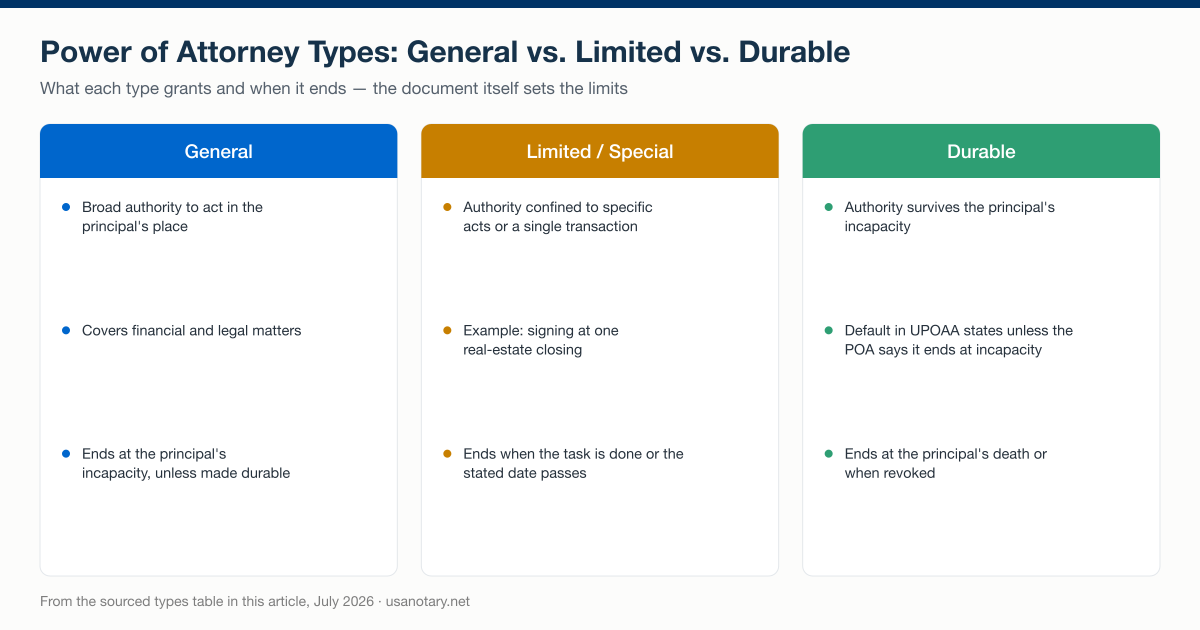
The three core POA categories — general, limited/special, and durable — from the sourced types table in this guide, July 2026.
| Type | What it grants | When it ends |
|---|---|---|
| General | Broad authority to act in the principal’s place across financial and legal matters | At the principal’s incapacity, unless made durable |
| Limited / special | Authority confined to specific acts or a single transaction (e.g., one closing) | When the task is done or the stated date passes |
| Durable | Authority that survives the principal’s incapacity | At the principal’s death or when revoked |
| Non-durable | Authority that operates only while the principal has capacity | When the principal loses capacity |
| Springing | Authority that activates only when a defined trigger occurs | Per its terms; ends at death or revocation |
| Medical | Authority over health-care decisions (also called a health-care proxy) | Per its terms; ends at death or revocation |
| Financial | Authority over money matters — banking, bills, taxes, property | Per its terms; ends at death or revocation |
The durable/non-durable distinction is the one families most often overlook. A durable power of attorney, per Cornell LII, “remains valid even in the event the principal is unable to make personal decisions due to incapacity” — which is exactly when many people need it most. Whether durability is automatic depends on your state’s statute. In states that enacted the Uniform Power of Attorney Act (UPOAA), approved by the Uniform Law Commission in 2006, the default flipped: under Section 104, a power of attorney “is durable unless it expressly provides that it is terminated by the incapacity of the principal.” In states that follow the older approach Cornell describes, the durability language “must be explicitly stated” or the POA ends the moment the principal loses capacity. Because Cornell LII cautions that “specific power of attorney laws vary by state,” confirm which rule your state follows before relying on a template.
A springing power of attorney is the mirror image of an immediately effective one. As the National Council on Aging describes it, this type “springs into action under certain conditions, such as when you become mentally incapacitated.” You define the trigger — commonly a licensed physician’s written declaration of incapacity, as CaringInfo notes — and that documentation requirement can delay the agent’s ability to act in urgent situations. That trade-off is why many planners prefer a durable POA paired with a trusted agent over a springing one.
Which type fits your situation?
| Your situation | Type that usually fits |
|---|---|
| You want someone to manage everything if you’re ever incapacitated | Durable general POA |
| You need someone to sign at one real-estate closing you can’t attend | Limited / special POA |
| You want authority to transfer only if a doctor declares you incapacitated | Springing POA |
| You want someone to make medical decisions if you can’t communicate | Medical POA (health-care proxy) |
| You want help with bills and banking, nothing else | Financial POA with listed powers |
This table is a starting point, not advice — the POA types your state recognizes and the exact execution requirements vary by state, so confirm the rules where the document will be used.
What can an agent do under a power of attorney?
The powers a POA grants are whatever the principal writes into it. In practice, agents commonly handle:
- Financial matters — paying bills, managing bank accounts and investments, filing taxes, and buying or selling property.
- Legal matters — signing contracts and dealing with insurers or government agencies.
- Medical decisions — but only under a medical (health-care) POA, and only when the principal can’t communicate their own wishes.
Having power of attorney does not hand over unlimited control. A principal can grant access to checking and savings accounts, for example, while withholding the authority to sell a home — CaringInfo notes a financial POA can designate specific tasks in exactly this way. The document is the boundary, and the agent has no authority beyond it. And because the agent is a fiduciary, every act inside that boundary still has to serve the principal’s interest.
Does a power of attorney need to be notarized?
In most cases, yes. A power of attorney is generally notarized — most often with an acknowledgment, in which the signer acknowledges signing before the notary — and some states also require witnesses. The requirement is set by state law and by the institution that will accept the document, such as a bank or title company.
The Uniform Power of Attorney Act shows why notarization matters even where it isn’t strictly mandatory. Under UPOAA Section 105, “a signature on a power of attorney is presumed to be genuine if the principal acknowledges the signature before a notary public or other individual authorized by law to take acknowledgments.” The act’s official comment goes further: while notarization is not required to create a valid POA under the uniform act, the act “strongly encourages the practice,” because the UPOAA’s acceptance protections — the provisions that discourage banks and other institutions from refusing a POA — apply only to acknowledged documents. In plain terms: an unnotarized POA may be technically valid in some states, but the people you hand it to may lawfully hesitate to accept it.
Because a POA hands real authority to another person, receiving parties treat notarization as the safeguard that the principal actually signed it. See our step-by-step on how to notarize a power of attorney for what the appointment involves, what ID to bring, and how the acknowledgment certificate is completed.
Can you notarize a power of attorney online?
Where your state authorizes it, a power of attorney can be notarized online by remote online notarization (RON): the principal appears on live video, proves their identity, and acknowledges signing — no in-person meeting required. The legal foundation is well established: under the federal ESIGN Act (15 U.S.C. § 7001), a signature or record “may not be denied legal effect, validity, or enforceability solely because it is in electronic form,” and most states’ RON statutes are modeled on the Revised Uniform Law on Notarial Acts (RULONA). RON is legally valid in all 50 states for the consumer service, though notary commissioning law is set state by state and not every state yet authorizes its own notaries to perform RON.
USA Notary’s online POA notarization service handles power-of-attorney signings by live video, and remote online notarization on USA Notary costs $25 per document in all 50 states. Confirm your recipient — the bank, title company, or agency — accepts an electronically notarized POA before you book, since some institutions still require their own form.
How do you set up a power of attorney?
The National Council on Aging’s guidance lays out a practical sequence, and one prerequisite frames all of it: you must create a POA while you still have mental capacity — ACTEC’s planning guidance stresses that the principal must be able to understand the document they’re signing. Waiting until after a diagnosis or crisis often means the POA option is gone and the family faces court instead. If you’re arranging this for a parent, our walkthrough on getting POA for an aging parent covers that situation step by step.
- Decide which type (or types) you need. Many people execute both a financial POA and a medical POA, since they cover different decisions and may name different agents.
- Choose your agent. NCOA’s criteria: someone completely trustworthy, responsible and organized, familiar with your wishes, and able to communicate clearly with professionals.
- Get the right form. Many states publish standardized statutory forms; an attorney can also draft a customized document.
- Spell out the authority. State exactly what the agent may and may not do — the document is the boundary.
- Sign it with the formalities your state requires. Per NCOA, most states require signing before a notary public and witnesses. This is the step you can complete online by live video where your state’s rules and your recipient allow it.
- Distribute copies. Give copies to your agent, attorney, health-care providers, and family who should know the POA exists.
- Review it periodically. Revoke and replace the document if your agent, wishes, or state of residence changes.
When does a power of attorney end?
Termination rules are one of the most-searched and least-understood parts of a POA, and the Uniform Power of Attorney Act codifies them precisely. Under UPOAA Section 110, a power of attorney terminates when:
- the principal dies — no POA survives the principal’s death, not even a durable one;
- the principal becomes incapacitated, if the POA is not durable;
- the principal revokes the power of attorney;
- the document’s own terms say it terminates;
- the purpose is accomplished (the usual endpoint for a limited POA); or
- the agent can no longer serve — dies, becomes incapacitated, or resigns — and no successor agent is named.
Two lesser-known UPOAA rules are worth flagging. First, the divorce rule: an agent-spouse’s authority terminates when an action is filed for dissolution or annulment of the marriage — not when the divorce is final — unless the POA says otherwise. Second, the no-expiration rule: unless the document provides otherwise, an agent’s authority remains exercisable “notwithstanding a lapse of time since the execution of the power of attorney” — an old POA is not automatically a dead POA. States that haven’t adopted the UPOAA may treat these events differently, so check the statute where the document will be used.
After the principal’s death, NCOA notes, authority over the estate passes to the executor named in the will — the former agent has no further power.
What are the risks of a power of attorney?
Because a POA transfers real authority, it carries real risk. The Consumer Financial Protection Bureau puts it bluntly: “A POA involves some risk. It gives someone else a great deal of authority over your finances without regular oversight.” Abuse can look like an agent spending the principal’s money on themselves, making unauthorized gifts, or changing beneficiaries.
The CFPB’s guidance recommends a few safeguards: appoint only someone you really trust and make sure they know your wishes, tell other friends, family members, and financial advisers about the POA so they can look out for you, and require the agent to report their transactions to a second person. A POA is also revocable — a principal with capacity can cancel or change it at any time, and the CFPB reminds principals of exactly that: if your agent proves unsuitable, “you can change them.”
Power of attorney vs. guardianship
A durable power of attorney is, at bottom, a guardianship-avoidance tool. If you become incapacitated with no POA in place, no one automatically gains authority to manage your affairs — a family member must typically petition a court for guardianship or conservatorship. ACTEC Fellow Bernard Krooks warns that in those proceedings “somebody’s going to have to spend thousands of dollars on lawyers’ fees,” on top of the delay and loss of privacy court supervision brings.
The Uniform Law Commission built this logic into the UPOAA itself: the act’s prefatory note explains that the durable-by-default rule “reflects the view that most principals prefer their powers of attorney to be durable as a hedge against the need for guardianship.” And if a court does later appoint a fiduciary, UPOAA Section 108 defers to the principal’s original choice — the agent’s authority continues unless the court limits, suspends, or terminates it. Executing a durable POA while healthy is the inexpensive path; guardianship is the expensive fallback.
Medical power of attorney vs. living will
A medical power of attorney and a living will solve different halves of the same problem. Per CaringInfo, a health-care power of attorney appoints an agent “to speak with doctors and make medical decisions on behalf of the principal” — a person who decides. A living will, by contrast, is a written statement of your own treatment wishes — a document that speaks. The two are often bundled together in a state’s advance directive, and CaringInfo notes the health-care POA is also what lets your agent access medical records under HIPAA. For families completing these documents at a hospital bedside or in a senior-care facility, see our page on online notarization in care settings. If you’re preparing the paired document, see our guide to notarizing a living will for how states execute advance directives.
This is general information, not legal advice. Power-of-attorney requirements — including notarization, witnesses, and the powers a POA can grant — vary by state, and some states require specific statutory forms. For your situation, consult a licensed attorney and follow your state’s rules.