
A living will is not a last will
A living will — the plainer legal name is an advance healthcare directive — states your wishes for medical treatment if you become unable to communicate them. A last will and testament directs how your property is handled after death. The National Notary Association draws the line sharply in its FAQ on the two documents: a living will operates during your life and, unlike a last will, “may be notarized like any other document” — there is usually no special statutory notarization procedure attached to it.
That distinction is not academic — it changes the signing rules. The formalities that govern a last will (probate-code witnessing, self-proving affidavits) do not automatically apply to a living will, and the reverse is also true. If you’re actually asking about the estate document, start with whether a will itself needs notarizing — in most states it does not, because two witnesses do the work instead — and then see our separate guide to notarizing a last will and testament online. This page is about the healthcare directive.
A living will is one piece of an advance directive
“Advance directive” is the umbrella term, and it covers more than the living will. The National Institute on Aging defines advance directives as “legal documents that provide instructions for medical care” that “only go into effect if you cannot communicate your own wishes” — and states that “the two most common advance directives for health care are the living will and the durable power of attorney for health care.”
So when a hospital or care facility asks whether you have an advance directive, it usually means two documents:
- Living will — your written treatment instructions. The NIA describes it as a document that “tells doctors how you want to be treated if you cannot make your own decisions about emergency treatment.”
- Durable power of attorney for health care — the document that “names your health care proxy, a person who can make health care decisions for you if you are unable to communicate these yourself” (NIA). The general mechanics of getting a power of attorney notarized are covered in a separate guide.
Most American adults have neither. A 2017 Health Affairs review of 150 studies covering 795,909 people found that only 36.7 percent of U.S. adults had completed any type of advance directive, including 29.3 percent with living wills — and completion barely differed between people with chronic illness (38.2 percent) and healthy adults (32.7 percent). In other words, roughly two out of three adults have no directive at all, so getting one signed correctly the first time puts you well ahead.
The two halves often travel together — Arizona, for instance, requires a living will that is not part of a health care power of attorney to be verified “in the same manner” as the power of attorney itself. And because a healthcare proxy must be named while the signer still has capacity, families facing a dementia diagnosis should act early rather than late — see our guide to dementia and signing capacity. Capacity questions are general information here, not legal advice — consult an elder-law attorney.
Does a living will need to be notarized?
There is no single national answer, because advance-directive execution is set state by state. The NNA notes that a living will “may be notarized like any other document,” and — unlike a last will — usually has no special statutory notarization procedure of its own. But whether notarization is required to make the directive valid is a matter of your state’s advance-directive statute, and states fall into different camps:
| Requirement pattern | What it means | Where it shows up |
|---|---|---|
| Witnesses only | One or two witnesses must sign; no notary needed | Washington, Florida, Illinois |
| Notarization only | A notary must verify identity and seal the signature | Some states |
| Either accepted | Notarization or witnesses satisfies the state | Arizona, California, Texas |
| Both required | The directive must be witnessed and notarized (or proved before a clerk) | North Carolina |
| Witness restrictions | Certain people are barred from witnessing (see below) | Layered on top of the above |
Because your state may sit in any of these camps, the only reliable step is to check your state’s advance-directive requirements before signing.
Does an advance directive need to be notarized?
State law decides — and the most common statutory pattern we verified makes notarization an alternative to witnesses, not an extra hurdle. Six states, checked against their own statutes or official guidance:
| State | Advance-directive signing requirement | Source |
|---|---|---|
| Arizona | Notarized or witnessed in writing by at least one adult; a stand-alone living will is verified “in the same manner” | A.R.S. § 36-3221, § 36-3261 |
| California | “Either acknowledged before a notary public or signed by at least two witnesses” | Prob. Code § 4673 |
| Texas | Signed in the presence of two qualified witnesses, or “in lieu of signing in the presence of witnesses,” acknowledged before a notary public | Health & Safety Code § 166.032 |
| Washington | Two witnesses who “cannot be related to the individual or stand to inherit anything from him or her”; notarization not listed | WA Attorney General |
| Florida | “Signed by the principal in the presence of two subscribing witnesses, one of whom is neither a spouse nor a blood relative”; no notarization requirement in the statute | Fla. Stat. § 765.302 |
| North Carolina | Signed in the presence of two qualified witnesses and proved before a clerk or assistant clerk of superior court or a notary public — both, not either | G.S. § 90-321 |
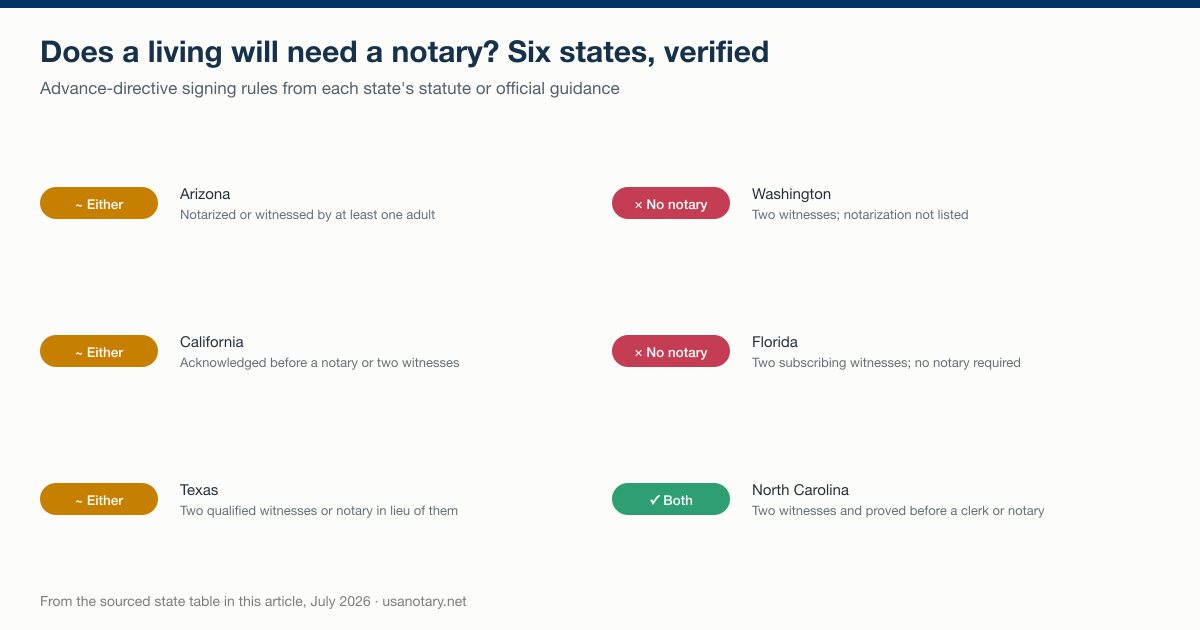
Whether a living will needs a notary in the six states verified in this article’s state table, July 2026.
Notice what that pattern means in practice: in Arizona, California, and Texas, a notary can replace the witness hunt entirely — useful when your state restricts who may witness and everyone within reach is a relative or an heir. In witness-only states like Washington and Florida, a notary can’t substitute, so line up eligible witnesses instead. North Carolina sits at the strict end: witnesses alone are not enough, and neither is a notary alone. For any state not in this table, the fastest check is your state’s official advance-directive form: the signing block at the end spells out exactly which combination your state accepts.
Who can’t witness — or notarize — your living will
Witness disqualification rules are the trap most people miss, because the people most likely to be nearby when you sign — your spouse, your named agent, your doctor, a nurse at your facility — are exactly the people many statutes exclude. Compare the verified rules:
| State | Who is barred from witnessing |
|---|---|
| California | The “patient’s health care provider or an employee of the patient’s health care provider,” operators or employees of community care or residential care facilities for the elderly, and your named agent; at least one witness must be unrelated by blood, marriage, or adoption and not entitled to inherit — Prob. Code § 4674 |
| Arizona | “A person designated to make medical decisions on the principal’s behalf” and anyone “directly involved with the provision of health care” at signing; a sole witness also can’t be a relative or heir — A.R.S. § 36-3221 |
| Texas | Two witnesses must qualify under § 166.003, and at least one must meet the stricter § 166.003(2) criteria — H&S Code § 166.032 |
| North Carolina | Anyone related within the third degree to you or your spouse, anyone who would inherit or has a claim against your estate, your attending physician, and paid employees of the physician, health facility, or nursing home — G.S. § 90-321 |
| Florida | At least one of the two witnesses must be “neither a spouse nor a blood relative” — Fla. Stat. § 765.302 |
| Washington | Witnesses “cannot be related to the individual or stand to inherit anything from him or her” — WA Attorney General |
Two consequences follow. First, if you’ve named a family member as your healthcare agent — the way many people also name a relative in a medical power of attorney — that person often cannot double as your witness, and in Arizona cannot serve as the notary either. Second, the notary and witness rules can diverge in the same statute: North Carolina bars paid facility employees from witnessing, yet expressly permits the notary who takes the acknowledgment to be a paid employee of the attending physician or facility. Read both sets of rules, not just one.
What real state rules look like
Two verified examples show how far apart states can be — and why you can’t copy a neighbor’s process:
- Washington requires two witnesses and adds a restriction: per the Washington State Attorney General, “the witnesses present cannot be related to the individual or stand to inherit anything from him or her.” The signer must also “be at least 18 years of age and be of sound mind.” Notarization is not listed as a requirement.
- Illinois also requires two adult witnesses and, per Illinois Legal Aid Online, does not require a living will to be notarized — though that same guidance notes that “it is more likely that another state will follow your Living Will if you sign it in front of two witnesses and a notary.”
Even where notarization isn’t mandatory, many people add it voluntarily. A notarized directive is more likely to be honored if you’re traveling or move to another state — which is exactly why Illinois Legal Aid suggests notarizing even though Illinois doesn’t require it. Voluntary notarization costs little and can’t invalidate a directive that already satisfies the witness rules; skipping a required notarization, as in North Carolina, invalidates the document entirely.
The skilled-nursing edge case
California adds a witness layer that almost no general guide mentions: a patient in a skilled nursing facility must have a patient advocate or ombudsman sign the advance directive as a witness — “either as one of two witnesses or in addition to notarization” (Prob. Code § 4675). The statute exists because custodial-care patients may face pressure the law wants a neutral advocate to screen for — so even a properly notarized California directive is incomplete for an SNF patient without that ombudsman signature.
The same theme runs through other states’ rules: North Carolina bars paid employees of the nursing home or adult care home where you reside from witnessing, and Arizona excludes anyone directly involved in providing your health care. If the signer can’t leave a facility at all, the logistics get harder still — our guide to notarization for homebound or hospitalized signers walks through the mobile and remote options for exactly that situation.
Can you notarize a living will online?
Two separate state rules have to line up before a living will can be signed and notarized over live video:
- Your state must authorize remote online notarization (RON) in the first place. RON is legally valid in all 50 states as a consumer service, but the notary commissioning law is per-state — some states have not yet authorized their own notaries to perform RON. Most state RON statutes are modeled on the Revised Uniform Law on Notarial Acts (RULONA).
- Your state’s advance-directive law must permit the document to be executed remotely — including any witnesses. Where witnesses must be physically present in the room, a remote notarization alone won’t complete the directive.
Here’s the information-gain point most guides skip. The federal ESIGN Act says a signature or record “may not be denied legal effect, validity, or enforceability solely because it is in electronic form.” ESIGN carves out documents governed by “the creation and execution of wills, codicils, or testamentary trusts” — but a living will is an advance healthcare directive, not one of those testamentary documents, so that specific carve-out doesn’t name it. That does not mean you can sign one online anywhere. It means the barrier, when there is one, comes from your state’s advance-directive formalities (especially in-person witnessing), not from ESIGN itself.
One more thing to keep straight: there is no enacted federal law forcing every state to accept RON. The SECURE Notarization Act has been introduced in Congress but not enacted, so the patchwork of state rules still governs. When you notarize a document online over live video, the notary appears on live video, confirms your identity, watches you sign, and applies an electronic notarial certificate — but a provider provides notary services, not legal advice, so the witnessing question is still yours to confirm.
Match the online option to your state’s camp. In an either-accepted state like Arizona, California, or Texas, an online notarization can satisfy the execution requirement by itself, because the notary substitutes for witnesses. In a witnesses-only state like Washington or Florida, an online notarization adds portability but cannot replace the two witnesses the statute demands. And in a both-required state like North Carolina, you need the qualified witnesses and the notarial act — so plan the session around gathering everyone the statute requires.
Advance directives in senior-care settings
Hospitals, assisted-living communities, and skilled-nursing facilities handle advance directives at admission — and the signing logistics are hardest exactly when the document matters most: a resident who can’t travel, family in another state, a directive that needs to be executed this week. Remote online notarization fits that gap. Facility staff initiate the session, the resident signs from their room, and out-of-state family can join the same video call as multi-signer participants. The platform verifies the signer’s identity, the notary watches the resident sign on live video, and the session produces a tamper-evident notarized PDF with a digital audit trail the facility can file with the chart. Sessions run 15–30 minutes, available 24/7, at $25 per document — see how healthcare and senior-care organizations run staff-initiated notarizations.
Two cautions for this setting. First, the witness restrictions above still apply where witnesses are required — states that bar interested witnesses or facility employees may exclude the very people standing at the bedside, and California layers on the § 4675 ombudsman requirement for skilled-nursing patients. Second, a signer must still have the capacity to understand what they’re signing; a notary can decline if that’s in doubt. This is general information, not legal advice — if capacity is in question, consult an elder-law attorney before scheduling any signing.
How much does it cost to notarize a living will?
Online notarization on USA Notary costs $25 per document — the signer appears on live video with a commissioned notary, with no travel and no appointment window, which matters when a directive has to be executed before a scheduled procedure. In-person notary fees vary by state and are set by each state’s maximum-fee schedule, and a mobile notary who travels to a home or facility typically charges travel fees on top. The living-will form itself is often free: many states publish a statutory form, and the signing block on that official form doubles as your checklist of exactly which witnesses and notarial acts your state requires. Whichever route you choose, budget for the witness problem too — in witnesses-only and both-required states, finding two people who clear the disqualification rules above is usually the harder half of the errand.
How to sign a living will correctly
- Confirm your state’s living-will rules — notarization, witnesses, either, or both — plus any witness restrictions.
- Line up eligible witnesses if your state requires them, avoiding anyone related to you, named in the document, or who stands to inherit — and in facility settings, avoiding your care providers and their employees where the statute bars them.
- Check whether remote execution is allowed if you want to do it online, since RON authorization and advance-directive rules are separate questions.
- Sign correctly — before a notary and/or witnesses, exactly as your state requires. When a notary is involved, expect to appear before them (in person or on live video for RON) and be positively identified before you sign.
- Distribute copies to your healthcare agent, your doctor or hospital, and close family. A living will only helps if the people making decisions can find it.
If your estate plan also involves moving assets into a trust, note that a living trust has its own notarization and funding steps that are separate from an advance directive — don’t fold them into one signing session assuming the rules match.
This is general information, not legal or medical advice. Advance-directive formalities are exactly the kind of detail where a small variance can invalidate the document, so confirm your state’s requirements — ideally with an attorney — before you rely on any signing method, in person or online.