
Can you notarize a will online?
In most states, online notarization does not, by itself, make a will valid. Notarizing a document and validly executing a will are two different acts, and a last will and testament is governed by a stricter set of rules than almost any other document you will ever sign.
Getting this wrong can void a will — the one document you cannot re-sign after the fact. So if you take one thing from this page: do not rely on a remote online notarization to execute a will without confirming your state’s law, ideally with an estate attorney. Online notary platforms will happily accept a will upload, connect you to a commissioned notary on live video, and apply a digital seal. None of that answers the only question that matters in probate: was the will executed the way your state’s probate law requires?
Below is exactly why the two questions diverge, where the narrow e-will exceptions are, what the major online notary services leave unsaid, and what online notarization does legitimately cover in an estate plan.
Notarizing a will vs. validly executing one
The confusion starts with a hidden assumption — that “getting it notarized” is what makes a legal document official. For most paperwork that is roughly true. For a will it is not. A will becomes legally valid when it is executed according to your state’s probate law, and in most states that means signing it before witnesses, not before a notary. In fact, most wills need witnesses rather than notarization at all — the notary enters the picture, if ever, for a supporting affidavit.
Here is how the four things people conflate actually differ:
| Act | What it does | Notary’s role |
|---|---|---|
| Signing the will | Records your intent in writing | None required in most states |
| Witnessing the will | Makes the will valid under state probate law (often two witnesses, physically present) | A notary does not substitute for witnesses |
| Self-proving affidavit | Sworn statement letting probate skip locating witnesses later | Notarized as a jurat — witnesses swear the contents are true and sign in front of the notary |
| Fully electronic will | The entire will created, signed, witnessed, and notarized in electronic form | Allowed only in the minority of states that authorize e-wills |
Estate planning attorney Harry Margolis, interviewed by TheStreet in January 2026, put the practical problem plainly: “One of the challenges with wills is that they do not just need notarization… They also require witnesses. Coordinating all of that online can be complicated.” His broader point applies everywhere: whether you can notarize a will online “depends heavily on your state, and in many cases, the answer is still no.”
If your document instead turns out to be an advance directive rather than a last will, the rules change again; see whether a living will needs notarizing or witnessing, which many people mix up with a last will.
Why wills follow stricter rules than other documents
A last will only takes effect after death, when the signer is no longer around to confirm what they intended or to prove they signed freely. To guard against fraud, coercion, and forgery, state probate law imposes execution formalities that most documents never require — chiefly, that the will be signed in the presence of witnesses who are physically present.
Federal law underscores how special wills are. The ESIGN Act made electronic signatures valid for most records in 2000 — under 15 U.S.C. § 7001, a signature or record “may not be denied legal effect, validity, or enforceability solely because it is in electronic form.” But Congress carved wills out by name. Under 15 U.S.C. § 7003, the electronic-signature rules do not apply to “a statute, regulation, or other rule of law governing the creation and execution of wills, codicils, or testamentary trusts.” Wills sit in the same short exception list as adoption and divorce records, court orders, foreclosure and eviction notices, and hazardous-materials documentation — the categories Congress decided were too consequential to sweep into the general e-signature rule.
The Uniform Electronic Transactions Act (UETA), the state-level counterpart adopted in most states, contains a parallel exclusion for wills. In other words: the two laws that make almost everything else signable online deliberately leave wills out.
That is the gap a remote online notarization cannot close on its own. A notarial act confirms who signed; it does not supply the witnesses the will’s validity depends on. Understanding what “notarized” actually means — identity verification and a sealed certificate, not a validity guarantee — is what keeps people from over-trusting a notary stamp on a will.
Does a will need to be notarized at all?
Usually not — and this surprises most people. Witnessing, not notarization, is what makes a will valid in nearly every state. FreeWill’s estate-planning guidance states that “as of August 2025, Louisiana is the only state that requires your will to be notarized.” Everywhere else, the notary is optional.
Where a notary does commonly appear in the will process is the self-proving affidavit: a sworn statement, signed by your witnesses before a notary, confirming they watched you sign. Attaching one lets the probate court accept the will without tracking down your witnesses years later — FreeWill notes it can “speed up probate court proceedings because the court doesn’t need to contact your witnesses.” The affidavit is notarized as a jurat, meaning the witnesses swear the contents are true and sign in front of the notary. Two jurisdictions are exceptions: per FreeWill, Ohio and Washington, D.C. do not accept self-proving affidavits.
So the realistic map of “notarization and your will” looks like this:
- The will itself — witnesses required in most states; notary not required (Louisiana being the reported exception).
- The self-proving affidavit — optional in most states, notarized as a jurat, and the usual reason a notary is in the room at a will signing.
- The rest of the estate plan — powers of attorney, trusts, and other documents that genuinely are notarized, and often can be notarized online.
Where a fully electronic (remote) will may be allowed
A minority of states have changed the default. To close the will exception without abandoning its safeguards, the Uniform Law Commission approved the Electronic Wills Act in 2019. Under the uniform act, an electronic will is “a will for all purposes of the law of this state” — it can be simultaneously executed, attested, and made self-proving, and a state adopting it will recognize an electronic will validly created under another state’s law. States choose whether witnesses must be physically present or may appear in “electronic presence.”
Adoption is state by state and still moving. Trust & Will’s legislative tracker counted 14 states plus D.C. and the U.S. Virgin Islands with e-will laws as of mid-2023 — naming Arizona, Florida, Illinois, Indiana, Maryland, Nevada, Virginia, Idaho, Minnesota, Colorado, North Dakota, Washington, and Utah — with some states following the uniform act and others writing their own statutes.
The freshest addition is Kentucky. In 2026, Governor Andy Beshear signed Senate Bill 50, which codifies the Electronic Wills Act effective July 2026. Even there, the rules stay strict: as Dinsmore & Shohl’s analysis explains, “two witnesses must contemporaneously witness the signing, even if on a video call,” and “these witnesses must be located in the Commonwealth and remain in the Commonwealth for a reasonable period of time.” Kentucky’s act also extends electronic execution to nontestamentary documents such as powers of attorney, trust agreements, and advance directives.
| Detail | |
|---|---|
| States with e-will laws (per Trust & Will, mid-2023) | AZ, FL, IL, IN, MD, NV, VA, ID, MN, CO, ND, WA, UT + D.C. and U.S.V.I. |
| Newest adopter confirmed | Kentucky — S.B. 50 signed 2026, effective July 2026 |
| What they allow | A fully electronic will, under that state’s specific execution rules |
| Everywhere else | Witnesses generally must be physically present; a remote will is not valid |
Two cautions before you rely on any of this. First, e-will statutes are not interchangeable — witnessing rules, notarization requirements, custody, and probate treatment differ by state, and Kentucky’s in-state witness rule shows how granular the conditions get. Second, a RON platform’s remote witnesses only satisfy the requirement if your state’s e-will law permits remote witnessing for wills specifically. Confirm both points with an estate attorney before executing electronically.
What online notary platforms don’t tell you
Search for “notarize a will online” and the top results are RON platforms offering to notarize your will in minutes, 24/7. The service they describe is real — but read what they are actually promising. They are promising a notarial act: a commissioned notary verifies your identity while you appear on live video, then applies an electronic seal. They are not promising — and cannot promise — that this act executes your will under your state’s probate law. Those are the platform’s terms of service doing quiet work: the platform provides notary services; it does not provide legal advice about whether your will is valid.
The legal architecture behind those platforms is worth understanding:
- State RON laws. According to the National Association of Secretaries of State, “currently, 47 states and the District of Columbia have a law that allows for remote e-notarization.” Most of those statutes are modeled on the Revised Uniform Law on Notarial Acts (RULONA).
- Nationwide validity for signers. Because a notarization performed by a properly commissioned notary is recognized across state lines, online notarization is legally valid in all 50 states as a consumer service — even though notary commissioning law remains per-state and a few states do not yet commission their own online notaries.
- No federal RON statute yet. The federal SECURE Notarization Act (H.R.1777) would set a nationwide baseline, but it has only been introduced in Congress — it is not law. Anyone implying federal law already authorizes online notarization of every document type is ahead of the statute books.
- The will carve-out survives all of it. RON laws govern how a notarization happens. They do not amend the probate code’s rules for how a will is executed. As the National Notary Association describes RON, the signer personally appears before the notary using audio-visual technology instead of being physically present — a definition about appearance, not about will validity.
That last distinction is the whole answer to this article’s question. A platform can lawfully notarize a signature on a document titled “Last Will and Testament” in a RON state. Whether that document is a valid will is decided later, in probate, under execution rules the notarization never touched.
How to check your own state’s rules
State-specific searches — “notarize a will online in California,” “notarize a will online in Texas” — all resolve through the same three questions, and you can answer them without guessing:
- What does your state’s probate code require to execute a will? The execution formalities (number of witnesses, presence requirements, who may serve) live in the probate or estates code, not in the notary statute. Your state legislature’s website publishes the current text, and your state bar’s public resources usually summarize it in plain language.
- Has your state enacted an e-will law? The Uniform Law Commission’s Electronic Wills Act page tracks enactments of the uniform act; states with their own e-will statutes (Florida and Nevada among the earliest, per Trust & Will’s tracker) publish them in their probate codes. If you cannot find an e-will statute, assume your state does not have one.
- If yes, does it permit remote witnessing and notarization for wills specifically? Kentucky’s 2026 act, for example, allows video witnessing but requires the witnesses to be located in-state — a condition an out-of-state RON platform’s staff witnesses would fail. Every e-will statute carries conditions like this; the statute’s text, not a platform’s marketing page, is the authority.
A related question TheStreet’s coverage raises is DIY versus attorney-prepared wills. An online template plus an online notarization feels like a complete workflow, which is exactly the trap: the template supplies the words, the notary supplies an identity check, and nobody in that chain has confirmed the execution complied with your state’s probate code. An attorney-supervised signing exists to close that gap. If you use a DIY will, treat your state’s execution rules — not the notarization — as the checklist that decides whether the document will hold.
What online notarization actually covers
None of this means remote online notarization is useless for your estate plan — it means the will is the wrong document to point it at. Where RON fits an estate plan is the supporting paperwork, where you appear on live video with a commissioned notary and, on USA Notary, the notarization costs $25 per document:
- A power of attorney, where remote notarization of a POA is widely available and notarization genuinely is the operative formality in many states.
- A living trust, where the same considerations around notarizing a trust apply — trusts are not subject to the will-execution formalities, which is precisely why they can usually be notarized online when wills cannot.
- An advance directive or living will, subject to your state’s witnessing rules for those documents.
- In e-will states only, potentially the self-proving affidavit attached to a will — a jurat, so your witnesses swear the contents are true and sign in front of the notary.
Decision guide: what does your situation actually require?
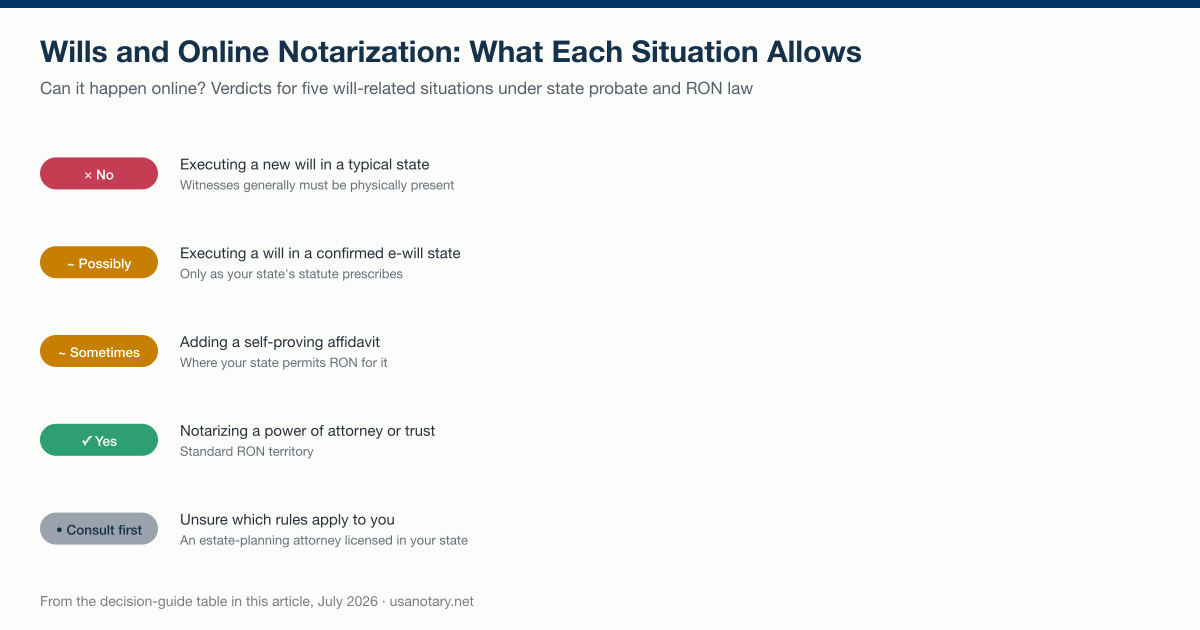
The five situations from this article’s decision guide and whether each can happen online, July 2026.
| Your situation | What you need | Can it happen online? |
|---|---|---|
| Executing a new will in a typical state | Witnesses per your state’s probate law (commonly two, physically present) | No — witnesses generally must be physically present |
| Executing a will in a confirmed e-will state | That state’s e-will execution procedure, followed exactly | Possibly — only as your state’s statute prescribes |
| Adding a self-proving affidavit | Witnesses swear and sign before a notary (jurat) | Sometimes — where your state permits RON for it |
| Notarizing a power of attorney or trust | A notarial act on a document that isn’t a will | Yes — this is standard RON territory |
| Unsure which rules apply to you | An estate-planning attorney licensed in your state | Consult first, notarize second |
How to handle a will the right way
- Confirm your state’s will-execution rules — how many witnesses, whether they must be physically present, who is disqualified from serving, and whether notarization is required or merely optional. Start by checking whether your document even needs a witness, then verify the probate-specific rules, which are stricter.
- Talk to an estate-planning attorney before executing, especially if you are considering an electronic will. This is the document where professional guidance matters most, because the mistake surfaces only after you can no longer fix it.
- Line up qualified witnesses. Most states want adults with no stake in the will; beneficiary-witnesses are restricted in many states. Physically present remains the default outside e-will states.
- Add the self-proving affidavit if your state accepts one — it is the cheapest probate insurance available, and the one place a notary routinely belongs at a will signing.
- Use online notarization for the documents it legally covers — powers of attorney, trusts, and other estate paperwork — rather than the will itself, unless you live in an e-will state and your attorney confirms the statute’s conditions are met.
This page is general information, not legal advice. Online notarization on USA Notary covers many documents, but a will’s validity depends on your state’s probate law — verify it before you rely on a remote notarization for the one document you cannot sign twice.