
What does it mean to get a document notarized?
Getting a document notarized means a notary public — a public official appointed by the state to act as an impartial witness — has confirmed who signed it. Cornell Law School’s Wex legal dictionary defines the term plainly: “To notarize is to have a document formally authenticated by a notary public through a notarial act,” and notes that notarization “is intended to deter fraud by verifying the identity of the signer, confirming that the signer appears voluntarily, and recording the act in the notary’s official records.”
California’s Secretary of State describes the office the same way in the January 2026 Notary Public Handbook: “A notary public is a public official appointed by the California Secretary of State and performs invaluable services for the legal, business, financial, and real estate communities.” During a notarization, the notary checks the signer’s identity using satisfactory evidence (typically a current government photo ID), confirms the person is signing willingly, and completes a notarial certificate stamped with an official seal.
The role is common enough that most people encounter it eventually. According to the National Notary Association’s 2022 census, “the total number of Notaries today remains stable at 4.4 million” across the United States. But numbers aside, the point of a notary is narrow and specific: fraud deterrence. A notarized signature is much harder to forge or later deny, because a neutral official verified the signer at the moment of signing. If you’re new to the idea, our explainer on what a notary public actually does covers the role in full.
What a notary verifies — and what they don’t
The notarial certificate itself states the limit of a notarization, and it is worth reading slowly. California’s required certificate disclaimer, which must appear in a boxed notice at the top of every acknowledgment certificate, reads: “A notary public or other officer completing this certificate verifies only the identity of the individual who signed the document to which this certificate is attached, and not the truthfulness, accuracy, or validity of that document.”
In plain terms, a notary confirms three things:
- Identity — the signer is who they claim to be, based on satisfactory evidence. California defines that as the absence of any information that would lead a reasonable person to doubt the signer is who they say they are, established through acceptable ID or credible witnesses.
- Willingness and awareness — the signer is acting of their own free will, not under visible duress.
- The notarial act — for some documents, that the signer took a spoken oath or affirmation.
A notary does not confirm that the statements in your document are true, that the document is legally sufficient, or that it will accomplish what you intend. This is why notarization does not make a document “legally binding” on its own, and why a notary cannot give legal advice. Enforceability comes from contract law and the document’s own terms — the notary only proves who signed.
The certificate itself carries real legal weight, though. In California, a notary completes an acknowledgment certificate under penalty of perjury, and a notary who willfully states as true any material fact known to be false faces a civil penalty of up to $10,000 under Civil Code section 1189(a)(4) — on top of possible criminal and administrative consequences. The narrow scope of a notarization is enforced narrowly, but seriously.
The three parts of every notarization
The National Notary Association describes notarization as “the official fraud-deterrent process that assures the parties of a transaction that a document is authentic, and can be trusted” — a three-part process of vetting, certifying, and record-keeping:
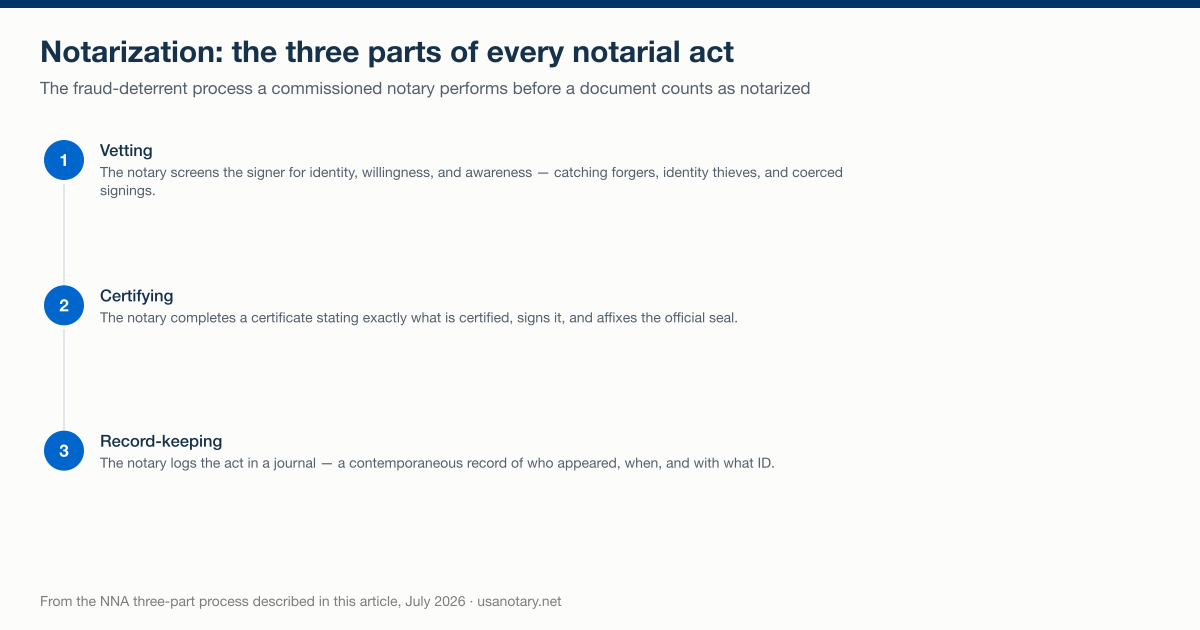
The three parts of notarization — vetting, certifying, and record-keeping — as described in this guide, July 2026.
- Vetting. The notary screens the signer for identity, willingness, and awareness. This screening is the heart of the fraud-deterrence function — it detects forgers, identity thieves, and coerced signings before a document enters circulation.
- Certifying. The notary completes a notarial certificate stating exactly what facts are being certified, then signs it and affixes the official seal. Per the NNA, the seal’s presence “renders it genuine on its face (i.e., prima facie evidence) in a court of law” — meaning a court presumes the signature is authentic unless someone proves otherwise.
- Record-keeping. The notary logs the act in a journal of notarial acts. Keeping a chronological journal is a widely endorsed best practice, and in some states it is a legal requirement. California’s handbook requires the journal entry to record the date and time, the type of act, the character of the document, the signer’s signature, how identity was established, and the fee charged — and for deeds, deeds of trust, quitclaim deeds, and powers of attorney affecting real property, the signer must also leave a right thumbprint in the journal.
That journal is what makes a notarized signature so hard to repudiate later. If a signature is ever challenged in court, there is a contemporaneous official record of who appeared, when, with what ID.
Acknowledgment vs. jurat: the two most common notarial acts
Two acts account for most notarizations, and the difference decides what the signer has to do. The distinction comes straight from the National Notary Association: an acknowledgment is “for a signer, whose identity has been verified, to declare to a Notary or notarial officer that he or she has willingly signed a document,” while a jurat is “for a signer to swear to or affirm the truthfulness of the contents of a document.”
| Acknowledgment | Jurat | |
|---|---|---|
| What the signer confirms | That they willingly signed — the signer acknowledges signing | That the document’s contents are true, under oath |
| Oath or affirmation | Not required | Required — spoken aloud; a silent nod is not acceptable |
| When it can be signed | Before or during the appointment | The signer signs in front of the notary |
| Certificate wording | “Acknowledged before me" | "Subscribed and sworn to (or affirmed) before me” |
| Typical documents | Deeds, powers of attorney, trusts, agreements | Affidavits, sworn statements, declarations |
Either way, the signer must personally appear and the notary must be satisfied of their identity. For a jurat, the signer also swears the contents are true out loud — California’s handbook offers an acceptable oath: “Do you swear or affirm that the statements in this document are true?” If a document arrives at the appointment already signed but needs a jurat, the signer simply signs it again in the notary’s presence.
One rule surprises many first-time signers: the notary cannot choose the act for you. Selecting an acknowledgment or a jurat on a signer’s behalf is considered the unauthorized practice of law for a non-attorney notary. The choice belongs to the signer or the agency receiving the document. If you’re deciding which one your form needs, our guide to choosing between a jurat and an acknowledgment walks through it.
How a notary verifies your identity
“Satisfactory evidence” is the legal standard, and each state defines it in its own statutes. California’s rules, laid out in Civil Code section 1185 and the Secretary of State’s handbook, are a useful model of how strict the standard is. Identity can be established three ways:
- Identification documents that are current or were issued within the past 5 years — a California driver’s license or DMV ID, a U.S. passport, or (if they include a photo, physical description, signature, and identifying number) a foreign passport or consular ID, a driver’s license from another state or from a Canadian or Mexican issuing agency, a U.S. military ID, or a tribal government ID.
- The oath of one credible witness who personally knows both the signer and the notary and swears, under penalty of perjury, that the signer is who they claim to be and cannot easily obtain other ID.
- The oaths of two credible witnesses who know the signer, when the notary knows neither, each identified by their own documents.
The ID details go into the notary’s journal — document type, issuing agency, serial number, and issue or expiration date. A notary “personally knowing” you is not enough in California; the statute channels everything through documented evidence or sworn witnesses. Other states accept personal knowledge, which is one more reason to check your own state’s handbook before an appointment.
What you need to get a document notarized
- A valid government-issued photo ID, or another form of satisfactory evidence your state accepts (some states allow credible identifying witnesses).
- The complete document — a notary must not notarize a document that appears to be incomplete, so fill in every blank (or mark inapplicable fields “N/A”) before the appointment. Leave the signature line blank if the act is a jurat, since the signer signs in front of the notary.
- To personally appear before the notary — in person, or over a live audio-video session for online notarization.
- Payment — capped by statute in many states for in-person acts; see what notaries charge state by state.
For a full walkthrough of the appointment itself, from finding a notary to checking the completed certificate, see our step-by-step guide to notarizing a document. And note that a notary witnessing your signature is not the same as the disinterested witnesses some deeds, wills, or estate documents separately require — our rundown on when a signing needs witnesses covers that distinction.
Notarized vs. certified vs. legally binding
People use these words interchangeably, but they answer different questions:
| Term | What it actually means | Who provides it |
|---|---|---|
| Notarized | A notary verified the signer’s identity and willingness at a signing event | Any commissioned notary public |
| Certified copy | Someone attests that a reproduction of an original is true, exact, and complete | A notary only in states that authorize it; vital records must be certified by the issuing agency |
| Legally binding | The document creates enforceable obligations | The document’s own contents and governing law — not the seal |
Copy certification deserves the extra caution. The NNA notes it “is not an authorized notarial act in every state,” and even where allowed, it may apply only to certain originals (California, for instance, limits notarial copy certification chiefly to powers of attorney). Birth certificates, marriage certificates, and other public records must be certified by the record’s custodian — a notary cannot do it.
And the boundary runs both ways: a document can be notarized and still be unenforceable, and many binding contracts are never notarized at all. Notarization adds evidentiary weight — proof of who signed and when — rather than legal force.
State law also defines which notarial acts exist at all, and a few states authorize unusual ones: Washington allows a notary to certify the occurrence of an act or event, and Maine, Florida, and South Carolina permit notaries to perform marriage rites.
What can make a notarization invalid — or get it refused
Notarizations fail for predictable reasons. The California handbook and NNA guidance flag these recurring problems:
- Identity can’t be established. Expired ID (beyond the state’s window), mismatched names, or no acceptable documents — the notary must refuse.
- The document is incomplete. Blank spaces that could be filled in later invite fraud, so a notary must decline until the document is finished.
- The signer didn’t personally appear. A pre-signed acknowledgment mailed to a notary is invalid; California’s handbook is explicit that an acknowledgment “cannot be affixed to a document mailed or otherwise delivered to a notary public whereby the signer did not personally appear.”
- The jurat oath wasn’t spoken. The signer must respond out loud; a nod does not count, and no one can take the oath on the signer’s behalf.
- The seal is illegible or misplaced. A county recorder may reject a document whose notary seal is smudged, incomplete, or stamped over text.
- Missing or wrong certificate wording. Each act requires its own certificate; a jurat certificate cannot be used for an acknowledgment or vice versa, and a notary cannot apply a seal without the correct notarial wording.
None of these are technicalities for their own sake — each one closes a specific fraud channel. They are also why a competent notary who says “no” is doing the job correctly.
How much does getting a document notarized cost?
In-person fees are set and capped by statute in many states. California’s Government Code section 8211 caps acknowledgments and jurats at $15 per signature, and the handbook adds that charging any fee at all “is at the discretion of the notary public,” provided the maximum is not exceeded — some acts, like notarizing a U.S. veteran’s benefit application, must be free. Maximums differ widely from state to state, so check how much a notary costs in your state before you go. Travel fees for mobile notaries and platform fees for online sessions sit on top of, or replace, those statutory maximums.
Online notarization on USA Notary costs $25 per document — one flat fee for everyday document notarization that covers identity verification, the live video session with a commissioned notary, and the electronic seal.
Can you get a document notarized online?
Yes. Remote online notarization (RON) completes every step above over a secure video call instead of a trip to a notary’s desk. The signer appears on live video, the notary verifies identity, witnesses the signing, and applies an electronic seal — producing a fully notarized document. The legal footing is well established: under the federal ESIGN Act, 15 U.S.C. § 7001, electronic signatures and records may not be denied legal effect solely because they are electronic, and most state RON statutes are modeled on the Revised Uniform Law on Notarial Acts (RULONA). A federal bill that would add nationwide minimum standards — the SECURE Notarization Act (H.R.1777) — has been introduced in Congress but remains only proposed, not enacted.
Adoption has moved fast. The NNA’s census reports that “more than 40 U.S. states now authorize Notaries to perform remote notarizations” where notaries and signers communicate through live audiovisual communication. But notary commissioning law is set state by state, and a few states have not yet authorized their own notaries to perform RON. California is the clearest 2026 example: its Online Notarization Act (SB 696, signed September 30, 2023) will let approved California notaries perform RON once the Secretary of State completes its technology project or on January 1, 2030, whichever is earlier (unless the Secretary tells the Legislature and the Governor in writing by January 1, 2029 that the project will not be completed), and since January 1, 2024, California law (Government Code sections 8232–8232.4) already recognizes remote notarizations performed by out-of-state notaries. That is the distinction that matters for consumers: RON as a service is legally valid in all 50 states, even where the state’s own notaries can’t yet offer it, because the signing routes through a notary commissioned in a RON-authorized state.
On USA Notary, you can notarize a document online in minutes: upload the document, verify your identity, and meet the notary over live video. Want to see the process before you commit? Read how online notarization works, or compare it against the counter at a bank or shipping store in our guide to where to get something notarized.