
What it means to notarize a document
Notarizing a document means a commissioned notary public serves as an impartial witness to its signing — verifying who is signing, confirming they do so willingly, and certifying the act with an official seal. A notary public does not judge what the document says; the notary confirms the signing, not the contents. That distinction is the whole job, and it is why what a notarized signature actually certifies is your identity and willingness — not the truth of every clause. The mechanics are consistent across states, even though the fine print differs.
One rule underlies everything below: you must personally appear before the notary. The National Notary Association states it plainly — “a signer must meet face-to-face with a Notary in order to have their signature notarized.” The Texas Secretary of State’s notary training spells out what does not count: a personal appearance “cannot be made via fax, telephone, a spouse or friend’s permission, or by power of attorney for an absent principal.” Remote online notarization satisfies the appearance requirement through live video where state law authorizes it — but no notary may ever notarize a signature over an ordinary phone call, by email, or by mail.
The steps to notarize a document
Whatever the document, a proper notarization follows the same sequence. The NNA breaks it into five steps; Texas trains its notaries on essentially the same process in four. Here it is from the signer’s side:
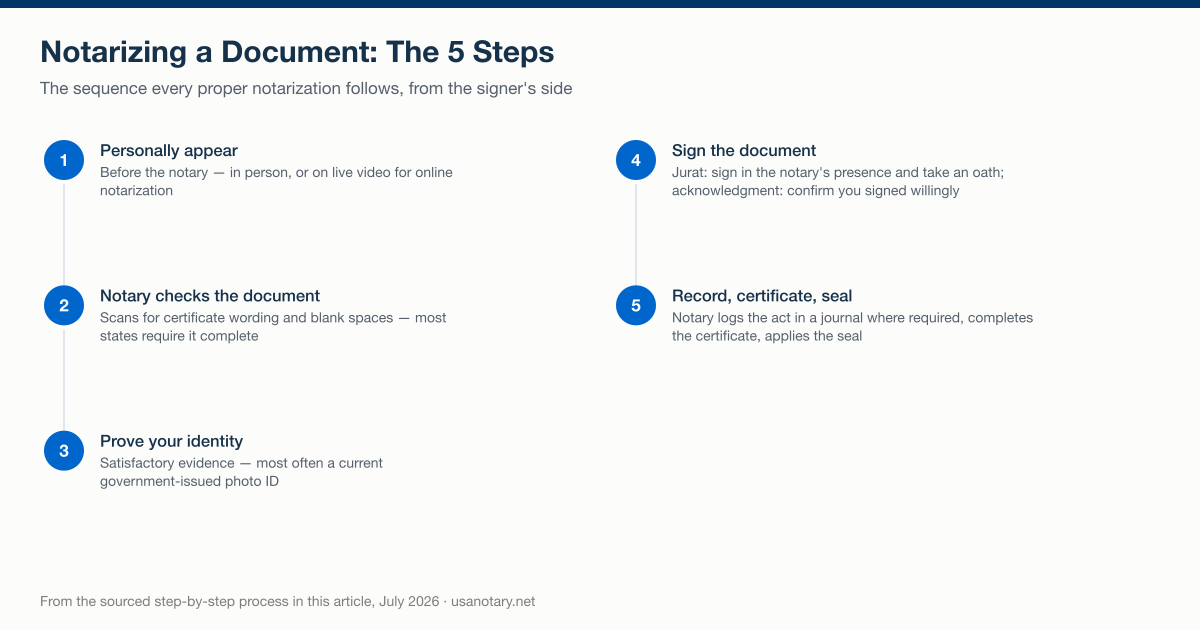
The five-step notarization sequence described in this guide, July 2026.
- Personally appear before the notary — in person, or on live video for online notarization. In Texas, appearance by video conference is permitted only if the notary is commissioned as an online notary public.
- The notary checks the document. They scan it for the certificate wording that sets the act and for blank spaces, because “blank documents can be altered later to commit fraud.” The notary glances over the document for what the certificate requires — they do not read it for its details, and they may not fill in any part of the document except the notarial certificate. Most states require the document to be complete before it is notarized; California flatly provides that “a notary public may not notarize a document that is incomplete.”
- Prove your identity. The notary establishes identity through “satisfactory evidence” — in California, tied to Civil Code section 1185, which in practice means a current government-issued photo ID. The three general methods, and how states restrict them, are covered below.
- Sign the document. For a jurat, you sign in front of the notary and take an oath — you swear the contents are true; for an acknowledgment, you confirm that you executed the document — you acknowledge signing willingly. (See jurat vs. acknowledgment for which one your document needs.)
- The notary records the act and completes the certificate. Where required, the notary logs the act in “one active sequential journal” — recording the “date, time and type of each official act” — then fills in the notarial certificate and applies the seal. California requires the certificate of acknowledgment to be “filled completely out at the time the notary public’s signature and seal are affixed” (Civil Code section 1189(a)(1)); Texas requires its notaries to keep the record of each notarization for 10 years.
How strict step 4 is for a jurat is spelled out in the California handbook: a jurat “cannot be affixed to a document mailed or otherwise delivered to a notary public whereby the signer did not personally appear, take an oath, and sign in the presence of the notary public, even if the signer is known by the notary public.” The stakes for the notary are real — under Texas law, notarizing for a signer who was not present at the time of notarization can be charged as a Class A misdemeanor or a felony and is grounds for revoking the notary’s commission. When a notary insists you appear and re-sign, that is the law working, not bureaucracy.
Which notarial act does your document need?
The certificate wording on the page determines the act — and the act determines whether you can sign in advance. If you are not sure which one applies, this is the fast comparison:
| Notarial act | What you are certifying | Sign in front of the notary? | Oath required? |
|---|---|---|---|
| Acknowledgment | That you willingly signed the document — you acknowledge signing | Not required — you may sign beforehand and acknowledge it | No |
| Jurat | That the contents are true — you swear the contents are true | Yes — you must sign in the notary’s presence | Yes |
| Copy certification | That a copy is a true match of the original | N/A — the notary compares copy to original | No (and not allowed in every state) |
Choosing the wrong act is a common reason a signing is rejected later, so confirm it with the receiving agency before your appointment — and note whether the document also requires a separate signing witness, which is a different question covered in do I need a witness to notarize.
If your document arrives with no certificate wording at all, the notary cannot simply stamp it — the California handbook is explicit that “a notary public seal and signature cannot be affixed to a document without the correct notarial wording.” Instead, you (not the notary) choose the appropriate certificate, and the notary attaches it as a separate “loose” certificate. Texas trains its notaries to present the signer with sample certificates and let the signer choose — picking it for you would be practicing law.
What to bring
Getting turned away is almost always avoidable. The NNA’s checklist of what to bring is short and specific:
- The completed document you wish to notarize — complete, with no blank spaces. An empty line for a critical date or dollar figure can be filled in after notarization, which is exactly the fraud the rule prevents.
- Valid photo ID that meets your state’s requirements, with a name that matches the name on the document.
- Any other signers, each with their own proper ID, present at the appointment — every person whose signature needs notarizing must appear.
- Payment for the notarial services. (Most states cap the per-signature fee; see how much a notary costs.)
Two traps account for most failed appointments. First, don’t sign in advance if your document needs a jurat — you must sign in front of the notary. Second, watch the name match: per the NNA, if you recently changed your legal name and the document uses your new name while your ID still shows the old one, the notary cannot proceed unless you can present alternate acceptable ID matching the name on the document. Fix the mismatch — update the ID or correct the document — before you book anything.
How the notary verifies your identity
Identifying the signer is the notary’s core duty. The NNA describes three general methods, each of which states may allow or restrict:
- Personal knowledge — the notary personally knows you. Not universal: California does not allow its notaries to rely on personal knowledge at all.
- Identity documents — driver’s licenses, passports, and other government-issued IDs that meet the state’s list.
- Credible identifying witnesses — one or two people who know you swear to your identity under oath, used when you lack acceptable ID.
California defines “satisfactory evidence” as “the absence of any information, evidence, or other circumstances which would lead a reasonable person to believe that the individual is not the individual they claim to be,” established by identification documents or by the oath of credible witnesses. The state-by-state fine print genuinely differs — two large states side by side:
| ID rule | California | Texas |
|---|---|---|
| ID validity window | Current or issued within the past 5 years | Must not be expired |
| Personal knowledge allowed? | No — ID documents or credible witnesses only | Yes, if the notary is reasonably certain and has known the signer an extended time |
| Foreign passport | Accepted in defined circumstances under state law | Only for documents transferring residential real estate |
| Journal/record book | Required — one active sequential journal, kept locked | Required — records kept 10 years after the last entry |
If you lack acceptable ID, ask about credible identifying witnesses before assuming you’re stuck: in California, one credible witness personally known to the notary — or two credible witnesses with valid ID — can establish your identity under oath (Civil Code section 1185(b)). Texas uses the same concept and requires the notary to record the witness’s name and mailing address in the record book.
What the notary will actually say
An oath sounds intimidating until you hear one. California prescribes no exact wording, but its handbook offers this as an acceptable oath for a jurat: “Do you swear or affirm that the statements in this document are true?” You answer affirmatively, sign, and the notary completes the certificate. Note the wording — “swear or affirm”: you may choose either form.
When a credible witness vouches for a signer’s identity, the witness takes an oath too. The Texas training script gives the flavor: “Do you solemnly swear that you personally know this document signer to be the individual she claims to be?” Expect the whole verbal portion of a notarization to take seconds, not minutes.
Who chooses the notarial act — you, not the notary
A common surprise: the notary cannot pick the type of notarization for you. Per the NNA, “as the signer, you must tell the Notary what type of notarization you need. Notaries can describe what the primary notarial acts are, but they cannot recommend one over another. It’s illegal for a Notary Public to give advice like this unless they are also a licensed attorney.” If you’re not sure whether you need a jurat or an acknowledgment, ask the court or agency that will receive the document — not the notary.
The same wall applies to the document itself. A notary may not advise you on its legal effects, may not translate their title into another language (in California, advertising as a “notario publico” is grounds for suspension), and may not complete any blank except the certificate. A notary who volunteers legal advice without being an attorney is a red flag, not a convenience.
Signing for someone else: the power-of-attorney case
An agent signing under a power of attorney can have that signature notarized — but the mechanics trip people up. Per the Texas Secretary of State’s training, the agent must bring the power-of-attorney document proving authority to sign for the principal, present their own valid ID, and personally appear. Critically, the agent signs their own name, never the principal’s — signing the principal’s signature “would be considered forgery” — and then notes next to the signature that they are signing as attorney-in-fact for the principal. The absent principal cannot be “represented” into a notarization: personal appearance attaches to whoever’s signature is being notarized.
What documents can’t be notarized
Almost anything with signable certificate wording — the everyday paperwork covered by general notary work online — can be notarized, but the exceptions are firm:
- Vital records. A notary cannot make or certify copies of birth, marriage, or death certificates — for those, go to the government agency that issued the record.
- Incomplete documents. California bars notarizing a document the notary knows to be incomplete; other states impose the same rule or require the notary to warn you.
- Documents with no notarial certificate wording — until the correct certificate is added (chosen by you, attached by the notary).
- A document in which the notary is named and attesting to facts — Texas trains notaries to review the contents and refuse if they are mentioned in the document attesting to facts outside their authority.
- Certificates demanding facts beyond the notary’s authority. Texas instructs notaries to refuse a certificate that asks them to certify things like the signer’s age, marital status, or employer — those belong in the document’s body, attested by the signer.
- Copy certifications in states that don’t permit them — availability varies by state.
When a notary must refuse — and why that protects you
A notary is not a rubber stamp, and several refusal grounds are written into training and law. Texas authorizes its notaries to refuse when they believe the document will be used for an unlawful or improper purpose, when the certificate is inaccurate or the procedure unclear, when the signer appears to lack the capacity to understand the document, or when the signer seems to be acting under coercion or undue influence. The NNA notes that Florida specifically prohibits notarizing if the signer appears mentally incapable of understanding the document.
That screening — for willingness and awareness — is a standard part of every notarization. Expect small talk and simple questions; the notary is making a layperson’s judgment that you know what you’re signing and are signing freely. For elderly or hospitalized signers this is the step that matters most, and it is why a notary may decline if a signer seems confused or pressured. A refusal on those grounds is the system protecting the signer, not an insult.
How much does it cost?
In-person notary fees are capped by statute in most states, and the caps are modest. California’s schedule under Government Code section 8211 is typical of the format:
| Service (California) | Maximum fee |
|---|---|
| Acknowledgment | $15 per signature |
| Jurat | $15 |
| Oath or affirmation | $15 |
A notary may always charge less than the cap — or nothing (see free notarization venues). What moves the total is everything around the stamp: travel and convenience fees for mobile notaries are separate (and not always capped), multiple signatures multiply per-signature fees, and after-hours availability is scarce — a 24-hour notary in person usually means a mobile notary premium. Online notarization on USA Notary costs $25 per document, flat, at any hour. For the full picture across states and options, see how much a notary costs.
Why notarizations get rejected
If a notarization fails, it is usually one of a handful of avoidable reasons:
- The signer did not personally appear (or tried to sign a jurat by mail).
- The document had blank spaces or was otherwise incomplete.
- The name on the ID did not match the name on the document.
- The ID was expired or not an accepted form under state law.
- The wrong act was requested for what the receiving agency needed.
- The document lacked certificate wording and no loose certificate was selected.
Clearing these before your appointment is the difference between a two-minute signing and a return trip. If in-person logistics are the obstacle — travel, hours, finding a notary at all — compare every option on where to get something notarized.
Can you notarize a document online?
Yes — remote online notarization (RON) meets the personal-appearance requirement over a live audio-video session instead of an in-person visit. You upload the document, verify your identity, and the signer appears on live video before a commissioned notary who completes the certificate electronically. The legal footing is layered and solid:
- The federal ESIGN Act provides that a signature or record “may not be denied legal effect, validity, or enforceability solely because it is in electronic form” — and its § 7001(g) says a notarization requirement “is satisfied if the electronic signature of the person authorized to perform those acts … is attached to or logically associated with the signature or record.”
- State RON statutes authorize notaries to perform the act itself; many are modeled on the Revised Uniform Law on Notarial Acts (RULONA).
- A federal bill that would authorize RON nationwide — the SECURE Notarization Act (H.R.1777) — has been introduced in Congress but not enacted, so a notary’s authority to perform RON still comes from state law. Notary commissioning is per-state, and some states do not yet authorize their own notaries to perform RON — but a RON document properly executed under an authorizing state’s law is legally valid in all 50 states.
Side by side, the trade-offs are simple:
| In-person notarization | Online notarization (RON) | |
|---|---|---|
| Personal appearance | Face-to-face meeting | Signer appears on live video |
| Identity check | Physical ID inspected by the notary | ID verified digitally, then confirmed on camera |
| Availability | Business hours; mobile notaries after hours at a premium | 24/7 |
| Typical cost | State-capped per-signature fee (e.g., $15 in California) plus any travel fees | $25 per document, flat, on USA Notary |
| Record | Paper journal entry (where required) | Audio-video session captured with a digital audit trail |
If your document qualifies and the receiving agency accepts electronic notarization, online notarization is usually the fastest path from “needs a stamp” to “done” — no appointment, no travel, any hour.