
What is the difference between a jurat and an acknowledgment?
A jurat and an acknowledgment are the two most commonly requested notarial acts, and both require the notary to verify your identity. The difference is what you are certifying and whether an oath is involved.
- In an acknowledgment, the signer acknowledges signing the document willingly. The document can be signed before the appointment.
- In a jurat, the signer swears (or affirms) that the contents of the document are true, and must sign the document in front of the notary.
The National Notary Association reduces the practical test to one line: a jurat “is for a signer to swear to or affirm the truthfulness of the contents of a document,” while an acknowledgment “is for a signer… to declare to a Notary… that he or she has willingly signed a document.” One is about the truth of the content; the other is about the authenticity of the signature. If you understand which of those two things the receiving party wants proven, you already know which act you need. For a broader primer on what a notarization certifies in the first place, see what “notarized” actually means.
How to recognize each one on the page
You rarely have to guess — the notarial certificate names the act. The wording is not decorative; it is prescribed by statute, and it is the fastest way to tell a jurat from an acknowledgment at a glance.
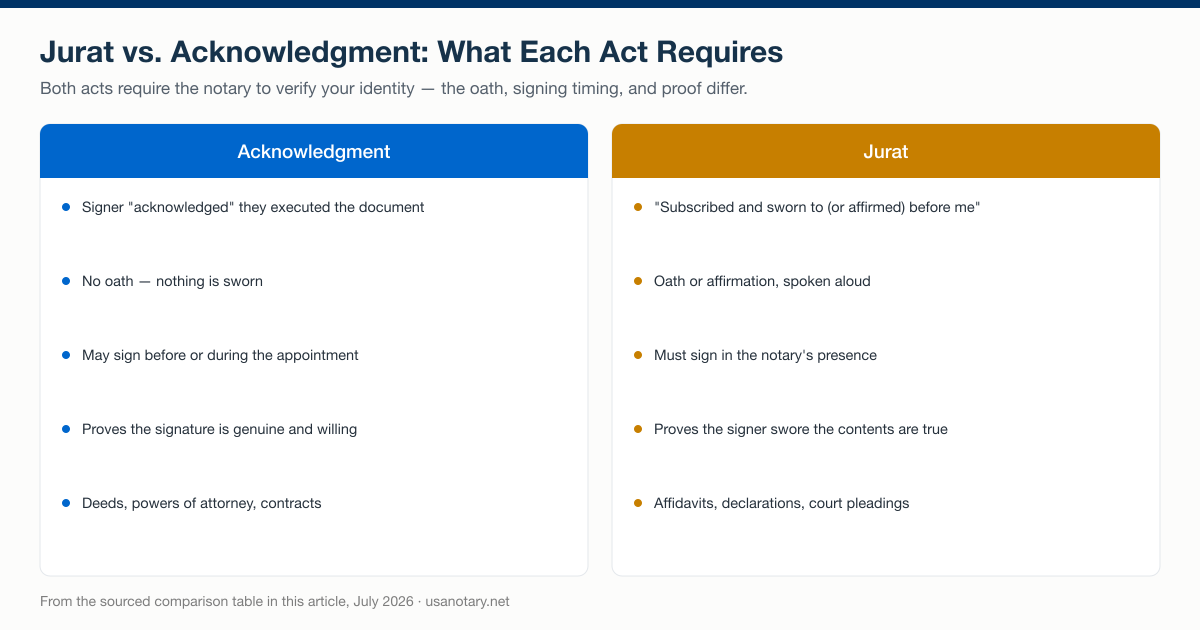
The five distinctions between an acknowledgment and a jurat, from the sourced comparison table in this article, July 2026.
| Acknowledgment | Jurat | |
|---|---|---|
| Certificate wording | Signer “acknowledged” they executed the document | “Subscribed and sworn to (or affirmed) before me” |
| Signer swears an oath | No | Yes — spoken aloud |
| Signing timing | Before or during the appointment | Must sign in the notary’s presence |
| What it proves | The signature is genuine and willing | The signer swore the contents are true |
| Who is attesting under oath | No one swears to the content | The signer (the affiant) |
| Common documents | Deeds, powers of attorney, contracts | Affidavits, declarations, court pleadings |
| Also known as | Acknowledgment | Verification on oath or affirmation (RULONA) |
| Interchangeable certificates? | No — an acknowledgment certificate cannot be used for a jurat | No — a jurat certificate cannot be used for an acknowledgment |
California’s jurat statute, Government Code § 8202, fixes this wording in law: the jurat form reads “Subscribed and sworn to (or affirmed) before me,” and the statute directs that “the affiant shall sign the document in the presence of the notary.” By contrast, the acknowledgment certificate in Civil Code § 1189 has the signer “acknowledge… that he/she/they executed the same” — with no requirement that the signing happen in front of the notary. The presence-at-signing rule is the single clearest line between the two acts.
The certificates are also not interchangeable. As the NNA puts it, “You cannot use a jurat certificate for an acknowledgment, or vice versa” — each act requires its own statutory wording, and swapping them is one of the common errors covered below.
What is a jurat?
A jurat is the notarial act in which the signer swears the contents are true and signs in front of the notary. In states that adopted the Revised Uniform Law on Notarial Acts (RULONA) — the Uniform Law Commission’s model notary statute — the act is called a verification on oath or affirmation, defined in Washington’s enactment (RCW 42.45.010) as “a declaration, made by an individual on oath or affirmation before a notarial officer, that a statement in a record is true.” Different label, identical act.
A jurat has three non-negotiable steps:
- Personal appearance. The signer appears before the notary — physically, or on live video where remote notarization is used.
- Signature in the notary’s presence. The signer signs the document in front of the notary. A signature made earlier does not qualify — the NNA is explicit: “You may not perform a jurat for a signature made before the signer appeared before you.” If you already signed, expect to sign a fresh copy at the appointment.
- A spoken oath or affirmation. The notary administers the oath and the signer must answer out loud. Silent answers, such as a nod of the head, are not acceptable.
What does the oath actually sound like? The Michigan Department of State’s guidance offers model wording: “Do you solemnly swear that the contents of this affidavit subscribed by you are correct and true, so help you God?” A signer who objects to swearing may instead affirm — Michigan’s alternative reads, “Do you solemnly, sincerely and truly declare and affirm that the statements made by you are true and correct?” An affirmation carries the same legal weight as an oath; the choice belongs to the signer. Michigan also directs that parties raise their right hand when the oath is administered (the left hand may be used in cases of disability), and the NNA recommends the raised hand even where law does not require it, “to emphasize the seriousness of the oath.”
One more rule: the oath is personal. A jurat cannot be executed by someone offering to take the oath in another person’s name — the original signer must swear or affirm in person before the notary.
What is an acknowledgment?
An acknowledgment is the notarial act in which the signer acknowledges signing the document willingly. RULONA-state statutes define it precisely: under RCW 42.45.010, an acknowledgment is “a declaration by an individual in the presence of a notarial officer stating that the individual has signed a record of the individual’s free will for the purpose stated in the record.” When the document is signed in a representative capacity — as a trustee, corporate officer, or attorney-in-fact — the signer additionally declares that they signed with proper authority on behalf of that person or entity.
The steps, per the National Notary Association:
- The signer appears in person before the notary.
- The notary positively identifies the signer under state rules.
- The signer may have signed the document before the appointment or may sign in the notary’s presence — either is acceptable.
- The signer declares (acknowledges) that they signed the document for its intended purpose.
Two details trip people up. First, the flexibility on signing timing does not remove the appearance requirement: Michigan’s Office of the Great Seal stresses that “there is no exception to the requirement of a personal appearance before the notary.” You can sign a deed at home on Tuesday, but you must still stand (or appear on live video) before the notary on Wednesday to acknowledge that signature. Second, the signer must be able to communicate the acknowledgment to the notary directly in most states — the NNA notes that Arizona, Colorado, and Mississippi are exceptions that permit communication through an interpreter who personally appears at the notarization, with Colorado barring any interpreter who has a disqualifying interest in the transaction.
What each act actually proves — and what neither one does
A notarization is a narrower guarantee than most people assume. Both California certificate forms carry an identical boxed disclaimer at the top, warning that the officer “verifies only the identity of the individual who signed the document to which this certificate is attached, and not the truthfulness, accuracy, or validity of that document.” Michigan’s guidance makes the same point about the sworn act: “jurat notarizations do not prove a document is true, legal, valid, or enforceable.” In other words, neither act vouches for the document’s contents — the notary is confirming who appeared, not what the paper says.
The difference sits in who attests to what:
- An acknowledgment proves the signature is genuine and was made willingly. It is the standard for documents that get recorded or that transfer rights — the receiving party mainly needs to know the signature is real. Notably, under Civil Code § 1189 it is the notary who certifies “under PENALTY OF PERJURY” that the identification and appearance facts in the certificate are true — the signer swears to nothing.
- A jurat flips the sworn burden onto the signer: the signer personally attests, under oath, that the statements in the document are true. That oath carries real weight — a false sworn statement exposes the affiant to perjury liability, which is exactly why courts require jurats on affidavits and pleadings.
The notary’s own honesty is policed separately. Under Civil Code § 1189, a California notary who willfully states as true a material fact known to be false faces a civil penalty of up to $10,000 — a reminder that the certificate itself is a legal instrument, not a rubber stamp.
Which documents need a jurat, and which need an acknowledgment?
The document’s purpose usually decides the act. Michigan’s Office of the Great Seal draws the line cleanly: jurats are “required for transactions where the signer must attest to the content of the document, such as all affidavits and pleadings in court,” while acknowledgments are “typically… executed on deeds and other documents that will be publicly recorded by a county official.”
| Document | Typical act | Why |
|---|---|---|
| Affidavit or sworn declaration | Jurat | The affiant swears the contents are true — see how to notarize an affidavit |
| Court pleadings requiring verification | Jurat | Courts need statements made under penalty of perjury |
| Real estate deed | Acknowledgment | Recorders need proof the signature is genuine and willing |
| Power of attorney | Acknowledgment | The grant of authority turns on an authentic, voluntary signature |
| Mortgage / deed of trust | Acknowledgment | Recorded instruments require acknowledged signatures |
| Contract or agreement | Acknowledgment | The parties need signature authenticity, not sworn content |
| Affidavit of death of a joint tenant | Jurat | The surviving owner swears to the facts of the death |
The recording connection is worth underlining for real estate. As the California Lawyers Association explains, under California law an instrument transferring an interest in real property must be acknowledged in order to be recorded with the county — and a power of attorney used to convey property must likewise be acknowledged and recorded (Civ. Code § 2933). An unacknowledged deed may still bind the parties who signed it, but without the acknowledgment it cannot enter the public record that protects the new owner against later claims.
A worked example makes the jurat side concrete. Suppose two people own a home as joint tenants and one dies. The survivor records an affidavit of death to clear the deceased owner from title. Because the survivor is swearing to facts — the death, the identity of the decedent — the affidavit is completed with a jurat: the survivor signs in front of the notary and takes the oath. Compare that with the deed the couple signed when they bought the house: nobody swore the deed’s contents were “true”; they acknowledged signing it willingly, so the county could record it.
Keep one adjacent requirement separate: witnesses. Whether a document additionally needs witnesses is set by the document type and state law, not by the notarial act — a jurat does not supply witnesses, and an acknowledgment does not waive them. See whether you also need a witness for that distinction.
Jurat, affidavit, affiant: three words, one transaction
These terms get tangled because they describe different parts of the same sworn-statement transaction:
- The affidavit is the document — the written statement of facts.
- The affiant is the person swearing to it. If that role is new to you, our explainer on what an affiant is covers it.
- The jurat is the notary’s certificate attached to the affidavit, stating that the affiant swore the contents are true and signed in the notary’s presence.
So “jurat vs. affidavit” is not really a versus: an affidavit is completed with a jurat. The comparison that matters is jurat vs. acknowledgment — two different certificates a notary can attach, only one of which involves an oath.
Who chooses the act — you or the notary?
The choice belongs to you or the entity requesting the document, never the notary. Michigan’s state guidance states it flatly: “A notary should not decide what type of notarial act a document requires. The customer must know and tell the notary.” The NNA’s guidance explains why: because using the wrong act can cause a document to be rejected or invalidated, a nonattorney notary who selected the act for you would be engaged in the unauthorized practice of law and could face penalties or liability.
What a notary may do is describe the difference between the two acts and let you choose. If you are still unsure, the resolution path is always the same:
- Check the document. Pre-printed certificate wording (“subscribed and sworn” vs. “acknowledged”) answers the question in most cases.
- Ask the issuing agency — the court, lender, or office that created the form.
- Ask the receiving agency — whoever will accept or record the document.
One wrinkle from state practice: Michigan instructs that even when a customer directs the act, if the certificate says the document was “sworn to before me,” an oath must be administered — the wording on the page controls what the notary has to do.
Common mistakes that get jurats and acknowledgments rejected
Most rejected notarizations trace back to a handful of avoidable errors:
- Bringing a pre-signed document for a jurat. The signature must be made in the notary’s presence; a jurat cannot be applied retroactively to an existing signature. Plan to re-sign a fresh copy.
- Swapping certificates. Attaching acknowledgment wording to an affidavit (or jurat wording to a deed) mismatches the act and invites rejection by the court or recorder.
- Skipping the spoken oath. A jurat without an administered, out-loud oath is defective even if everything else is correct — a nod does not count.
- Assuming no appearance is needed for an acknowledgment. Pre-signing is allowed; skipping the appearance is not. The signer must still appear before the notary, in person or on live video.
- Expecting the notary to pick the act. A notary who is not an attorney cannot choose for you; asking them to do so stalls the appointment. Confirm the required act with the receiving agency before you go.
- Taking the oath for someone else. Only the affiant can swear to an affidavit — a spouse, agent, or attorney cannot take the oath in the signer’s name.
Can one document carry both a jurat and an acknowledgment?
Occasionally a form’s certificate combines both concepts — wording like “subscribed, sworn to, and acknowledged before me.” The NNA advises that a notary may perform both acts for a signer when requested, but each is a distinct notarization: the signer must appear with the document, acknowledge the signature, sign in the notary’s presence, and take the oath, and the notary completes wording that satisfies both acts under state rules. If your document shows hybrid wording, flag it to the notary at the start of the appointment so the right steps — and the right certificate — are used.
Getting a jurat or acknowledgment online
Remote online notarization handles both acts over a live video session. The notary verifies your identity, administers an oath when a jurat is required, and applies the matching electronic certificate — the same two acts, performed on screen instead of across a desk. Because the signer appears on live video, a jurat’s “sign in the notary’s presence” requirement is satisfied in real time, and the spoken oath is administered exactly as it would be at a desk. RULONA-based statutes treat the acts identically whether the record is tangible or electronic — Washington’s definitions apply to a notarial act “whether performed with respect to a tangible or electronic record.”
Online notarization on USA Notary costs $25 per document, and the resulting notarization is legally valid in all 50 states. You can notarize your document online, review how a remote session works, or confirm whether online notarization is legally valid where you live.