
How do you notarize an affidavit?
An affidavit is a written statement you swear is true, so it is notarized with a jurat — the notarial act built around an oath. In a jurat, you appear before the notary, take an oath or affirmation that the contents are true, and sign the affidavit in the notary’s presence. California Government Code section 8202, reproduced in the 2026 California Notary Public Handbook, states the rule directly: “When executing a jurat, a notary shall administer an oath or affirmation to the affiant and shall determine, from satisfactory evidence… that the affiant is the person executing the document.”
Per the handbook, the jurat certifies four things:
- That the signer personally appeared before the notary on the date and in the county indicated;
- That the signer signed the document in the notary’s presence;
- That the notary administered the oath or affirmation; and
- That the notary identified the signer from satisfactory evidence.
The certificate itself opens with the words “Subscribed and sworn to (or affirmed) before me” — that phrase is how you recognize a jurat on sight. And that single requirement — sign in front of the notary, after being sworn — is what separates an affidavit from documents that use an acknowledgment, where the signer merely acknowledges signing and can sign in advance.
The rest of this guide covers the entire process: confirming which notarial act your affidavit actually needs, the exact oath wording you’ll hear, doing it online versus in person, where to go, what it costs, the mistakes that void the notarization, and the one federal statute that sometimes lets you skip the notary entirely.
What is an affidavit, and who is the affiant?
An affidavit is a voluntary written statement of facts that its author swears or affirms to be true before an authorized officer. Tennessee’s Department of Health puts the definition in one sentence in its vital records guidance: “A notarized affidavit is a written statement made under oath and signed in the presence of a notary public.” The person making and signing it is the affiant — the one who takes the oath.
Affidavits function as written testimony. According to the National Notary Association, they are commonly used as evidence in court proceedings such as divorces, lawsuits, and bankruptcy cases — especially when the affiant cannot appear in person — and in business transactions like home purchases and mortgage refinancings, where a Signature and Name Affidavit in the loan package confirms the borrower is signing under their correct legal name.
Two related documents get confused with affidavits, so pin the terms down:
- A sworn affidavit vs. a simple statement. A general written statement that only needs your signature witnessed typically takes an acknowledgment, not a jurat — which is why notarizing a letter usually follows a different path than notarizing a sworn affidavit.
- The affidavit vs. the jurat. The affidavit is your statement; the jurat is the notary’s certificate attached to it. You write (or your attorney writes) the affidavit; the notary completes the jurat.
One point people miss: the notary is not vouching for the truth of your affidavit. The notary administers the oath and certifies that you swore to the contents — the accuracy of those contents is entirely on you. Swearing to a false statement in a notarized affidavit is what can expose an affiant to perjury liability.
Jurat or acknowledgment: which act does your affidavit need?
Usually a jurat — but not always, and this is the nuance most guides skip. The National Notary Association is explicit: “affidavits do not always require a jurat — some require an acknowledgment instead.” Some affidavit forms arrive pre-printed with acknowledgment wording because the court or agency that drafted them wants the signature verified rather than the contents sworn.
Here is the practical decision path:
- Read the notarial certificate printed at the end of your affidavit. Wording like “subscribed and sworn to (or affirmed) before me” means jurat. Wording like “acknowledged before me” means acknowledgment.
- If there is no certificate at all, ask the receiving party — the court clerk, agency, or attorney who requested the affidavit — which act they require.
- Do not ask the notary to choose. A notary who selects the notarial act on your behalf risks penalties for the unauthorized practice of law, per the NNA. The notary can describe both acts; only you (or the receiving party) can pick one.
Ohio’s Secretary of State frames the difference in one line each in its notary FAQ: for a jurat under R.C. 147.011(C), “the signer appears, is administered an oath or affirmation, and signs in the notary’s presence,” while for an acknowledgment “the notary need not witness the signing.” For a deeper treatment of when each act applies, see our full guide to jurat vs. acknowledgment.
Steps to notarize an affidavit
- Finish the affidavit first — but don’t sign it. Fill in every blank; notaries generally will not complete a jurat on a document with empty fields. Leave only the signature line blank, because a jurat requires signing in the notary’s presence.
- Confirm the notarial act. Check the certificate wording (step above) so you and the notary both know a jurat is required.
- Gather your ID. A current government-issued photo ID whose name reasonably matches the name on the affidavit — or other satisfactory evidence your state allows.
- Appear before the notary. In person, or on live video for online notarization.
- Take the oath or affirmation. The notary asks you to swear or affirm that the affidavit’s contents are true, and you answer aloud.
- Sign in front of the notary. The notary watches you sign the affidavit.
- The notary completes the jurat. Certificate wording filled in, signature and seal applied — electronically, in an online session — and, where state law requires it, an entry recorded in the notary’s journal.
The whole appointment typically turns on steps 5 and 6: oath first, signature second, both witnessed by the notary. Everything before is preparation; everything after is the notary’s paperwork.
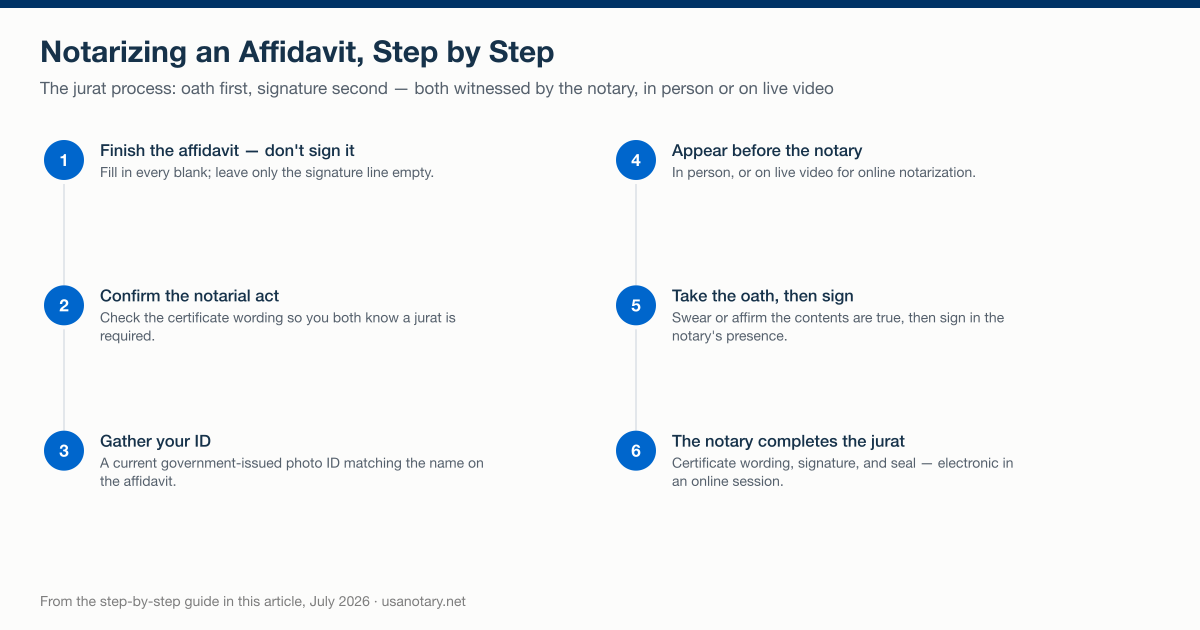
The affidavit notarization process taught in this guide — oath first, signature second, July 2026.
The oath or affirmation: what you’ll actually be asked
The oath is a real, spoken exchange — not a formality buried in the paperwork. The Ohio Secretary of State publishes the exact wording its notaries use for affidavits:
Oath: “Do you solemnly swear that the statements in the affidavit are true, so help you God?”
Affirmation: “Do you solemnly affirm that the statements in the affidavit are true, under penalty of perjury?”
You answer — “I do” or “yes” — and then sign. Ohio law (R.C. 2319.02) requires an oath or affirmation whenever a document is an affidavit or sworn statement, and flags the telltale phrases: “upon oath,” “sworn to and subscribed,” “being duly sworn.”
An oath and an affirmation carry identical legal weight. The oath invokes a higher power; the affirmation is a secular pledge under penalty of perjury. That is why jurat certificates read “sworn to (or affirmed)” — the parenthetical is the accommodation, and the choice is always yours. A notary cannot skip this step: administering the oath or affirmation is one of the elements the jurat certifies, and a jurat completed without one is defective.
Jurat vs. acknowledgment: why affidavits can’t be pre-signed
The “sign in front of the notary” rule is the practical difference between the two acts. In an acknowledgment, the signer acknowledges signing — the document can be signed beforehand, and the signer confirms the signature is theirs. In a jurat, the signer swears the contents are true and signs in front of the notary. Because an affidavit is a sworn statement, it takes a jurat, which is why signing in advance defeats the purpose.
| Document | Usual notarial act | Signer swears contents are true? | Sign in front of notary? |
|---|---|---|---|
| Affidavit / sworn statement | Jurat | Yes | Yes |
| Declaration under oath | Jurat | Yes | Yes |
| Affidavit pre-printed with acknowledgment wording | Acknowledgment | No | Not required |
| Power of attorney | Acknowledgment (varies by state) | No | Not required |
| Deed | Acknowledgment | No | Not required |
If you already signed your affidavit before realizing it needs a jurat, don’t panic — the notary will have you sign again during the session so the act is valid. Ohio’s guidance is representative: asked whether a pre-signed document can take a jurat, the Secretary of State’s answer is “no — the signer must sign in your presence” — the requirement codified in R.C. 147.011(C).
What the notary certifies — and what stays on you
California law makes the division of responsibility impossible to miss. Under Government Code section 8202(b), every jurat attached to an affidavit must carry a legible boxed notice at the top stating:
“A notary public or other officer completing this certificate verifies only the identity of the individual who signed the document to which this certificate is attached, and not the truthfulness, accuracy, or validity of that document.”
That is the entire bargain of notarization in one sentence. The notary’s certificate proves who signed, that they signed in the notary’s presence, and that they were sworn. It proves nothing about whether the statements are accurate. The affiant carries that burden alone — which is precisely what makes an affidavit useful as evidence, and what makes a false one perjury.
For you as a signer, the practical consequences are:
- The notary will not read, review, or correct your affidavit’s contents.
- The notary cannot draft the affidavit or advise you on what it should say — that is legal advice, reserved for attorneys.
- If the facts change after notarization, you cannot amend the affidavit; you prepare and swear a new one.
Can you notarize an affidavit online?
Yes. In remote online notarization (RON), you appear on live video, the notary verifies your identity, administers the oath or affirmation, watches you sign, and applies an electronic jurat certificate — the same elements as an in-person jurat, performed over secure audio-video.
The legal footing is layered but solid. According to the Mortgage Bankers Association’s RON adoption tracking, 45 states and the District of Columbia have enacted laws permitting RON, most following the model bill the MBA and the American Land Title Association developed in 2017. Many state RON statutes are modeled on the Revised Uniform Law on Notarial Acts (RULONA), and the federal ESIGN Act, 15 U.S.C. § 7001, provides that an electronic signature or record may not be denied legal effect solely because it is electronic. A federal bill to standardize RON nationwide — the SECURE Notarization Act, H.R.1777 — has been introduced in Congress but not enacted, so state law still governs where notaries can be commissioned for RON.
That commissioning point matters for the distinction people trip over: per-state RON law governs where a notary can be commissioned, not where you as a signer can receive the service. Because online notarization is a consumer service, it is legally valid in all 50 states — a signer in any state can notarize an affidavit online with a notary commissioned in a RON state.
On USA Notary, online notarization costs $25 per document in all 50 states. A single affidavit is one document; review how a live session works or check pricing before you book. One caution: before your session, confirm the court, agency, or party receiving your affidavit accepts a remotely notarized version, since acceptance depends on their rules, not the notary’s.
Where can you get an affidavit notarized?
Affidavits are among the most commonly notarized documents, so nearly every notary venue handles them. The venues differ in speed, hours, and fit:
| Option | How it works | Best for | Watch out for |
|---|---|---|---|
| Online notarization (RON) | You appear on live video; oath, signature, and electronic jurat completed in one session | Deadlines, odd hours, signers far from the receiving party | Confirm the recipient accepts a remotely notarized affidavit |
| Shipping/print stores (e.g., The UPS Store) | Walk-in or appointment with an in-store notary | Errands you’re already running | Availability varies by location — The UPS Store notes many of its locations do not notarize certain forms (e.g., I-9s); call ahead |
| Banks and credit unions | Branch notary during banking hours | Existing customers | Not every branch staffs a notary; hours are limited |
| Courthouses and law offices | Court clerks or attorney-office notaries | Affidavits being filed with that same court | Limited to business hours; some clerks only notarize court-related documents |
| Mobile notary | A commissioned notary travels to you | Signers who can’t travel; hospital or facility signings | Travel fees add to the base notarial fee |
For an affidavit with a filing deadline, the online path is usually fastest: no appointment window, no travel, and the completed electronic document is returned to you the same session. And if the affidavit belongs to an insurance claim, our insurance claim notarization page covers the carrier-side workflow. For what each venue typically charges, notary fees are capped by state law for in-person acts — the caps and typical totals are a topic of their own.
Common types of affidavits people notarize
The word “affidavit” covers dozens of specific forms. Types that recur in court filings, lending, and everyday administration include:
- Signature and Name Affidavit — in mortgage loan packages, confirms the borrower is signing under their correct legal name (per the NNA, a staple document for Notary Signing Agents).
- Financial affidavit — sworn statement of income, assets, or financial status, common in divorce and support proceedings.
- Affidavit of residence — sworn statement of where you live, often requested by schools or agencies.
- Affidavit of service — sworn statement that legal documents were delivered to a party.
- Small estate affidavit — used in many states to transfer a deceased person’s property without full probate; requirements vary by state.
- Self-proving affidavit — attached to a will, sworn by the witnesses; state execution requirements vary.
- Correction affidavits — Tennessee’s vital records office, for example, uses notarized affidavits to correct errors on birth and death certificates, and specifies the affidavit should state the incorrect data as listed and the data as it should read.
Whatever the label, the notarization mechanics are the same jurat described above: oath, signature in the notary’s presence, certificate. What differs is the content — and state-specific forms (small estate, self-proving) should come from the relevant court or agency, not a generic template. If your affidavit is part of an immigration filing, our guide to notarization for immigration documents covers those forms separately.
Common mistakes that void an affidavit notarization
- Signing before the appointment — a jurat requires signing in the notary’s presence; pre-signing is the single most common error.
- Bringing an expired or mismatched ID — the name on your ID must reasonably match the affidavit; an expired ID can be rejected.
- Leaving blanks in the affidavit — notaries generally will not complete a jurat on a document with empty fields meant to be filled in.
- Wrong notarial certificate — an affidavit that needs a jurat but carries acknowledgment wording (or vice versa) will bounce at the courthouse; check the wording before the session.
- Assuming the notary drafts or reviews the statement — notaries are prohibited from giving legal advice or preparing the affidavit’s content; that is the affiant’s job or an attorney’s.
- Skipping the oath — a jurat without a verbally administered oath or affirmation is defective; if the notary never asked you to swear, the act was not completed properly.
- Skipping confirmation with the receiving party — always verify the recipient accepts a remotely notarized affidavit before you pay for the session.
When you don’t need a notary: unsworn declarations
Federal law carves out one notable substitute. Under 28 U.S.C. § 1746, whenever a federal law or rule requires a sworn affidavit, the matter “may, with like force and effect” be supported by an unsworn written declaration signed as true under penalty of perjury. Executed inside the United States, the statutory wording is: “I declare under penalty of perjury that the foregoing is true and correct,” followed by the date and signature.
The statute has hard limits:
- It applies to federal matters; state courts and agencies set their own rules, and many still require a notarized affidavit.
- It expressly does not cover depositions, oaths of office, or oaths required to be taken before a specified official other than a notary public.
- The receiving party decides in practice — a clerk instructed to collect notarized affidavits will not improvise.
So treat § 1746 as a fallback to ask about, not a default. When the instruction says “notarized affidavit,” the reliable path is the jurat — and the fastest version of that path is a live-video online session that administers your oath, witnesses your signature, and returns the sealed document the same day.