
What does it mean to notarize a letter?
Notarizing a letter means a notary public verifies your identity and confirms your signature on it, then attaches a signed and sealed notarial certificate. The notary is a state-commissioned witness whose job is narrow but specific: to deter fraud by proving the person who signed is who they claim to be. The National Notary Association describes notarization as “the official fraud-deterrent process that assures the parties of a transaction that a document is authentic, and can be trusted” — a three-part process of vetting, certifying, and record-keeping. People notarize letters for consent, authorization, guardianship, hardship, or sworn-statement purposes — and in every one of those cases the notary confirms who signed, not whether the letter’s contents are true. If the term “notarized” itself is new to you, our plain-English guide to what notarization actually proves covers the fundamentals.
That boundary is written directly into the certificate. Under California Secretary of State rules, the disclaimer boxed at the top of the form reads: “A notary public or other officer completing this certificate verifies only the identity of the individual who signed the document to which this certificate is attached, and not the truthfulness, accuracy, or validity of that document.” A notarized letter, in other words, carries a verified signature — not a stamp of approval on what the letter says.
The seal does carry real weight, though. The NNA notes that a notary’s completed certificate and seal render a notarized document “genuine on its face (i.e., prima facie evidence) in a court of law” — which is exactly why courts, lenders, schools, and agencies ask for notarized letters in the first place.
When do you need a letter notarized?
A letter needs notarization when the party receiving it wants assurance that you personally signed it. Common examples include:
- Consent and authorization letters — permission for a minor to travel, medical consent, or authorizing someone to act on your behalf.
- Hardship or financial letters — statements to a lender, court, or agency where the recipient wants a verified signer.
- Sworn statements — a letter where you affirm the contents are true under oath, which functions like an affidavit and needs a jurat.
- Employment, school, and residency letters — confirmations an employer, school, landlord, embassy, or agency asks to be notarized, such as a proof-of-residency letter.
- Guardianship and caregiver letters — temporary authorization for a grandparent, relative, or caregiver to make decisions for a child.
- Beneficiary and financial-instruction letters — instructions to a bank or institution about accounts or distributions, where the institution requires a notarized signature.
For notarizing consent, authorization, and other personal letters online, see our personal document notarization service.
The requester decides whether notarization is needed and which notarial act applies. A notary cannot choose the act for you or advise which one to request — under NNA guidance, a notary “may describe the different types, but you may not make the decision for the signer unless you are a licensed attorney.”
Acknowledgment vs. jurat: which certificate does your letter need?
The right notarial act depends on what the letter has to do. There are two common ones, and they are not interchangeable. In an acknowledgment, the signer acknowledges signing the document. In a jurat, the signer swears the contents are true and signs in front of the notary.
| If your letter… | Notarial act | You sign… | The notary also… |
|---|---|---|---|
| Just needs your verified signature | Acknowledgment | Before or during the appointment | Confirms your identity and that you acknowledge the signature |
| Swears its contents are true | Jurat | In the notary’s presence only | Administers an oath or affirmation, then completes the certificate |
The distinction is precise in state guidance. The California Notary Public Handbook explains that “when preparing a jurat, the person requesting the jurat must appear before you, take an oath, and sign the document in your presence. When preparing a certificate of acknowledgment, the document can be signed before the person brings it to you for notarization.” For an acknowledgment, “the signer must personally appear before you and acknowledge that the signer executed the document, not that the signer executed the document in your presence.”
A jurat also has teeth an acknowledgment does not. Because it involves an oath or affirmation, the NNA notes that “a person who takes an oath or affirmation in connection with an official proceeding may be prosecuted for perjury should he or she fail to be truthful.” Swearing a letter’s contents are true is a legal act, not a formality.
The practical takeaway: if your letter needs a jurat, do not sign it in advance — a jurat requires you to sign in front of the notary. If it needs an acknowledgment, pre-signing is fine. When you are unsure which applies, ask the recipient, and read our full breakdown of how a jurat differs from an acknowledgment before your appointment.
How to prepare your letter before the appointment
Most failed notarizations trace back to the document, not the notary. A notary is expected to check your letter before notarizing it — NNA guidance directs notaries to look for certificate wording, blank spaces, the date, and whether “the name on the ID supports the name in the document.” Prepare accordingly:
- Confirm the notarial act with the requester. Acknowledgment or jurat — the receiving party decides, not the notary.
- Use your legal name, exactly as it appears on your ID. If the letter says “Bob Smith” and your license says “Robert A. Smith,” expect friction.
- Fill in every blank. Notaries check for blank spaces because, as the NNA puts it, “blank documents can be altered later to commit fraud.” Some states mandate that there be no blanks at all.
- Date the letter and keep it complete. The notary dates the certificate with the date of notarization; your letter itself should also be finished, with nothing left “to add later.”
- Include or leave room for the notarial certificate. If your letter has no certificate wording, the notary will attach a separate, loose certificate — and you must tell the notary which type you need. If you don’t know, contact the agency or party receiving the letter.
- Hold your signature if it’s a jurat. Sign only in the notary’s presence.
- Bring current, government-issued photo ID. Details below.
A typical letter headed for notarization is short: a date, a clear statement of what you are declaring or authorizing, your printed legal name, a signature line, and space beneath for the notarial certificate. There is no magic legal wording for the letter body itself — the legal weight comes from the identity verification and the certificate.
How to get a letter notarized in person: 5 steps
The in-person process for a letter mirrors the standard notarization sequence the National Notary Association teaches notaries:
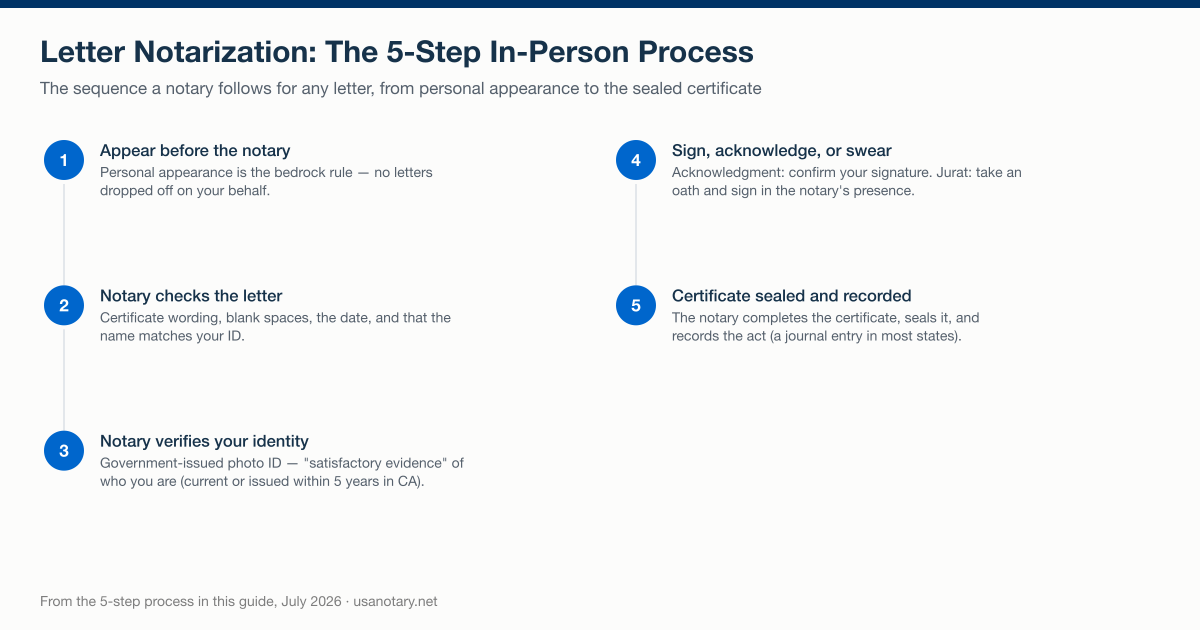
The five in-person steps described in this guide, from appearance to sealed certificate, July 2026.
- Appear in person before the notary. Personal appearance is the bedrock rule — the notary must deal with you directly, not with a letter dropped off on your behalf.
- The notary checks the letter. They scan for certificate wording (which tells them the act), blank spaces, the date, and that the name in the letter matches your ID. They do not read it for content or judge what it says.
- The notary verifies your identity. In California, identity must rest on “satisfactory evidence” as defined by Civil Code section 1185 — an acceptable identification document that is “current or was issued within 5 years,” such as a DMV-issued driver’s license or ID card or a U.S. passport. California notably does not allow notaries to rely on personally knowing you; ID or credible witnesses are required.
- You sign, acknowledge, or swear. For an acknowledgment, you confirm the signature is yours (you may have signed earlier). For a jurat, the notary administers an oath or affirmation and you sign in front of the notary.
- The notary completes the certificate, seals it, and records the act. The certificate’s venue line (“State of …, County of …”) reflects where the notarization happened, and most states require or recommend a journal entry documenting the act.
The same sequence applies to any document, not just letters — our step-by-step guide to notarizing any document walks through it in more detail. If you need a physical location, banks, shipping stores, law offices, and libraries are the usual candidates; our guide to where to get something notarized compares the options, hours, and trade-offs.
How to get a letter notarized online
Remote online notarization (RON) lets you complete the whole process over live video, without finding a walk-in location or scheduling around business hours. On USA Notary the steps are:
- Confirm the act — acknowledgment or jurat — with whoever is requesting the letter.
- Prepare the letter — upload it, and leave it unsigned if it needs a jurat.
- Start a session — you appear on live video with a commissioned notary.
- Verify identity — present a government-issued photo ID and complete identity verification.
- Sign and seal — sign (or acknowledge your signature); the notary administers an oath if it’s a jurat, then applies the electronic seal and certificate.
USA Notary provides notary services online for $25 per document in all 50 states. You can see the full flow on the how online notarization works page, or start a notarization session when your letter is ready.
Is an online notarized letter legally valid?
For the consumer, a remotely notarized letter is available to signers in all 50 states — the electronic notarial act is recognized under federal law even though notary commissioning rules still vary by state, and some states do not yet authorize their own notaries to perform RON. The federal backbone is the ESIGN Act. Under 15 U.S.C. § 7001(a), “a signature, contract, or other record relating to such transaction may not be denied legal effect, validity, or enforceability solely because it is in electronic form.”
ESIGN goes further than the general rule most articles quote. Section 7001(g) addresses notarization directly: where a law requires a record to be “notarized, acknowledged, verified, or made under oath, that requirement is satisfied if the electronic signature of the person authorized to perform those acts, together with all other information required to be included by other applicable statute, regulation, or rule of law, is attached to or logically associated with the signature or record.” An electronic notarial certificate, properly attached, satisfies a notarization requirement under federal law. State-level UETA adoptions reinforce the same principle for records and signatures within each state.
On the state side, notarial statutes — including RON provisions — are increasingly modeled on the Revised Uniform Law on Notarial Acts (RULONA), the Uniform Law Commission’s model act, which is why the process looks consistent across most states. A federal floor for remote notarization, the SECURE Notarization Act (H.R.1777), has been introduced in Congress but not enacted — as of 2026, RON authority still comes from state law.
One practical step still matters: confirm the recipient accepts a remotely notarized letter before you book. The notarization is valid, but an individual agency, court, or foreign consulate may have its own submission format.
How much does it cost to notarize a letter?
In-person notary fees are capped by state law, and the caps are modest. California’s schedule under Government Code section 8211 is typical of how states structure it: $15 per signature for taking an acknowledgment, and $15 for administering the oath and executing a jurat. The handbook also notes a notary “may decide to charge no fee or an amount that is less than the maximum” — which is why some banks and employers notarize at no charge.
| Method | What you pay | What drives the price |
|---|---|---|
| Walk-in notary (bank, shipping store, law office) | State-capped fee per act — e.g., $15 per signature in California | State statute caps the notarial fee; the notary may charge less or nothing |
| Mobile notary (comes to you) | State-capped notarial fee, plus travel-related charges that vary by provider and state | Convenience of the visit, distance, and scheduling |
| Online (RON) on USA Notary | $25 per document, flat | Live video session, identity verification, and electronic certificate included |
For a single letter, the real cost difference is rarely the fee — it’s the trip, the wait, and the business hours. Online notarization on USA Notary costs $25 per document and runs whenever you are ready, with the notary appearing on live video.
Common problems when notarizing a letter (and how to solve them)
- Your letter is handwritten. The notary’s checks are the same whether the letter is typed or handwritten: certificate wording, no blanks, name matches ID, identity verified. A complete, legible handwritten letter can carry a notarial certificate the same way a typed one does. Individual walk-in counters set their own business policies about what they’ll accept, so if one location declines, another notary — or an online session — can usually complete it.
- The letter has no notarial wording. This is normal for letters. Per NNA guidance, the notary will “attach a separate, or loose, Notary certificate” — but you must tell them whether you need an acknowledgment or a jurat. If you don’t know, ask the party receiving the letter before the appointment.
- You already signed it, but it needs a jurat. A jurat must be signed in the notary’s presence, so a pre-signed letter can’t take one as-is. Ask the notary how to proceed — typically you’ll sign again in their presence or bring a clean copy to sign.
- You don’t have acceptable ID. California’s satisfactory-evidence rules allow identity to be established by “the oath of a single credible witness, personally known to the notary public” or “the oaths of two credible witnesses under penalty of perjury” — people who know you and can vouch for your identity. Availability and conditions vary by state; online sessions require the ID-based verification path.
- The only notary you know is a relative. In California, a notary “may notarize documents for relatives or others, unless doing so would provide a direct financial or beneficial interest to the notary public” (Government Code section 8224). If the notary stands to gain from what the letter does, find a disinterested notary. Some states are stricter, so a neutral third party is always the cleaner option.
- You want the notary to help you write the letter. They can’t. A notary who is not an attorney cannot give legal advice — in California, non-attorney notaries who advertise in another language must post a notice stating exactly that: “I am not an attorney and, therefore, cannot give legal advice about immigration or any other legal matters.” Draft the letter yourself, use the requester’s template, or consult an attorney; the notary’s role begins when the letter is finished.
What a notarized letter does not do
A notary seal is easy to overread. It does not make the letter’s statements true, does not make the letter legally binding on its own, and does not give the letter special enforceability. As the certificate disclaimer makes explicit, the notary verifies identity “and not the truthfulness, accuracy, or validity of that document.” Notarization also does not “approve” the letter’s purpose — the notary neither reads it for substance nor vouches for what it asks.
What it does do is narrower and more durable: it attaches a public official’s verification of who signed, backed by an identity check, a certificate, a seal, and (in most states) a journal entry. Whether your letter creates an obligation depends on its wording and the underlying agreement — the notarization simply proves that you, verifiably, are the person who signed it.