
Online Notarization Services
USA Notary notarizes documents online for individuals, businesses, and real estate professionals in all 50 states. You meet a commissioned notary on a live, recorded video call, verify your identity, and sign electronically — $25 per document, most sessions 15–30 minutes, available 24/7. No appointment across town and no mail-in step.
Published July 9, 2026 · Last updated: August 8, 2026 · By Andrew Ray Yon, MBA, ChFC — CEO & Founder, USA Notary
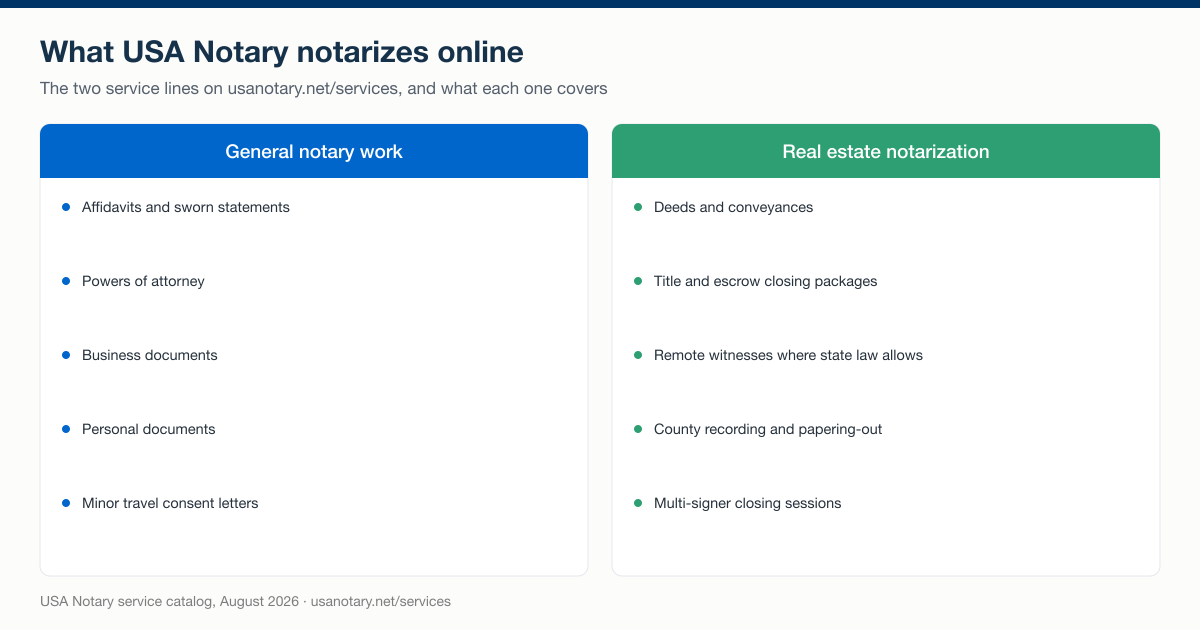
What can USA Notary notarize online?
USA Notary notarizes every document your state allows to be notarized remotely — which excludes wills, codicils and testamentary trusts under federal law, and varies state by state beyond that. If your document carries an acknowledgment or a jurat certificate and is not in an excluded category, a commissioned notary can complete it in one video session.
| Your document | Service track | Typical use |
|---|---|---|
| Affidavit or sworn statement | General notary work | Legal proceedings, identity, financial matters |
| Power of attorney | General notary work | Financial, medical, or legal authority |
| Business contract or corporate resolution | General notary work | Agreements, operating and partnership docs |
| Consent letter or authorization | General notary work | Travel consent, guardianship, personal declarations |
| Deed or title document | Real estate notarization | Property transfers and recordings |
| Mortgage or closing package | Real estate notarization | Remote closings and loan signings |
Which documents are excluded, and where?
Two rules exclude documents, and they stack. Federal law comes first: 15 U.S.C. § 7003(a) holds that the ESIGN Act's electronic-records rules do not apply to law "governing the creation and execution of wills, codicils, or testamentary trusts," to state law "governing adoption, divorce, or other matters of family law," or to most of the Uniform Commercial Code (retrieved August 8, 2026). State RON statutes then add their own carve-outs, which differ — a document a notary may handle remotely in one state can be off-limits across a state line.
The practical gate is often neither: it is whether the bank, lender, consulate or registrar receiving the document accepts a remote notarization at all. Ask them before you book — how remote online notarization works covers both gates in detail, and where RON is authorized has the state-by-state position.
How long does one notarization take, end to end?
Most sessions run 15–30 minutes from upload to download — and identity verification is the step that varies. The notary's part is quick and predictable; proving who you are to a third-party verification service is the part that can take a signer five minutes or twenty.
- 1Upload — the complete document, in final form, with its notarial certificate wording already on it.
- 2Verify identity — credential analysis of your photo ID, then knowledge-based authentication. This is the variable step.
- 3Meet the notary on live video — the recording starts, the notary confirms your ID and your understanding of the document.
- 4Sign and seal — you sign while the notary watches, then the notary completes the certificate and applies the electronic seal.
- 5Download — tamper-evident sealed, with the audit trail attached.
What makes ID verification take longer for some signers?
Knowledge-based authentication draws its questions from public and commercial records about your own history, so the signers who slow down are the ones whose records are thin or recently changed: a signer who moved in the last few months, who shares a name with a parent or child, who has little credit history, or who is being asked about a mortgage refinanced years ago. None of that means anything is wrong — it means the record trail is harder to match.
Two things shorten it: a current, undamaged government photo ID that matches the name on the document, and good light on the camera when you capture it. See what knowledge-based authentication asks and how credential analysis reads your ID, or walk the full remote online notarization process step by step.
What do you need before you start a session?
Four things, and the document is the one people get wrong. A notary cannot add missing certificate wording, cannot fill blanks, and cannot notarize a signature that already exists on the page.
- A valid government-issued photo ID — unexpired, undamaged, and matching the name on the document.
- The complete document, unsigned — every page, in final form, with the acknowledgment or jurat wording already on it and no blanks left to fill.
- A device with a camera and microphone, on a connection stable enough to hold live video — phone, tablet, or computer, in a browser.
- Every signer, available at the same time — each one verifies their own identity and appears on the same session.
Not sure your document carries the right certificate? The difference between a jurat and an acknowledgment is the thing to check, and how to get a document notarized walks the whole preparation.
Which documents will get declined, and what happens to my $25?
A notary must refuse in situations that have nothing to do with the platform — they are conditions of the commission itself, and they apply to a bank branch notary and an online notary identically. A session ends without a notarization when:
- Identity cannot be established — the ID fails credential analysis, or the signer does not clear knowledge-based authentication.
- The document has no notarial certificate — a notary may not choose the certificate wording for you; that is a legal decision belonging to you or your attorney.
- Pages are missing or blanks remain that affect the document's intent.
- A required signer is absent, or a signer will not or cannot appear on camera.
- The signer does not appear to understand what they are signing, or is not signing willingly.
- The document is in an excluded category — see the federal and state exclusions above.
Beyond those universal refusals, USA Notary has not published a platform-specific list of document types it will not accept, or a refund rule for a session that cannot be completed. If your document is unusual, or if you are unsure whether it qualifies, settle it before you pay: contact the team or call 804-767-7500 and describe the document first.
Most declines are preventable at the preparation stage, which is why the checklist above matters more than it looks. If a remote session is not the right route at all, the honest alternatives are on where to get something notarized in person.
How many signers and witnesses can join one session, and do you supply the witnesses?
Multiple signers can join one remote session, and each one verifies their own identity separately before the notary begins — a session with two signers is two identity checks, not one shared check. Remote witnesses are supported where state law and the document's own rules permit them; that caveat is doing real work, because witness requirements come from the document and the state, not from the platform.
USA Notary has not published a maximum number of signers per session, whether it can supply a witness, or any additional fee for extra participants. A multi-signer or witnessed signing is worth arranging in advance rather than discovering the answer mid-session: contact the team with the document type and the number of people involved.
Whether your document needs a witness at all is a separate question with a state-by-state answer — see do I need a witness to notarize a document? and, for property documents, deed witness requirements by state.
Should you use general notary work or real-estate notarization?
Use real-estate notarization if the document is part of a property transaction — the notarization is the same act, but the closing has parties, deadlines and recording rules around it. Everything else is general notary work.
General Notary Work
Day-to-day notarial acts for personal and business life: affidavits and sworn statements, powers of attorney, contracts, and consent forms. This is the right track for most one-off documents.
Real Estate Notarization
Purpose-built for property transactions: remote closings, out-of-state signers, deeds, title documents, and loan packages, with the compliance and audit trails title and escrow teams expect.
Notarizing at volume for an organization? USA Notary supports title & escrow teams, law firms, and nine other industries. Still unsure which applies? Ask our team or see the $25-per-document pricing breakdown.
Frequently Asked Questions
What online notarization services does USA Notary offer?
USA Notary provides remote online notarization across two focused tracks: general notary work — affidavits, powers of attorney, business agreements, and personal documents — and real estate notarization for deeds, closings, and loan packages. Every service is completed over a live, recorded video session with a commissioned notary.
What types of documents can you notarize online?
Commonly handled documents include affidavits and sworn statements, general and durable powers of attorney, business contracts, operating and partnership agreements, corporate resolutions, consent and authorization forms, declarations, and real estate items such as deeds, title documents, mortgage paperwork, and closing packages. If a document requires an acknowledgment or jurat, it can typically be notarized online.
How much does online notarization cost?
Individual notarizations start at $25 per document, which includes identity verification, the live video session with a commissioned notary, the electronic seal, and a complete audit trail. Businesses and high-volume notaries can use subscription plans instead. See the pricing page for the current breakdown.
How fast can I get a document notarized?
Most sessions are completed in 15 to 30 minutes once your identity is verified. You verify your ID, meet the notary on live video, review the document, and e-sign — there is no travel and no mail-in step, so time-sensitive documents can be handled the same day.
Is online notarization legally valid?
Yes. Remote online notarization is authorized by permanent law in most U.S. states, and a document notarized under a commissioned RON notary's state law is generally recognized across the United States. A few states still restrict RON for specific transactions, so confirm what your state accepts.
Do I need to install any software?
No. Sessions run in a web browser and work on desktop, tablet, and mobile devices. You need a device with a camera and microphone, a stable internet connection, and a valid government-issued photo ID for identity verification.
Can businesses and title companies use these services?
Yes. Title and escrow teams, law firms, financial institutions, and healthcare organizations use the platform for compliant remote signings at scale, with recorded sessions and audit trails built into every notarization.
Sources
- 15 U.S.C. § 7003 — Specific exceptions (ESIGN Act), Cornell Legal Information Institute — retrieved August 8, 2026
This page describes USA Notary's services and is general information, not legal advice. State remote-notarization rules change; confirm current requirements with your state's notary authority and with the party receiving your document.
About the author
Andrew Ray Yon, MBA, ChFC
CEO & Founder, USA Notary Services LLC
Andrew Ray Yon is the founder and CEO of USA Notary Services LLC and the architect of the SharpNote remote online notarization platform. A Certified Notary Signing Agent since 2005, he has handled mortgage and title loan signings for two decades — personally completing more than 10,000 notarizations — and holds an MBA and the ChFC (Chartered Financial Consultant) designation. Based in Virginia’s Greater Richmond region, he leads the company’s strategy, compliance, and platform development.
Connect on LinkedInReady to Get Started?
Have your photo ID and the complete, unsigned document ready — $25 per document, most sessions 15–30 minutes, available to signers in all 50 states.
Questions? Contact our team or call 804-767-7500