
Which states require witnesses on a deed?
Five states build witnesses into deed execution: Florida, South Carolina, Connecticut, Louisiana, and Georgia. Deed witness requirements by state come down to a short list of statutes — Fla. Stat. § 689.01 requires two subscribing witnesses, S.C. Code § 27-7-10 requires two or more credible witnesses, C.G.S. § 47-5 requires attestation by two witnesses, Louisiana’s authentic act requires a notary plus two witnesses, and Georgia requires an attesting officer plus one other witness. Everywhere else, the deed is recorded on the grantor’s notarized, acknowledged signature — no extra names on the signature page.
One sense-pin before the table, because “witness” carries several meanings in signing law. This guide covers subscribing (attesting) witnesses — the people who watch the grantor sign the deed and add their own signatures to the document. That is a different role from a credible identifying witness, who vouches for a signer’s identity to the notary; the five witness roles are mapped in our guide to whether you need a witness to notarize a document. The notarization itself — the acknowledgment the notary certifies — is covered in our walkthrough of notarizing a deed. Witnesses sit on top of notarization in the five states below, not instead of it.
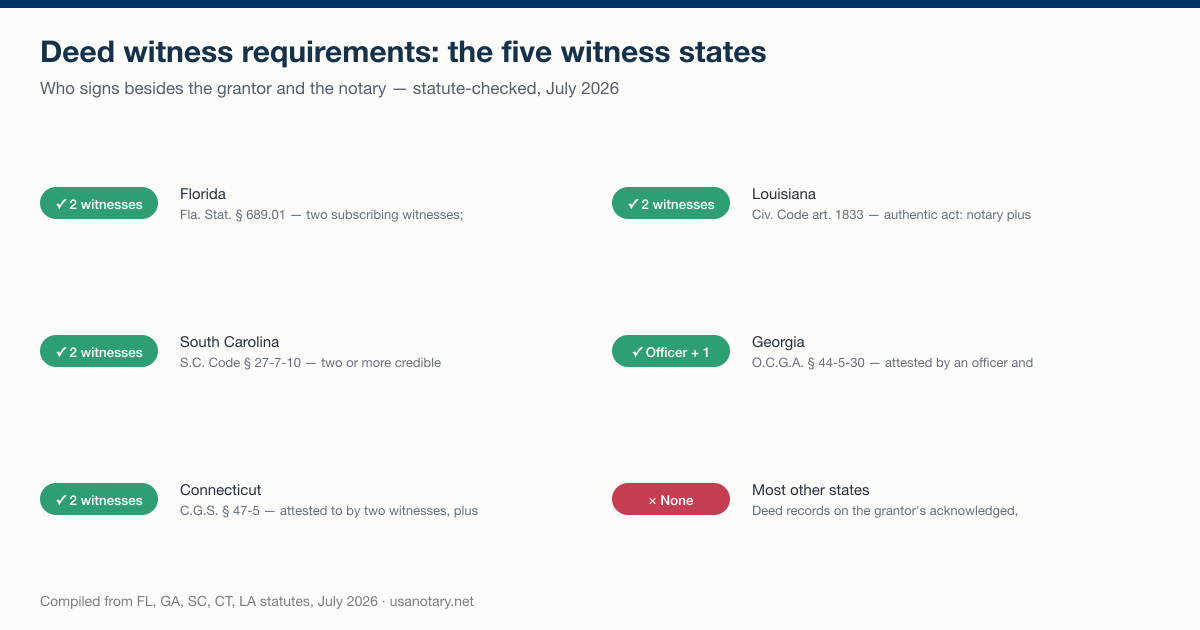
The statute-checked verdicts from this article’s state table — five states put witnesses on the deed’s signature page, July 2026.
Here is the state-by-state picture, checked against current statute text:
| State | Witnesses required | What the statute says |
|---|---|---|
| Florida | Two | Fla. Stat. § 689.01: signed “in the presence of two subscribing witnesses”; leases exempt; witnesses may sign electronically by audio-video communication technology |
| South Carolina | Two | S.C. Code § 27-7-10: executed “in the presence of and be subscribed by two or more credible witnesses” |
| Connecticut | Two | C.G.S. § 47-5: “attested to by two witnesses with their own hands,” on top of writing, subscription, and acknowledgment |
| Louisiana | Two (authentic act) | La. Civ. Code art. 1833: an authentic act is executed before a notary public “in the presence of two witnesses,” signed by each party, each witness, and the notary |
| Georgia | Officer + one | O.C.G.A. § 44-5-30: attested by an officer under § 44-2-15 and “by one other witness” |
| Most other states | Generally none | Recording statutes rely on the grantor’s acknowledged signature; no subscribing witnesses on the deed itself |
An honest caveat on that last row: this table covers the states where the witness question actually turns, and deed-execution statutes get amended. When a specific file raises the question, the controlling text is the current statute, linked in each row.
Florida deed witness requirements: two subscribing witnesses
Florida requires two subscribing witnesses on a deed — the strictest and most litigated witness rule in the country. Fla. Stat. § 689.01 requires an instrument conveying real estate to be “signed in the presence of two subscribing witnesses by the party creating, making, granting, conveying, transferring, or releasing such estate.” Two features of the current statute matter for anyone planning a signing:
Leases are carved out. The statute states that “no subscribing witnesses shall be required for a lease of real property or any such instrument pertaining to a lease of real property.” The two-witness rule targets conveyances — deeds — not lease paperwork.
The witnesses can be electronic. Since Florida modernized its execution law alongside online notarization, § 689.01(2)(a) allows the witness requirement to be satisfied by “witnesses being present and electronically signing by means of audio-video communication technology, as defined in s. 117.201.” Florida wrote remote witnessing directly into its deed statute — the mechanics live in § 117.285, covered below.
Subsection (3) adds a recording backstop: once such an instrument is recorded, it “may not be denied to have provided constructive notice based on any alleged failure to have strictly complied with this section or the laws governing notarization of instruments, including online notarization.” Recording a properly witnessed, properly notarized Florida deed closes the door on later constructive-notice attacks.
Who can serve as a Florida witness? Section 689.01 does not restrict who the two subscribing witnesses may be — no age, residency, or disinterest qualifications appear in the conveyance statute — which is why the practical vetting (can the closing staff witness? can a family member?) usually follows the title underwriter’s instructions rather than a statutory list.
Georgia: an attesting officer plus one other witness
Georgia requires a deed to be attested by an officer and by one other witness — the state’s signature quirk. O.C.G.A. § 44-5-30 sets the requisites of a deed to lands: an original document, in writing, signed by the maker, “attested by an officer as provided in Code Section 44-2-15,” attested “by one other witness,” and delivered. In practice that means two attesting signatures beyond the grantor’s: the official witness (almost always the notary) and the unofficial witness (any other individual).
O.C.G.A. § 44-2-15 lists who counts as the officer: a judge of a court of record, a magistrate, a notary public, or a clerk or deputy clerk of a superior court (or of a city court created by special Act). One geographic detail worth knowing: “With the exception of notaries public and judges of courts of record, such officers may attest such instruments only in the county in which they respectively hold their offices.” The notary is the portable option.
The out-of-state seller: § 44-2-21
Georgia planned for the seller who is nowhere near Georgia. O.C.G.A. § 44-2-21 provides that a deed executed outside the state may be attested by a U.S. consul or vice-consul, a judge or clerk of a court of record, or “a notary public or justice of the peace of the county or city of the state” where the deed is executed. Subsection (b) keeps the two-signature arithmetic: “A deed to realty must be attested by two witnesses, one of whom may be one of the officials named in subsection (a).” A Texas seller conveying Georgia land signs before a Texas notary plus one other witness, and the deed is recorded in Georgia. Whether a remotely notarized out-of-state acknowledgment satisfies a given underwriter is a file-level question — the interstate-recognition rules are unpacked in our guide to whether a remote notarization is valid out of state.
The 2025 tightening: HB 1292
Georgia also raised the execution stakes recently. Per The National Law Review’s summary of HB 1292, starting January 1, 2025, Georgia notaries must keep a journal for notarial acts performed for “self-filers” submitting real estate documents without professional affiliation, must verify identity against government-issued photo identification (or personal knowledge) rather than the old “satisfactory evidence” standard, and must complete training before appointment and at each renewal. Deed execution in Georgia is getting more formal, not less — one more reason witness planning happens before the signing.
South Carolina, Louisiana, and Connecticut rules
Each of the remaining three witness states requires two witnesses, and each arrives there by a different legal route.
South Carolina: two credible witnesses, then prove it to record
South Carolina’s conveyance form statute, S.C. Code § 27-7-10, requires a deed to be “executed in the presence of and be subscribed by two or more credible witnesses.” The witnesses then do double duty at the courthouse: under S.C. Code § 30-5-30, before a deed is recorded its execution “must be first proved by the affidavit of a subscribing witness to the instrument,” or acknowledged by the grantor “in the presence of two witnesses.” In South Carolina the witness signatures are not ceremony — they are the recording clerk’s proof that the deed was actually executed.
Louisiana: two witnesses on the authentic act
Louisiana frames the rule through its civil-law form of execution. La. Civ. Code art. 1839 states that “a transfer of immovable property must be made by authentic act or by act under private signature,” and that an instrument involving immovable property “shall have effect against third persons only from the time it is filed for registry in the parish where the property is located.” Executed as an authentic act — the notarial form — the deed requires what art. 1833 spells out: a writing “executed before a notary public or other officer authorized to perform that function, in the presence of two witnesses, and signed by each party who executed it, by each witness, and by each notary public before whom it was executed.” Three non-party signatures: notary, witness, witness.
Connecticut: two attesting witnesses among four requirements
Connecticut’s C.G.S. § 47-5 stacks four execution requirements on every conveyance of land: it must be (1) in writing, (2) subscribed by the grantor personally, by mark, or by a duly authorized agent, (3) acknowledged by the grantor as a free act and deed, and (4) “attested to by two witnesses with their own hands.” Acknowledgment and attestation are separate boxes — a Connecticut deed needs both the notary’s certificate and the two witness signatures.
Can the notary double as a witness on a deed?
Sometimes — the answer is state-arithmetic, not a universal rule. In Georgia, the notary is not merely allowed to be a witness; the notary is the official witness. Section 44-5-30’s structure — officer plus “one other witness” — means the notary’s attestation counts as one of the two, and § 44-2-21(b) says it outright for out-of-state executions: two witnesses, “one of whom may be one of the officials.” A Georgia deed signing therefore needs the notary plus exactly one more person.
In Louisiana, the opposite: art. 1833 requires the act to be signed by each party, “by each witness, and by each notary public” — the notary and the two witnesses are three separate signatures. A Louisiana authentic act cannot fold the notary into the witness count.
For Florida, South Carolina, and Connecticut, the conveyance statutes quoted above impose the witness count without saying whether the notary may pull double duty, so the safe practice question belongs to the notarization side of the law and the underwriter’s instructions. The general rules — including when a notary can and cannot serve as a witness to the document being notarized — are covered in our companion guide on witnesses at a notarization.
How do witnesses work in a remote online notarization?
Remote witnessing is possible where state law and the document’s rules permit — and Florida is the state that wrote the playbook into statute. Fla. Stat. § 117.285 governs witnessing when a Florida electronic record is notarized online, and its rules answer the questions title agents actually ask:
- Where the witness stands. “The witness may be in the physical presence of the principal or remote from the principal provided the witness and principal are using audio-video communication technology.” Both configurations are legal — witness in the room with the signer, or witness on the video session from somewhere else.
- How a remote witness is identified. For a witness appearing by audio-video technology, “the principal’s and witness’s identities must be verified in accordance with the procedures for identifying a principal” — the remote witness clears the same identity verification as the signer. A witness physically present with the signer instead confirms identity by stating name and current address on the audio-video recording.
- Where the witness must be. A remote witness must “verbally confirm that he or she is a resident of and physically located within the United States or a territory of the United States.”
- Which documents get stricter treatment. Section 117.285(5) imposes extra limits when fewer than two witnesses are physically present with the principal — but that subsection targets wills, trusts with testamentary aspects, health care directives, spousal-rights waivers, and certain powers of attorney. Deeds are not on that list.
On our platform, remote witnesses are supported where state law and the document’s rules permit. Sessions handle multiple signers, so a Florida seller, two witnesses, and the notary can all appear in one recorded video session — the signer’s identity is verified through credential analysis and knowledge-based authentication run by a third-party identity-verification service, and the session produces a tamper-evident PDF plus a complete audit trail, with the audio-video recording and electronic journal retained for 10 years or longer where state law requires. For the closing-package context around the deed — what else in the seller’s stack is notarized, and how a full remote closing runs — see our guide to online notarization for a real estate closing.
One discipline point: the platform fact and the legal fact are separate. The platform can put a witness on the video session; whether that satisfies your state’s deed statute is the § 689.01-style question this article exists to answer. Florida says yes by statute. Georgia routes through the out-of-state execution rule. For any other witness state, the session is planned around the statute — never the reverse.
What happens when a deed is recorded without the required witnesses?
A missing witness is an execution defect that outlives the closing — but at least one state runs a statutory clock on it. Florida’s curative statute, Fla. Stat. § 95.231, provides that once a defective instrument has been on record for five years, it “shall be held to have its purported effect to convey, affect, or devise, the title to the real property of the person signing the instrument, as if there had been no lack of seal or seals, witness or witnesses” — in the absence of fraud, adverse possession, or pending litigation. Translation: a Florida deed short one witness is a title problem for five years, then the record heals it.
South Carolina’s structure makes the defect surface earlier. Because § 30-5-30 requires execution to be proved by a subscribing witness’s affidavit (or a two-witness acknowledgment) before the deed is recorded, a deed with no witnesses has no one to make the proof — the recording prerequisite itself fails. The witness requirement in South Carolina is not just about validity arguments later; it is the gate at the recorder’s desk.
For the title team, the operational lesson is identical in every witness state: the cost of a witness defect is a re-execution — tracking down a seller who may have moved, re-signing, re-recording — plus whatever the title insurer requires in the meantime. Witness planning costs minutes before the session; a witness defect costs weeks after it.
How title teams handle witness states on out-of-state seller files
Witness-state files fail at the logistics, not the law — the statute tells you exactly who must sign; the hard part is getting those people in front of the deed when the seller is three states away. The traditional answer is the courier round-trip: ship the package, hope the seller finds a notary and two bystanders willing to sign, wait for the originals. The remote answer compresses that into one scheduled video session.
Here is how the file runs on our platform. The escrow officer opens a staff-initiated session — business-initiated workflows mean your team, not the signer, controls document upload and timing. Sessions run 24/7 and take 15–30 minutes, so a witness-state deed signing books around the seller’s calendar, not a notary’s office hours. Where state law and the document’s rules permit, the witnesses join the same multi-signer session; Florida’s § 117.285 procedure, with its identity-verified remote witnesses, is the model case. The deed comes back as a tamper-evident PDF with a complete audit trail — and per the National Association of Secretaries of State, 47 states and the District of Columbia have a law allowing remote e-notarization, so the notarization layer itself is available almost everywhere your sellers are.
Pricing is flat: $25 per document, with volume pricing for teams that run seller packages every week. Title and escrow operations that want witness-state files handled as a standing workflow — Florida seller deeds, Georgia out-of-state executions, South Carolina witness proofs — can set that up through our online notarization service for title and escrow teams.
The rule to remember: the witness requirement travels with the land, not the signer. A Florida deed needs Florida’s two witnesses no matter where the seller sits. Check the statute for the state where the property is recorded, plan the witnesses before the session, and the deed is recorded on the first pass — the recorder-desk side of that story, e-recording and papering out included, is covered in our guide to recording a remotely notarized deed. Questions about a specific file? Call 804-767-7500 or contact us.