
Can you close on a home with online notarization?
Yes — in states that authorize remote online notarization (RON), the notarized documents in a real estate closing are signed and notarized over live video, and the format has moved from pandemic workaround to mainstream option. The National Association of Secretaries of State reports that “47 states and the District of Columbia have a law that allows for remote e-notarization,” and the notarization platform Proof reports that RON is legal in 49 states and DC as of 2026 — counts differ by source and by what each counts as authorization. Proof identifies California as the last outlier; California’s online-notary provisions become operative when the Secretary of State completes its technology project or on January 1, 2030, whichever is earlier, unless the Secretary tells the Legislature and the Governor in writing by January 1, 2029 that the project will not be completed.
For the wider trend, our report on digital closing adoption tracks eNotes at 15.19% of MERS-registered loans as of January 2026 (ICE) against fully digital closings at 2.5% of 2022 transactions (ALTA).
Adoption followed the law. Proof’s remote-closing guide reports that during the pandemic, the number of title and settlement companies offering digital closings increased by 228%, and the number of remote online notarizations for real estate transactions grew by 547%. Those are provider-reported figures, but the direction is unambiguous: a fully remote closing is no longer exotic.
Two things stay distinct here. A document notarized under a state’s RON law is legally valid and should be recognized across state lines — that side of RON works nationwide. Whether a notary can be commissioned to perform RON, though, depends on the state. The legal backbone is older than RON itself: under the federal ESIGN Act (15 U.S.C. § 7001), an electronic signature or record may not be denied legal effect solely because it is electronic, and most RON statutes are modeled on the Revised Uniform Law on Notarial Acts (RULONA), which the Uniform Law Commission amended in 2018 and 2021 to permit notarization over audio-visual technology.
Because a closing has more moving parts than a single notarization, “can I do it online?” really breaks into three questions: does the notary’s state allow it, do your lender and title company accept it, and will the county record the result?
In this guide:
- The three gates for a RON closing
- RON vs. hybrid vs. IPEN vs. RIN: four closing formats compared
- What a RON closing looks like, step by step
- How the notary verifies your identity
- Do lenders, Fannie Mae, and title companies accept RON closings?
- Which documents in a closing get notarized?
- The recording step people miss
- Closing from a different state than the property
- What a RON closing costs
- Before you schedule: a five-point checklist
The three gates for a RON closing
A RON closing clears three approval gates, each controlled by a different party. Miss any one and the closing reverts to a hybrid or in-person format.
| Gate | Who decides | What to confirm |
|---|---|---|
| Is RON allowed? | The notary’s commissioning state | The notary holds a RON authorization and your document type is eligible |
| Is it accepted? | Lender + title company | They approve a RON closing for your loan and investor |
| Will it record? | The property’s county recorder | The county accepts remotely notarized deeds |
The first two gates are increasingly routine — the secondary mortgage market and the title industry have both built RON into their standards, as covered below. The third gate — recording — is the one that most often surprises people, because county recorders set their own rules and some are stricter than others about remotely notarized deeds.
RON vs. hybrid vs. IPEN vs. RIN: four closing formats compared
A fully remote closing is one of four digital closing formats. First American’s eClosing guidance defines all four, and your title company will steer you to the one your state and loan allow.
| Format | Where you sign | Notary present how | Documents | When it’s used |
|---|---|---|---|---|
| RON (remote online notarization) | 100% online, from anywhere | Live video session | Fully electronic, eSigned and eNotarized | State authorizes RON and lender/title accept it |
| Hybrid | Non-notarized docs online in advance; notarized docs in person | Physically present for the notarized documents | Mixed: eSigned package + ink-signed recordable documents | Common today; a workable fallback everywhere |
| IPEN (in-person electronic notarization) | In person, typically on a shared tablet | Physically present | Fully electronic | State allows e-notarization but not remote |
| RIN (remote ink-signed notarization) | Remote — you ink-sign paper on webcam | Watches by live video; documents mailed back for ink notarization | Paper | Limited states/situations where RON isn’t available |
A hybrid closing is the pragmatic fallback: you e-sign everything that doesn’t need a notary before closing day, then sign the deed and key loan documents in front of a notary. RON is the only format of the four that lets you finish the entire closing without leaving home — which is why it’s the one real estate notarization online is built around.
What a RON closing looks like, step by step
A RON closing adds a few preparation steps to an ordinary closing, then compresses signing day into a single video session.
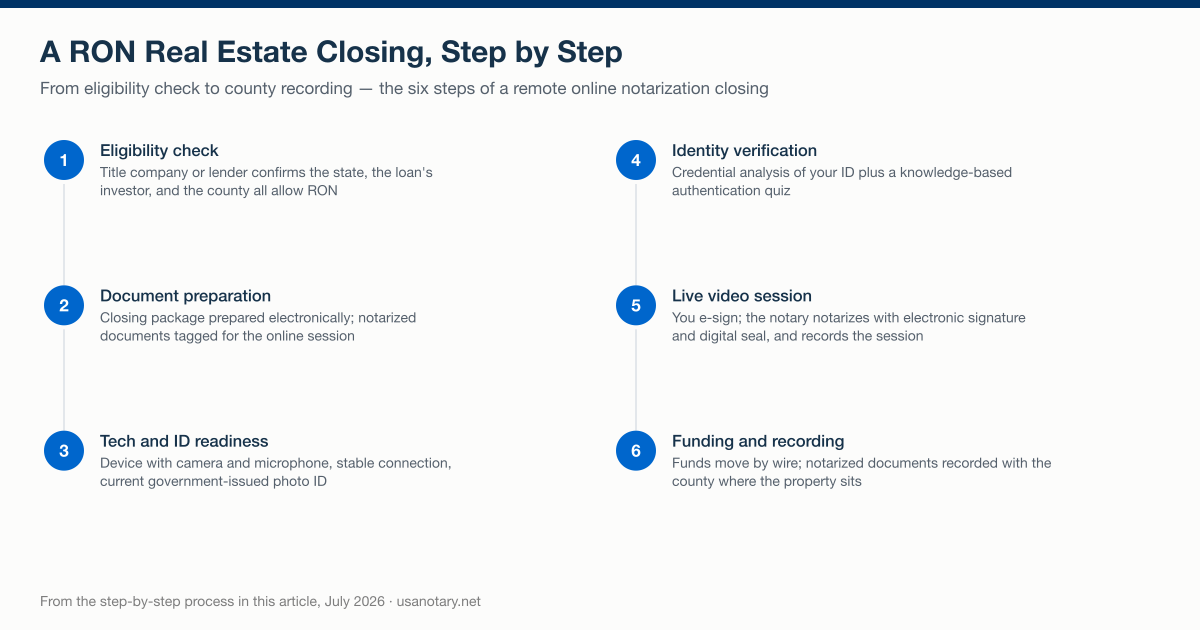
The six steps of a RON closing described in this guide, July 2026.
- Eligibility check. The title company or lender confirms the transaction qualifies for RON — the state authorizes it, the loan’s investor accepts it, and the county will record the result.
- Document preparation. The closing package is prepared electronically, with the notarized documents tagged for the online notary session.
- Tech and ID readiness. You’ll need a device with a camera and microphone, a stable connection, and a current government-issued photo ID.
- Identity verification. Before or at the start of the session, the platform runs credential analysis on your ID and a knowledge-based authentication quiz — the details are in the next section.
- The live video session. The signer appears on live video with the commissioned online notary. You e-sign the closing documents; the notary notarizes the deed and required loan documents with an electronic signature and digital seal, and records the session.
- Funding and recording. Funds move by wire transfer, and the notarized documents are returned for recording with the county where the property sits.
Nothing about the underlying notarial acts changes. The deed still typically carries an acknowledgment — the grantor acknowledges signing — and any sworn document still uses a jurat, where the signer swears the contents are true and signs in front of the notary, with “in front of” satisfied by the live video appearance under the state’s RON law.
RON closing vs. traditional closing at a glance
| Traditional closing | RON closing | |
|---|---|---|
| Where you appear | At the closing table, in person | Anywhere — the signer appears on live video |
| Documents | Paper, ink-signed | Electronic, eSigned and eNotarized |
| Identity check | Notary inspects your photo ID in person | Credential analysis + knowledge-based authentication + live video observation |
| Notary’s seal | Physical stamp or embosser | Electronic signature and digital seal |
| Record of the act | Notary’s journal entry | Journal entry plus the audio-visual session recording |
| Scheduling | All parties coordinate one time and place | Session scheduled online; parties can be in different states |
The identity check is the striking difference: a RON signing is arguably more documented than a table signing, because the automated ID validation, the KBA quiz, and the session recording all leave evidence a paper closing never generates.
How the notary verifies your identity
Identity proofing is the core of RON’s legitimacy — it’s what regulators demanded in exchange for removing the physical meeting. The National Association of Secretaries of State names the two standard methods: credential analysis and knowledge-based authentication (KBA), layered with security measures for the audio-video communication itself.
- Credential analysis runs your government-issued photo ID through automated validation — checking its security features and data against issuing standards — rather than relying on a notary eyeballing a card over video.
- Knowledge-based authentication is a timed quiz built from public- or private-record data about you, with questions you never pre-answered. States set the bar by rule: Ohio’s administrative rule (Ohio Admin. Code 111:6-1-05), for example, requires a minimum of five questions, each with at least five answer choices, at least 80% answered correctly, and all questions answered within two minutes.
- The recorded session itself is the third layer: the notary observes you on live video, and the audio-visual recording preserves the appearance.
This layered identity proofing is a principal reason lenders and title insurers accept RON. First American’s eClosing guidance is blunt about the stakes, warning that “laws and processes that lack these consumer safeguards present undue risk to title insurers and consumers alike.”
Do lenders, Fannie Mae, and title companies accept RON closings?
The secondary mortgage market answered this directly. Fannie Mae’s Selling Guide (A2-4.1-03) states that Fannie Mae “accepts delivery and servicing of loans with electronic documents, including security instruments or mortgage loan modification agreements that have been electronically notarized, either in person or remotely using real-time, two-way audio/video communication.” The conditions matter: the notarization must be legally valid under the laws of the state where it is performed, and the RON platform must meet requirements including compliance with the MISMO RON Standards and maintained audit trails. The same Selling Guide language names loan modification agreements; whether one needs a notary at all is covered in loan modification notarization rules.
The same guide adds a borrower protection worth knowing: “a lender may not require a borrower to use remote notarization and must have other notary options available for borrowers upon request.” RON is your option to choose, not the lender’s to impose. For the lender’s side of the equation, see our notary solutions for mortgage lenders.
On the title side, First American reports that the Mortgage Bankers Association (MBA) and the American Land Title Association (ALTA) proposed model RON legislation precisely to bake consumer safeguards into state laws — the industry drafted the guardrails it needed before scaling adoption. In practice, title and escrow teams now coordinate RON signings as a standard workflow: verifying state authorization, matching the signing to lender and investor requirements, and routing documents to recording.
None of this makes acceptance automatic for your deal. A lender or title company sets its own policy, and some transactions or investors still require in-person signing or a specific closing format. Confirm your specific lender and title company accept a RON closing before you schedule it.
Which documents in a closing get notarized?
Not everything in a closing package needs a notary. Typically the notarized documents are:
- The deed — the instrument that transfers the property, usually notarized with an acknowledgment, where the grantor acknowledges signing. (For the mechanics, see how a deed gets notarized.)
- The mortgage or deed of trust — the security instrument the lender records against the property; this is the “security instrument” Fannie Mae’s remote-notarization policy covers. For the loan-package breakdown, see which mortgage documents require notarization.
- Selected loan documents and affidavits that require notarization; the promissory note and many other documents are signed but not notarized. The contract’s addenda — the pre-drafted attachments riding on the purchase agreement — follow the signature rule of the document they attach to.
A loan signing agent — the professional who runs the signing — guides the borrower through which documents need a notary and which don’t, in person or on the RON platform. See what a loan signing agent does.
The recording step people miss
Recording is where a remote closing can stall even after a flawless signing. A deed has to be recorded with the recorder in the county where the property sits, and that county recorder — not the notary, the lender, or the title company — decides whether it will accept a remotely notarized deed. Many now do, but acceptance and formatting requirements still vary locally, and a rejected deed at recording can hold up the whole transaction.
Three practical points:
- Confirm before you schedule, not after you sign. Ask the title company to verify the property’s county records remotely notarized deeds — they handle this county-by-county question constantly.
- Electronic recording and RON are separate questions. A county may e-record documents but still have particular requirements for remotely notarized ones, or vice versa; the title company matches the document format to the county’s practice.
- There is still no nationwide RON standard. The SECURE Notarization Act (H.R.1777) would set federal minimum standards and interstate recognition, but it has been introduced in Congress, not enacted — NASS notes a bipartisan House companion (H.R. 1777) was introduced as well. Until something passes, RON acceptance remains a patchwork of state statutes and county practice.
Closing from a different state than the property
RON’s biggest practical payoff is geographic: the signer, the notary, and the property can all be in different places. The rule of thumb that keeps this straight — the notary’s commissioning state law governs whether and how the remote notarization can be performed, while the property’s state and county govern what gets recorded and how.
That is why an out-of-state buyer can complete a closing for, say, a Florida property from a kitchen table in Colorado: the notarization is performed under the online notary’s state law, and the resulting document is then recorded where the property sits. Whether a remotely notarized document holds up when it crosses state lines is its own question — covered in detail in is a remote notarization valid in another state? — but the short version is that recognition doctrines and RON statutes are built to make properly performed out-of-state notarizations stick.
The same logic serves sellers who have already moved, buyers relocating for work, and parties splitting one closing across multiple locations. The constraint to check is the same three gates as always: state authorization, lender and title acceptance, and county recording.
What a RON closing costs
The notarization itself is the small line item in a closing, and the pricing is simple: on USA Notary, online notarization costs $25 per document. A closing package typically has a handful of notarized documents — the deed plus the security instrument and selected affidavits — so the notarization cost is knowable up front, unlike many closing fees.
Title companies and lenders may package signing services differently within their own fee structures, so the number on your Closing Disclosure reflects your specific transaction. For a standalone notarization need — a deed, a power of attorney for the closing, a seller-side document — real estate notarization online handles the single-document case without a full closing apparatus.
Before you schedule: a five-point checklist
- Confirm your lender and title company accept a RON closing for your specific loan and investor.
- Confirm the property’s county records remotely notarized deeds — ask the title company to verify.
- Know which documents need notarization — usually the deed, the mortgage or deed of trust, and selected affidavits.
- Get your ID and tech ready — a current government-issued photo ID, a device with camera and microphone, and a reliable connection for the video session.
- Have a hybrid, IPEN, or RIN backup in mind if full RON isn’t available for your state, loan, or county.
A remote closing done right feels anticlimactic: identity verified, the signer appears on live video, documents e-signed and notarized, deed recorded. The work is in the confirmations beforehand — and every one of them is a question your title company or notary platform answers routinely.