
Does a deed have to be notarized?
A deed transfers ownership of real estate, and to be valid and recordable it almost always must be notarized with an acknowledgment. According to the National Notary Association, signatures on a warranty deed require acknowledgment before a notary public, and “the absence of an acknowledgment or proof may prevent a General Warranty Deed from being recorded in the land records.” Some states write the rule directly into their recording statutes: California Government Code § 27287 provides that “before an instrument can be recorded its execution shall be acknowledged by the person executing it.” In other words, an un-notarized deed generally cannot be recorded — and a deed that is never recorded leaves the transfer exposed and the chain of title unclear.
The grantor — the person transferring the property — is the one whose signature gets notarized. The grantee (the person receiving the property) usually does not sign or get notarized at all. Recording statutes track the same logic: California’s § 27287 requires acknowledgment “by the person executing” the instrument, which for a deed is the grantor. Exactly which signatures need notarizing, and whether witnesses are also required, is set by state law and the county recorder, so confirm your county’s requirements before you record.
There are narrow exceptions. California’s recording statute, for instance, exempts a trustee’s deed issued after foreclosure and a deed of reconveyance from the acknowledgment requirement. Unless your document falls into a carve-out like that, plan on notarization as a hard prerequisite to recording.
What notarial act does a deed use?
Almost always an acknowledgment. In an acknowledgment the grantor personally appears before the notary and acknowledges that they signed the deed. Because it’s an acknowledgment (not a jurat), the grantor can sign the deed before the appointment; they simply have to appear and acknowledge the signature as theirs. The notary then confirms the grantor’s identity by satisfactory evidence — typically a government photo ID — and completes the acknowledgment certificate.
That distinction matters. A jurat requires the signer to swear the contents are true and to sign in front of the notary; an acknowledgment only requires the signer to acknowledge signing. Getting the act wrong can invalidate the notarization, so if you’re unsure which applies, read our breakdown of when to use a jurat versus an acknowledgment. Most state notary laws follow the Revised Uniform Law on Notarial Acts (RULONA), which governs “taking an acknowledgment, administering an oath or affirmation, witnessing or attesting a signature, and certifying a copy of a document” — so the acknowledgment on a deed works essentially the same way from state to state, even though the certificate wording varies.
One practical consequence of the acknowledgment rule: never let anyone pre-complete the notarial certificate. The deed’s signature block can be signed in advance, but the acknowledgment certificate is the notary’s to fill out, date, and seal at the appointment.
Types of deed and how each is notarized
The word “deed” covers several instruments. The notarial act is the same acknowledgment for each — what changes is the legal protection the deed offers the grantee.
| Deed type | What it does | Who signs / gets notarized | Notarial act |
|---|---|---|---|
| Warranty deed | Transfers title with full guarantees against defects | Grantor | Acknowledgment |
| Grant deed | Transfers title with limited guarantees | Grantor | Acknowledgment |
| Quitclaim deed | Transfers whatever interest the grantor has, no guarantees | Grantor | Acknowledgment |
| Bargain and sale deed | Transfers title with no warranties (common in foreclosures) | Grantor | Acknowledgment |
| Deed of trust | Secures a loan against the property (borrower → trustee) | Borrower | Acknowledgment |
| Interspousal transfer deed | Moves title between spouses (common in refinances and divorce) | Transferring spouse | Acknowledgment |
| Transfer-on-death deed | Names a beneficiary who takes title at the owner’s death | Owner | Acknowledgment |
A notary’s job is identical across all of them: verify the signer, complete the certificate, and seal it. The notary does not decide which deed you need or whether it’s filled out correctly — selecting or drafting a deed is the practice of law, which notaries are prohibited from doing. Quitclaim and grant deeds dominate the non-sale transfers (adding or removing a spouse, moving property into a living trust, settling an estate), while warranty deeds and deeds of trust show up in purchases and refinances — for the loan side of those transactions, see our guide to mortgage document notarization rules. Whichever instrument you bring, the notary performs the same acknowledgment.
A worked example: a homeowner moving their house into a living trust signs a quitclaim (or grant) deed as grantor, with the trust as grantee. The homeowner appears before a notary — in person or on live video — presents ID, acknowledges signing, and receives the completed acknowledgment certificate. In California, the notary also takes the homeowner’s thumbprint in the journal because the deed affects real property. The notarized deed then goes to the county recorder in the property’s county. The trust never signs, and no oath is administered anywhere in the process — it’s an acknowledgment from start to finish.
How the notary verifies your identity on a deed
Identity verification is the substance of the acknowledgment, and state law defines exactly what counts. California Civil Code § 1185 — the model most consumers will encounter in practice — provides that “the acknowledgment of an instrument shall not be taken unless the officer taking it has satisfactory evidence that the person making the acknowledgment is the individual who is described in and who executed the instrument.” “Satisfactory evidence” is a defined term, not a vibe: it means the absence of any red flags plus one of the statute’s approved proofs.
Under § 1185, satisfactory evidence for a deed signer comes from:
- A qualifying identification document — a DMV driver’s license or ID card, a U.S. passport, an out-of-state driver’s license or ID, an Armed Forces ID, a state employee ID, or a federally recognized tribal government ID (current or issued within the last five years).
- The oath of one credible witness personally known to the notary, or
- The oaths of two credible witnesses who present their own identification and swear to the signer’s identity under penalty of perjury.
Deeds also trigger extra formalities some other documents don’t. California requires the signer of “a deed, quitclaim deed, deed of trust, or other document affecting real property” to place a right thumbprint in the notary’s journal, per the California Secretary of State’s Notary Public Handbook — an anti-fraud measure aimed squarely at forged property transfers. If you’re notarizing a deed in California, expect the inkpad. Other states set their own journal rules, so ask the notary what they’ll need before the appointment.
How to notarize a deed, step by step
- Prepare the deed completely. Names, the property’s legal description, and the transfer language should all be final. For an acknowledgment the deed can be signed beforehand — but leave the notarial certificate blank for the notary to complete.
- Book the appointment. Any commissioned notary works: a local notary, a bank, a mobile notary, or — where your state authorizes it — an online notary session where you notarize real estate documents online over live video.
- The grantor appears before the notary — in person or on live video for remote online notarization (RON). Personal appearance is non-negotiable; a notary cannot take an acknowledgment from someone who is not before them.
- Identity is verified with a government photo ID or other satisfactory evidence of identity, as state law defines it.
- The grantor acknowledges signing. No oath is required for an acknowledgment; the grantor simply confirms the signature is theirs and was made willingly.
- The notary completes the acknowledgment certificate, signs it, applies the seal, and makes the journal entry (in California, including the thumbprint).
- The deed is recorded with the recorder’s office in the county where the property sits. Recording is your task (or your title company’s), not the notary’s — and it’s what makes the transfer part of the public land records.
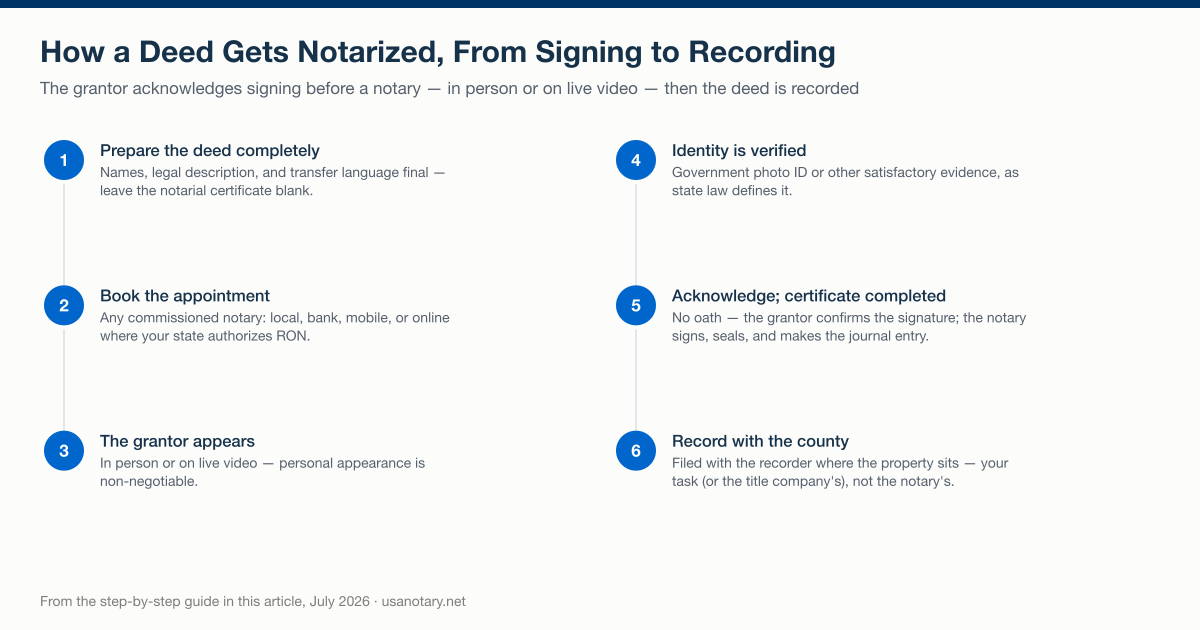
The deed notarization process described in this guide, from preparation to county recording, July 2026.
Budget the most lead time for step 7. Notarization takes minutes; confirming the county’s recording requirements — formatting margins, transfer-tax declarations, cover pages, and whether a remotely notarized deed is accepted — is where deeds most often stall.
Who can notarize a deed?
Any actively commissioned notary public in the relevant state can notarize a deed — a specialized notary signing agent or loan signing agent is not legally required for the notarial act itself. The NNA answers the question directly: “A Notary Public can notarize any type of deed in Arizona. Being a Notary Signing agent (NSA) or loan signing agent (LSA) is not required.” Signing-agent credentials are professional designations (background check, added insurance, loan-package training) that lenders and title companies prefer, not a legal prerequisite for the acknowledgment. Attorneys, bankers, and real estate professionals who also hold a notary commission can notarize deeds too.
The disqualifier is self-interest. A notary who is a party to the deed cannot notarize it: California Government Code § 8224, quoted in the state’s notary handbook, bars a notary with “a direct financial or beneficial interest” from performing any notarial act in the transaction — and for real property it spells out the list, including anyone named as grantor, grantee, mortgagor, mortgagee, trustor, or trustee. If you and your spouse are deeding property to each other, neither of you can be the notary, however convenient the commission on the shelf might be.
What about a grantor who cannot appear at all? A few states allow a proof of execution by a subscribing witness — someone who watched the grantor sign appears before the notary in the grantor’s place. Treat it as a narrow, state-specific exception, not a workaround: California expressly prohibits proof of execution on quitclaim deeds, grant deeds, deeds of trust, and any other instrument affecting real property. The default remains the grantor personally appearing — at a table or on live video — and acknowledging the signature.
How much does it cost to notarize a deed?
Notary fees attach to the notarial act, not the document type, so a deed costs the same per acknowledgment as anything else the notary stamps. In-person maximums are set by state law — California’s schedule in Government Code § 8211, published in the Notary Public Handbook, caps an acknowledgment at $15 per signature. Mobile notaries may add a separately itemized travel fee where state rules allow it.
Online notarization on USA Notary costs $25 per document, which covers the live video session, identity verification, and the electronic seal. Two costs sit outside the notarization entirely: county recording fees (set by the recorder where the property sits) and any transfer taxes your state or county levies on the conveyance. Neither is paid to the notary, and both vary by county — check the recorder’s fee schedule when you confirm their recording requirements.
| Cost item | Who sets it | Typical basis |
|---|---|---|
| In-person acknowledgment | State law (e.g., $15/signature cap in California) | Per signature notarized |
| Online notarization (USA Notary) | Platform | $25 per document |
| Mobile notary travel fee | State rules / notary | Separate, itemized |
| Recording fee | County recorder | Per document/page — confirm with the county |
| Transfer tax | State/county | On the conveyance, where levied |
Notarizing a deed online
Where your state authorizes RON, a deed can be notarized over live video instead of at a table: the signer appears on live video, identity is verified electronically, and the notary applies an electronic seal. RON is not a fringe workaround — the American Land Title Association reported that RON transactions rose 547% in 2020 over 2019, with 29 states having enacted permanent RON laws by that point and more since.
The legal footing is solid and specific. Under the federal ESIGN Act, 15 U.S.C. § 7001, a signature or record “may not be denied legal effect, validity, or enforceability solely because it is in electronic form” — and § 7001(g) goes further, providing that where a law requires a record to be “notarized, acknowledged, verified, or made under oath,” an electronic signature of the authorized officer, attached to or logically associated with the record, satisfies the requirement. State RON statutes, many drawing on RULONA, supply the authorization on the notary’s side. Note the layer that is still missing: the federal SECURE Notarization Act (H.R.1777), which would set nationwide RON standards, remains only introduced in the 119th Congress — not enacted. RON authority today comes from state law, which is why whether your notary’s state authorizes RON matters.
Online notarization on USA Notary costs $25 per document, and you can notarize your deed online from anywhere on live video. For the full closing picture — where a deed sits alongside the mortgage, affidavits, and other instruments — see online notarization for a real estate closing, or the real estate notarization service for what’s covered.
The catch is recording, not notarizing. Even where RON is legal for the act, the county recorder where the property sits may have its own rules for accepting a remotely notarized deed. Confirm the property’s county records remote deeds before you close or record.
What can keep a notarized deed from being recorded?
Most deed failures trace to the certificate, the identity check, or a county formality — not the signature itself. The recurring blockers:
- No acknowledgment at all. The NNA’s warning bears repeating: the absence of an acknowledgment (or proof of execution, where allowed) may prevent the deed from being recorded in the land records.
- A defective or mismatched certificate. An acknowledgment certificate used where state law required different wording, missing venue details, or a certificate completed before the signer actually appeared.
- Identity not established. If the notary cannot establish the signer’s identity by satisfactory evidence — a qualifying ID or credible witnesses under a statute like Civil Code § 1185 — the acknowledgment cannot be taken.
- A disqualified notary. A notary named in the deed (grantor, grantee, trustee) has a direct financial or beneficial interest and cannot notarize it.
- Missing state formalities. In California, no journal thumbprint on a real-property deed is a compliance failure; other states have their own journal and certificate rules.
- County recording requirements. Formatting, transfer-tax forms, and the county’s rules for remotely notarized deeds — the one item you should always confirm with the recorder in advance.
Two things that vary by state and county
| Variable | Set by | Why it matters |
|---|---|---|
| Witnesses | State law | Some states require one or more witnesses on a deed, separate from the notary |
| Recording a remote deed | County recorder | Some counties have their own rules for accepting RON-notarized deeds |
These are the two places a deed most often gets held up. If witnesses are required, line them up in advance — and check whether remote witnesses are allowed for an online signing; our guide on whether a notarization needs a witness walks through the difference. And before recording, confirm the property’s county accepts a remotely notarized deed.