
Notarization and witnessing are not the same act
People often assume “getting it notarized” and “getting it witnessed” are one step. They are two different roles, and some documents need both.
- A notary is an impartial official who verifies your identity, confirms you are signing willingly, and completes a sealed notarial certificate.
- A witness is a person who observes the signing and can later attest that it happened — and, on some documents, signs a witness line.
A notarization does not automatically supply the witnesses a document may separately require. The two functions answer different questions: the notary answers who signed and that it was done properly, while an independent witness answers that I watched this person sign. Understanding what “notarized” actually means makes the gap clearer — notarization is an identity-and-execution check, not a headcount of observers.
The distinction matters in practice. A witness line left blank because “the notary was there” can get a deed rejected by a recorder or a will challenged in probate. Conversely, rounding up two witnesses does not notarize anything — a witness has no seal, no commission, and no authority to complete a notarial certificate.
On this page
- Notarization and witnessing are not the same act
- When does a document need witnesses on top of a notary?
- Which documents most often call for witnesses?
- The five kinds of “witness” in notarization
- Who can serve as a witness?
- Can the notary also be your witness?
- Credible witnesses: proving who you are, not what you signed
- Signing with a mark: when extra witnesses are mandatory
- Do witnesses work in an online notarization?
- How to line up witnesses without delaying your signing
- Before you sign: a short checklist
When does a document need witnesses on top of a notary?
Witness requirements depend on the document type and your state. In some states, certain wills, deeds, powers of attorney, and living wills require one or two independent witnesses in addition to notarization. The clearest illustration that witnessing and notarization are separate: the Florida Department of State explains that a Florida living will “requires two witnesses but does not require notarization” — the witnesses satisfy the law, and notarization is optional on top.
Real property is where independent witnesses appear most often. Florida’s conveyance statute, Section 689.01, Florida Statutes, requires that a deed transferring an interest in real estate be “signed in the presence of two subscribing witnesses” — although the same statute expressly exempts leases from the witness requirement. A notarial certificate on the deed does not replace those two witness signatures; both requirements must be met for the deed to be recordable.
Because these requirements are set state by state, the reliable step is to check what your specific document needs — or ask the party requiring it: the recorder’s office, the title company, the court, or the agency that issued the form. Never assume a rule from one state carries over to another; witness counts, eligibility rules, and whether the notary can double as a witness all change at the state line.
| Role | What they do | Always required? |
|---|---|---|
| Notary | Verifies identity, confirms the signing, completes the notarial certificate | For notarized documents, yes |
| Document witness | Observes and attests the signing; may sign a witness line | Only when the document or state requires |
| Credible identifying witness | Helps prove the signer’s identity when ID is lacking | Only when needed to establish identity |
Which documents most often call for witnesses?
No national rule dictates which documents need witnesses — but the same categories come up again and again. The table below pairs each category with a real, sourced example so you can see how a state writes the requirement into law. Treat the examples as illustrations, not as your state’s rule: confirm the requirement for your document and your state before you sign.
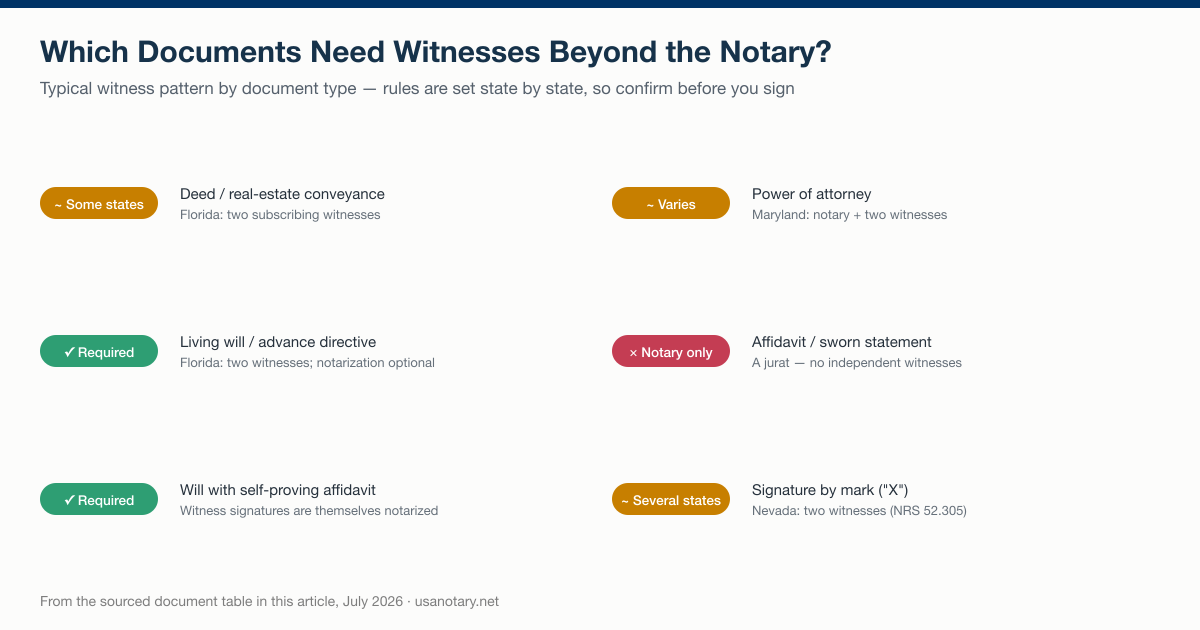
The typical witness pattern for six common document types, from the sourced table in this article, July 2026.
| Document type | Typical witness pattern | Sourced example |
|---|---|---|
| Deed or real-estate conveyance | Independent witnesses required in some states | Florida: two subscribing witnesses under § 689.01, Fla. Stat. (leases exempt) |
| Living will / advance directive | Witnesses required even where notarization is not | Florida: two witnesses, one of whom is “neither the spouse, nor a blood relative” of the signer; notarization optional |
| Will with self-proving affidavit | Witnesses required, and their signatures are themselves notarized | Florida: the self-proof affidavit “requires the notarization of the signatures of the testator and both witnesses” |
| Power of attorney | Varies — some states require witnesses on top of acknowledgment | The NNA notes Maryland requires a power of attorney to be acknowledged before a notary and witnessed by two witnesses |
| Affidavit / sworn statement | Usually the notary alone — a jurat, no independent witnesses | The signer swears the contents are true and signs in front of the notary |
| Signature by mark (“X”) | One or two witnesses mandatory in several states | Nevada: a mark serving as a signature to a sworn statement must be “witnessed by two persons” (NRS 52.305) |
Two patterns from this table are worth remembering. First, witnesses and notarization are independent dials — a document can need two witnesses and no notary (Florida living will), a notary and no witnesses (most affidavits), or both (a Florida deed that is also being acknowledged). Second, the strictest combinations appear on estate and real-property documents, because those are the documents most often disputed after the signer is unavailable to testify. If your document is a power of attorney, check both dials: many POA forms carry a witness block and a notarial certificate on the same page.
The five kinds of “witness” in notarization
“Witness” is one word covering several distinct situations. The National Notary Association groups them into the categories below — knowing which one applies tells you whether you need to bring a witness, or whether the notary handles it as part of the act.
| Type of witness | What it is | Who arranges it |
|---|---|---|
| Document witness | A private person who watches you sign and signs a witness line; not a notarial act | You bring them |
| Credible identifying witness | A person who vouches for your identity when you lack acceptable ID | You bring them |
| Subscribing witness | A person who saw the principal sign and appears before the notary in the signer’s place (proof of execution) | You arrange; some states bar it |
| Signature witnessing | An official notarial act (authorized in states such as Colorado and Pennsylvania) where you sign in the notary’s presence | The notary performs it |
| Signature-by-mark witness | A witness required when a signer who cannot write signs with a mark such as “X” | State law requires it |
Two of these cause the most confusion.
A subscribing witness stands in for a signer who cannot appear before the notary — the witness watched the signing (or heard the signer acknowledge it) and then appears in the signer’s place, a procedure called proof of execution. Many states restrict it sharply: California does not allow proof of execution by subscribing witness on any instrument affecting real property, and the Florida Department of State answers flatly that notarizing a signature this way is not permitted in Florida — “Some states, like California, do, in fact, allow such notarizations, but Florida does not.” If someone suggests a friend can “take the document to the notary for you,” that is the procedure they are describing, and in many states it is unavailable.
A signature witnessing is the opposite of a workaround — it is a formal notarial act in the states that authorize it. The NNA distinguishes it from the two standard acts: unlike an acknowledgment, it requires signing in the notary’s presence; unlike a jurat, it involves no oath. If your certificate wording says “sworn to,” you have a jurat; if it says “acknowledged,” an acknowledgment; the differences are unpacked in jurat vs. acknowledgment.
Who can serve as a witness?
Eligibility rules are set by each state and sometimes by the specific document law, but the recurring themes are independence and disinterest:
- No financial interest. California’s credible-witness statute requires the witness to swear they do “not have a financial interest in the document being acknowledged” and are “not named in the document” — and the NNA reports that several states, including California, Florida, Nebraska and North Carolina, bar interested persons from serving as credible identifying witnesses.
- Not too close to the signer. Some document statutes disqualify relatives outright: Florida’s living-will law requires that one of the two witnesses be “neither the spouse, nor a blood relative” of the principal.
- Actually present. A witness must observe the signing (or, where a statute allows, hear the signer acknowledge the signature). Signing a witness line for an event you never saw defeats the entire purpose and can void the document.
- Able to testify later. The practical function of a witness is to be a live human who can confirm the signing if the document is ever challenged — which is why disinterested adults are the safe default even where a state is silent.
A grandparent who inherits under the will, a business partner who benefits from the contract, or the attorney-in-fact named in the power of attorney are all poor witness choices even where no statute expressly forbids them. If a dispute arises, the first question asked of a witness is whether they had something to gain.
Can the notary also be your witness?
Whether the notary can double as your independent witness is a state-by-state answer, and getting it wrong can void the notarization. Florida and South Carolina allow a notary to serve as one of the required witnesses and notarize the same document; Georgia, Michigan, and North Carolina do not. Georgia’s rule comes straight from statute — the NNA points to OCGA 45-17-8(c), which prohibits a notary from notarizing when “the notary is a signer of the document which is to be notarized.” In states without clear rules — the NNA names California and Texas — its guidance is for notaries to decline both roles on one document.
Florida illustrates the permissive side. The Florida Department of State calls doubling up “a common practice among Florida notaries, particularly on real estate transactions,” and cites a Florida court’s holding in Walker v. City of Jacksonville (1978) that “there is nothing to prevent a notary from also being a witness.”
There is one hard limit even where doubling up is allowed. As the Florida Department of State notes, before signing as a witness “the notary should ensure that the document does not require the notarization of the witnesses’ signatures” — a self-proving affidavit on a will, for example, requires the notary to notarize the testator’s and both witnesses’ signatures, so a notary who also signed as a witness would be notarizing their own signature, which the Florida Department of State describes as “a criminal violation of the notary law.” When your document needs witnesses whose signatures get notarized, you need separate people for the two jobs. This comes up often with a power of attorney or a sworn affidavit, where a witness line and a notarial certificate can sit on the same page.
The practical takeaway for signers: never plan on the notary being your witness. Even in states where it is allowed, the notary may decline, the document may forbid it, and a mobile or online session may involve a notary who cannot lawfully fill both roles. Bring your own witnesses and treat a notary-witness as a bonus, not a plan.
Credible witnesses: proving who you are, not what you signed
There is a separate use of “witness” in notarization worth knowing. If a signer cannot produce acceptable identification, a notary may establish identity through a credible identifying witness. Under California Civil Code section 1185(b), a notary may rely on the oath of a single credible witness who is personally known to the notary and whose own identity is proven by ID — or the oaths of two credible witnesses whom the notary does not know but who each present acceptable ID. In every case the witness must swear that the signer is the person named in the document, that the signer is personally known to the witness, that obtaining other ID would be very difficult or impossible, and that the witness has no financial interest in the document and is not named in it.
California backs the procedure with real teeth: under section 1185(b)(1)(B), a notary who fails to obtain the required satisfactory evidence of identity is subject to a civil penalty of up to $10,000, enforceable by the Secretary of State or a public prosecutor. Identity vouching is not a casual favor — it is a sworn statement with legal consequences for everyone involved.
This witness vouches for who you are, not for the document itself. And they must be there: the Nevada Secretary of State states directly that “the credible witness needs to be present” — identity cannot be vouched for by phone or letter — and Nevada also requires the credible witness to sign the notary’s journal. The simplest way to avoid needing a credible witness at all is to bring valid, current photo ID to your appointment.
Signing with a mark: when extra witnesses are mandatory
A signer who cannot write their name can, in many states, sign with a mark such as “X” — but state law then typically inserts witnesses into the process whether or not the document itself calls for any.
Nevada’s statute is a clean example. Under NRS 52.305, as published by the Nevada Secretary of State, a mark is valid as a signature if the signer’s name is written near it and the mark “is witnessed by a person who writes his own name as a witness” — and for the mark to be acknowledged or to serve as the signature on a sworn statement, it “must be witnessed by two persons who must subscribe their own names as witnesses thereto.”
Requirements differ elsewhere: the NNA reports that Arkansas requires a single witness with no interest in the document, while Florida requires two disinterested witnesses, and notes it is common practice for one witness to print the signer’s name next to the mark. If you are arranging a notarization for someone who signs by mark — common with elderly or hospitalized signers — ask the notary in advance how many witnesses your state requires so the appointment doesn’t stall.
Do witnesses work in an online notarization?
Where a document requires independent witnesses, remote online notarization can often accommodate remote witnesses who join the same live video session — in states that permit it. During a remote session the signer appears on live video, the notary verifies identity, and any required witnesses observe the signing in real time before signing electronically.
State law is catching up to this explicitly. Florida amended its conveyance statute so that “any requirement that an instrument be signed in the presence of two subscribing witnesses may be satisfied by witnesses being present and electronically signing by means of audio-video communication technology” — witness language written directly into Section 689.01, Florida Statutes. At the federal level, the ESIGN Act provides that a signature or record “may not be denied legal effect, validity, or enforceability solely because it is in electronic form,” which is part of why remotely notarized documents are accepted nationwide. Remote witnessing, though, remains a state-by-state question layered on top: whether your witnesses can appear by video depends on your state’s law and the document’s own rules.
Online notarization on USA Notary costs $25 per document, and the signer appears on live video for the notary to verify identity and complete the act. If your document also needs witnesses, USA Notary supports remote witnesses where state law and the document’s rules permit them — confirm the specifics when you book. You can see how a remote session works end to end, and whether a jurat or an acknowledgment is involved changes what happens on camera: in an acknowledgment the signer acknowledges signing, while in a jurat the signer swears the contents are true and signs in front of the notary. When you are ready, you can notarize online without leaving home.
How to line up witnesses without delaying your signing
Witnesses are the most common last-minute failure in a signing appointment — the notary arrives or the video session starts, and the required second witness never materializes. A short plan prevents that:
- Read the document’s signature page first. Count the witness lines. If the form has two witness blocks, plan for two people, even before you confirm the legal requirement.
- Ask the document’s recipient what they require. Recorders, title companies, courts, and agencies sometimes require witnesses beyond the statutory minimum — their rules control whether they accept the document.
- Choose disinterested adults. No beneficiaries, no named parties, no one who gains from the document; for health-care documents, check whether relatives are disqualified, as Florida does for one living-will witness.
- Confirm they can attend the whole signing. A witness who steps out before the signature happens has witnessed nothing.
- For a remote session, confirm remote-witness support in advance. Ask whether your state and your document’s rules permit witnesses to appear by video, and how the platform brings them into the session.
- Have everyone bring ID. The notary identifies the signer, and may need to identify witnesses too, depending on the state and the document.
Before you sign: a short checklist
- Confirm whether your document needs witnesses — ask the recipient or check your state’s rules for that document type.
- Line up witnesses in advance if required, and make sure they have no financial interest in the document and are not disqualified by your state.
- Check whether the witnesses’ signatures must be notarized — if so, the notary cannot also be a witness, and you’ll need separate people.
- Have valid photo ID ready so a credible identifying witness isn’t needed.
- For a remote session, confirm the platform supports remote witnesses in your state before you book.
Witness rules are the least standardized corner of notarization law, which is exactly why the safe sequence never changes: identify the document, ask the party who will receive it, and bring more disinterested witnesses than you think you need. The notary handles the notarial act — the witnesses are on you.