
Can you record a remotely notarized deed?
Yes. A remotely notarized deed can be recorded, and the land-records system has two established paths for it: e-recording, where the county recorder accepts the electronic original through the county’s electronic channel, and papering out, where a paper-only county accepts a notary-certified paper copy of the electronic document. Which path applies turns on one variable — the county where the property sits — which is why title teams confirm the county’s path before the signing session, not after the signed deed comes back.
The legal footing sits in state enactments of the Uniform Real Property Electronic Recording Act (URPERA). Florida’s version, Fla. Stat. § 695.27, answers the two objections a skeptical clerk could raise, in two sentences. On the paper question: “If a law requires, as a condition for recording, that a document be an original, be on paper or another tangible medium, or be in writing, the requirement is satisfied by an electronic document satisfying the requirements of this section.” And on the notarization question: “A requirement that a document or a signature associated with a document be notarized, acknowledged, verified, witnessed, or made under oath is satisfied if the electronic signature of the person authorized to perform that act, and all other information required to be included, is attached to or logically associated with the document or signature.” In a state with URPERA on the books, the electronic deed is not a second-class document, and the online notary’s electronic signature and seal satisfy the acknowledgment requirement that recording statutes impose.
One boundary before the mechanics: this guide covers the recorder’s side only — acceptance, e-recording, papering out, and rejection prevention. The notarization itself (who signs, which certificate, what can make the acknowledgment defective) is covered in our guide to how a deed gets notarized.
”Recording” means two different things in a RON file
Recording, in a remote online notarization file, names two unrelated events — and search results routinely blur them. The county recorder records the deed in the land records: that is the recording this article is about. The notary records the session: the audio-video record of the notarization itself, kept with the notary’s journal. The session recording never travels to the county. The recorder receives the deed and its acknowledgment certificate, exactly the content a paper closing produces; the session video and the session’s audit trail exist for the title underwriter and for any later challenge to the signing. On USA Notary, the audio-video recording and electronic journal are retained for 10 years, or longer where state law requires. If a county clerk asks “where is the recording?”, the correct answer is: in the notary’s journal, where the law puts it — the land records get the deed.
How does a remotely notarized deed reach the land records?
A remotely notarized deed reaches the land records either as an electronic document submitted through the county’s e-recording channel, or as a certified paper copy created under a papering-out statute. The two paths produce the same result — a recorded deed with a book-and-page or instrument number — but they differ in what the recorder accepts, who prepares the submission, and where the legal authority comes from:
| E-recording | Papering out | |
|---|---|---|
| When it applies | The county participates in e-recording | The county records on paper only |
| What the recorder accepts | The electronic original, acknowledgment and electronic seal intact | A paper printout of the complete electronic document, with a notary’s certification attached |
| Legal authority | State URPERA enactments (e.g., Fla. Stat. § 695.27) | State papering-out statutes (e.g., Tex. Prop. Code § 12.0013) |
| Who prepares the submission | The settlement office, through its e-recording submitter | A notary in the settlement office, who supervises printing and certifies the copy |
| Watch-outs | Confirm the county’s participation and document formatting standards | Discretionary for the recorder in many states; Florida and Virginia restrict it to counties without e-recording |
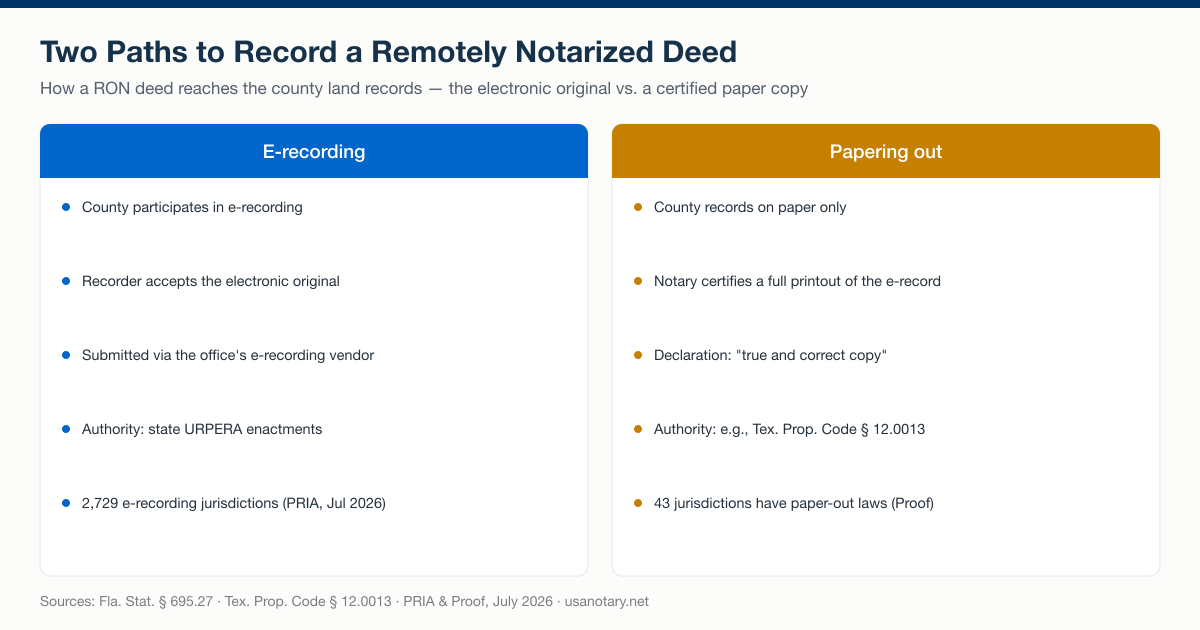
The two recording paths for a remotely notarized deed, compiled from Fla. Stat. § 695.27, Tex. Prop. Code § 12.0013, PRIA and Proof, July 2026.
The e-recording path
The Property Records Industry Association (PRIA) — the body that develops and promotes national standards and best practices for the property records industry — counts 2,729 e-recording jurisdictions as of July 2026, a figure it updates monthly. In an e-recording county, the workflow for a RON deed is short: the settlement office downloads the signed deed as a tamper-evident PDF after the session, submits it through its e-recording submitter (the vendor that connects settlement offices to county recorders), and the recorder indexes the electronic document into the land records. The deed remains electronic end to end — no printing, no courier, no wet-ink original, because no wet-ink original ever existed.
The e-recording path is also why a RON deed often records faster than its paper equivalent: there is no round trip between the signing table and the settlement office. The deed comes out of the session already in the format the county’s electronic channel accepts.
What URPERA changed at the recorder’s desk
URPERA, promulgated by the National Conference of Commissioners on Uniform State Laws in 2004, authorizes county recorders to run electronic land records — and states adopted it as the framework for e-recording. Florida’s enactment spells out the powers: the county recorder may “receive, index, store, archive, and transmit electronic documents,” may “provide for access to, and for search and retrieval of, documents and information by electronic means,” and may “convert paper documents accepted for recording into electronic form.” Georgia’s version shows how adoption works in practice: the state adopted URPERA as House Bill 127, signed into law on May 5, 2009, and designated the Georgia Superior Court Clerks’ Cooperative Authority (GSCCCA) to set statewide standards, so that any clerk implementing electronic recording “shall do so in compliance with standards established by the Authority.”
The point for a title agent is that e-recording is not an ad hoc county experiment. It runs on a uniform act, state standards bodies, and an industry association’s technical standards — infrastructure that predates remote online notarization by more than a decade. RON did not create the electronic deed; it created an electronic deed origination to match the electronic recording system that already existed.
How does papering out work when the county requires paper?
Papering out converts the electronic original into a recordable paper document, for the counties that still record on paper only. Proof’s guide to the practice states the general rule: “many states now have laws that allow recording entities, at their discretion, to record a true and complete paper printout of the electronic document.” The process has three steps:
- A notary supervises the printing. The printout must be the entire electronic document, including the notarization — the acknowledgment certificate and the image of the online notary’s electronic seal print along with the deed itself. A partial printout is the classic paper-out defect.
- The notary attaches a certification. The certificate states that the printout is a true and accurate copy of the electronic record, in whatever form the state’s statute prescribes.
- The paper document, with the certification, is submitted for recording. From the recorder’s perspective it is now a paper instrument, indexed and returned like any other.
Note who acts here: the certifying notary is typically a commissioned employee in the settlement office — not the notary who performed the online session. The online notary’s work ended when the electronic deed was signed and sealed; papering out is a records operation on the submitting side.
Texas: the papering-out statute in action
Texas wrote the mechanics into Tex. Prop. Code § 12.0013, and it is worth reading as the model. A notary public — or another officer authorized to take acknowledgments — executes a declaration under penalty of perjury stating that the attached paper document “is a true and correct copy of an electronic record printed by me or under my supervision,” and that “no security features present on the electronic record indicated any changes or errors in an electronic signature or other information” since the record’s creation. With that declaration attached and sealed, the county clerk “shall record” a paper or tangible copy of an electronic record that is otherwise eligible under state law to be recorded in the real property records.
That “shall” matters. Where Proof characterizes many states’ papering-out laws as discretionary for the recorder, Texas made acceptance mandatory for a compliant certified copy — the clerk’s discretion is out of the equation. Knowing which kind of statute your state has tells you how firm the ground is before you rely on the paper-out path.
Where papering out is limited
Papering out is broadly available but not universal. Proof’s guide lists 40 jurisdictions with papering-out laws, and flags two structural limits worth knowing: Florida and Virginia restrict the practice to counties without electronic recording systems — in those states, an e-recording county is expected to take the electronic original, not a printout. And in the discretionary states, a recorder that has never processed a certified printout of an electronic deed may want the certification language in front of them before signing day.
If a county neither participates in e-recording nor accepts a papered-out copy, the deed for that county comes off the RON track entirely, and the file falls back to a hybrid signing or the courier route described in our breakdown of what a mail-away closing involves. Finding that out during title commitment costs nothing; finding it out after the session costs the closing date.
Does the recorder accept a deed notarized under another state’s RON law?
Generally yes, because recording statutes have accepted out-of-state acknowledgments since long before remote online notarization existed. Florida’s recording statute is typical: under Fla. Stat. § 695.03(2), an acknowledgment taken outside Florida but inside the United States may be taken “by or before any notary public, justice of the peace, master in chancery, or registrar or recorder of deeds of any state, territory, or district having a seal.” A deed notarized under another state’s RON law arrives at the recorder’s desk with exactly that: a certificate and seal from a notary commissioned in another state. The National Association of Secretaries of State reports that 47 states and the District of Columbia have a law that allows for remote e-notarization, so the out-of-state RON acknowledgment is now an ordinary instrument, not an exotic one.
The interstate-recognition question — why a notarization performed under State A’s law is valid for a transaction in State B — has its own legal machinery, covered in depth in our guide to whether remote notarization is valid across state lines. At the recorder’s desk, the practical version is narrower: the clerk indexes instruments, and an out-of-state electronic seal on a papered-out deed may simply be unfamiliar. That is not a legal problem; it is a confirmation-call problem. Which brings us to the checklist.
What should you confirm with the county recorder before the signing session?
The county recorder’s requirements are checkable in one call or one visit to the recorder’s website — and the check belongs at file opening, next to the title search, not in the closing week. Seven questions cover it:
- Does the county participate in e-recording? If yes, confirm which e-recording submitters the county works with and that your office’s submitter is among them.
- If the county records on paper only: does the state’s papering-out law apply? Confirm the recorder accepts certified paper copies of electronic documents, and — in discretionary states — that this recorder exercises that discretion.
- What certification wording does the recorder expect on a papered-out copy? Statutory declaration language (like the Texas form) travels best; have it ready before the session.
- What are the county’s document formatting standards? Margins, first-page requirements, and cover sheets apply to a RON deed the same as to any other — the electronic origin does not exempt the deed from local formatting rules.
- Which transfer-tax declarations or ancillary forms must accompany the deed? These county- and state-specific forms are the most common companions to a rejection notice, whatever the notarization method.
- How are recording fees paid on your chosen path? E-recording submitters handle fees electronically; a papered-out submission follows the county’s paper fee schedule.
- What is the county’s rejection-and-resubmission procedure? Knowing the turnaround on a bounced document tells you how much calendar risk a rejection actually carries.
Log the answers on the file. County practice changes — PRIA’s jurisdiction list moves monthly — so a recorded answer with a date beats an office’s collective memory.
What causes a RON deed rejection at the recorder’s desk?
RON deed rejections cluster around submission mechanics, not the remote notarization itself. The recorder is checking the same things it checks on every instrument — recordable form, required certificates, required companion documents — and each failure mode has a straightforward prevention:
| Rejection cause | Prevention |
|---|---|
| Electronic deed submitted to a county that records on paper only | Confirm the county’s path at file opening; paper out with the statutory certification instead |
| Papered-out printout missing part of the electronic notarization (certificate page or seal image) | Print the entire electronic document under the notary’s supervision — the acknowledgment and seal are part of the record |
| Certification wording on the paper copy doesn’t match what the statute or recorder expects | Use the statutory declaration language; send it to the recorder for review before signing day |
| Formatting noncompliance — margins, first-page layout, missing cover sheet | Pull the county’s published document standards and format the deed to them before the session |
| Missing transfer-tax declaration or companion form | Build the county’s ancillary forms into the closing package checklist |
| Clerk questions the out-of-state electronic seal | Raise it on the confirmation call; recognition statutes like Fla. Stat. § 695.03(2) are the answer, and a forewarned clerk rarely asks |
One category deliberately absent from this table: defects inside the notarization — a missing acknowledgment, the wrong certificate for the act, an unidentifiable signer. Those failures belong to the signing, not the recording, and preventing them is the notary’s craft; our deed notarization guide covers what makes a deed’s acknowledgment defective and how to avoid it. A clean acknowledgment plus a confirmed recording path is the whole formula.
How do title and escrow teams build recording into the RON workflow?
Recording acceptance works best as a pre-session checkpoint in the file, not a post-closing scramble — and that is how we structure it in our online notarization workflow for title and escrow teams. The escrow officer initiates the session (staff-initiated workflows, so no one emails a signer a link and hopes), the signer completes identity verification and signs before a commissioned online notary, and the executed deed returns as a tamper-evident PDF with a complete audit trail. From there it goes straight to the office’s e-recording submitter, or to the office notary for a supervised printing and certification when the county requires paper.
The operational math favors the electronic path wherever the county allows it. Sessions run 24/7 and take 15–30 minutes, multiple signers can join one session, and notarization costs $25 per document, with volume pricing for settlement offices that close daily. For the rest of the closing stack — which documents get notarized, how lenders treat RON, where hybrid formats fit — see our full guide to online notarization for real estate closings.
The rule this article reduces to: the deed is recorded when the path is confirmed first. E-recording counties accept the electronic original; paper counties in most states accept the certified copy; the title agent who asked the seven questions at file opening never meets the rejection table above. Questions about a specific county’s practice or a recurring seller-side workflow? Call 804-767-7500 or reach our team.