
What is a mail-away closing?
A mail-away closing is a real estate closing in which the settlement agent ships the closing package to a buyer or seller who cannot attend, and the absent signer executes the documents in wet ink before a notary near them, then couriers the originals back to the closing office. The transaction still closes where the title company or closing attorney sits — only the signing travels. ALTA’s consumer education site HomeClosing101 describes the arrangement in two sentences: “The settlement provider sends the closing documents to the buyer and seller,” and the parties can “obtain their own notary and mail the documents back to the settlement provider after signing.”
The name shifts from office to office — many settlement firms write it as one word, “mailaway,” the spelling Atlanta closing firm Campbell & Brannon uses in its own client instructions — but the mechanics never change: paper leaves the closing office, gets signed and notarized somewhere else, and comes back. That courier round trip is the defining feature of a mail-away closing, and it is also the source of every failure mode this guide covers.
Mail-away closings exist for a predictable cast of signers: the out-of-state seller who moved before the property listed, the buyer relocating for work who cannot fly back for a one-hour appointment, heirs selling an inherited house from three states away, and investors who never set foot in the property’s county. For each of them, the settlement industry has historically offered a short menu of workarounds — ship the paper to the signer (the mail-away), appoint someone to sign in their place (a power of attorney at the closing table, which brings its own lender-approval hurdles), or, since state RON laws arrived, replace the courier loop with a live video session. This guide covers the first option in full, then compares it honestly against the last one.
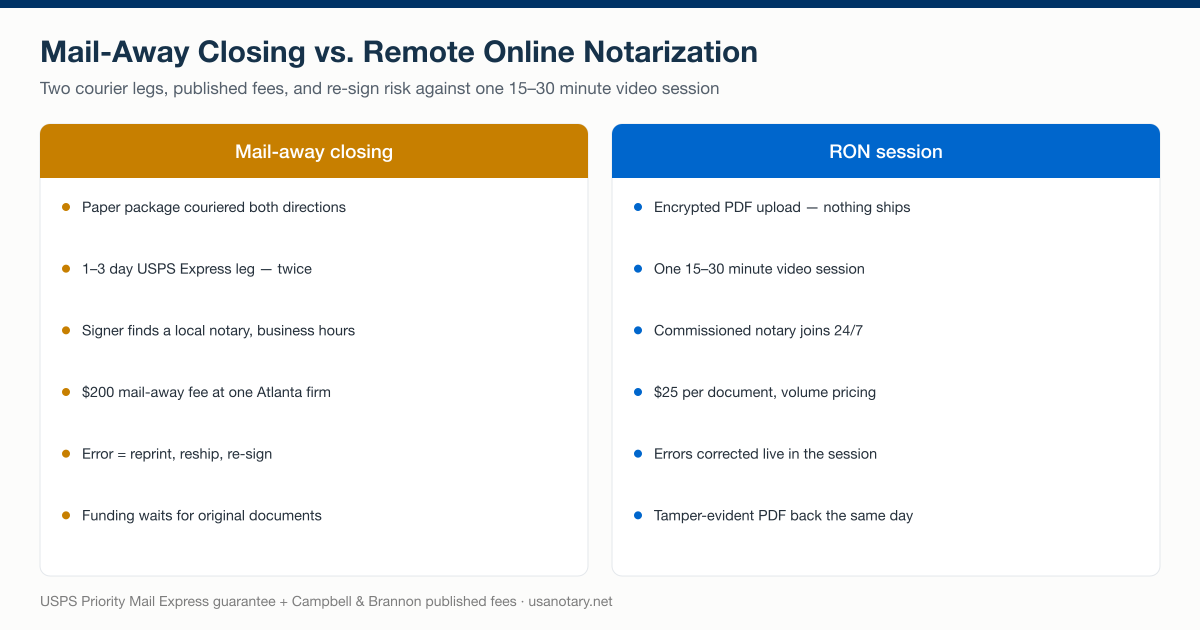
The courier loop against the video session — shipping legs and fees from USPS’s published guarantee and one Atlanta firm’s fee schedule, session facts from our own platform, July 2026.
How does a mail-away closing work, step by step?
A mail-away closing works by moving the paper to the person, with every formality of an in-office signing preserved at a distance. The sequence below follows the procedures settlement firms publish for their own clients, with the published rules cited where a firm states them outright.
- The lender approves the mail-away. Nothing ships without sign-off. Campbell & Brannon’s client instructions are explicit: “Mailaways must be approved by your lender and closing papers available 3 days in advance.” A package that ships without that approval risks documents the lender will not fund against.
- The settlement agent prepares the paper package. The full closing set is printed — the deed, the security instrument or loan documents, the settlement statement, owner’s and lender’s affidavits, and tax forms — along with signing instructions that flag which pages carry notarial certificates and which need witnesses.
- The package is shipped. Overnight courier or USPS Priority Mail Express, which carries a published “1–3 Day Guarantee” with delivery by 6 p.m. The countdown to the closing date starts the moment the package leaves the office.
- The signer arranges the notary. HomeClosing101 describes both patterns: a notary “will then meet the parties at an agreed location to witness the signing and collect the documents,” or the buyers and sellers “obtain their own notary.” Some firms instead route the package to a settlement office near the signer — Campbell & Brannon sends documents “to your nearest appropriate title company for execution.”
- The signing appointment happens — every formality intact. Wet-ink signatures on every flagged line, a completed notarial certificate on every acknowledgment-bearing document, and witnesses wherever state law demands them. On a Florida deed, that means two subscribing witnesses under Fla. Stat. § 689.01 — a notary alone does not satisfy the statute.
- Copies go back for review. Careful firms ask the signer to email a scanned copy before the originals move — Campbell & Brannon builds this into its procedure — so obvious misses are caught while the signer still holds the paper.
- The originals are couriered back. The second shipping leg: same carrier options, same 1–3 day window, same weather, routing, and misdelivery risks as the first.
- The settlement agent reviews, funds, and records. Every page is checked against the signing instructions. Only when the originals are complete and correctly notarized does the file fund — and only then is the deed recorded in the county land records.
Eight steps, two courier legs, and at least three parties coordinating calendars: that is the machine a mail-away closing sets in motion for a signature session that itself takes well under an hour.
How long does a mail-away closing take — and what does it cost?
A mail-away closing adds days to the file, not hours — the signing is quick, but the paper’s travel schedule is not. USPS Priority Mail Express, the Postal Service’s fastest shipping service, publishes a 1–3 business-day delivery guarantee; a mail-away runs that leg twice. Bracket those two legs with the lead time firms require — Campbell & Brannon wants closing papers ready three days in advance — and the notary appointment in the middle, and the realistic added time runs from several business days to more than a week when anything slips.
| Stage | Time | What drives it |
|---|---|---|
| Approval and package prep | Papers ready 3 days before closing (one firm’s published rule) | Lender sign-off, printing, signing instructions |
| Outbound shipping | 1–3 business days | USPS Priority Mail Express guarantee; private couriers vary |
| Notary appointment | Signer-dependent | Local notary availability, witness coordination |
| Return shipping | 1–3 business days | The second courier leg |
| Review and correction | Zero — or the loop restarts | Any defective page sends a new package out |
The cost side stacks the same way, one line item at a time:
- The mail-away fee. Settlement firms price the extra handling. Campbell & Brannon publishes a flat figure — “The mailaway fee is $200” — and notes that the title company receiving the package on the signer’s end “typically charges an additional fee” of its own.
- Courier charges, twice. Priority Mail Express starts at $35.65 at Post Office rates for each leg; private overnight courier rates vary by weight and destination, and a closing package is not light.
- The notary’s charges. A mobile notary who travels to the signer charges for the trip on top of the notarial acts, and fees differ from state to state.
None of that money buys anything the transaction needs — it buys transportation for paper. That distinction is worth holding onto for the comparison two sections down.
Where do mail-away closings go wrong?
Mail-away failure modes cluster in three places: in transit, at the signing table, and on the review desk. The firms that run mail-aways daily are candid about the risk profile — Campbell & Brannon tells its own clients it “highly discourage[s]” the option.
In transit
The courier guarantee protects the postage, not the closing. USPS’s Priority Mail Express promise is a money-back guarantee on the shipping fee when the delivery date is missed — a refund that does not reschedule a funding deadline or extend a contract’s closing date. A package delayed by weather sits in a sort facility while the closing date approaches; a package lost outright means reprinting the entire set and restarting the clock. Distance multiplies the exposure: when the absent signer is abroad, international transit stretches the timeline further and notarization logistics get harder still — our guide to getting documents notarized from overseas covers what that path involves.
At the signing table
A defective acknowledgment is the classic mail-away wound. Notarization is required before the deed and most security instruments can be recorded, and the notary completing the certificate at a distant kitchen table has never seen this closing package before: a missing seal, an incomplete certificate, a wrong date, or a signature line the instructions flagged but the appointment missed will all surface later as a document the county rejects or the title examiner objects to. Witness rules raise the stakes in the states that have them — a Florida deed signed before a notary but without its two subscribing witnesses fails § 689.01 and must be re-executed. The catalog of execution defects that stall a deed is its own topic; our walkthrough of how to notarize a deed covers what recorders and examiners actually check. Beneath the legal defects sit the mundane ones: a missed initial block, a blank date line, a signature that does not match the vesting on title.
On the review desk
Timing is what turns small errors into large delays. Every mistake in a mail-away closing is discovered only after the second courier leg — when the originals land back on the settlement agent’s desk and a page-by-page review finds the gap. The remedy is always the same: reprint, reship, re-sign, and courier the package a fourth time across the country, while funding and recording wait for corrected originals and payoffs, rate locks, and possession dates keep moving. An emailed scan in step six catches some of this; it cannot catch what the scan itself doesn’t show, and it adds another review cycle of its own.
How does a mail-away closing compare with remote online notarization?
Remote online notarization replaces the courier loop with a live audio-video session: the same documents, signed electronically and notarized in real time by a commissioned online notary. HomeClosing101 describes the format as one that “connects you with a notary using two-way audio and video conferencing technology, which allows you to sign all documents securely and conveniently with an electronic signature.” The legal footing is broad — NASS counts 47 states and the District of Columbia with a law that allows remote e-notarization — and adoption is climbing: ALTA’s own study found fully digital or hybrid closings grew from 7% of transactions in 2021 to 10% in 2022.
Here is the side-by-side, line for line:
| Mail-away closing | Remote online notarization | |
|---|---|---|
| What travels | A paper package, shipped both directions | An encrypted PDF upload — nothing ships |
| Time to signed documents | 2–6 business days in transit, plus the appointment | One 15–30 minute video session |
| Scheduling | Notary hours plus courier pickup cutoffs | Sessions run 24/7 |
| Identity verification | The notary inspects a photo ID at the table | Credential analysis plus knowledge-based authentication, run by a third-party identity verification service |
| Witnesses | Physically present at the signing | Remote witnesses supported where state law and the document’s rules permit |
| Error recovery | Reprint, reship, re-sign, re-courier | Corrected live, in the session |
| The record | Paper originals; a journal entry where state law requires one | Tamper-evident PDF, complete audit trail, and an audio-video recording with an electronic journal retained 10 years or longer where state law requires |
| Cost per signing | Mail-away fee (one published example: $200) plus two courier legs plus notary charges | $25 per document |
Two follow-up questions decide whether the right-hand column is available for a given file. The first is geography: the notary is often commissioned in a different state than the property, and whether that notarization holds up is a settled question with a specific legal answer — our guide to whether a remote notarization is valid out of state walks through it. The second is the closing itself: which documents in the package get notarized, what lenders and title underwriters accept, and how recording works afterward are covered end to end in our guide to online notarization for a real estate closing.
Witness states deserve one more sentence, because they surprise people in both columns. Florida’s two-subscribing-witness rule applies however the deed is signed — but the same statute now provides that the requirement “may be satisfied by witnesses being present and electronically signing by means of audio-video communication technology,” which means the witness problem that complicates a Florida mail-away has a defined path inside an online session as well.
When is a mail-away closing still the right choice?
A mail-away closing is still the right choice when the lender, the jurisdiction, or the signer rules the online session out — an honest comparison ends with those cases rather than pretending they don’t exist.
- The lender requires paper. Both formats run through lender approval — Campbell & Brannon’s rule that “mailaways must be approved by your lender” makes the gatekeeper explicit. When a lender declines electronic signatures or online notarization for its loan package, the courier loop or a hybrid signing is the working fallback.
- The state or the document has no RON path. Forty-seven states plus D.C. have a remote e-notarization law by NASS’s count — which still leaves a small set of jurisdictions without one, and some documents carry execution rules that call for physical presence. When the governing law excludes an online session, paper travels.
- The signer opts out. Comfort with video sessions, webcams, and camera-ready identification is not universal. A signer who prefers a pen and a person across the table is accommodated by the mail-away, and a good settlement team offers both.
- County recording logistics favor originals. Recording workflows differ from county to county, and some offices handle paper originals more smoothly than electronic documents. A settlement team confirms the county’s path before choosing the signing format — a check worth making whichever column the file lands in.
What has changed is the default. The mail-away was once the only way to close an absent signer; it is now the fallback for the files that a 15–30 minute session cannot serve.
How do title and escrow teams replace the courier loop?
Title and escrow teams replace the courier loop with a staff-initiated online session: the escrow officer uploads the seller package, schedules the session, and the signer joins by video — no print run, no tracking numbers, no return label taped to a FedEx envelope with the closing date riding on it.
Concretely, here is what changes on a seller-side file. The package that would have shipped is uploaded as a PDF. The signer connects from wherever they are — signers can be located in any of the 50 states — at an hour that fits their calendar, because sessions run 24/7. The signing itself takes 15–30 minutes, with multi-signer sessions available when a co-seller or spouse signs the same package. And the escrow team gets back a tamper-evident PDF with a complete audit trail the same day, while the audio-video recording and electronic journal entry are retained for 10 years, or longer where state law requires. Identity is verified before the notary ever appears: credential analysis on the government ID plus knowledge-based authentication, run by a third-party identity verification service — a deeper check than a glance at a driver’s license across a distant kitchen table.
The math is simpler, too: $25 per document, with volume pricing for teams that run seller packages every week — the full schedule is on our pricing page. Set against a published $200 mail-away fee plus two courier legs at $35.65 and up apiece, the session generally costs less than the shipping it replaces, before counting the days it gives back.
Our online notarization service for title and escrow teams is built around exactly this workflow — business-initiated sessions, multi-signer support, and the evidence pack that answers underwriter questions before they’re asked. To see it against a live file, call 804-767-7500 or reach the team.