
Can you use a power of attorney at a real estate closing?
Yes — a power of attorney for a real estate closing is legal in every state, but legality is not the hurdle. Acceptance is. The lender and the title company each review the POA before closing, and either one can reject it. Front Door Title, a Maryland title agency, states the rule plainly for the buy side: “For a purchaser, the mortgage lender must give their approval on both the use of the POA and the content of the document.” A POA that arrives on closing day, unreviewed, is the version that stops a closing.
A power of attorney for a real estate closing is the document by which a borrower or seller — the principal — authorizes another person, the attorney-in-fact, to sign the closing documents on their behalf. Cornell’s Legal Information Institute notes that powers of attorney “may be general, limited or special,” and the version that clears a closing is almost always the limited one: drafted for one transaction, one property, one set of documents.
Two separate gatekeepers explain why the review is strict. The lender is funding a loan on signatures the borrower never personally made, so it must approve the POA against its investor’s requirements — for most conventional loans, Fannie Mae’s Selling Guide. The title company is insuring a chain of title that will now include an instrument signed by an agent, so it must approve the same POA against its underwriter’s standards, and it usually needs the original document because the POA is recorded in the county land records alongside the deed or security instrument.
The practical rule that follows: send the POA — or better, its draft, before anyone signs it — to both the lender and the title company as early in the transaction as possible. Front Door Title cautions that a POA should not be used “as a matter of convenience” or as a “last-minute alternative to someone attending the closing.” Treat it as a document with its own approval track, running parallel to the loan itself.
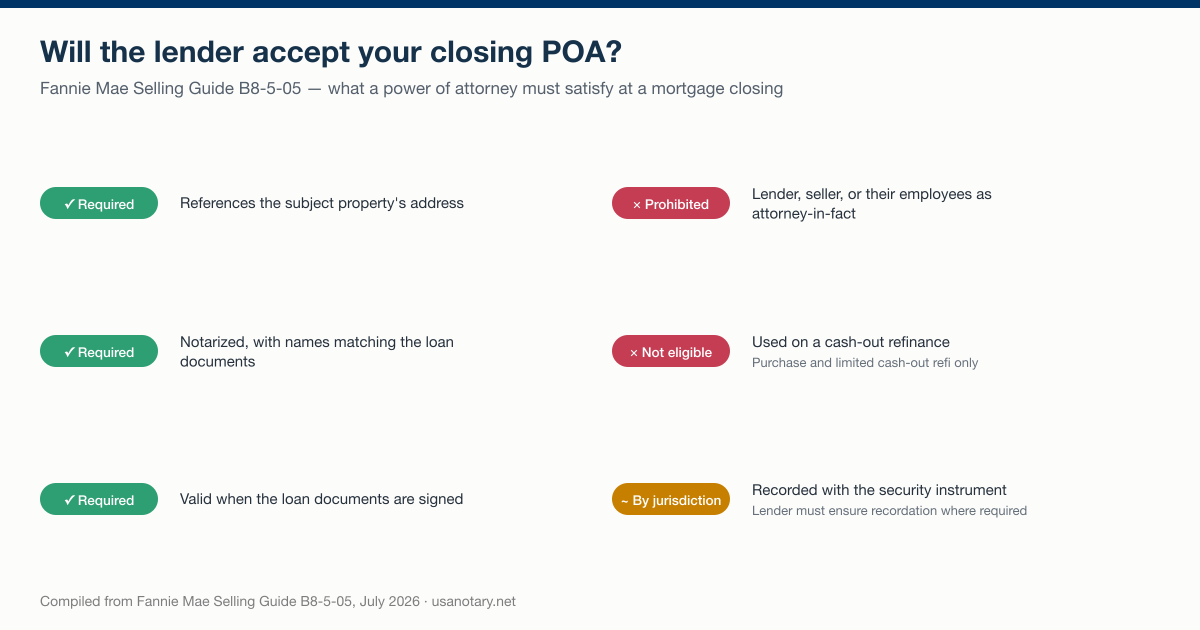
The B8-5-05 acceptance checklist at a glance — what a closing POA must satisfy before a conventional lender signs off, July 2026.
What do lenders require before they accept a closing POA?
Lenders apply their investor’s rules, and for conventional loans that means Fannie Mae Selling Guide B8-5-05 — the closest thing to a national standard for a power of attorney at a mortgage closing. Under B8-5-05, the lender must obtain a copy of the POA and confirm five things before closing under it:
- It references the property. The POA “must reference the address of the subject property.” This single requirement is why generic POAs fail: a document signed years earlier for general financial management names no property.
- It is notarized. The POA must be notarized — the principal’s signature is acknowledged before a notary, which also positions the document for recording later.
- It is valid when the documents are signed. The POA must be “dated such that it was valid at the time the relevant loan document was executed.” A POA signed after the closing documents, or one that expired before closing day, fails this test.
- The names match. The names on the POA must match the names on the loan documents. A POA granted to “Jane E. Smith” does not cover documents an underwriter expects “Jane Elizabeth Smith” to sign — exact-name discipline runs through the whole closing package.
- The attorney-in-fact is eligible. B8-5-05 restricts who may serve, which is its own section below.
Two more B8-5-05 rules bound the transaction itself. First, loan purpose: purchase and limited cash-out refinance — Fannie Mae’s term for a refinance that pays off the old loan with only minimal cash back — are the eligible transaction types, and cash-out refinances are excluded. A borrower planning to pull equity out should plan to sign personally. Second, recording: “in jurisdictions where a POA used for a signature on a security instrument must be recorded with the security instrument, the lender must ensure that recordation has been effected.” The lender’s responsibility does not end when the ink dries; it ends when the county record is complete.
Why the lender wants the POA before the closing package ships
Underwriting reviews the POA as a loan condition, not a closing-table formality. If the document fails a checkpoint — no property address, a barred attorney-in-fact, a cash-out loan purpose — the fix is a new POA, which means a new signing by a principal who may be deployed, hospitalized, or overseas. Building that round trip into the schedule is the difference between a POA that saves the closing date and one that costs it.
Why do title companies reject general POAs?
A general POA gets rejected at closing because it proves too little about this transaction. The title company is about to record an instrument signed by someone other than the owner and then insure the title behind it, so the document has to establish — on its face — that the principal authorized this deal. A specific (limited) POA does that; a general POA asks the reviewer to infer it. Here is how the two read side by side against the questions a closing reviewer actually asks:
| Question the reviewer asks | Specific (limited) closing POA | General POA |
|---|---|---|
| Does it name this property? | References the address of the subject property — Fannie Mae’s requirement | No property reference |
| Does it cover these documents? | Expressly authorizes the agent to execute the required loan documents | Broad wording the reviewer must interpret at their own risk |
| Was it built for this deal? | Drafted for one transaction, often with the lender and loan amount stated | Signed for general affairs, sometimes years earlier |
| Will it satisfy the investor? | Tracks the B8-5-05 checkpoints | May fail the property-reference and dating checks outright |
| Will it record cleanly? | Executed and notarized with recording in mind | Execution formalities may not meet the county’s standard |
Wording inside the POA can sink it even when the document type is right. West Coast Escrow, a California escrow company, gives the example that matters most at a mortgage closing: a POA stating the designee “may not incur any new debt clearly will not work if the designee is signing loan documents.” Estate-planning POAs often carry exactly that kind of protective restriction — sensible for managing an elderly parent’s accounts, fatal for signing a deed of trust.
State law can add its own formalities on top. Front Door Title notes that Maryland’s statutory form for a limited POA runs seven pages and must be signed before two witnesses in each other’s presence and notarized — so even the “right” POA fails if the execution ceremony misses a witness. The escrow and settlement side of this review is its own workflow, which is why title and escrow teams route POA signings through the same notarization checkpoints lenders do. The universal advice from the title side: always consult the title company handling the settlement before drafting or signing the POA, not after.
Who can — and cannot — be your attorney-in-fact at closing?
The attorney-in-fact must be someone without a financial stake in the transaction — that is the principle behind Fannie Mae’s eligibility rules, and it disqualifies most of the people conveniently standing near the closing table. Under B8-5-05, the following parties are barred from serving as a borrower’s attorney-in-fact unless the agent is the borrower’s relative and, for several categories, additional express-authorization conditions are met:
| Party | Eligible to serve? |
|---|---|
| The lender or an affiliate of the lender | No, unless the borrower’s relative |
| An employee of the lender | No, unless the borrower’s relative |
| The loan originator | No, unless the borrower’s relative and extra conditions are met |
| An employee of the title insurance company | No, unless the borrower’s relative and extra conditions are met |
| The property seller, or anyone related to the seller | No |
| A real estate agent with a financial interest in the transaction | No, unless the borrower’s relative and extra conditions are met |
The “extra conditions” are narrow and deliberate. For the exception categories, B8-5-05 requires among other things that the POA “expressly states an intention to secure a loan not to exceed a stated amount from a named lender on a specific property” and “expressly authorizes the agent to execute the required loan documents” — and that the borrower confirm identity and intent in a recorded, interactive session. In other words, the exception exists for carefully documented edge cases, not for handing the paperwork to whoever is in the room.
Title companies draw the line even harder on one category. Front Door Title’s guidance is that a real estate agent should never sign for a client through a POA, calling it a potential conflict of interest — the agent’s commission rides on the deal closing, which is precisely the incentive an attorney-in-fact must not have. The safe choices are the people with no stake in the outcome: a spouse or family member who is not on the other side of the transaction, or the borrower’s own attorney.
Does the POA get recorded with the deed?
Where the deed or security instrument is recorded, the POA generally is recorded with it — that is what makes the county’s chain of title coherent. Anyone later examining the record needs to see not just a deed signed by “Maria Lopez, as attorney-in-fact for Daniel Lopez,” but the instrument that gave Maria that authority. West Coast Escrow states the operational consequence: “the original POA must be recorded in the county where the property is located,” and the document delivered for recording must carry “the original, notarized signature of the principal.” A photocopy, a fax, or a scan of a wet-signed POA does not satisfy a county that requires the original.
Texas shows what this looks like as statute. Under Texas Estates Code § 751.151, a durable POA used for a real property transaction requiring a recorded instrument must be recorded in “the office of the county clerk of the county in which the property is located” — “not later than the 30th day after the date the instrument is filed for recording.” The deed goes on record, and the POA follows it within a month, in the same county, or the record is defective. Fannie Mae’s instruction to lenders mirrors the same duty from the investor side: where recording is required, the lender must ensure that recordation has been effected.
What recording means when the POA is notarized online
A POA notarized online is an electronic document with an electronic notarial certificate, so the recording question becomes whether the property county accepts electronic instruments — many recorders do through e-recording, and paper-out procedures exist where they don’t. The recording logistics for remotely notarized instruments are the same ones a fully digital closing already navigates; our guide to how an online real estate closing works covers county acceptance in that context. The practical step is unchanged either way: ask the settlement agent to confirm, before the session, that the property county will record the POA in the form you plan to sign it.
When does a closing POA expire?
A closing POA runs on four clocks, and the transaction has to finish before any of them does:
- The document’s own terms. A limited POA grants authority for the transaction it describes; when it states an expiration date or a completed purpose, the authority ends with it. Reviewers read those limits literally — that is the same strictness that rejects general POAs, pointed in the other direction.
- The lender’s dating rule. Fannie Mae requires the POA to be “dated such that it was valid at the time the relevant loan document was executed.” If the closing slips past the POA’s window, the loan file fails the check even if nobody at the table notices.
- Incapacity — unless the POA is durable. Cornell’s Legal Information Institute states that a power of attorney “only remains effective as long as the principal is alive and competent to make decisions,” while a durable POA persists after the principal can no longer decide. Closing POAs are typically drafted durable so a medical event between signing and closing doesn’t void the authority.
- Death — always. As West Coast Escrow puts it, “POAs expire upon death.” No POA survives the principal, durable or not. If the principal dies before closing, the transaction stops and the estate takes over.
Individual title underwriters may also treat an old POA as stale and ask for re-execution or confirmation that it has not been revoked; practices differ, so ask the title company how it handles a POA signed months before the closing.
How do military and overseas borrowers get the POA notarized?
Military borrowers hold the strongest card: federal law. Under 10 U.S.C. § 1044b, a military power of attorney — one prepared through a military legal assistance office — “is exempt from any requirement of form, substance, formality, or recording that is provided for powers of attorney under the laws of a State” and “shall be given the same legal effect as a power of attorney prepared and executed in accordance with the laws of the State concerned.” A deployed servicemember can execute a POA through a JAG office, and a state cannot refuse it for failing state-form technicalities. Lender and investor content rules still apply, so the military POA should still name the property and the transaction.
Civilian borrowers abroad historically had one path — a notarization appointment at a U.S. embassy or consulate — and those appointments are scarce in many posts; our guide to notarizing documents from overseas covers that route. Remote online notarization is the alternative that fits a closing calendar: the National Association of Secretaries of State reports that 47 states and the District of Columbia have a law that allows for remote e-notarization, so the POA itself can be signed before a commissioned U.S. notary over live video from anywhere with a stable connection.
Here is how the closing POA gets notarized online once the lender and title company have approved the draft:
- Upload the approved POA. Use the exact document the lender and title company reviewed — the notary notarizes the principal’s signature on it and does not alter the text.
- Verify identity. The principal completes credential analysis and knowledge-based authentication run by a third-party identity-verification service before the session starts.
- Sign in the video session. Sessions run 24/7 and take 15–30 minutes; multi-signer sessions handle a spouse who must also sign, and remote witnesses are supported where state law and the document’s rules permit — relevant where a statutory POA form requires witnesses.
- Deliver the completed document. The session produces a tamper-evident PDF with a complete audit trail, and the audio-video recording and electronic journal entry are retained for 10 years or longer where state law requires — a deeper evidence file than a paper POA ever carries.
The full walkthrough, including state-specific catches, is in our step-by-step guide to notarizing a power of attorney online. Pricing is flat: $25 per document, with volume pricing for teams that handle signings at scale.
Get the POA approved before it becomes the delay
The sequence that works: draft the POA for the specific transaction, send it to the lender and the title company for approval, notarize it only after both sign off, and deliver the original in time to be recorded with the deed or security instrument. Every failure mode in this article — the generic POA, the barred attorney-in-fact, the expired window, the missing original — traces back to skipping a step in that order.
Lenders and servicers that process borrower POAs at volume can move the notarization step in-house: staff-initiated sessions, multi-signer support, and a document-level audit trail through our online notarization service for mortgage lenders. Questions about a specific borrower’s POA or a recurring workflow? Call 804-767-7500 or reach us through the contact page.