
What is credential analysis?
Credential analysis is the part of a remote online notarization (RON) that checks whether the signer’s government-issued ID is genuine. Instead of a notary glancing at a license across a desk, the credential — the physical ID document itself — is run through a third-party technology service that confirms it is authentic and unaltered before the notarization proceeds.
Florida law puts a precise definition on it. Under Florida Statutes § 117.201(3), credential analysis means “a process or service, in compliance with applicable law, in which a third party aids a notary public in affirming the validity of a government-issued identification credential and data thereon through review of public or proprietary data sources.” Two ideas sit inside that sentence: a third party does the analysis, and it validates both the credential and the data printed on it.
That check is not optional where RON is authorized. Florida’s online notarization procedures require an online notary who does not personally know the signer to confirm identity through remote presentation of a government ID, “credential analysis of each government-issued identification credential,” and identity proofing such as knowledge-based authentication. If those steps cannot be satisfied — or the databases consulted “do not contain sufficient information to permit authentication” — the statute is blunt: the notary “may not perform the online notarization.” Credential analysis is one of the safeguards that lets a notarization happen securely without the signer being physically present, and it sits at the center of how online notarization stays secure.
What credential analysis actually checks
The signer transmits an image of their ID — what Florida law calls remote presentation, defined in § 117.201(15) as an image “of sufficient quality to enable the online notary public to identify the individual seeking the notary’s services and to perform credential analysis.” The technology then inspects the credential rather than trusting a human glance.
The Texas Secretary of State describes the mechanics plainly: credential analysis “requires a third party to use technology to confirm the security features on an ID and confirm the ID is not fraudulent,” and the third party “also uses information available from the issuing source or other authoritative source to confirm the details on the credential.” In practice, that automated analysis examines features like these:
- Physical security features — holograms, microprint, UV markings, and layout elements that genuine credentials carry and forgeries usually miss.
- The machine-readable zone and barcodes — the encoded data on the back of a license or in a passport’s MRZ, cross-checked against what is printed on the front.
- Format and template validation — whether the document matches the known template for that state or country’s current ID design.
- Data consistency — confirming the details on the credential agree with the issuing source or another authoritative source rather than having been edited or overprinted.
The output is an authenticity result delivered to the notary — Texas calls it “an output of the authenticity test” — not a bare “looks fine.”
How credential analysis works, step by step
The signer’s side of credential analysis takes a few minutes and happens before or at the start of the video session. The exact screens vary by platform, but the sequence on most RON platforms follows the same shape:
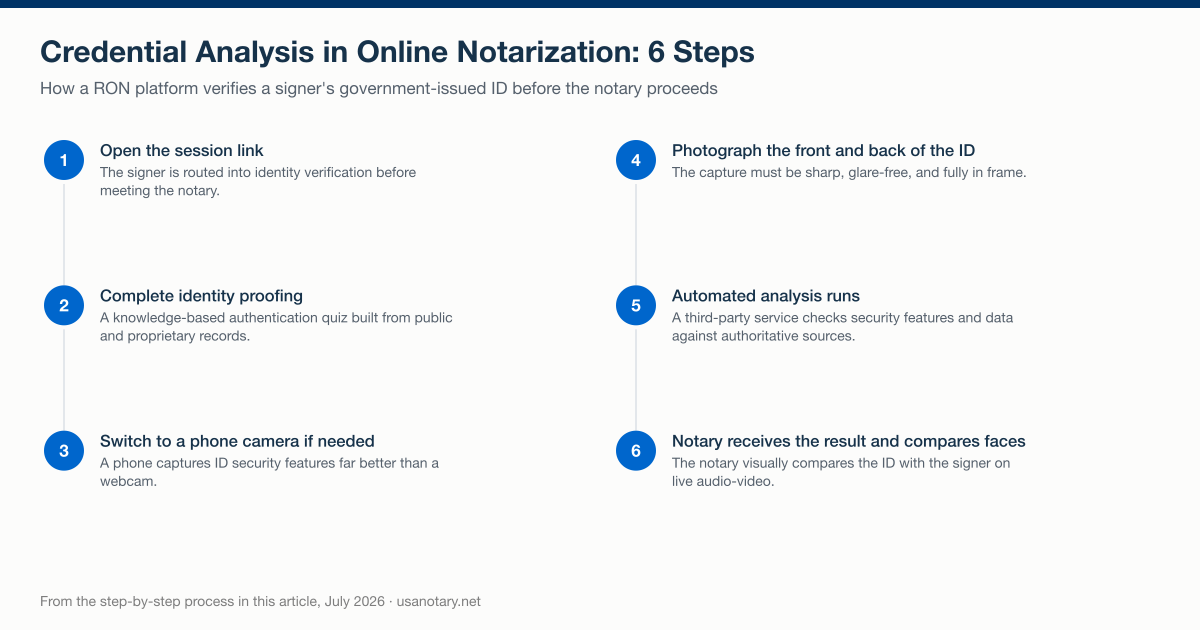
The six-step credential-analysis sequence described in this guide, July 2026.
- Open the session link. The signer receives an invitation to the notarization and is routed into identity verification before meeting the notary.
- Complete identity proofing. Most sessions start with a knowledge-based authentication quiz — personal-history questions built from public and proprietary records. Our explainer on what KBA is and why RON requires it covers the quiz in depth.
- Move to a phone camera if needed. Platforms commonly hand desktop users off to a smartphone, since a phone camera captures ID security features far better than a webcam.
- Photograph the front and back of the ID. The capture must be sharp, glare-free, and fully in frame — remember, Florida’s remote-presentation rule requires an image of “sufficient quality” to support credential analysis.
- Automated analysis runs. The third-party service checks the security features, the encoded data, and the details on the credential against authoritative sources.
- The notary receives the result and compares faces. Per the Texas Secretary of State, the provider must “enable the notary to visually compare the credential used during credential analysis with the principal who has personally appeared before the notary via audio-visual transmission.” Some platforms also add biometric verification — for example, a selfie matched against the ID photo — which Florida’s identity-proofing definition expressly contemplates.
Only after these checks pass does the notarization itself begin, with the signer appearing on live video for the recorded session.
Credential analysis vs. the other identity checks
Remote online notarization verifies identity in layers, and credential analysis is only one of them. The National Association of Secretaries of State (NASS) adopted revised national standards in 2018 requiring multiple means of verifying a signer’s identity — “e.g. Knowledge Based Authentication and credential analysis” — together with the live audio-video appearance.
| Layer | What it examines | Question it answers | Who or what performs it |
|---|---|---|---|
| Credential analysis | The ID document | Is this ID real and unaltered? | Third-party technology service |
| Knowledge-based authentication | The signer’s knowledge | Does this person know what only they should? | Third-party identity-proofing service |
| Biometric verification (where used) | The signer’s face vs. the ID photo | Is the person holding the ID its owner? | Third-party technology service |
| Live audio-video comparison | The person on camera | Does the face match the credential? | The notary |
No single layer carries the whole burden. A stolen ID might survive credential analysis but fail the knowledge quiz; a memorized personal history might pass KBA but collapse when the notary compares the face on camera to the photo on the credential. Florida’s § 117.201(7) even builds the flexibility in at the definition level: identity proofing may work “by means of knowledge-based authentication or biometric verification,” but it always runs alongside — never instead of — credential analysis of the ID itself.
Who performs credential analysis — and why not the notary alone
A recurring surprise for signers: the notary is not the one running the analysis. Texas is explicit that the notary cannot provide it themselves. Both Chapter 406 of the Government Code and the Secretary of State’s administrative rules “require a third party to provide both the identity proofing and credential analysis procedures.” Texas does not even keep an approved-provider list; a notary must instead look for a provider that can show it satisfies Chapter 87, Subchapter H of the Texas Administrative Code.
Florida structures it the same way through the RON service provider — defined in § 117.201(14) as a person providing the audio-video technology “and related processes, services, software, data storage, or other services” that directly facilitate online notarizations. Under § 117.265(5), the online notary selects the RON service provider, and no one may force a particular provider on them (an employer may designate one for notarizations performed on the job).
That separation is the point. An independent, technology-driven check that the notary personally cannot fake or skip is what makes remote identity proofing defensible. The completed act is then sealed into a tamper-evident electronic record; to understand what that record captures, read our guide to the audit trail behind an online notarization.
What the rules look like in practice: Florida vs. Texas
Florida and Texas — two of the earliest and most detailed RON regimes — show how the same credential-analysis principle gets implemented with different specifics:
| Requirement | Florida | Texas |
|---|---|---|
| Legal basis | Fla. Stat. §§ 117.201, 117.245, 117.265 | Gov’t Code ch. 406; 1 TAC ch. 87 |
| Who runs credential analysis | Third party (RON service provider ecosystem) | Third party — notary may not self-provide |
| KBA pass threshold | KBA authorized as identity proofing; thresholds set by Department of State rules | At least 80% of questions answered correctly |
| KBA retakes | Set by rule | One retake within 24 hours; a second failure bars retrying with the same notary for at least 24 hours |
| Notary’s role after the tech check | Confirms identity over recorded two-way audio-video | Receives the authenticity-test output and visually compares ID to signer on live video |
| Record of the check | Journal must note the ID type, that it satisfied credential analysis, and that identity proofing was passed | Digital certificate affixed to the document makes it tamper evident |
| Retention | Journal and session recording kept at least 10 years | Set by Texas statute and rule |
The table’s throughline: the architecture is identical — third-party credential analysis, layered identity proofing, live notary comparison — while the numeric details (pass rates, retake windows, retention clocks) come from each state’s statutes and administrative rules.
What IDs pass credential analysis?
Florida ties the answer to its in-person ID rules: a “government-issued identification credential” for online notarization means any credential approved for identity verification under § 117.05(5)(b)2 — the same family of current, government-issued photo IDs (driver’s licenses, state ID cards, passports) accepted at a physical signing.
Florida also codifies an edge case most guides skip. Under § 117.201(6), a principal located outside the United States may present “a passport issued by a foreign government not including the stamp of the United States Bureau of Citizenship and Immigration Services.” That matters for the large population of signers abroad — military families, expatriates, overseas property sellers — who hold no U.S. credential at all. It is part of why online notarization has become the practical route for notarizing documents from overseas.
Two practical constraints apply everywhere:
- The credential must be current. An expired ID can fail the analysis outright.
- The credential must be legible. Damage, heavy wear, or lamination bubbles that obscure security features give the software nothing to verify.
Exact accepted credentials still depend on state law and the platform’s identity provider, so confirm what your notarization requires before the session.
Why did my ID fail credential analysis — and what can you do?
Failure usually traces to the capture or the credential, not the signer’s identity. Work through these in order:
- Retake the photo. Blur, glare, cropped edges, and dim lighting are the most common culprits. Use a phone camera, indirect light, and a dark, non-reflective surface behind the ID.
- Check the expiration date. A current credential is a baseline requirement; renew before booking the session if your ID has lapsed.
- Inspect for damage. Cracks, peeling lamination, or worn print over the photo, barcode, or MRZ can defeat the automated read even on a genuine ID.
- Try a different accepted credential. If your license fails repeatedly, a passport often scans more reliably because its data page is optimized for machine reading.
- Know the stop rule. Verification is a legal precondition, not a formality. Florida’s § 117.265(4) instructs that if credential analysis and identity proofing cannot be satisfied, the notary “may not perform the online notarization” — so an unresolved failure ends the session rather than being waived.
What if credential analysis was skipped — is the notarization void?
Signers sometimes worry that a procedural slip — say, a session where the platform’s checks misfired — silently voids their document. Florida answers this directly. Under § 117.265(9), a failure to comply with the online notarization procedures “does not impair the validity of the notarial act or the electronic record that was notarized.” The document does not automatically collapse.
The same subsection gives the failure real teeth, though: the lapse “may be introduced as evidence to establish violations of this chapter or as an indication of possible fraud, forgery, impersonation, duress, incapacity, undue influence, minority, illegality, or unconscionability.” In other words, skipped credential analysis becomes ammunition for anyone challenging the document later, and it does not excuse the notary from the statute’s requirements or from discipline.
Two related procedural guarantees round out the Florida framework. The electronic notarial certificate must flag that the act was an online notarization — satisfied by placing “online notary” in or adjacent to the notary’s seal — and the notary or the RON service provider must take reasonable steps to keep the audio-video channel “secure from unauthorized interception.” Identity verification, in short, is one strand of a security fabric that also covers the session itself and the certificate on the finished document.
What happens to your ID data after the session
Credential analysis leaves a paper trail — by design. Under Florida Statutes § 117.245, the online notary’s electronic journal must record, for every online notarization, the type of government-issued credential presented, “an indication that the government-issued identification credential satisfied the credential analysis,” and an indication that the principal passed identity proofing. The RON service provider must also retain “an uninterrupted and unedited copy” of the session recording.
Retention is long. Florida requires the electronic journal and the audio-video recordings to be maintained “for at least 10 years after the date of the notarial act,” and the Department of State keeps jurisdiction over those records to investigate notarial misconduct for that same 10-year period. If a notarization is ever challenged, the journal notation and recording show exactly which ID was checked and that it passed.
Platform-level handling of ID images sits on top of those legal floors and is governed by the provider’s privacy practices. USA Notary’s security and privacy page explains what our platform captures and how it is protected.
Does credential analysis vary by state?
Yes — because notary law is state law. Virginia authorized the first remote e-notarization statute in 2011, followed by Montana in 2015 and Nevada and Texas in 2017. Per NASS, 47 states and the District of Columbia now have a law allowing remote e-notarization, and many of those laws “reflect the updated national e-notarization standards, though the specific requirements and procedures vary among states.” Several state statutes also draw on the Uniform Law Commission’s Revised Uniform Law on Notarial Acts (RULONA) as a model framework.
Keep two distinct legal questions separate. Online notarization is legally valid in all 50 states as a consumer service — a document notarized by a properly commissioned online notary is recognized nationwide, reinforced by the federal ESIGN Act’s rule at 15 U.S.C. § 7001 that a signature or record “may not be denied legal effect, validity, or enforceability solely because it is in electronic form.” Notary commissioning law, by contrast, is set state by state, and some states do not yet authorize their own notaries to perform RON. Congress has weighed harmonizing this — the SECURE Notarization Act (H.R.1777) has been introduced but not enacted, and NASS notes a bipartisan House counterpart (H.R. 1777) — so today the state-by-state framework governs. For the full legal picture, see is online notarization legal.
What varies among states: the accepted credentials, identity-proofing thresholds and retake rules, provider-qualification requirements, and retention clocks. What stays constant: an independent credential check by a third party, paired with identity proofing and a live visual comparison by the notary.
Credential analysis at USA Notary
Layered identity proofing is what makes a remote notarization trustworthy. On USA Notary, the signer appears on live video, the platform runs credential analysis and knowledge-based authentication before the notary proceeds, and online notarization costs $25 per document. To see how identity verification and session security are handled end to end, visit trust & compliance, or walk through how online notarization works from upload to sealed document.