
Is Remote Online Notarization Legal?
Yes — in most of the country. Remote online notarization is authorized by permanent law in the majority of U.S. states, and a document notarized by a commissioned RON notary under their state's law is generally recognized and accepted across the United States. The exact rules differ from state to state.
Last updated: July 9, 2026 · By Andrew Ray Yon, MBA, ChFC — CEO & Founder, USA Notary
Which States Allow Remote Online Notarization?
Growing State Adoption
Most U.S. states have enacted legislation authorizing Remote Online Notarization. According to the National Association of Secretaries of State (NASS), 47 states and the District of Columbia have a law that allows for remote online notarization. These laws establish the requirements notaries must follow and the technology standards platforms must meet — and those requirements, effective dates, and permitted document types differ from state to state.
States that have authorized RON have established clear guidelines for:
- Identity verification requirements
- Audio-video communication standards
- Recording and retention obligations
- Electronic seal and signature requirements
Notary Licensing
Notaries who perform Remote Online Notarizations must be licensed or commissioned by a state that authorizes RON. They must complete additional training and meet technology requirements beyond traditional notary qualifications. If you're looking to get commissioned, our become-a-notary guides by state walk through the requirements where you live.
Our Commitment
We work exclusively with notaries who are properly commissioned in states that authorize Remote Online Notarization and who have completed all required training and technology certifications.
Where RON stands, state by state
The status below reflects each state's own remote online notarization law. Remember: because a notary commissioned in a RON state can serve a signer located anywhere, USA Notary's consumer service reaches signers in all 50 states — even from a state that hasn't authorized its own RON commissions yet. For why the state count differs by who is counting — NASS says 47 plus DC, ALTA says 48 — see our breakdown of the disagreeing RON state counts.
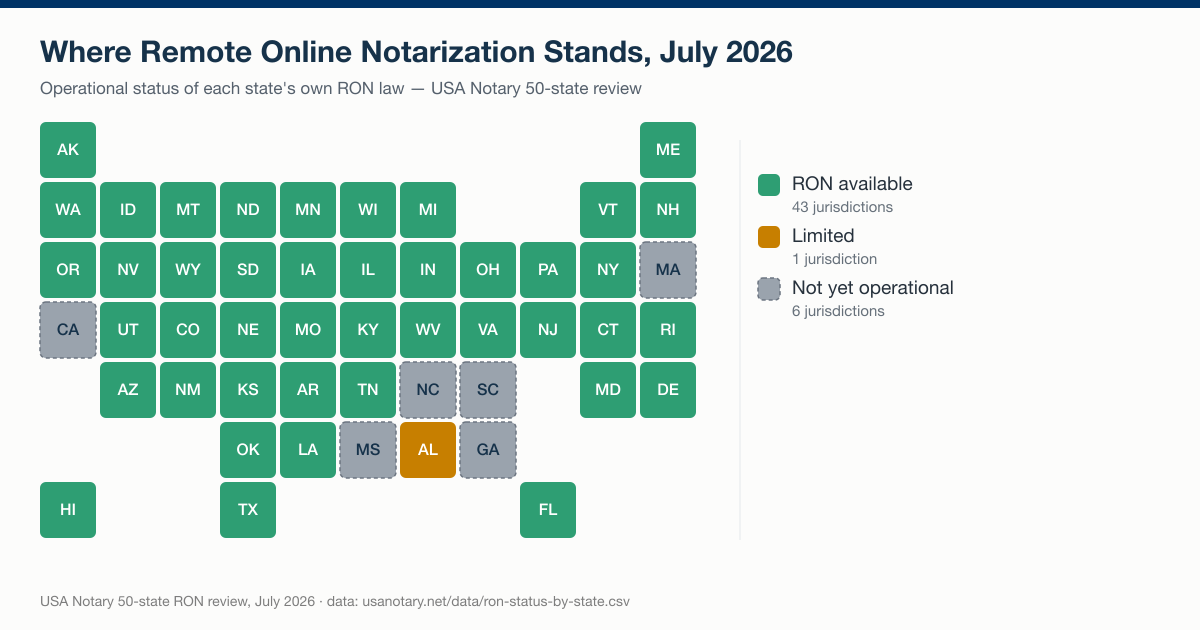
RON available (43)
Texas, Florida, New York, Ohio, Illinois, Michigan, Indiana, New Jersey, Arizona, Colorado, Missouri, Washington, Louisiana, Maryland, Oklahoma, Arkansas, Nevada, Oregon, Iowa, Kansas, Utah, Nebraska, New Mexico, Virginia, West Virginia, Wisconsin, Idaho, Maine, Hawaii, Kentucky, Rhode Island, Tennessee, Delaware, New Hampshire, Montana, Pennsylvania, Alaska, North Dakota, South Dakota, Wyoming, Minnesota, Vermont, Connecticut
Limited (1)
Not yet (6)
California, Georgia, North Carolina, South Carolina, Massachusetts, Mississippi
Per-state RON status researched by USA Notary from each state's notary authority; see the NASS tracker for official updates. Confirm your state before relying on it.
RON status, state fee and effective date by state
Each row is that state's own remote online notarization law: whether a notary commissioned there can perform a RON today, what the state charges a notary to register for RON, and when the authority took effect. The fee column is a notary-side figure — it is not what a signer pays. Texas is the one exception: its entry is a statutory cap on what a notary may charge per online notarization. The Verified column is the date USA Notary last checked that state's source, not the date the law changed.
| State | RON status | State RON fee (notary-side) | Authorized / effective | Official source | Verified |
|---|---|---|---|---|---|
| Alabama | Limited | No separate state fee to perform remote ink-signed notarizations; you use your standard notary commission. | Remote ink-signed notarization is authorized under Ala. Code § 36-20-73.1 (added 2021, amended effective September 1, 2023); fully electronic RON is not currently available in Alabama. | Proof — Alabama Remote Notarization Status (RON/RIN cross-check) | July 9, 2026 |
| Alaska | Available | $100 one-time for a new 4-year commission, or $25 per remaining year of an existing commission, payable to the State of Alaska (separate from vendor fees) | Authorized by HB 124; operative January 1, 2021 (AS 44.50.075) | Alaska Lieutenant Governor - Notarial Resources (RON vendors & guidance) | July 16, 2026 |
| Arizona | Available | No additional state fee (must use an approved technology provider) | RON was enacted by SB 1030 (2019) and took effect July 1, 2020; Executive Order 2020-26 only temporarily accelerated it during the 2020 emergency. It is now governed by A.R.S. § 41-263 under Arizona's Revised Uniform Law on Notarial Acts. The maximum notary fee is $10 per notarial act. | Arizona Secretary of State — Remote & eNotary | July 9, 2026 |
| Arkansas | Available | $25 eNotary application ($20 filing + $5 convenience), plus roughly $30 for the required ASN training and exam | Operative since April 29, 2021, when Act 1047 (SB 340) permanently authorized online remote notarization. | National Notary Association — How to Become a Remote Online Notary in Arkansas | July 9, 2026 |
| California | Not yet | Not yet set — online notarization is not operative in California. | SB 696's online-notary provisions become operative when the Secretary of State completes its technology project, or January 1, 2030 at the latest, whichever comes first. | California SOS — Customer Alerts (SB 696 / Online Notarization) | July 9, 2026 |
| Colorado | Available | $10 remote notary application fee (state) | Colorado notaries have been able to register to perform remote online notarizations since December 31, 2020. | Colorado Secretary of State — Remote Notarization FAQs | July 9, 2026 |
| Connecticut | Available | No separate state RON fee (platform subscription varies by provider) | Public Act 23-28, An Act Concerning Remote Notarial Acts, signed June 12, 2023; effective October 1, 2023. | Connecticut Secretary of the State — Notary Public Licensing | July 16, 2026 |
| Delaware | Available | No separate state fee; request via your Notary Profile (RON platform and e-seal costs vary by provider) | Effective August 1, 2023 | Delaware Notary Public - Frequently Asked Questions (bond, training, RON) | July 16, 2026 |
| Florida | Available | $10 state registration fee | Florida's RON law (Chapter 2019-71) took effect January 1, 2020, so online notary registration is available now. | Florida Department of State — Remote Online Notary Public (RON) | July 9, 2026 |
| Georgia | Not yet | — not published | Not operative as of July 2026 — RON legislation (HB 289 / SB 8) was pending, so no Georgia online-notary registration or state online fee exists yet. | See the Georgia guide for cited sources | July 9, 2026 |
| Hawaii | Available | $120 ($20 RON application fee + $100 new RON commission fee) | Authorized by Act 54, Session Laws of Hawaii 2020, effective January 1, 2021. | Hawaii Department of the Attorney General — Notaries Public | July 16, 2026 |
| Idaho | Available | No separate state fee to add RON online; $20 manual processing fee applies only to paper filings. | Remote online notarization has been allowed in Idaho since January 1, 2020. | Idaho Secretary of State - Notary Information | July 16, 2026 |
| Illinois | Available | $40 for a combined notary + electronic application, or $25 to add electronic authority to an existing commission | Illinois's electronic and remote notarization rules took effect in 2023; notaries can register for electronic/remote authority now. | Illinois Secretary of State - Notary Services | July 9, 2026 |
| Indiana | Available | $100 nonrefundable RON registration fee (covers the RON training and exam) | RON is authorized under Indiana Code Title 33, Article 42, Chapter 17 and has been operative since 2020. | Indiana Code Title 33, Article 42, Chapter 17 - Remote Notarial Acts | July 9, 2026 |
| Iowa | Available | No state fee for the RON application (vendor/platform costs apply separately) | Authorized under Iowa Code 9B.14A with rules in Iowa Administrative Code 721-Chapter 43; remote provisions effective July 1, 2020 | Iowa Secretary of State - Notary Forms and Fees | July 16, 2026 |
| Kansas | Available | $20 RON registration fee | RON registration runs concurrent with your four-year notary commission; you cannot register for RON without first holding a Kansas commission number. | Kansas Secretary of State — Notary | July 9, 2026 |
| Kentucky | Available | $10 registration fee (in addition to the $10 commission fee) | Remote/online notarization operative in Kentucky as of January 1, 2020 under KRS 423.300–423.455 (KRS 423.355, 423.390). | National Notary Association – How to Become a Remote Online Notary in Kentucky | July 16, 2026 |
| Louisiana | Available | $100 one-time filing fee (separate from provider technology fees) | R.S. 35:621 et seq.; RON registration opened February 1, 2022 | Louisiana Secretary of State — RON Requirements | July 16, 2026 |
| Maine | Available | No additional state registration fee; approved technology-provider platform costs vary by supplier. | Maine adopted the Revised Uniform Law on Notarial Acts (RULONA), effective July 1, 2023 (4 M.R.S. ch. 39). | Maine Secretary of State - Notary Public Resources (fees, RON, renewal) | July 16, 2026 |
| Maryland | Available | No separate state fee | Remote online notarization became permanent in Maryland in October 2020 under Senate Bill 678. | Maryland Secretary of State — Remote Notary Information | July 9, 2026 |
| Massachusetts | Not yet | Not yet established (RON not operative). | The RON statute has been on the books since it was enacted, but performance is on hold pending the Secretary of the Commonwealth's rules. The office has stated the training and notification form 'aren't yet available, so notaries shouldn't use online remote platforms at this time.' Aspiring Massachusetts notaries should get commissioned traditionally now and be ready to register for RON once the state opens it. | Secretary of the Commonwealth of Massachusetts — Remote Online Notarization | July 9, 2026 |
| Michigan | Available | No separate state fee — the Form 99 filing is free; you pay your chosen approved vendor's platform subscription. | Remote and electronic notarization are operative in Michigan under the Michigan Law on Notarial Acts (MiLONA); no separate remote commission is issued. | Michigan SOS — Electronic & Remote Notary Request for Change (Form 99) | July 9, 2026 |
| Minnesota | Available | No separate state registration fee; RON technology platform costs vary by provider | Enacted effective January 1, 2019 under Minnesota Statutes 358.645 (Chapters 358 and 359) | Minnesota Secretary of State — Remote Online Notarization Authorization | July 16, 2026 |
| Mississippi | Not yet | Not applicable (RON not available for Mississippi notaries) | Revised Mississippi Law on Notarial Acts effective July 1, 2021 (Miss. Code Ann. 25-34-67); no RON law in effect as of 2026 per NNA (updated Aug 2025) and Proof. | Proof - Mississippi State Legislation (RON status) | July 16, 2026 |
| Missouri | Available | There is no online-only barrier beyond first holding a Missouri commission. Register as an electronic notary through the Secretary of State after you are commissioned (additional training and exam required). Third-party guides report a separate registration fee, but confirm the current figure directly with the Missouri SOS before relying on it. | Operative statewide. Permanent electronic and remote online notarization authority was enacted through SB 655 (RSMo Chapter 486); remote online notaries register directly through the Missouri Secretary of State. | Missouri Secretary of State — Notary Public & Commissions | July 9, 2026 |
| Montana | Available | No separate state RON registration fee; you file a Notary Public Information Update form. RON platform subscription costs vary by provider. | Montana notaries may perform RON beginning October 1, 2019 (Title 1, ch. 5, MCA). | Montana Secretary of State — Technology Based Notarization (RON, IPEN) | July 16, 2026 |
| Nebraska | Available | $50 online notary registration filing fee | Nebraska's remote online notarization took effect July 1, 2020; online notaries are governed by Chapter 8 (Online Notary Public) of the Secretary of State's rules. | Nebraska Secretary of State — Steps to Become an Online Notary (official) | July 16, 2026 |
| Nevada | Available | $45 training fee + $50 registration fee | RON is operative in Nevada now; your electronic notary registration runs concurrently with your traditional four-year commission. | National Notary Association — How to Become a Remote Electronic Notary in Nevada | July 9, 2026 |
| New Hampshire | Available | No separate state RON registration fee specified | Authorized under the Uniform Law on Notarial Acts (RSA 456-B), which includes New Hampshire's remote notarization provisions. | New Hampshire Secretary of State - Notary Public | July 16, 2026 |
| New Jersey | Available | No separate state registration fee is documented in the official FAQ or law — you add remote/electronic notarization by updating your commission record through the DORES portal; communication-technology and vendor costs are separate. | RON operative since October 20, 2021 (P.L. 2021, c. 179); commissioned notaries update their records via the DORES portal to offer it. | NJ Treasury, Division of Revenue & Enterprise Services — Notary Public Law | July 9, 2026 |
| New Mexico | Available | $75.00 RON application filing fee | Authorized under New Mexico's Revised Uniform Law on Notarial Acts, effective January 1, 2022; RON rules at 12.9.4 NMAC. | New Mexico Secretary of State — Become a Remote Online Notary (RON) | July 16, 2026 |
| New York | Available | $60 electronic notary registration | Electronic/remote online notarization has been operative since February 1, 2023 under New York Executive Law Section 135-c. | New York Department of State — Become a Notary Public | July 9, 2026 |
| North Carolina | Not yet | — not published | RENA became law on July 8, 2022, but the Secretary of State has not yet issued any remote electronic notary licenses and remote electronic notarization rulemaking remains open. Separately, "electronic notarization" in North Carolina is not remote: the Secretary of State defines it as adding an electronic signature and seal to an electronic document while the eNotary and signer are physically present together. Emergency Video Notarizations (EVN) — a temporary measure, not RON — expire at 12:01 AM on July 1, 2026, with pending legislation that would extend them to July 1, 2027 or until the first remote electronic notarization license is issued. | North Carolina Secretary of State — eNotary / Remote Electronic Notary | July 9, 2026 |
| North Dakota | Available | No additional state fee for the amendment; RON platform costs vary by provider | Authorized under the Revised Uniform Law on Notarial Acts, NDCC ch. 44-06.1 | North Dakota Secretary of State — Performing Electronic and Remote Notarizations | July 16, 2026 |
| Ohio | Available | $20 to the Secretary of State, plus a one-time $250 education & testing fee paid to the approved provider | RON has been operative in Ohio since the 2019 Notary Public Modernization Act; 2025's House Bill 315 raised the maximum RON notarization fee to $30, plus a technology fee of up to $10 per session. Online notaries must also complete continuing education. | Ohio Secretary of State - Notary | July 9, 2026 |
| Oklahoma | Available | $25 (state RON authorization filing fee) | RON is active and available to register today. You cannot be an online-only notary in Oklahoma — a current traditional commission is required first. | Oklahoma Statutes, Title 49 — Notaries Public & Remote Online Notary Act | July 9, 2026 |
| Oregon | Available | No separate state registration fee found in official sources — you file a RON notice with the Secretary of State. Vendor platform/subscription fees vary, and the RON notarial fee is capped at $25 per act. | RON was legalized in Oregon under HB 4212 (2020) and later made permanent; it is currently available to commissioned notaries who register with the Secretary of State. | Oregon Secretary of State — Remote Online Notarization | July 9, 2026 |
| Pennsylvania | Available | No separate state registration fee is published; the notification is filed through the Department of State online system. RON technology-vendor subscription costs vary by provider. | Made permanent by Act 97 of 2020, effective October 29, 2020 (electronic notarization program established January 30, 2006). | PA Department of State — Electronic/Remote Notarization | July 16, 2026 |
| Rhode Island | Available | No state fee to register (the Notary Public Information Update form is free to file); costs are the solution-provider subscription and digital tools. | RON was made permanent effective June 30, 2022 under HB 7363 / SB 2705, codified in RIGL Chapter 42-30.1. The notary must be physically located in Rhode Island at the time of the act. | Rhode Island Department of State — Become an Electronic/Remote Notary | July 16, 2026 |
| South Carolina | Not yet | None — South Carolina does not commission remote online notaries. | South Carolina does recognize valid remote online notarizations performed by notaries commissioned in other RON-enabled states (S.C. Code Ann. § 26-3-20), but SC-commissioned notaries cannot perform them. Confirm current status with the Secretary of State before relying on any online notarization. | Proof — South Carolina State Legislation (RON status) | July 9, 2026 |
| South Dakota | Available | No separate state fee specified for e-notary registration | Full RON on electronic records effective July 1, 2024 (SB 211, SDCL 18-1-11.2); paper-based remote notarization has been allowed since 2019 (SDCL 18-1-11.1). | SD Secretary of State - Remote Electronic Notarization | July 16, 2026 |
| Tennessee | Available | $75 initial state fee (plus separate vendor and course costs) | Online Notary Public Act (SB 1758), TCA 8-16-301 et seq.; effective July 1, 2019. Rules: Chapter 1360-07-03. | Tennessee Secretary of State - How to become an Online Notary Public | July 16, 2026 |
| Texas | Available | $25 cap per online notarization (Gov't Code § 406.111), in addition to standard fees under § 406.024 | Online notarization authorized effective July 1, 2018 (Acts 2017, H.B. 1217). | See the Texas guide for cited sources | July 9, 2026 |
| Utah | Available | $50 RON application fee (plus the bond increase to $10,000) | Utah's remote notarization law is in effect and RON applications are being accepted now. | Utah Lieutenant Governor — Remote Online Notary (RON) Application Process | July 9, 2026 |
| Vermont | Available | Confirm any special-endorsement fee with OPR (not published on the OPR FAQ) | Emergency Rules for Remote and Electronic Notarial Acts, effective March 4, 2024; permanent rules pending as of 2026 | Vermont Secretary of State — Notaries Public (RON emergency rules) | July 16, 2026 |
| Virginia | Available | $45 eNotary application fee (no added bond) | Virginia was the first U.S. state to authorize remote online notarization (electronic notary framework under Code of Virginia § 47.1-6.1 and § 47.1-7). Effective July 1, 2027, eNotary applicants must also complete an approved course. | Virginia Secretary of the Commonwealth — Notary Commissions | July 16, 2026 |
| Washington | Available | $15 (electronic records notary endorsement; remote acts require no extra state fee) | Remote online notarization is operative now in Washington under chapter 42.45 RCW; you need the $15 electronic records endorsement plus remote authorization before performing remote acts. | Washington State Department of Licensing — Get your notary license | July 9, 2026 |
| West Virginia | Available | No state fee for the E-Notarization Authorization application (RON platform/vendor fees are separate). | RON authorized effective June 17, 2021; electronic notarization governed by W. Va. Code §39-4-19. | WV Secretary of State — Applying for a Notary Public Commission | July 16, 2026 |
| Wisconsin | Available | No separate state RON registration fee; technology-provider platform fees vary by provider. | Authorized by 2019 Wisconsin Act 125, effective May 1, 2020; governed by Wis. Stats. ch. 140 (secs. 140.145, 140.147, 140.20) and Wis. Admin. Code ch. DFI-CCS 25. | Wisconsin DFI — Remote Online Notary | July 16, 2026 |
| Wyoming | Available | No added state fee (registered on the standard $60 application; platform/technology costs are separate) | Wyoming Revised Uniform Law on Notarial Acts, effective July 1, 2021 | Wyoming Secretary of State — Notary Public Commission Application/Renewal (Revised Jan 2026) | July 16, 2026 |
The fee column is what the state charges a notary to register for RON — not a signer's price. Our consumer service is $25 per document. Laws change — confirm with your state's commissioning authority before relying on any row.
Use this data
The full 50-state dataset behind this page — each state's RON status (43 available, 1 limited, 6 not yet), the state RON fee it charges notaries where one is set, and effective-date notes — is downloadable as a CSV. It is regenerated from our state research on every site update, so the file always matches this page.
Download ron-status-by-state.csv
Reuse is welcome with attribution. Suggested citation: USA Notary, "Remote Online Notarization status by state," July 2026, usanotary.net. Status definitions: available = consumers can complete a RON with a notary commissioned under that state's law today; limited/not yet = the state's own commissions aren't (fully) operational, even where a law exists — which is why counts differ from law-tracker tallies like NASS's.
Is a Remote Notarization Valid in Other States?
Cross-State Validity
Under longstanding legal principles, a notarization performed by a notary commissioned in one state is generally recognized in other states. This principle extends to Remote Online Notarization.
When a notary performs a Remote Online Notarization, they act under the authority of their commissioning state, and the resulting document is generally accepted for use across the United States — carrying the same legal weight as a traditional in-person notarization. A few states still limit RON for specific transactions, such as certain real estate closings, so confirm what your state accepts.
Nationwide Acceptance
Under interstate recognition, documents notarized under a RON notary's commissioning-state law are generally accepted for use across the country — though some states still limit RON for specific transactions, such as certain real-estate closings, so confirm what your state accepts.
Industry Acceptance
Title companies, lenders, and government agencies increasingly accept documents notarized via RON.
Common Misconceptions
Misconception: "RON isn't as secure as in-person notarization"
Reality:
Remote Online Notarization can provide stronger identity verification than a traditional in-person notarization. It can include knowledge-based authentication, credential analysis, session recording, and a complete audit trail that are not typically present in in-person notarizations.
Misconception: "RON documents aren't accepted everywhere"
Reality:
Properly executed Remote Online Notarizations are widely accepted by title companies, lenders, government agencies, and courts, and are recognized for use across all 50 states under interstate recognition principles. A few states still restrict RON for specific uses, such as certain real estate closings.
Misconception: "Any notary can perform RON"
Reality:
Only notaries commissioned in states that authorize Remote Online Notarization may perform RON. They must complete additional training and meet specific technology requirements beyond traditional notary qualifications.
Misconception: "RON is only for simple documents"
Reality:
Remote Online Notarization is used for a wide range of documents, including real estate closings, powers of attorney, business agreements, affidavits, and legal documents, subject to applicable state law requirements.
Our Compliance Commitment
We maintain strict adherence to all applicable Remote Online Notarization laws and work only with properly commissioned notaries. Every session follows state-mandated procedures for identity verification, recordkeeping, and notarial acts.
Learn About Our Compliance StandardsAbout the author
Andrew Ray Yon, MBA, ChFC
CEO & Founder, USA Notary Services LLC
Andrew Ray Yon is the founder and CEO of USA Notary Services LLC and the architect of the SharpNote remote online notarization platform. A Certified Notary Signing Agent since 2005, he has handled mortgage and title loan signings for two decades — personally completing more than 10,000 notarizations — and holds an MBA and the ChFC (Chartered Financial Consultant) designation. Based in Virginia’s Greater Richmond region, he leads the company’s strategy, compliance, and platform development.
Connect on LinkedInSources & disclaimer
- National Association of Secretaries of State — Remote Electronic Notarization (official state-by-state RON status)
- Mortgage Bankers Association — Remote Online Notarization (RON adoption tracking chart)
- National Notary Association — Remote Online Notarization (RON overview and requirements)
This page is general information, not legal advice. Remote online notarization laws and requirements differ by state and change over time — always confirm the current requirements with your state's commissioning authority (or a qualified attorney) before relying on RON for a specific document.