
What is an affiant?
An affiant is the person who makes an affidavit and swears that its statements are true. The Cornell Legal Information Institute defines it directly: “An affiant is a person who is the author of an affidavit and who swears to the truth and accuracy of the statements made in the affidavit.” The affiant “takes an oath that the contents are true to the best of their knowledge.” Court glossaries put it the same way — the St. Lucie County Clerk of the Circuit Court defines an affiant as “a person who signs an affidavit and swears to its truth before a notary public or some person authorized to take oaths.”
The two words travel together, so pin them down once: the affidavit is the sworn written statement; the affiant is the human being who swears to it. If you are preparing an affidavit, you are the affiant. The document is your statement of facts, and by signing it under oath you personally stand behind every line. On the affidavit itself, your name typically appears in an opening line such as “I, [name], being duly sworn, depose and say” — that named person is the affiant, and the signature at the bottom must match. Understanding what notarization actually certifies makes the affiant’s role easier to place: the notary’s certificate speaks to identity and the oath, while the affiant’s signature speaks to the facts.
The U.S. Department of State’s Foreign Affairs Manual captures why the role exists at all: “The purpose of the notarial act of taking an affidavit is to have an individual make a statement under penalty of perjury by personally swearing to or affirming the statement” (7 FAM 851). Strip away the Latin and the affiant is simply the person who converts an ordinary written statement into sworn evidence by putting their oath — and their perjury exposure — behind it.
Affiant vs. notary vs. deponent vs. witness
Four roles cluster around a sworn document, and they are constantly confused. The affiant makes and swears to the statement. The notary administers the oath and witnesses the signing. A deponent is a near-synonym for affiant. A witness is a separate signer entirely. Pinning each word down keeps the liability clear.
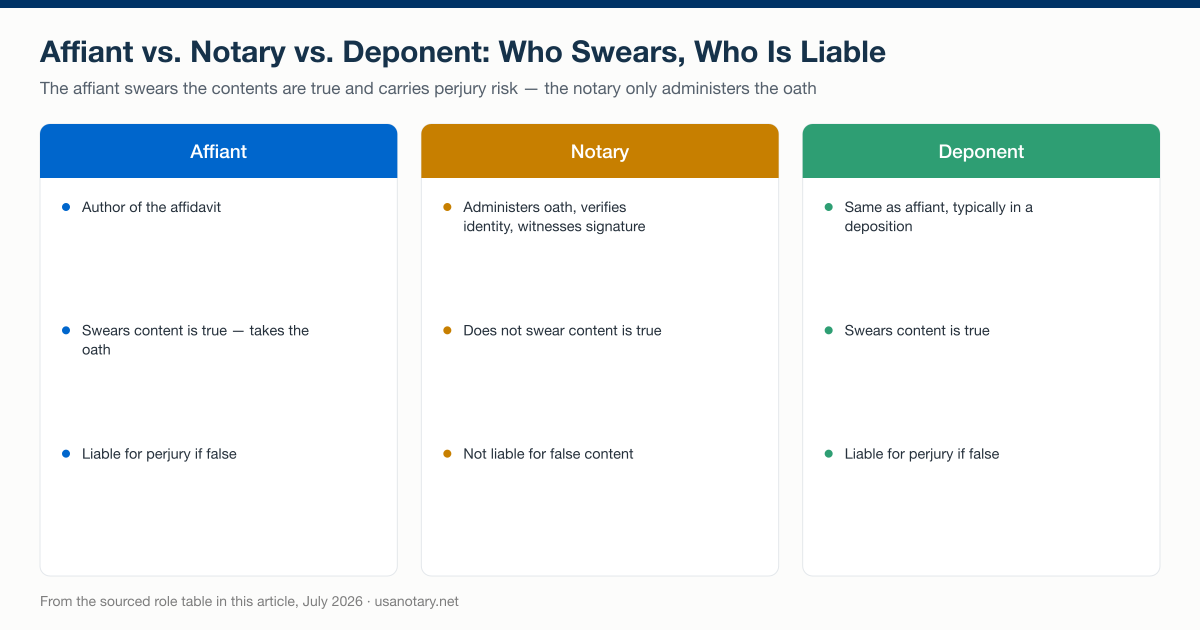
How the affiant, notary, and deponent roles divide the oath and the perjury liability, from the sourced role table in this article, July 2026.
| Role | What they do | Swears content is true? | Liable for false content? |
|---|---|---|---|
| Affiant | Author of the affidavit | Yes — takes the oath | Yes — perjury |
| Notary (notarizing officer) | Administers the oath, verifies identity, witnesses the signature | No | No |
| Deponent | Same as affiant, typically in a deposition | Yes | Yes |
| Witness | Optional extra signer attesting they saw the signing | No | No |
Merriam-Webster confirms the overlap, defining an affiant as “one who swears to an affidavit; broadly: deponent.” Deponent is the label you will see when the sworn statement is taken in a deposition; affiant is the label on a stand-alone affidavit. Either way, the person swearing owns the truth of the content.
The line between affiant and notary is the one that matters most. The notary confirms who signed and that an oath was taken — never whether the statement is true. A notary who administered your oath is the “notarizing officer” on the certificate, not a co-author of your facts, and a notary cannot serve as the affiant on a document they are notarizing, because the officer administering the oath and the person taking it must be different people. That division of labor is also what separates a jurat from an acknowledgment: in a jurat, the signer swears the contents are true and signs in front of the notary; in an acknowledgment, the signer merely acknowledges signing, and no oath about the content is taken. If you are unsure which certificate your document needs, compare a jurat versus an acknowledgment — an affiant, by definition, is on the jurat side of that line.
What the affiant swears to: the oath or affirmation
Before an affidavit is complete, the affiant does three things:
- Personally appears before the notary — in person, or over live video for online notarization.
- Takes an oath or affirmation that the statements are true to the best of their knowledge.
- Signs in the notary’s presence — the State Department advises the affiant “should always sign the affidavit in the presence of the notarizing officer.”
That personal appearance is non-negotiable. The State Department’s manual states the notarizing officer “must require that the signer personally appear, verbally swear the oath or affirm the truth… and sign before the notarizing officer,” adding that “an oath cannot be taken on behalf of someone else, including a corporation.” No one can swear for you — an agent, a spouse, or an attorney cannot take the oath in your place. The oath is the whole point. An affidavit is, in Cornell LII’s words, “a sworn statement a person makes before a notary or officer of the court… asserting that certain facts are true.” Swearing to it is what gives the document legal weight.
The exact words an affiant hears
Most articles about affiants never show you the ceremony itself. The State Department’s manual (7 FAM 852) prints the officer’s script. For an oath:
“Do you solemnly swear that the statements set forth in this paper which you have here signed before me are true, so help you God?”
Or, for an affirmation:
“Do you solemnly, sincerely, and truly affirm and declare under penalty of perjury that…”
The affiant answers “I do.” That spoken assent — not the signature alone — is the act of swearing. The choice between the two forms belongs to the affiant: an oath invokes a higher power, while an affirmation is a secular pledge under penalty of perjury for anyone who prefers not to swear religiously. Legally they are interchangeable, and the perjury exposure is identical either way.
The jurat: proof the oath happened
After the affiant swears and signs, the notary completes a jurat — per 7 FAM 854, “the written statement attesting to the administration of an oath or affirmation,” usually worded “Subscribed and sworn before me this day.” The jurat is the notary’s half of the transaction: it records that the affiant appeared, swore, and signed, and it carries the notary’s signature and seal. When a court reads a completed affidavit, the affiant’s signature vouches for the facts and the jurat vouches for the oath.
Who can be an affiant?
Almost anyone with firsthand knowledge of the facts can serve as an affiant. USLegal’s guidance on persons who may make an affidavit summarizes the requirements: an affiant “must have the intellectual capacity to take an oath or make an affirmation” and “must have personal knowledge of the facts described in the affidavit,” and there is no age requirement as such. In practice, three conditions must hold:
- Personal knowledge — the affiant must know the facts firsthand, not repeat hearsay. An affidavit states facts “true to the best of that person’s knowledge.”
- Competence to take an oath — the affiant must be able to understand and voluntarily take the oath or affirmation.
- Personal appearance before a notary — the affiant must appear and sign before a notarizing officer, in person or on live video.
Yes, you can be your own affiant: if you make and swear to the statements, the affidavit is yours. There is no requirement that a lawyer draft it — per 7 FAM 853, affidavits “are usually drawn by attorneys or are set out in established forms,” but the oath belongs to the affiant regardless of who typed the document. The manual also notes an accessibility point worth knowing: an affiant who is blind or unable to hear, speak, read, or write can still swear an affidavit — the officer adapts the ceremony (accepting “other indication of assent if the person is unable to speak”) and the jurat records that “the affiant understood the instrument.”
Where you’ll be the affiant: common affidavit types
Affiants show up everywhere legal facts need to be sworn without live courtroom testimony. As family-law firm Lebron Law notes, in a divorce “one spouse may serve as the affiant in a financial affidavit, declaring their income, assets, and debts,” and the court then relies on that document to decide matters like alimony and property division.
| Affidavit type | Who the affiant usually is | What the affiant swears to |
|---|---|---|
| Financial affidavit | A spouse in a divorce or support case | Their income, assets, and debts |
| Affidavit of service | The person who delivered legal papers | That documents were delivered, and when and how |
| Small-estate affidavit | An heir or successor of a deceased person | Facts entitling them to collect estate property |
| Residency affidavit | A parent, tenant, or applicant | Where a person actually lives |
| Identity / same-name affidavit | A person whose name appears in different forms | That the differing names refer to one person |
The pattern is constant across all of them: the affiant is whichever person has firsthand knowledge of the facts and puts their oath behind the written statement. If your document is one of these, the practical next step is a step-by-step guide to notarizing an affidavit — or you can notarize an affidavit online in a single video session.
One caution on form: affidavit requirements are not uniform. The State Department’s manual states that “the form and substantive requirements of an affidavit depend principally on the purpose for which it is made and the laws of the jurisdiction where it is to be used” (7 FAM 853). A financial affidavit for one state’s family court may prescribe a specific form; another jurisdiction may accept any sworn statement. Check the receiving agency’s or court’s requirements before you swear.
Perjury: the affiant’s liability
Because the affiant swears the statement is true, the affiant carries the legal risk if it is not. The State Department warns that “by taking an oath or affirmation with respect to an affidavit… a person may be subject to criminal penalties for perjury, should they fail to be truthful.” Cornell LII adds that a false statement can lead to perjury charges “if the contradiction was made knowingly, intentionally, and involved a material issue.”
The federal perjury statute puts a number on the exposure. Under 18 U.S.C. § 1621, a person who, “having taken an oath before a competent tribunal, officer, or person… willfully and contrary to such oath states or subscribes any material matter which he does not believe to be true” is guilty of perjury and “shall… be fined under this title or imprisoned not more than five years, or both.” Three elements do the work there: the statement must be willful (not an honest mistake), contrary to the oath (the affiant did not believe it true), and material (it matters to the proceeding). An innocent error of memory is not perjury; a knowing lie about something that counts is.
One important qualifier: outside federal proceedings, perjury is defined by state law, so the exact elements and penalties depend on the jurisdiction where the affidavit is used. The principle is constant — the affiant, not the notary, owns the truth of the content — but the specifics vary. Beyond criminal exposure, a knowingly false affidavit can also cost the affiant credibility in every later stage of a case, which is why sworn statements should be reviewed carefully before signing. Practical rule for any affiant: read every line before the oath, correct anything you are not certain of, and never swear to facts you only heard secondhand.
Affiant vs. declarant: the unsworn declaration alternative
One related instrument is worth knowing, because it is the main situation where a sworn-statement author is not an affiant. For statements used in U.S. federal court, 28 U.S.C. § 1746 lets a person sign an unsworn declaration under penalty of perjury in lieu of an oath before a notary. The statute’s magic words, verbatim: “I declare (or certify, verify, or state) under penalty of perjury that the foregoing is true and correct.” (Signed outside the United States, the phrase adds “under the laws of the United States of America.”) The State Department’s manual even instructs its notarizing officers to encourage § 1746 declarations for federal-court paperwork rather than administering an oath (7 FAM 856).
| Affidavit (affiant) | Unsworn declaration (declarant) | |
|---|---|---|
| Who makes it | Affiant | Declarant |
| Oath or affirmation | Yes — administered by a notary or officer | No oath; statutory perjury language instead |
| Notary required | Yes — jurat completed | No |
| Perjury exposure | Yes | Yes — § 1746 declarations are covered by 18 U.S.C. § 1621 |
| Where accepted | Courts and agencies per the receiving jurisdiction’s rules | U.S. federal courts and matters governed by federal law |
The comparison is the exception that proves the rule: an affiant, by definition, swears before an officer. A declarant carries the same truth obligation — § 1621 expressly reaches anyone who “in any declaration, certificate, verification, or statement under penalty of perjury… willfully subscribes as true any material matter which he does not believe to be true” — but skips the notary. If your document is destined for a state court, a bank, a school district, or a foreign authority, the notarized affidavit remains the default: many receiving parties simply will not accept an unsworn declaration.
How an affiant completes an affidavit, step by step
The affiant’s job, from blank form to sworn document:
- Draft or obtain the affidavit. Use the court’s or agency’s prescribed form if one exists; otherwise a written statement of facts with a signature block and jurat.
- Verify every statement against personal knowledge. Strike anything you cannot personally vouch for — the oath will cover every line.
- Do not sign yet. The affiant signs in the notary’s presence, not before.
- Appear before the notary with valid identification — in person, or on live video for online notarization.
- Take the oath or affirmation aloud and answer affirmatively (“I do”).
- Sign while the notary watches, then let the notary complete the jurat, sign, and seal.
Step 3 is the one first-time affiants most often get wrong. Unlike an acknowledgment — where a signer may sign in advance and later acknowledge the signature — a jurat requires the signature to happen in front of the notary. Arriving with a pre-signed affidavit usually means signing a fresh copy.
Can you be an affiant through online notarization?
Yes. An affiant can complete the entire process remotely. In remote online notarization the affiant appears on live video, verbally takes the oath or affirmation, and signs electronically while the notary watches — the same steps as an in-person jurat, moved to a screen. Most state remote-notarization statutes are modeled on the Revised Uniform Law on Notarial Acts (RULONA), the Uniform Law Commission’s model law for notarial acts. Federal law backs the electronic paperwork: under the ESIGN Act, a signature or record “may not be denied legal effect, validity, or enforceability solely because it is in electronic form.”
Two distinctions keep the legal picture straight. First, RON is legally valid in all 50 states for the consumer service — a properly performed online notarization is recognized nationwide — while notary commissioning law is per-state, and some states do not yet authorize their own notaries to perform RON. Second, the State Department manual quoted throughout this article governs notarizing officers at U.S. posts abroad, where the oath-taker appears physically; state RON statutes separately authorize the live audio-video appearance that online notarization uses. As the affiant, your obligations are identical on camera: appear, swear aloud, sign while the notary watches.
USA Notary provides notary services for sworn statements through online notarization for a flat $25 per document. If you are ready to move a specific document, see how to notarize an affidavit online or start affidavit notarization directly — you appear on live video, take the oath, and sign as the affiant in the notary’s presence.