
What a notary public is
A notary public is a public official appointed by a state government to serve as an impartial witness when important documents are signed. The office exists for one purpose: to deter fraud. By confirming who is signing and that they are doing so willingly, a notary makes a signature far harder to forge or later disown. The National Notary Association (NNA) defines the role as “an official appointed by a state government to serve the public as an impartial witness in administering oaths and performing other official acts” — and stresses that a notary’s duties “are expressly dictated by state law.”
The terms “notary” and “notary public” mean the same thing in the United States: “notary” is simply the everyday shorthand for the commissioned office. The authorization itself is called a commission (some states say “appointment”), and it is always granted by a state authority — usually the Secretary of State. The California Secretary of State, whose Notary Public Handbook is the state’s official rulebook, describes the notary as “a public official appointed by the California Secretary of State” who “performs invaluable services for the legal, business, financial, and real estate communities.” Pennsylvania’s Department of State puts the public-protection purpose even more plainly: notaries “are public officials who play a vital role in commerce and are on the front lines of deterring document fraud,” per pa.gov.
Because a notarized signature carries this state-backed assurance, it is trusted on real estate deeds, powers of attorney, affidavits, wills in some contexts, adoption paperwork, and countless business filings nationwide. For a plain-language walk-through of what the finished stamp actually certifies, see our explainer on what “notarized” really means.
How many notaries are there in the United States?
Roughly 4.4 million people hold an active notary commission in the U.S. The National Notary Association’s 2022 Notary Census — a count the NNA conducts every five years using data from state officials — found “the total U.S. Notary population remained remarkably stable at 4.4 million Notaries” (4.44 million in 2022, versus 4.48 million five years earlier). “The Notary census numbers tell the story that the Notary Public office is remarkably resilient come what may,” said NNA Vice President of Government Affairs Bill Anderson in the census report.
The state-by-state picture from that census:
| Rank | State | Commissioned notaries (2022) | 5-year trend |
|---|---|---|---|
| 1 | Texas | 484,230 | +56,674 |
| 2 | Florida | 474,670 | −21,221 |
| 3 | New York | 278,741 | — |
| 4 | New Jersey | 196,199 | +61,785 (largest growth) |
| 5 | Ohio | 194,919 | — |
Density varies widely too: the census notes Texas has about one notary for every 1,600 residents, while Pennsylvania has one for every 500 — even though Pennsylvania’s notary population fell by roughly 41,600 over the five-year period after the state adopted the Revised Uniform Law on Notarial Acts (effective October 26, 2017), which added education and exam requirements for all new notaries.
What a notary public actually does
Every notarization follows the same core sequence, whatever the document says. The NNA summarizes the office’s four primary responsibilities as verifying the signer’s identity, confirming mental competence and willingness, administering oaths and affirmations, and overseeing the signing. In practice, the notary’s duties look like this:
- Verify identity. The notary establishes each signer’s identity through “satisfactory evidence” — usually a current government-issued ID with a photo, physical description, and signature, such as a driver’s license or passport.
- Confirm willingness and awareness. The notary checks that the signer is acting freely, is not under duress, and appears mentally competent to understand what they are signing. Notaries occasionally encounter signers being pressured to sign; refusing those requests is part of the job.
- Administer an oath or affirmation. For a jurat and other sworn documents, the notary places the signer under oath — a declaration under penalty of perjury that the contents are true. An oath invokes a higher power; an affirmation is its legal equivalent made on the signer’s personal honor.
- Complete and seal the certificate. The notary fills in the correct notarial wording — an acknowledgment or a jurat — and affixes their official seal.
- Record the act. Many states require a journal. California mandates that a notary keep “one active sequential journal at a time of all acts performed as a notary public,” logging each notarization.
The New York Department of State describes the same duties from the state’s side: New York notaries are commissioned by the Secretary of State to administer oaths and affirmations, take affidavits and depositions, and receive and certify acknowledgments of written instruments such as deeds, mortgages, and powers of attorney. For the signer’s-eye view of the process, see how to notarize a document.
What a notary public cannot do
The role has firm limits, and knowing them protects you. A notary is a witness to the signing, not a judge of the document:
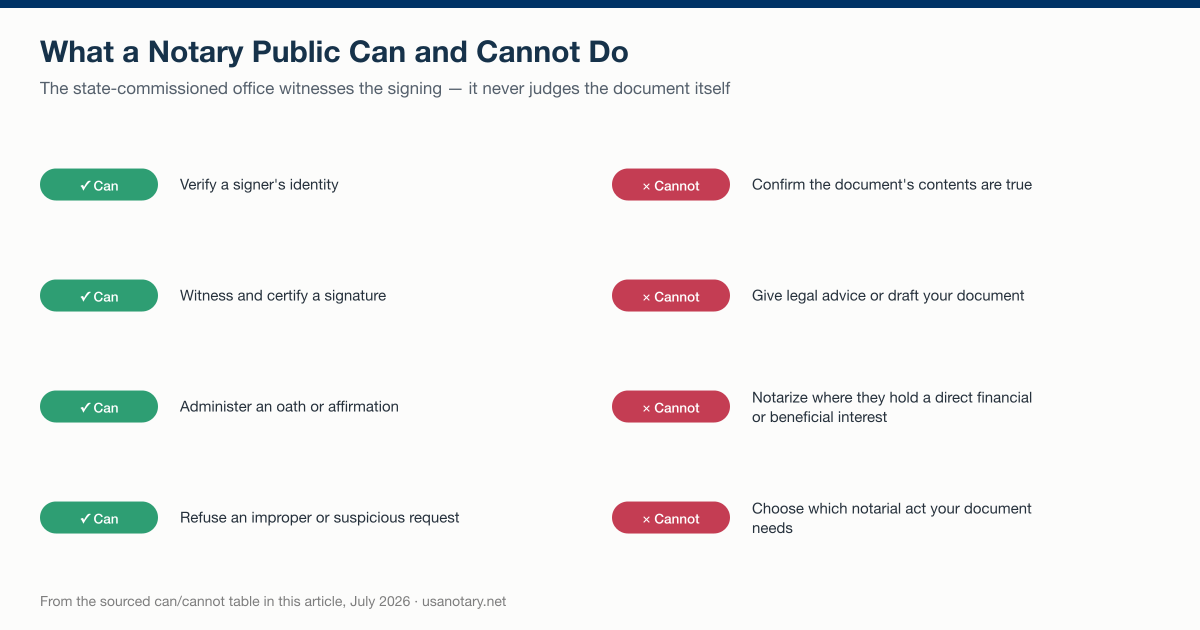
The eight duties and limits from the sourced can/cannot table in this article, July 2026.
| A notary CAN | A notary CANNOT |
|---|---|
| Verify a signer’s identity | Confirm the document’s contents are true |
| Witness and certify a signature | Give legal advice or draft your document |
| Administer an oath or affirmation | Notarize where they have a direct financial or beneficial interest |
| Refuse an improper or suspicious request | Choose which notarial act your document needs |
The notarial certificate itself states this boundary. California Civil Code § 1189 requires every acknowledgment certificate to carry this boxed notice: “A notary public or other officer completing this certificate verifies only the identity of the individual who signed the document to which this certificate is attached, and not the truthfulness, accuracy, or validity of that document.”
The National Notary Association is equally direct on the legal-advice line: notaries “are prohibited from providing legal advice unless they’re also an attorney.” That means a notary cannot tell you which document to use, what it should say, or whether your form will accomplish what you want — those are questions for a lawyer or the agency requesting the document.
Conflicts of interest disqualify a notary too. California’s handbook explains that a notary cannot notarize a transaction in which they hold a direct financial or beneficial interest — though acting purely as an agent, employee, attorney, escrow holder, or lender for an interested party does not by itself create that disqualifying interest. For the specifics of who is allowed to notarize a document — including whether you can notarize your own or a family member’s paperwork — see the full breakdown.
Acknowledgment vs. jurat: the two most common acts
Most notarizations are one of two acts, and the difference decides what the signer must do:
| Notarial act | What the signer does | Oath required? | Signed in front of notary? |
|---|---|---|---|
| Acknowledgment | Acknowledges that they signed the document | No | Not always — signature can predate the appearance |
| Jurat | Swears or affirms the contents are true | Yes | Yes — signs in front of the notary |
In an acknowledgment, the signer acknowledges signing; in a jurat, the signer swears the contents are true and signs in front of the notary after taking an oath. Picking the wrong one can invalidate the notarization, so the requesting agency — not the notary — specifies which act the document needs. Our side-by-side on jurat vs. acknowledgment breaks down when each applies.
Beyond these two, state law authorizes a handful of other acts. New York notaries take affidavits and depositions and administer standalone oaths and affirmations. California notaries may also certify copies of a power of attorney under Probate Code section 4307. The exact menu of permitted acts — like everything else about the office — is set by each state’s notary statute.
The four types of notaries
Every notary holds the same underlying state commission, but the NNA groups working notaries into four practical types based on where and how they serve signers:
| Notary type | Document format | Where they work |
|---|---|---|
| Employee notary | Paper, electronic | In person or virtual, for an employer |
| Mobile notary | Paper | Travels to the signer’s location |
| Remote online notary | Electronic | Virtual, over live audio-video |
| Notary signing agent | Paper, electronic | In person, at loan closings |
An employee notary notarizes as one part of a broader job — think bank staff or law-office employees. A mobile notary travels to homes, offices, and hospitals. A remote online notary has met their state’s additional requirements to notarize over live video. A notary signing agent specializes in mortgage-closing packages. Self-employment dominates the independent side of the profession: in the NNA’s 2023 Notary Survey, 51.1% of respondents were self-employed mobile notaries or signing agents.
Notary public vs. notary signing agent
A notary signing agent is a notary public who has been trained to handle loan documents in real estate transactions, and who has passed an added background screening. As the National Notary Association puts it, all notary signing agents are commissioned notaries, but not all notaries are signing agents. The scope of work is the biggest practical difference:
| Aspect | Notary public | Notary signing agent |
|---|---|---|
| Qualifications | Notary commission | Notary commission plus background check |
| Training | General notary services | Loan documents and closing procedures |
| Typical fees | Often capped at a state maximum | Sets own fee — generally $50–$200 per loan package |
| Session length | About 5–10 minutes | 45 minutes to a few hours |
Signing agents are not loan officers: the NNA cautions that they should never explain loan terms or answer questions about the content of loan documents — those go to a qualified loan officer. If your work centers on mortgages and closings, read our full comparison of a notary versus a signing agent before deciding which path to pursue.
How notary commissions vary by state
Notaries are commissioned under state law, so eligibility, term length, bonding, and training rules differ from state to state. Three large states show the range:
| Requirement | California | New York | Pennsylvania |
|---|---|---|---|
| Commissioning authority | Secretary of State | Secretary of State | Department of State |
| Term length | 4 years | 4 years | 4 years |
| Surety bond | $15,000, filed with the county clerk | Not part of the DOS overview | Bond recorded within 45 days of appointment |
| Education / exam | State exam required | State exam | 3 hours of approved education within 6 months of applying, plus an exam for first-time applicants |
| Filing deadline | Oath + bond within 30 days of the term beginning | — | Oath, signature registration, and bond within 45 days |
California illustrates how strict the deadlines are: an appointee has “30 calendar days from the beginning of the term prescribed in the commission to take, subscribe, and file an oath of office and file a $15,000 surety bond with the county clerk’s office” — miss it, and the commission never takes effect.
A model law smooths out some of this variation. The Revised Uniform Law on Notarial Acts (RULONA), maintained by the Uniform Law Commission, “governs actions by a notary public, including taking an acknowledgment, administering an oath or affirmation, witnessing or attesting a signature, and certifying a copy of a document,” and its 2021 revision permits electronic notarization and authorizes remote online notarization. States that adopt RULONA — Pennsylvania did so effective October 26, 2017 — align their notary statutes with this uniform framework, though each legislature still tailors the details.
Can a notary public work online?
Notaries can increasingly work over the internet. In states that authorize it, a commissioned notary performs a remote online notarization while the signer appears on live video, using identity-proofing tools such as credential analysis and knowledge-based authentication. The core duties — verify identity, confirm willingness, complete the certificate — are identical to an in-person act. Federal law supports the electronic layer: under the ESIGN Act, 15 U.S.C. § 7001, a signature or record “may not be denied legal effect, validity, or enforceability solely because it is in electronic form.”
Two things stay distinct here. First, the consumer service: once a notary is authorized to perform it, an online notarization is legally valid in all 50 states, and the signer never has to travel. Second, commissioning law: whether a notary in a given state can be commissioned to perform remote online notarization is set state by state, and some states do not yet authorize it. California, for instance, enacted its Online Notarization Act (SB 696, signed September 30, 2023), which became effective January 1, 2024 and is operative in stages — its security requirements for remote notarizations (Government Code section 8231.18) became operative January 1, 2025. A federal bill, the SECURE Notarization Act (H.R.1777), would set nationwide RON standards, but it has only been introduced — it is not law. If you want the consumer’s view of how online notarization works end to end, see our guide to remote online notarization.
How much does a notary cost?
Most states cap what a notary may charge for a standard notarial act, per the NNA’s state fee schedules. California’s caps are typical of the fee-capped states: $15 per signature for an acknowledgment, $15 for administering an oath and executing a jurat, and $15 for certifying a copy of a power of attorney. Travel fees, loan-signing fees, and extra services sit outside those caps in many states, which is why a mobile notary visit usually costs more than the statutory fee alone.
Online notarization is priced per document rather than per signature in most cases — online notarization on USA Notary costs $25 per document, with the notarization completed over live video in minutes. If you’re deciding between a bank, a shipping store, a mobile notary, or an online session, our guide to where to get something notarized compares every option and its typical cost.
How to become a notary public
Becoming a notary means meeting your state’s rules, in this general order:
- Confirm you meet the eligibility requirements. Pennsylvania’s are representative: be at least 18, be a U.S. citizen or permanent resident, reside or work in the state, and have a record free of disqualifying convictions.
- Complete any required education and exam. Pennsylvania requires three hours of approved notary education within six months before applying, plus an exam for first-time applicants; California requires a state exam.
- File your oath and bond on time. California requires the oath of office and a $15,000 surety bond filed with the county clerk within 30 days of the term beginning; Pennsylvania gives 45 days to take the oath, register a signature, and record the bond.
- Get your seal and journal, then start notarizing. California requires an official seal that includes the notary’s name and county, and one active sequential journal of all acts.
Because every requirement is set at the state level, start with your own state: our step-by-step guide to becoming a notary covers the specifics. Already commissioned and want to add online work? Learn what it takes to join USA Notary as a remote online notary.