
Notary public vs. notary signing agent: the short answer
A notary public is an official appointed by a state government to serve as an impartial witness when important documents are signed. A notary signing agent (NSA) is a notary public who has added specialized training and a background screening so they can handle mortgage and loan-closing packages. The National Notary Association draws the line plainly: all notary signing agents are commissioned notaries, but not all notaries are notary signing agents.
Put another way, “notary public” is the state commission; “signing agent” is a specialization the mortgage industry builds on top of it. The state makes you a notary; lenders and title companies decide whether you are cleared to sit at a closing table. If you are still sorting out the base role first, our primer on what a notary public actually is covers the commission itself.
The core differences at a glance
The two roles share the same foundation — an active state commission — but diverge on training, scope, fees, appointment length, and who sets the rules. The comparison below reflects how the NNA distinguishes them.
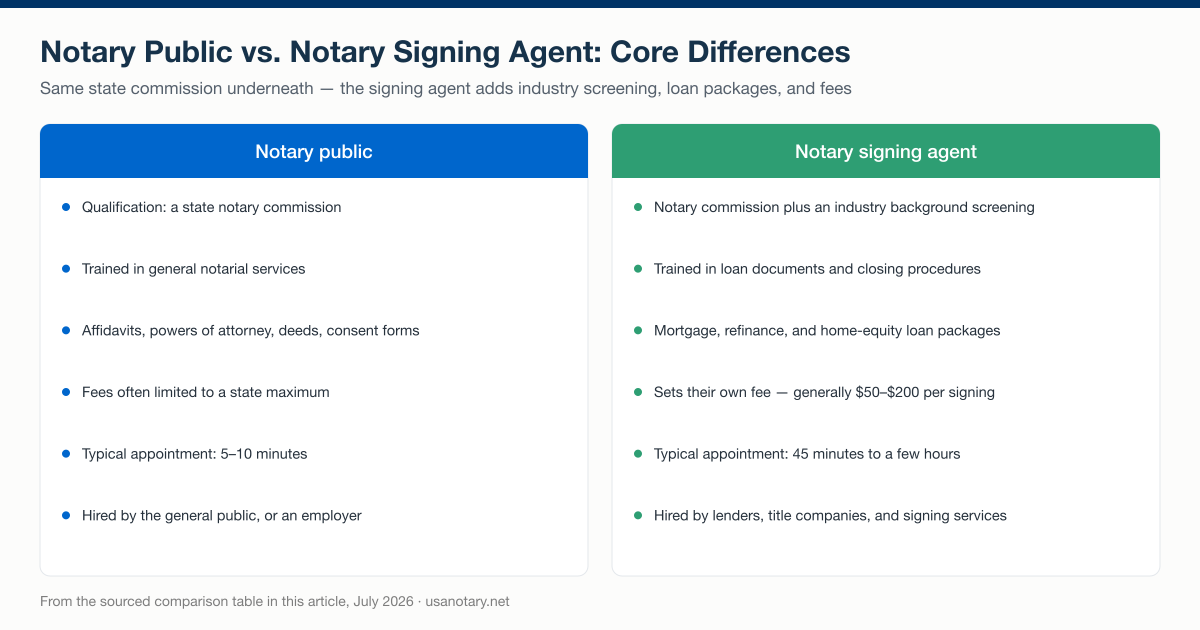
How the two roles diverge on qualifications, documents, fees, and appointment length — from the sourced comparison table in this article, July 2026.
| Notary public | Notary signing agent | |
|---|---|---|
| Qualifications | State notary commission | Notary commission plus an industry background screening |
| Training | General notarial services | Specialization in loan documents and closing procedures |
| Scope of work | Verify identity, screen for willingness and awareness, complete the certificate | The same, plus presenting the loan package and returning documents |
| Typical documents | Affidavits, powers of attorney, deeds, consent forms — whatever the public brings | Mortgage, refinance, and home-equity loan packages |
| Fees | Often limited to a state maximum fee | Sets their own fee by volume and complexity |
| Typical appointment length | 5–10 minutes | 45 minutes to a few hours |
| Who hires them | The general public, or an employer | Lenders, title companies, and signing services — as independent contractors |
| Who requires the extra step | The state | The mortgage industry |
The signing-agent qualifications come from the mortgage industry rather than the state notary office. That is the key mental model, and it explains everything else in this comparison: the annual background screening, the higher fees, and the state-by-state restrictions covered below all exist because a signing agent operates inside the mortgage pipeline, where a botched package can delay a loan from funding.
What a notary public does
A notary public’s core duties are fixed by state law and apply to the full range of documents the public brings in. According to the NNA’s overview of the office and its responsibilities, the notary:
- Verifies identity — confirming the signer is who they claim to be, usually via a current photo ID such as a driver’s license or passport.
- Confirms willingness and awareness — checking that the signer is mentally competent and signing freely, not under duress.
- Administers oaths and affirmations — requiring the signer to declare under penalty of perjury that a statement is true. An oath invokes a higher power; an affirmation, its legal equivalent, is made on the signer’s personal honor.
- Completes the notarial certificate — the official record of the act. For an acknowledgment, the signer acknowledges signing; for a jurat, the signer swears the contents are true and signs in front of the notary.
The notary is a neutral gatekeeper against fraud — never a judge of what the document says. That impartiality is the whole point of the office, and it carries over unchanged into signing-agent work.
The four types of notary — and where the signing agent fits
“Signing agent” is one branch of a wider family. The NNA groups working notaries into four types, all of which share the same core duties but differ in document format and where the work happens:
| Notary type | What makes it distinct | Document format | Location |
|---|---|---|---|
| Employee notary | Notarizes for an employer as part of their job | Paper, electronic | In person, virtual |
| Mobile notary | Travels to the signer’s home, workplace, or hospital | Paper | In person |
| Remote online notary | Has met their state’s additional requirements to notarize over live audio-video | Electronic | Virtual |
| Notary signing agent | Trained and background-screened for mortgage and refinance loan signings | Paper, electronic | In person |
Two of these labels get confused constantly. A mobile notary travels to notarize any kind of document; a notary signing agent specializes in loan packages and usually travels too. The overlap is real — most signing agents operate as mobile notaries — but the credential is different: mobility is a business model, while the signing-agent designation is an industry qualification with its own screening and training.
Does a signing agent hold a different commission? No
The signing-agent title adds zero notarial authority. There is one commission — the state notary commission — and every notarization a signing agent performs at a closing table is an ordinary notarial act governed by ordinary state notary law. As bond provider Notary Public Underwriters puts it, whether you work as a notary, a mobile notary, or a notary signing agent, “each state’s notary laws and rules apply the same.”
This is worth internalizing because it cuts through a common misconception: a signing agent is not “higher” than a notary, and the certificate a signing agent completes on a deed of trust is legally identical to the one a walk-in notary would complete. What the designation changes is market access — the training, screening, and industry relationships that make lenders and title companies willing to hand you a closing package. The state grants the power; the industry grants the work.
What a notary signing agent does at a loan closing
A notary signing agent does everything a notary does, but focused on a single high-stakes deliverable: the loan-closing package. Lenders and title companies hire signing agents as independent contractors for the last step of the loan process — the step that enables the loan to be funded. According to the NNA, a signing agent’s responsibilities generally include:
- Printing the loan documents — often two full copies of a package that can run well past a hundred pages.
- Meeting the signer and notarizing their signatures — presenting each document, confirming identity, and completing every required certificate.
- Returning the documents for processing — on the lender’s timeline, so the loan can fund.
- Following any additional lender instructions — such as faxing back specific pages or using a required shipping service to return the paperwork safely.
The role is narrower in subject but heavier in stakes. The agent walks a borrower through the stack, ensures every required signature and notarization is complete, then gets the package back for processing. It is the last human step before money moves — and a missed signature or a mis-dated certificate can stall funding for everyone involved.
What a signing agent is not allowed to do
A signing agent explains where to sign — not what the terms mean. The NNA is explicit: signing agents “are not loan officers and should never try to explain loan documents or answer questions from a signer regarding the terms of a loan.” In fact, both notaries and signing agents are prohibited from giving legal advice unless they are also an attorney. Loan-term questions go to the loan officer; legal questions go to a lawyer. This boundary is not a courtesy — in several states, crossing it is treated as the unauthorized practice of law, which is exactly why some states restrict who may conduct a closing at all (more on that below).
Why signing agents need a background check
A borrower’s closing package is a concentrated file of private financial and personal information, and the signing agent handles it alone — printing it, carrying it, and operating without direct supervision. That is why the industry, not the state, requires a background screening.
The NNA’s Certified Background Screening follows standards set by the Signing Professionals Workgroup (SPW), and to stay aligned with those standards, signing agents complete a screening every 12 months. Lenders are responsible for safeguarding borrowers’ private data, so they require title companies to confirm that every signing agent they hire is currently screened. Per the NNA, the screening works like this:
- Identity verification runs on the applicant’s Social Security number and driver’s license.
- Records covered include criminal history, motor vehicle and driving history, national and financial security checks, and sex offender registries.
- Lookback period is roughly ten years of federal, state, and county records; some states limit it to seven.
- Scoring is point-based. Offenses carry point values by severity — from 2 points for a non-moving violation up to 25 for robbery. A total of 24 points or fewer passes; 25 or more disqualifies.
- Two checks are automatic disqualifiers regardless of score: a hit on the national sex offender registry or on the USA PATRIOT Act terrorist watch list.
- Pending serious cases hold the screening as incomplete until the case resolves.
This is a different animal from a notary-commission background check. The NNA notes that 12 states require a background check simply to get a notary commission — a one-time, state-facing step. The signing-agent screening is stricter, industry-set, and renewed annually, precisely because of the sensitive material the agent carries.
Where state law limits signing-agent work
The comparison is not uniform across the country, and this is the part most “notary vs. signing agent” explainers skip. Per the NNA’s state-restrictions guidance (last published April 30, 2024), 19 states impose additional requirements or limitations on loan signings:
| Restriction type | States | What it means for a signing agent |
|---|---|---|
| Attorney involvement required | Connecticut, Delaware, Georgia, Massachusetts, South Carolina, Vermont, West Virginia | An attorney must conduct or supervise the closing; the signing agent may still perform the notarizations |
| Attorney involvement customary | Illinois, northern New Jersey, New York, North Carolina, Ohio | An attorney is involved by custom or practice in some or all closings; North Carolina requires attorney oversight of loan signing services |
| Professional license required | Indiana, Maryland, Minnesota, Virginia | Conducting a closing requires a title-insurance-producer or closing-agent license, not just a notary commission |
| Notary fee limits | Nebraska, Nevada | State law caps what a notary may charge, including limits on travel fees |
| Loan-type limitation | Texas | The Texas Constitution (Art. XVI, §50(a)(6)(N)) requires HELOC closings to occur at the office of a lender, attorney, or title company |
Two takeaways for anyone weighing the career. First, “attorney closing state” does not mean “no signing-agent work” — in those states courts have concluded that a non-attorney who explains legal concepts at a closing is engaged in the unauthorized practice of law, but a signing agent may still perform the notarization of the loan documents while the attorney conducts the closing. Second, the restriction landscape changes by legislation and court decision, so check your own state’s current rules before investing in training. In the roughly 31 states with no listed restrictions, a commissioned, screened signing agent can conduct closings without an additional license.
How much more can a signing agent earn?
The financial case for the specialization is straightforward: signing agents are not bound by state notary fee caps for the signing service. Most states set a maximum per-act fee for ordinary notarizations, but there is no maximum fee a signing agent may charge per assignment. The NNA reports that notary signing agents generally make between $50 and $200 to present, notarize, and return a loan document package — a fee that is separate from, and typically well above, the per-act fee for ordinary notarizations.
That fee is negotiated, not fixed. Per the NNA, signing agents set their prices based on business expenses, the companies they work with, the travel and time an assignment requires, and demand in their area. The math also has to absorb real costs — printing double copies of large packages, mileage, and the annual screening — which is why volume and efficiency matter as much as the headline fee. Our breakdown of how notaries actually earn on the USA Notary platform walks through the revenue side in detail.
The specialization is also where much of the profession has moved. In the NNA’s 2023 Notary Survey, 51.1% of respondents were self-employed mobile notaries or notary signing agents — a signal of how central the signing-agent path has become to notaries who work for themselves. Signing agents find assignments primarily through signing-service and title-company relationships and by getting listed in signing-agent directories. If loan work is the goal, the deeper mechanics live in our guide to becoming a loan signing agent.
Can a signing agent work online?
Some closings can move to a screen. In states that authorize remote online notarization (RON), a qualified signing agent can conduct eligible loan closings online, with the signer appearing on live video for the notarization — subject to lender and title-company acceptance and to state law. Keep the two legal layers distinct: RON is legally valid in all 50 states for the consumer service, but the notary commissioning rule is per-state — a notary must meet their state’s additional requirements to be authorized to perform remote notarizations, and some states do not yet authorize RON at all. Most state RON statutes are modeled on the Revised Uniform Law on Notarial Acts (RULONA), which is why the process looks similar from state to state even when the details differ.
There is still no enacted federal RON standard. The SECURE Notarization Act (H.R.1777) has been introduced in Congress but not enacted, so remote-notarization authority remains a state-by-state grant. And for real estate specifically, acceptance runs through more gatekeepers than the notary law: the lender, the title underwriter, and the county where the deed will be recorded all get a say. Our walkthrough on online notarization for a real estate closing covers exactly what to confirm with the lender and the property’s county before relying on a remote closing.
Which path is right for you?
Four questions separate the notaries who should add the signing-agent credential from those who shouldn’t:
- Does your state’s closing market have room for you? In an attorney-closing or license-required state, the role is narrower — confirm what the restriction table above means for your state before spending anything.
- Can you absorb the overhead? Signing-agent work means printing large packages, driving to appointments, and renewing a background screening every 12 months. The $50–$200 per-signing fee has to cover all of it.
- Do you want appointment-length work? A general notarization takes 5–10 minutes; a loan signing runs 45 minutes to a few hours. The economics reward people who can block out real time.
- Are you comfortable staying in your lane? The job demands presenting dozens of documents while never explaining a single loan term. Signers will ask; the answer is always a referral to the loan officer.
If the answers point toward loan work, every route runs through the same first door: a live notary commission.
- Start as a notary public. Nothing else is possible without an active state commission — see the steps to get commissioned in your state, and budget for it first: the cost of becoming a notary varies widely by state.
- Check your state’s signing-agent rules. If you are in one of the 19 restricted states above, understand what an attorney-closing rule or license requirement means for the work before paying for training.
- Add signing-agent training and screening if you want mortgage-closing work: complete the signing-agent course and exam, then pass the industry-required background screening — and plan to renew the screening every 12 months.
- Decide how you’ll get work — traditional mobile closings at the signer’s location, or remote online closings where your state, the lender, and the title company allow them.
If loan signings are where you want to spend your time, the loan signing agent guide covers the role in depth, and you can see what it takes to work with USA Notary once you are commissioned. Still deciding on the fundamentals? Start with what a notary public is and can’t do.