
How much does it cost to become a notary?
Becoming a notary costs under $200 in most states, but the spread is wide. The National Notary Association’s guide to becoming a notary, updated July 2026, puts it plainly: “The cost to become a Notary can range from less than $100 to $600 or more, depending on your state’s requirements.” Notary commissioning is governed state by state, so both the amounts and which line items even apply — bond, course, exam, background check — change the moment you cross a state line.
Your total is the sum of six components: the state application fee, a surety bond (required in some states, not others), an education course and exam where the state mandates them, a background check where required, official supplies, and — optionally — errors-and-omissions insurance to protect yourself. This guide prices each component with confirmed 2026 figures, compares ten states side by side, and shows what actually drives the difference between a $50 commission and a $500 one. For your exact numbers, start with the state-by-state notary guides, which are sourced from each state’s notary authority.
What are the costs to become a notary?
Every state assembles its price from the same menu. Here is each component with real, confirmed ranges:
- State application or filing fee — the one cost no state skips. Confirmed examples run from $15 (Ohio) to $60 plus a $15 exam fee (New York); Georgia collects $40–$55 at the county level instead of a flat state fee.
- Surety bond — required in some states ($5,000 in Illinois up to $50,000 in Alabama), none at all in others (Ohio, Georgia, New York). You pay a premium of roughly $30–$75 for the full term, not the face value.
- Education course — mandated in many states, typically three to six hours. Some states provide it free (Texas’s education videos, Alabama’s probate-judge training); commercial six-hour California courses run up to $199.
- Exam — a written or proctored test in some states. New York’s costs $15; Texas charges a $20 nonrefundable attempt fee for its assessment; Ohio bundles course and exam at about $130.
- Background check or oath filing — California requires Live Scan fingerprinting for a DOJ and FBI check; Ohio requires a criminal records check through its Bureau of Criminal Investigation; Texas caps the oath notarization at $10.
- Supplies — your official stamp or seal (roughly $20–$25) and, where required or recommended, a journal.
Errors-and-omissions insurance is the seventh, optional line: it protects you rather than the public, with entry-level Florida policies starting around $29.
Notary costs in ten states, compared
A single national “average” hides more than it reveals, because no two states price commissioning the same way. The table below compares the filing fee, bond, education and exam rules, and commission term across ten states — every figure confirmed against the state’s notary authority, its administering body, or a bonding agency’s published fee schedule.
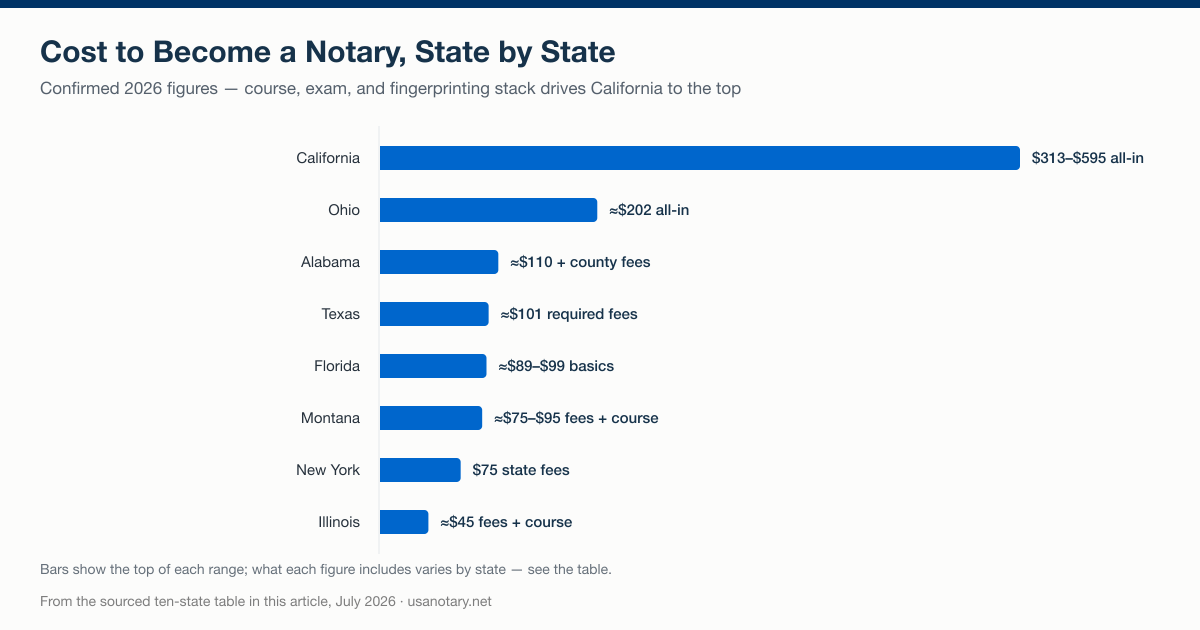
Confirmed per-state cost figures from the sourced ten-state comparison table in this article, July 2026.
| State | State / filing fee | Surety bond | Course & exam | Term | Confirmed cost notes |
|---|---|---|---|---|---|
| California | $40 (application + exam) | $15,000 | 6-hr course + proctored exam | 4 years | $313–$595 all-in (NNA) |
| Florida | $39 | $7,500 (≈$30 premium) | 3-hr course; no exam | 4 years | ≈$89–$99 for the required basics |
| Texas | $21 | $10,000 ($50 premium) | Free state videos + assessment ($20 attempt fee) | 4 years | ≈$101 in required fees + supplies |
| Ohio | $15 | None | 3-hr course + 30-question exam (≈$130) | 5 years | ≈$202 all-in (NNA) |
| Georgia | $40–$55 (county) | None | Course; no exam | 4 years | County fee + course + supplies |
| New York | $60 (+ $15 exam) | None | Exam; no required course | 4 years | $75 in state fees + supplies |
| Illinois | $15 ($15 combined with e-notary) | $5,000 (≈$30 premium) | 3-hr course + exam | 4 years | ≈$45 in fees + course |
| Pennsylvania | $42 | $25,000 | 3-hr course + Pearson VUE exam | 4 years | Fee + bond premium + course/exam |
| Alabama | $10 (+ $25 commission fee) | $50,000 (≈$75 premium) | Free state training; no exam | 4 years | ≈$110 + county recording fees |
| Montana | $25 | $25,000 (≈$50–$70 premium) | 4-hr training + exam | 4 years | ≈$75–$95 in fees + course |
The gap is real. The National Notary Association estimates California at $313 to $595, “depending on the company you choose for your Notary training and supplies and the county”, while Ohio lands near $202 — $130 of it the required course and exam, plus a $15 application fee. Florida’s required basics run about $89–$99, and a Texas notary can cover every mandatory fee — $21 filing, $50 bond, $20 assessment attempt, up to $10 for the oath — for roughly $101 before supplies.
Notice what the expensive states have in common: it is rarely the bond. California’s cost driver is the stack of a mandatory six-hour course, a proctored exam, and Live Scan fingerprinting on top of its $15,000 bond. A bond-free, exam-free state like Georgia asks only $40–$55 at the county Clerk of Superior Court plus a training course.
What a notary surety bond actually costs
A surety bond’s face value and its price are two very different numbers — a point that confuses more new notaries than any other. Where a bond is required, you buy it from a surety company for a small premium covering your full commission term. The confirmed premiums below show how weakly price tracks face value:
| State | Bond face value | What you actually pay (full term) |
|---|---|---|
| Illinois | $5,000 | ≈$30 |
| Florida | $7,500 | ≈$30 |
| Texas | $10,000 | $50 |
| Montana | $25,000 | ≈$50–$70 |
| Alabama | $50,000 | ≈$75 |
Alabama’s bond is ten times the size of Illinois’s, yet costs only about two and a half times as much. Bond premiums are a rounding error next to course, exam, and background-check costs — which is why bond-heavy states aren’t automatically expensive states.
The part that matters more than price: the bond protects the public, not you. If a signer is financially harmed by your notarial error, the bond pays them — and the surety company can then recover that payout from you personally. That exposure is exactly why many notaries add optional E&O insurance, which does cover the notary. The full distinction is worth understanding before you buy either; see notary bond vs. E&O insurance.
Course and exam costs, state by state
Education and testing — not bonds — separate the cheap states from the expensive ones. The rules fall into four tiers:
- No course, exam only. New York skips mandatory training entirely and gates entry with a $15 proctored written exam; attorneys and court clerks of the Unified Court System are exempt.
- Free state-provided education. Texas hosts education videos on the Secretary of State’s site and requires a 70% score on its assessment, charging only a $20 nonrefundable attempt fee. Alabama’s pre-commission training, prepared by the Alabama Probate Judges Association and the Alabama Law Institute, is free.
- Paid course and exam through approved providers. Ohio’s required three-hour course and 30-question exam (80% to pass) run about $130 through authorized providers. Illinois requires a three-hour certified course ending in a 50-question exam with an 85% passing score. Pennsylvania requires three hours of RULONA-compliant education plus an exam administered by Pearson VUE.
- Long mandatory course plus proctored exam. California tops the scale: a six-hour Secretary of State-approved course for new applicants (renewing notaries with a current commission may take a three-hour refresher), then a written exam administered by CPS HR Consulting. Commercial versions of the six-hour course reach $199 — the NNA’s own online California course price — and the state’s $40 fee covers the application and exam, with $20 for each retake.
Course prices vary by vendor even within one state, so treat any single course price as a data point, not the market. If you’re weighing the time cost alongside the money, see how long it takes to become a notary — the same states that charge the most also tend to take the longest.
Background checks, oaths, and county filing fees
Small administrative fees hide outside the headline numbers, and in some states they’re unavoidable:
- Fingerprinting and background checks. California requires Live Scan fingerprinting for a Department of Justice and FBI review before commissioning. Ohio requires a criminal records check through its Bureau of Criminal Investigation, which must be current when you apply.
- Oath and bond filings. California notaries file their oath and $15,000 bond with the county clerk within 30 days of the commission start date — and the county charges its own filing fee. Alabama’s county probate offices add recording and bond-approval fees when the $50,000 bond is recorded. Texas caps the oath notarization at $10.
- County-level appointment fees. Georgia has no state filing fee at all; you apply and pay $40–$55 at your county’s Clerk of Superior Court, so the exact price depends on where you live.
These items rarely exceed $50 combined outside California, but they explain why two notaries in the same state can pay different totals.
Supplies and optional E&O insurance
Supplies are the one near-constant across all fifty states. A notary stamp runs about $20 in Florida’s published pricing, an embossing seal about $25, and a journal — required in some states, recommended everywhere — a similar amount. Budget $30–$60 for the full supply kit, and expect to replace the stamp at each renewal, since it typically carries your commission expiration date.
Errors-and-omissions insurance is the main optional cost. Entry-level Florida policies start around $29, and pricing scales with coverage. E&O is the mirror image of the bond: the bond protects the public from your mistakes, E&O protects you. Notaries who handle high-stakes documents — deeds, loan packages, powers of attorney — most often decide the premium is worth it.
What drives your total cost
Four variables decide where in the under-$100-to-$600 band you land:
- Does your state require a bond, and does it require recording it? The premium itself is modest ($30–$75 confirmed above), but county recording adds fees in states like Alabama.
- Is a course required, who provides it, and how long is it? Free state-provided training (Texas, Alabama) versus a $130 provider bundle (Ohio) versus a six-hour commercial course (California, up to $199) is the single biggest swing factor.
- Is there an exam or background check? Proctored exams and Live Scan fingerprinting push California to the top of the national range.
- Who collects the fees — state, county, or both? Georgia is county-only; California is state fee plus county filing; New York is state-only.
Two worked examples from the confirmed figures: a Texas applicant pays $21 (filing) + $50 (bond) + $20 (assessment) + up to $10 (oath) = about $101, plus a stamp and record book. A California applicant pays $40 (application and exam) + a six-hour course + Live Scan + a $15,000 bond and county filing — which is how the NNA’s estimate stretches to $313–$595 depending on vendor and county.
Extra costs to become an online (remote) notary
Notarizing over live video adds a second layer of costs on top of your traditional commission. Remote online notarization is legally valid in all 50 states for the consumer service — a signer anywhere can get a document notarized online by an authorized notary — but notary commissioning law is per-state, and some states do not yet authorize their own notaries to perform RON. California is the clearest example: SB 696 authorized RON, but the NNA’s 2026 fee schedule still lists California as “remote notarization not yet implemented,” because the provisions don’t become operative until the Secretary of State completes its technology project (or January 1, 2030, whichever is earlier, unless the Secretary notifies the Legislature and Governor in writing by January 1, 2029 that the project will not be completed).
Where RON is authorized, the confirmed add-on costs look like this:
- State registration: $10 in Florida, $60 in New York (electronic notary registration), $20 in Ohio plus a one-time $250 education-and-testing fee paid to the approved provider, no state fee in Illinois to add electronic authority to an existing commission (the $25 electronic-notary fee is waived for two years from July 2026) and $15 for a new commission, combined notary and e-notary application included, and $50 for Texas’s online notary application.
- A larger bond in some states: Illinois raises the requirement from a $5,000 bond to $30,000 for electronic notaries.
- Technology: a digital certificate, an electronic seal, and a subscription to an approved RON platform — recurring costs, not one-time. See what the main RON platforms charge.
The legal footing for all of it is settled. Many state RON statutes are modeled on the Revised Uniform Law on Notarial Acts (RULONA), and under the federal ESIGN Act, electronic signatures and records may not be denied legal effect solely because they are electronic. A federal RON standard — the SECURE Notarization Act — has been introduced in Congress but remains only proposed, not enacted, so the rules that govern you today are your state’s. For the eligibility side of the question, see whether you can become a notary online.
Ongoing costs after you’re commissioned
A notary commission is a recurring expense, not a one-time purchase:
- Renewal — you repeat the state fee, and any required course or exam, each term. Most commissions run four years; Ohio’s runs five for non-attorney notaries. New York’s renewal costs $60, the same as the initial application, and Georgia requires the training course again within 30 days before each renewal.
- Supplies — a new stamp at renewal to reflect the updated expiration date, and journal replacements as they fill.
- E&O insurance — a recurring premium if you carry it.
- Online-notary technology — platform subscription, digital certificate renewals, and any state re-registration if you perform RON.
Can you earn the cost back?
Recouping a sub-$200 startup cost takes surprisingly few signings, but state fee caps set the ceiling. California, for example, caps the notary fee at $15 per signature for an acknowledgment under the NNA’s 2026 fees-by-state schedule — so a California notary’s $313–$595 outlay is a few dozen notarizations to break even, while an Ohio notary’s ~$202 pays back faster against a five-year term. Online signings change the math again: on USA Notary, online notarization costs $25 per document for the signer, and the signer appears on live video with a commissioned notary.
What you’ll actually pay and earn on a platform is its own topic — the notary costs and fees breakdown covers subscriber and contractor economics on USA Notary in detail.
How to budget the whole path
- Look up your state’s four variables — fee, bond, course, and exam. Those set most of your cost. The become-a-notary state guides list each one, sourced from your state’s notary authority.
- Price the bond premium, not the face value — expect roughly $30–$75 for the full term where a bond is required.
- Check whether your state’s education is free or paid — this is the biggest swing factor between states.
- Add supplies — about $30–$60 for a stamp, seal, and journal.
- Decide on E&O insurance for your own protection.
- Factor renewal every term (commonly four years), including any repeat course or exam.
- Add RON registration and platform costs only if you’ll notarize online — and confirm your state authorizes it first.
Confirm every figure against your own state’s notary authority before you apply. Fees and bond amounts change — Georgia’s training mandate and Illinois’s course-and-exam requirement are both recent additions — and your state’s current numbers are the ones your commission actually depends on.