
How long does it take to become a notary?
Becoming a notary takes a few weeks to a couple of months for most people. There is no single national answer because notary commissioning is handled state by state, and the required steps differ. The fastest path runs through states that ask only for an application and a bond; the longest runs through states that require an education course, a proctored exam, and a filing deadline after approval — plus however long the state’s queue takes.
The queue is the part applicants underestimate. Pennsylvania’s Department of State recommends allowing two to four weeks just to process a commission application. California goes further and publishes its backlog in real time: as of mid-July 2026, the Secretary of State’s current processing dates page showed the office working through applications from exams held June 10, 2026 — roughly a five-week queue, and that clock starts only after your exam results arrive. Stack the steps end to end and a “simple” commission can span two to three months.
Our state-by-state notary guides show exactly which steps your state requires, with fees, bond amounts, and terms verified against each state’s own commissioning authority.
What determines the timeline
Your total time is the sum of a handful of state-set steps. Each one is a switch that is either on or off in your state:
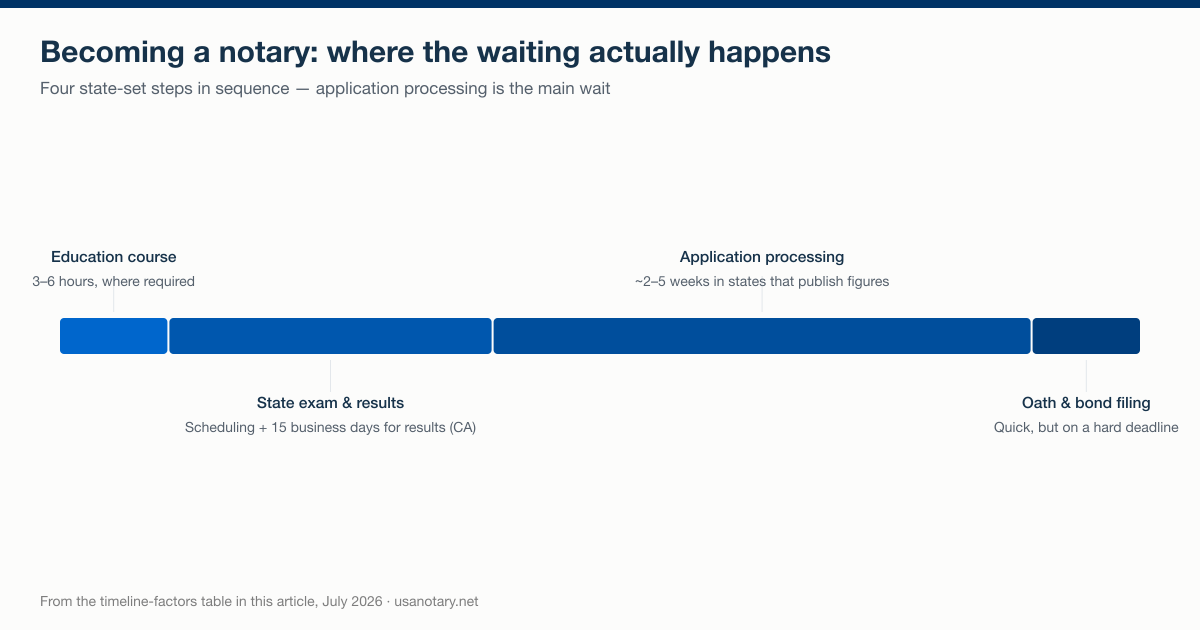
The four state-set steps in sequence, sized by relative wait, from the timeline-factors table below — July 2026.
| Step | Adds time when… | Typical range |
|---|---|---|
| Education course | Your state requires one | 3–6 hours of coursework |
| State exam | Your state requires a proctored test | Scheduling + a results wait (15 business days in California) |
| Background check | Your state fingerprints applicants (California, Utah) | Runs alongside processing |
| Application processing | Always — this is the main wait | ~2–5 weeks in the states that publish figures |
| Oath & bond filing | Required after approval in many states | A short county trip, but on a hard deadline |
Because these switches differ, the same task can take two weeks in one state and three months in another. Eligibility rules — age, residency, character requirements — come before all of it; the notary requirements overview breaks those down.
Notary timelines by state: what each state turns on
State specifics below come from each state’s commissioning authority. The pattern to read for: no course + no exam = fast; course + proctored exam + filing deadline = slow.
| State | Course | Exam | Bond | Term |
|---|---|---|---|---|
| California | 6 hours (first-time) | Yes — score 70+, results in 15 business days | $15,000 | 4 years |
| Pennsylvania | 3 hours, within 6 months of applying | Yes — Pearson VUE, after application review | $25,000 | 4 years |
| New York | None required | Yes — attorneys and court clerks exempt | None | 4 years |
| Florida | 3 hours (first-time) | No | $7,500 | 4 years |
| Illinois | 3 hours (course + exam, since 2024) | Yes — 50 questions, 85% to pass | $5,000 | 4 years |
| Nevada | 3 hours minimum | Yes — 80% to pass | $10,000 | 4 years |
| Arizona | None (free state manual) | Yes — Prometric, 45 questions, 80% | $5,000 | 4 years |
| Colorado | Yes — free online via Secretary of State | Yes — free online | None | 4 years |
| Washington | None | No | $10,000 | 4 years |
| Utah | None — self-study | Yes — online, through the Lieutenant Governor’s site | $5,000 | 4 years |
| Ohio | 3 hours (non-attorneys) | Yes — 80% (non-attorneys) | None | 5 years |
| Louisiana | No set hours — but the statewide exam is rigorous | Yes — offered at least twice a year | $50,000 | Lifetime |
Two structural observations from that table. First, an exam is not always a course, and a course is not always an exam — New York tests without training you, Florida trains without testing you. Second, term length is independent of difficulty: Louisiana has one of the hardest exams and a lifetime commission, while Washington asks almost nothing and still issues a standard four-year term.
Professional exemptions can also collapse the timeline. New York’s Department of State exempts attorneys and court clerks of the Unified Court System from the written exam entirely — for them, the $60 application and the processing wait are the whole process. Ohio, New Jersey, Illinois, and Louisiana carve out similar attorney exemptions from exams or coursework, though the details differ state to state — Ohio, for instance, excuses attorneys from the exam but still requires the education course.
The fastest paths — and why they’re fast
If speed matters, look for states where the only real wait is processing:
- Washington requires no course and no exam. You apply with a $40 fee and a $10,000 surety bond, then wait on the Department of Licensing.
- Virginia currently requires no course and no exam — a $45 application and a $10 circuit-court oath fee. That changes on July 1, 2027, when Virginia begins requiring a state-approved course completed within six months of applying, plus an exam for first-time applicants. Applying before that date is the faster path.
- Colorado requires training and an exam, but the Secretary of State offers both free and online, and your certificates just need to be under 90 days old when you apply. The requirements exist, but you control the schedule.
- Utah skips the course entirely: you self-study the state’s materials and take an online exam through the Lieutenant Governor’s notary site, post a $5,000 bond, and clear a background check.
The common thread: nothing on that list forces you to wait for a proctored testing date or mailed results. Every step is something you can do this week.
The slowest paths — and where the time actually goes
California is the clearest worked example, because every number in it is published by the state:
- Six-hour course. First-time applicants must complete a Secretary of State–approved six-hour course of study before appointment.
- Proctored exam. You register for and sit a written exam administered by CPS HR Consulting; a score of 70 or more is required to pass.
- Results wait. Exam results are available 15 business days after the examination — three full calendar weeks before your application is even transmitted to the Secretary of State.
- State processing. The Secretary of State’s queue, per its own processing-dates page, was about five weeks deep in July 2026.
- Oath and bond filing. After the commission packet arrives, you have 30 calendar days from your commission’s start date to file your oath and $15,000 bond with the county clerk.
Add those published waits together — course, exam scheduling, three weeks of results, five weeks of processing, county filing — and the California path realistically spans two to three months. Pennsylvania runs a similar gauntlet with a twist: the exam, administered by Pearson VUE, is taken after the Department of State reviews your application, so the processing wait and the exam wait happen in sequence rather than in parallel.
Louisiana is slow for a different reason: no course hours are mandated, but the statewide proctored exam is offered at least twice a year at designated sites — so your timeline can hinge on when the next test date falls.
California vs. Pennsylvania: the same steps, two clocks
Both states require training, a proctored exam, a surety bond, and a deadline-bound filing after approval — yet the specifics diverge:
| Factor | California | Pennsylvania |
|---|---|---|
| Training course | 6 hours (first-time applicants) | 3 hours, within 6 months of applying |
| Exam | Proctored, score 70+ to pass | Proctored, via Pearson VUE, after application review |
| Results wait | 15 business days for exam results | ~2–4 weeks recommended for processing |
| Application fee | $40 | $42 |
| Surety bond | $15,000 | $25,000 (raised from $10,000 on March 28, 2026) |
| Deadline after approval | File oath & bond within 30 days | Bond executed within 45 days, recorded with the Recorder of Deeds |
| Commission term | 4 years | 4 years |
California’s requirements — an approved course of study, a written examination, and a background check — are laid out on the Secretary of State’s qualifications checklist. Pennsylvania’s application page requires at least 3 hours of approved notary education completed within the six months before applying, plus the exam and a $42 filing fee. Neither state is dramatically faster: California front-loads the waiting (results, then processing), Pennsylvania back-loads it (processing, then exam scheduling). Both realistically land in the six-to-twelve-week band.
The typical steps, in order
Wherever you live, the sequence looks the same. Where each step applies, do it in this order:
- Confirm eligibility — age (18+ everywhere), residency or in-state employment, and character/background rules set by your state.
- Complete an education course if your state requires one (three to six hours is common) — and mind expiry rules: Pennsylvania’s course must be within 6 months of applying, Colorado’s certificate within 90 days.
- Submit your application and fees.
- Pass the exam if your state requires one, then wait for results.
- Clear the background check where required — California uses Live Scan fingerprinting; Utah runs a mandatory check too.
- Receive your commission from the state after processing.
- File your oath of office and surety bond where required — and on time.
- Get your supplies (seal, journal), and, if you plan to work online, register separately as a remote online notary.
The order matters more than the speed. An expired course certificate or a bond bought before you know your commission dates creates rework that costs more time than any queue.
Don’t lose the commission on a filing deadline
The step people overlook is the last one. In many states the commission is not final until you file your oath and bond, and there is a clock on it:
- California: 30 calendar days from your commission’s start date to file the oath and $15,000 bond with your county clerk.
- Pennsylvania: the $25,000 bond must be executed within 45 days of appointment and recorded with the county recorder of deeds.
- Nevada: the $10,000 bond and signed oath must be filed and recorded with the clerk of your home county — a separate stop beyond the Secretary of State application.
Miss the window and the months of coursework, testing, and waiting can lapse, sending you back to reapply. This is a scheduling problem, not a waiting problem — treat the county filing trip as urgent the moment your commission packet arrives.
2026–2027 rule changes that move the clock
Notary law is moving right now, and several changes directly affect timelines and budgets. Each of these is reflected in our state guides:
- Pennsylvania raised its surety bond from $10,000 to $25,000 for notaries appointed or reappointed on or after March 28, 2026.
- Louisiana raised its non-attorney bond to $50,000 effective February 1, 2026, and no longer accepts errors-and-omissions insurance in lieu of a bond.
- Arizona began requiring a proctored Prometric competency exam — 45 questions, 80% to pass — for all new and renewing notaries on July 1, 2025.
- Utah launches a new notary application system on July 21, 2026, per the Lieutenant Governor’s office.
- Virginia adds a mandatory pre-application course and a first-time-applicant exam on July 1, 2027 — the biggest future change on the fast-state list.
The direction of travel is clear: states are adding training, testing, and bonding requirements, not removing them. If your state is on this list, applying under today’s rules is usually the shorter path.
If you want to work online, add a registration step
Traditional and online notary work are commissioned separately. To perform remote online notarization (RON) — where the signer appears on live video — you must first hold an active commission, then register with your state as an online notary. That registration is an extra step on top of the base timeline, and RON authority for notaries is set state by state.
Keep two facts distinct here. For consumers, a document notarized online through a platform like USA Notary is legally valid in all 50 states, and online notarization on USA Notary costs $25 per document. For notaries, commissioning law is per-state — and some states’ notaries still cannot register. California enacted SB 696, its Online Notarization Act, but the online-notary provisions are not yet operative: until the Secretary of State completes the required technology platform (or January 1, 2030, whichever is earlier, unless the Secretary of State notifies the Legislature and Governor in writing by January 1, 2029 that the project will not be completed), California-commissioned notaries cannot register for or perform RON.
Most states’ RON statutes are modeled on the Revised Uniform Law on Notarial Acts (RULONA), and a federal standard — the SECURE Notarization Act, H.R.1777 — has been introduced in Congress but not enacted, so the state patchwork still governs who can register and when. If online signings are your goal, see whether you can become a notary online before you plan your timeline.
Renewing is faster than starting
Once you hold a commission, the second pass through the process is shorter almost everywhere:
- California lets renewing notaries with a valid commission take a three-hour refresher course instead of the six-hour original — and issues reappointment commissions up to 30 days before the current one expires, so there’s no coverage gap if you file early.
- Pennsylvania exempts reappointment applicants from the exam as long as they apply while their commission is still active; let it lapse and you retake the test.
- Illinois is the counterexample: since 2024, renewing notaries must repeat the three-hour course and pass its exam, with narrow exemptions.
The pattern: renewal rewards notaries who start early and punishes lapses. Our guide to renewing a notary commission covers the sequencing in detail.
How to shorten the timeline
You can’t rush a state’s queue, but you can remove every gap between the steps you control:
- Finish the course before you apply so it never becomes a bottleneck — but watch validity windows (6 months in Pennsylvania, 90 days in Colorado).
- Schedule the exam early. In exam states, the wait for a seat plus the results wait is often the longest single delay — 15 business days for results in California alone.
- Line up your bond while you wait. Bond premiums are small and sureties issue quickly, so have it ready the day approval lands.
- File your oath and bond immediately to protect the 30- or 45-day deadline.
- Renew before expiry — an active commission unlocks exam waivers and refresher-course shortcuts that a lapsed one forfeits.
Once you’re commissioned, USA Notary’s notary program is the next step for putting the commission to work in online signings. For the money side of the same decision, see how much it costs to become a notary — the fee, bond, and course costs vary as much as the timelines do.