
When does a notary commission expire?
A notary commission runs for a fixed term, then expires — four years is the most common length. The New Mexico Secretary of State, for example, commissions a notary “for a term of four (4) years,” and California, Texas, and Florida use the same four-year term. Ohio is a useful reminder that the term itself varies: a non-attorney Ohio notary’s commission expires five years from the date of issuance unless a renewal application is successfully submitted. Your commission certificate lists the exact expiration date, and that date is the one that matters — renewal is not automatic anywhere. To keep notarizing without interruption, you reapply through your state’s notary authority before your current term ends.
Tracking that date is your job, not the state’s. New York’s Department of State tells notaries plainly that “you are responsible for keeping track of your license expiration date and renewing on time,” and notes there have been delays in mailing its renewal reminder postcards. New Mexico does mail a notice one month before expiration, but a one-month heads-up is tight if your state also requires a course, an exam, or a new bond. The safest habit is to work from the certificate date itself and start early.
The reason to renew early is concrete. If your commission lapses, you can’t legally notarize until you’re commissioned again — and several states will make you start over as a first-time applicant, which is slower and more expensive than a straight renewal. If you’re weighing the effort against the payoff, renewal is almost always faster than the first-time track we describe in how long it takes to become a notary.
How to renew a notary commission, step by step
The mechanics vary by state, but the sequence is consistent:
- Check your expiration date on your commission certificate and confirm your state’s renewal window — 90 days in New York and Texas, a three-month window in Ohio, any time before expiration in New Mexico.
- Complete any required refresher course or exam — and confirm whether your still-active commission qualifies you for a shorter refresher or an education waiver.
- Submit your renewal application and fee before the deadline, using your state’s online portal where one exists (New York’s BusinessExpress, New Mexico’s enterprise.sos.nm.gov, Ohio’s notary.ohiosos.gov).
- File a new oath and bond where your state requires them, within the state’s filing deadline — California allows 30 calendar days from the commission commencement date, and that period cannot be extended.
- Register or order your new stamp once your new commission number or dates are issued; New Mexico, for instance, requires the official stamp to be registered within 45 days of approval.
- Update your listings and platforms — your profile on signing services, your county records, and your notary platform account should all reflect the new commission dates.
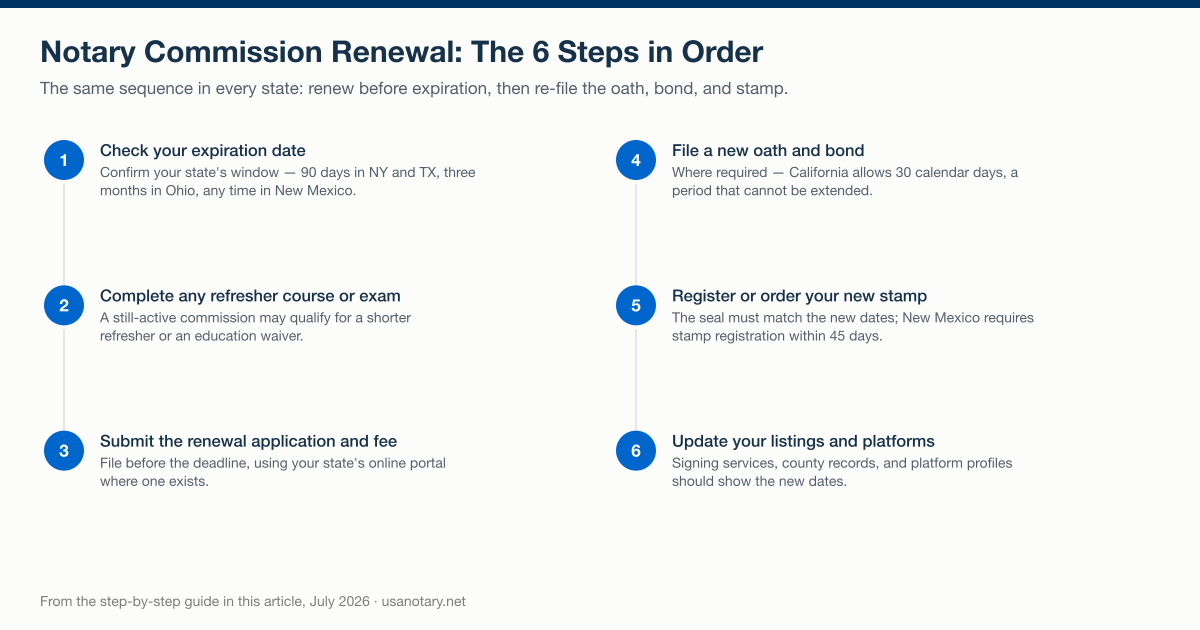
The six renewal steps described in this guide, in order, July 2026.
Two of those steps hide most of the failure modes: the education step (because refresher eligibility usually depends on renewing before expiration) and the oath-and-bond step (because a missed filing deadline can invalidate the new commission). The sections below take each one apart.
State renewal windows compared
There is no single national renewal date and no national renewal form. Each state sets its own window, fee, and education rule, and missing the window can force a gap. The table below compares six states’ rules, drawn from their own guidance — treat it as an illustration of the range, not a substitute for your state’s rules.
| State | Term | When you can renew | Renewal fee | Education to renew |
|---|---|---|---|---|
| New York | Set by license | Up to 90 days before expiration, online via BusinessExpress or paper form DOS-0026 | See state portal | No course listed for renewal |
| Texas | 4 years | No earlier than 90 days before expiration, using Form 2301 | $21 filing fee | No course listed for renewal |
| Ohio | 5 years (non-attorney) | Within the three-month window before expiration | $15 | Expired commission = reapply as new |
| New Mexico | 4 years | Any time before expiration; reminder mailed one month out | See state portal | Course/exam waived if prior commission issued after Jan 1, 2022 and not expired over a year |
| California | 4 years | SoS advises taking the exam at least six months before expiration | $20 application fee | 3-hour refresher if current; 6-hour course if lapsed; exam either way |
| Florida | 4 years | Window opens six months before expiration | $39 state filing fee | No course for a standard renewal; 2-hour course to add RON |
New York’s rule is unusually precise: its Department of State states that “you are eligible to renew your license 90 days prior to your license expiration date,” and renewals go through the online BusinessExpress portal. Texas mirrors the 90-day figure from the other direction — the Texas Secretary of State accepts a renewal “no earlier than 90 days before the expiration” of the commission. Ohio compresses everything into a three-month filing window with a $15 fee. New Mexico is the most flexible on timing and even preserves your anniversary: renew early and the new four-year term keeps the same month and day, while a late renewal resets the expiration clock to the approval date. The practical takeaway is the same everywhere — find your window, then work backward.
Does renewal require the course and exam again?
It depends on the state, and this is where renewal genuinely differs from the first time. Some states offer a lighter path for notaries who are still current; others treat every application the same; a few skip education for renewals entirely.
California is the clearest example of the lighter path — and of how easily it is lost. The California Secretary of State states that “an approved three-hour refresher course is only acceptable if the notary public applies for reappointment before expiration of the current notary public commission.” First-time applicants take a six-hour course; a current notary renewing on time takes the 3-hour refresher instead. But “if the notary public commission expires before course completion and a completed application is received, the person must take another approved six-hour course.” The state exam must be retaken either way, and the SoS’s own FAQ advises sitting for it “at least six months prior to the expiration date” of your current commission — exam results stay valid for one year, and results typically arrive 15–20 business days after the test.
New Mexico goes further and waives education for qualifying renewals: a notary whose commission was issued after January 1, 2022 and has not been expired for more than a year does not retake the qualification course and exam — the original certificate of completion is submitted with the renewal application instead. Florida sits at the other end of the spectrum for standard renewals: no course is required to renew a traditional commission at all, though adding remote online notarization does require training (more on that below).
The pattern across all of these: the lighter path is a reward for renewing on time. File before expiration and your training burden shrinks or disappears; let the commission lapse and most states push you back onto the first-time track.
California’s refresher rule at a glance
| Your situation | Course required | Exam required |
|---|---|---|
| First-time applicant | 6-hour approved course | Yes |
| Current commission, applying before expiration | 3-hour refresher | Yes |
| Commission lapsed before application complete | 6-hour course again | Yes |
Eligibility still applies when you renew
Renewal is a fresh appointment, not a rubber stamp, so the qualifications that got you commissioned the first time are checked again. Florida’s renewal standards, per Florida Notary Service, mirror the original appointment: you must be at least 18, have maintained legal Florida residency throughout the term, and be actively commissioned and in good standing. An application can be denied at renewal for the same reasons a first-time application can.
Good standing is the part renewing notaries overlook. Disciplinary action during your term, an unresolved complaint, or a change that breaks a base requirement — moving out of state where residency is required, for example — can turn a routine renewal into a denial. If your circumstances changed during the term (name, address, county, residency), resolve the update with your state before or alongside the renewal so the new commission is issued with accurate information. New York’s Department of State handles both on the same renew-or-update track, which is a useful model for the order of operations: fix the record, then renew it.
What renewal costs
Renewal filing fees are small; the surrounding requirements are where the money goes. Confirmed state figures: Ohio’s renewal application fee is $15, California’s application fee is $20, Texas’s filing fee is $21, and Florida’s state filing fee is $39 (Florida vendors commonly bundle the fee, the $7,500 bond, and supplies into packages around $99). On top of the filing fee, budget for whatever your state layers on:
- A surety bond, in bond states — $15,000 in California, $7,500 in Florida.
- A course and exam, where required — California’s refresher plus exam, versus nothing at all for a standard Florida renewal.
- A new stamp and journal, since your seal must match the new commission dates and number.
- A RON registration, if you maintain online authority — Florida’s remote-online upgrade adds a two-hour state-approved course and a larger $25,000 bond plus $25,000 in errors-and-omissions coverage.
The bond deserves one clarification, because renewing notaries often confuse it with insurance: a surety bond protects the public from your mistakes, not you. If you want protection against your own liability, that is a separate errors-and-omissions policy, which we compare in notary bond vs. E&O insurance.
What happens if your commission lapses
A lapsed commission is not a grace period — it is a stop. The moment your term ends, your authority to notarize ends with it, and any notarization performed after that date is invalid. The follow-on cost depends on the state:
- California bumps a lapsed notary from the 3-hour refresher back to the full 6-hour course.
- Ohio treats an expired commission as gone: renewal is no longer available, and you reapply as a new notary.
- New Mexico keeps you on the renewal track but resets your expiration date to the approval date, so you lose your original anniversary.
For anyone who let a commission lapse and now faces the full first-time track, our guide on how long it takes to become a notary walks through the complete timeline you’d be repeating — application, education, exam where required, oath and bond, and supplies. That timeline is the whole argument for renewing early rather than at the deadline.
Renewing your stamp, seal, and bond
Your physical supplies are tied to the commission, not to the calendar. When your dates or commission number change, your seal has to change with them. As one California renewal guide puts it, an expired stamp “becomes legally invalid once your commission expires” — even if it “physically appears intact and usable” — so you order a new stamp only after your new commission packet arrives, and it must match your current commission information exactly: your name as commissioned, commission number, expiration date, and (in California) the county where your oath was filed. Some states add a registration step — New Mexico requires the official stamp to be registered within 45 days of renewal approval.
The bond and oath reset too. In bond states, a new term means a new surety bond and a freshly filed oath of office. California renewing notaries file the oath and a $15,000 bond with the county clerk’s office in the county where their principal place of business is located, “within 30 calendar days from the commencement date of the commission” — and the Secretary of State is explicit that “this 30 day period cannot be extended.” Miss it and the new commission is invalid, which converts a completed renewal into a lapse. Filing in person rather than by mail is the state’s own recommendation for beating the deadline.
Renewing and remote online notarization
An active commission is also the foundation of any online authority you hold. Renewing the underlying commission is what keeps you eligible to notarize remotely — the online registration sits on top of it. Remote online notarization is available to signers in all 50 states as a consumer service, but the commissioning rules that let a notary perform it stay per-state, and most are modeled on the Revised Uniform Law on Notarial Acts (RULONA). The federal backstop for the electronic records themselves is the ESIGN Act, under which a signature or record “may not be denied legal effect … solely because it is in electronic form.” A federal floor for remote notarization itself — the SECURE Notarization Act, H.R.1777 — has been introduced in Congress but remains only proposed, not enacted, so your state’s rules still control what you may perform.
If your state authorizes RON, confirm whether your online registration renews on the same cycle as your commission or separately — some states run them on different clocks, and some fold the upgrade into renewal itself. Florida is a concrete example: a renewing notary can add remote online authority by completing a two-hour state-approved course and carrying the larger $25,000 bond and $25,000 E&O coverage, per Florida Notary Service. If you’re deciding whether the upgrade is worth it, our guide to becoming a notary online separates the commissioning process from the online-notarization authority it unlocks.
A renewed, active commission is all you need to keep running signings, in person or on live video, on USA Notary. To turn that renewed commission into more work, see the notary marketing hub for ways to grow your book of business.
Renewal timeline: working backward from your expiration date
Deadlines drive everything in renewal, so plan from the expiration date on your certificate and count backward:
- Six months out — confirm your state’s rules and window. In California this is when the SoS says to take the exam; in Florida this is when the renewal window opens.
- Three to four months out — complete any required course, gather your bond quote, and prepare the application. Ohio’s entire filing window is these final three months.
- 90 days out — file where the window has opened: New York (up to 90 days prior) and Texas (no earlier than 90 days prior) both key to this date.
- After approval — file the oath and bond within your state’s deadline (30 calendar days in California), register or order the stamp that matches the new commission (45 days in New Mexico), and retire the old stamp.
- Before the old term ends — verify the new commission’s commencement date so there is no day on which you hold no authority.
State specifics beyond the six states covered here live in our state-by-state become-a-notary guides, which include each state’s renewal, refresher-course, and oath-and-bond rules.