
Can you become a notary online?
For most people, a large part of the process can be done online — but “online” means two different things here, and separating them prevents the most common mix-up:
- Completing the commissioning steps over the internet — the application, the required course, and sometimes the exam.
- Becoming a remote online notary (RON) — being authorized to notarize over live video, where the signer appears on a webcam instead of in front of you.
Context on the profession’s size: the NNA’s 2022 census counted 4,442,904 notaries nationwide, a figure we unpack in our 2026 notary and RON data report.
The first is about how you apply to become a notary at all. The second is a separate capability you add after you already hold a commission. You can do the first without ever doing the second — plenty of notaries apply online and then only stamp documents in person.
Both paths run through your state, because notary commissioning is state law, not federal law. That’s why every practical detail below — fees, courses, exams, whether RON is even available — changes at the state line, and why the safest first step is checking your own state’s rules in our state-by-state notary requirements.
What parts of becoming a notary are online — and what may not be
Every state sets its own commissioning process, so no single answer fits all 50. That said, the pattern below holds in most states:
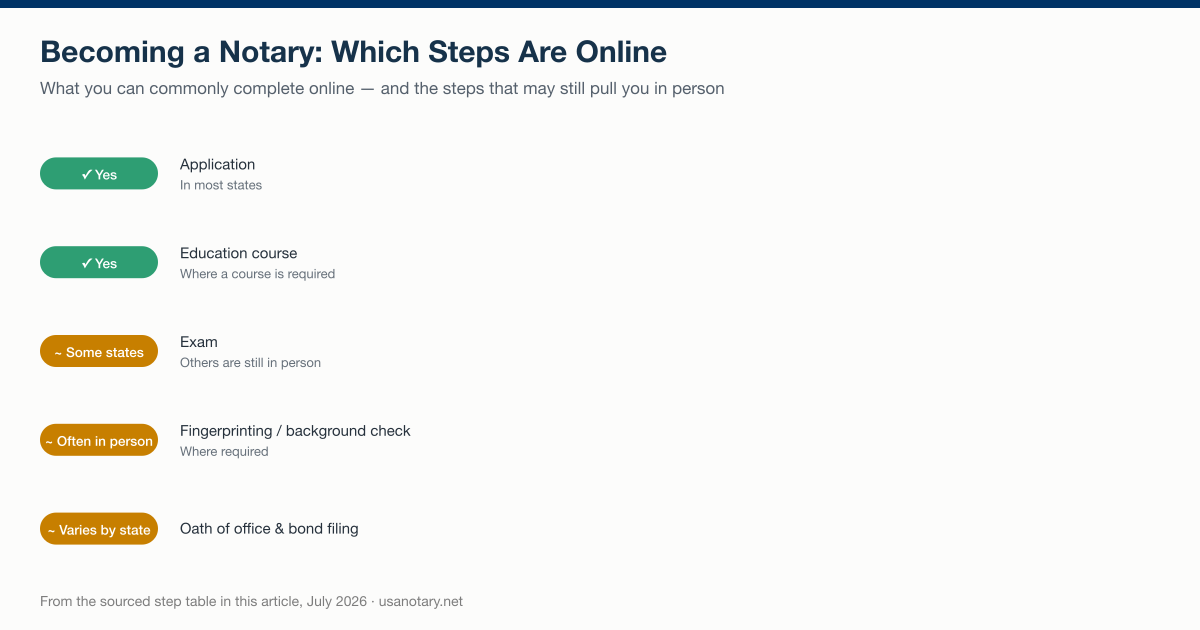
Which commissioning steps are commonly online versus in person, from the sourced step table in this article, July 2026.
| Step | Commonly online? |
|---|---|
| Application | Yes, in most states |
| Education course | Yes, where a course is required |
| Exam | Some states (others are still in person) |
| Fingerprinting / background check | Often in person, where required |
| Oath of office & bond filing | Varies by state |
Three of those rows deserve a closer look:
- The application is the most reliably online step. Texas, for example, requires online-notary applicants to apply electronically to the Secretary of State through its online commissioning system, and Tennessee’s online-notary application “must be submitted and paid online.” Even for traditional commissions, most states now run web-based application portals.
- The exam is the step most likely to pull you offline. Some states offer it remotely; others still require a proctored, in-person sitting. Ohio splits the difference: Ohio Notary Services — the Ohio Secretary of State’s sole authorized training and testing provider, per the Akron Bar Association — lets applicants choose an in-person class and test or do both online.
- The oath and bond filing is the classic in-person holdout. Several states still route it through the county clerk, on a deadline that starts when your commission is approved.
Because the exact steps differ, the only reliable answer is your own state’s — start with our state-by-state notary requirements rather than a generic national checklist. If you want a realistic timeline before you begin, we break the stages down in how long it takes to become a notary, and the fee side in what it costs to become a notary.
Becoming a remote online notary (RON), step by step
This is the part people usually mean when they say “notarize online.” A remote online notary performs a legally recognized notarial act while the signer appears on live video — the difference between a plain notary and a signing agent is a related distinction worth knowing before you specialize.
The prerequisite rule is the one to get right first: in every state we verified this cycle, you must already hold a notary commission before you can add RON authority. Texas requires “a current commission as a notary public in the State of Texas” before you apply as an online notary. Tennessee’s Secretary of State is explicit that “only those who are currently an active notary may apply to become an online notary.” Florida likewise requires a commissioned Florida notary before RON registration. If your state differs, its notary regulator’s page will say so — don’t assume you can combine the steps.
With a commission in hand, the RON path generally looks like this:
- Meet your state’s baseline qualifications — commonly at least 18, a legal resident of the state, no disqualifying convictions.
- Complete any RON-specific training course. Florida requires a two-hour approved course; other states set different hours or none at all.
- Pass a RON exam, if your state requires one. Per PropLogix’s RON certification guide, “Indiana, Montana, Nevada, and Ohio all have remote notarization laws requiring notaries to take an exam” covering RON-specific technology and procedures.
- Obtain your electronic seal and digital certificate. Texas specifies that the digital certificate must come from a third-party provider, use Public Key Infrastructure (PKI) technology, be X.509-compliant, and render any later changes to the document evident.
- Contract with a state-approved RON technology provider for the audio-visual session, identity proofing, and session recording. Tennessee requires the vendor contract to be in place before you apply.
- Add any required bond or insurance. Florida requires a $25,000 RON surety bond and a $25,000 errors-and-omissions policy on top of the standard commission bond.
- Submit the application and fee to your state’s notary regulating official — online, in the states we verified.
You’ll notarize using a computer with a webcam, microphone, and a reliable connection running a RON platform that complies with your state’s law. USA Notary’s platform provides notary services once you’re authorized; online notarization costs $25 per document, and the signer appears on live video during the session. If you are choosing where to work as an online notary, compare RON platforms side by side.
The equipment and technology you’ll need
The hardware side is ordinary; the credential side is where states get specific. Plan for both:
- Hardware: a computer with a webcam, a microphone and speaker, and a reliable internet connection. Every RON platform runs in a standard web browser — there’s no special terminal to buy.
- Digital certificate: the credential that binds your identity to each electronic notarization. Texas is the most explicit about specifications: the certificate must be issued by a third-party provider, use Public Key Infrastructure (PKI) technology, be X.509-compliant, and make any later change to the document evident. Other states describe the same idea in looser language.
- Electronic seal: the digital counterpart of your rubber stamp, applied inside the platform rather than pressed onto paper.
- A RON platform contract: the audio-visual service that hosts the session, runs identity proofing, and records the act. Tennessee requires this contract to exist before you apply, so line up your vendor early rather than last.
None of this replaces the notary. State RON laws require a live, commissioned notary to perform the act on video — the technology automates identity checks and record-keeping, not the notarization itself.
How long does it take?
Plan for weeks, not days. The National Notary Association estimates that it can take up to six weeks to become an online notary, with up to four of those weeks spent on the first step — becoming a traditional notary. Once your commission is in hand, the RON-specific steps move faster: a few hours of training, a day or two to line up your digital certificate and vendor contract, and then processing time on the state’s end.
The four-week traditional-commission estimate is also the most variable part: states with courses, proctored exams, and application backlogs run much longer than states with a simple application-and-bond process. Our guide to how long it takes to become a notary breaks that stage down state by state.
What it really costs: three states’ actual numbers
Generic cost ranges hide the real spread, so here are three states’ current figures, drawn from their Secretaries of State and Florida’s approved bonding-agency documentation. The state fee is usually the smallest line item — the digital certificate, seal, and platform costs vary by vendor and typically outweigh it:
| Cost item | Texas | Tennessee | Florida |
|---|---|---|---|
| Prerequisite | Current TX notary commission | Active TN notary commission | Commissioned FL notary |
| State application/registration fee | $50 (+ 2.7% convenience fee) | $75 | $10 |
| RON training course | Secretary of State education course required ($20) | Approved course + exam before applying | Two-hour approved course (about $20) |
| Extra bond / insurance | — | — | $25,000 RON bond ( |
| Technology | Third-party PKI, X.509-compliant digital certificate + electronic seal | Vendor contract required before applying | Contract with an approved RON provider; prices vary by vendor |
Sources: the Texas Secretary of State’s online-notary guide, the Tennessee Secretary of State’s online-notary guide, and the Florida Notary Association’s RON registration page. Remember these sit on top of your traditional-commission costs — application fee, any course and exam, and your standard surety bond — which we itemize in how much it costs to become a notary.
One renewal edge case worth flagging now: Tennessee ties the two credentials together — your online commission expires with your traditional notary commission, no matter when you added it. States commonly link the two this way, which makes notary commission renewal a single, coordinated event rather than two separate clocks.
Can you become a notary online for free?
No state commissions notaries for free — every state we verified charges an application or registration fee, and RON adds vendor costs on top. But two line items can be legitimately free:
- The education course, in some states. Florida’s Department of State offers a free online option for its required three-hour notary education course, per our Florida notary guide — you only pay for a commercial provider if you prefer one.
- The platform signup. Joining a notary platform is typically free for the notary; the platform earns from the per-document fee the signer pays.
What you cannot avoid: the state fee ($10 in Florida, $50 in Texas, $75 in Tennessee for the online-notary step), the bond where required, and the digital certificate. Treat any “become a notary free” pitch as marketing for one free component, not a free commission — and budget with the real cost breakdown instead.
Which states let you become an online notary in 2026?
Here is the distinction that matters most, and where people get it backward. As a consumer service, remote online notarization is legally valid in all 50 states — a signer in any state can generally get a document notarized online by a properly authorized notary. But whether you can become a RON depends on your state’s commissioning law, and those are not identical.
The National Association of Secretaries of State reports that 47 states and the District of Columbia have a law that allows for remote e-notarization. Enacted, though, is not the same as operative: several states have passed a RON law whose registration system isn’t running yet. As of July 2026, per our state-by-state guides (each verified against the state’s own commissioning authority), notaries in these states still cannot register for full RON:
| State | Status as of July 2026 |
|---|---|
| California | SB 696 (Online Notarization Act) enacted, but the online-notary provisions are not yet operative |
| Georgia | No operative RON law; 2026 bills (HB 289, SB 8) did not become law |
| North Carolina | Remote Electronic Notarization Act enacted July 8, 2022, but remote electronic notarization requires a platform licensed by the Secretary of State and none has been licensed yet |
| Massachusetts | Permanent RON law enacted (amending M.G.L. Chapter 222), but implementing regulations not finalized |
| Mississippi | RON not authorized; repeated bills have not become law |
| South Carolina | Electronic notarization only with the signer physically present (S.C. Code Ann. § 26-2-50); no RON |
| Alabama | Remote ink-signed notarization only (Ala. Code § 36-20-73.1) — video appearance, but a wet-ink paper document |
| Connecticut | Remote notarization of paper originals only (Conn. Gen. Stat. § 3-95b); not fully electronic RON |
Everywhere else, RON registration is available now — the fastest way to see your state’s exact steps, fees, and vendor rules is your state’s page in our become-a-notary guides. Legislation in this area moves quickly (Georgia’s 2026 bills are an example), so confirm current status with your state’s notary regulator before you spend money on training or technology.
Where can you and the signer be located?
The location rule surprises new online notaries, and it cuts in one direction. Under most state RON laws, the notary must be physically inside their commissioning state during the act, while the signer may appear on live video from another state — or outside the U.S., subject to conditions. Colorado’s Secretary of State states it plainly in its remote notarization FAQs: a Colorado notary “cannot perform a remote notarization if physically located outside the state,” but may notarize for a remotely located individual who is outside Colorado.
Practically, that means becoming an online notary doesn’t let you work while traveling out of state — but it does let you serve signers far beyond your county. Before you market yourself across state lines, confirm your own state’s version of the rule; a few states word it differently.
Is an online notarization legally valid?
Yes, when the notary is properly authorized. Two federal and model-law foundations sit underneath the whole system:
- Electronic records hold up. Under the federal ESIGN Act (15 U.S.C. § 7001), a signature, contract, or record “may not be denied legal effect, validity, or enforceability solely because it is in electronic form.” That’s why a properly executed electronic notarization isn’t a lesser document.
- State RON laws share a common blueprint. Many states’ remote-notarization statutes are modeled on the Revised Uniform Law on Notarial Acts (RULONA), which is why the shape of the process rhymes from state to state even when the fees and forms don’t.
- There is no single federal RON law — yet. The SECURE Notarization Act (H.R.1777) has been introduced in Congress but not enacted, so for now RON authority is granted state by state, not federally.
Put together: RON is legally valid in all 50 states as a consumer service, while the notary’s authority to perform it comes from — and stays limited by — the notary’s own state.
Is it worth becoming an online notary?
The economics depend on your state’s fee cap and your volume, so look at both before you invest. RON fee caps vary far more than traditional notarization fees. Per DocuSign’s state-by-state fee guide: Texas allows $25 on top of the regular notarization fee, Tennessee and Florida cap RON at $25 per act, Ohio allows $30 plus a technology fee, Arizona caps RON at the same $10 as in-person acts, and Alaska sets no fixed fee at all. A cap in the $25–$30 range leaves real margin after platform costs; a $10 cap makes RON a convenience play rather than a profit center.
On the cost side, the table above shows the registration itself is cheap — the recurring expense is your RON platform and digital certificate. Weigh those against how much online work you can realistically attract. If you plan to specialize, the highest-paying adjacent path is loan-signing work, which we compare in notary vs. signing agent.
For most commissioned notaries in RON-operative states, the add-on math is favorable: a one-time registration under $100 in the states we verified, plus vendor costs, in exchange for serving signers anywhere. The full earning picture for USA Notary members covers what online signings pay in practice.
After you’re commissioned
Once you hold a commission and, where applicable, RON authority, you can start earning as a USA Notary and perform online signings on the platform — join USA Notary to get set up. New to how the online roles differ? See IPEN vs. RON for the two flavors of electronic notarization and where each one fits.