
IPEN vs. RON: what’s the difference?
In-person electronic notarization (IPEN) and remote online notarization (RON) are both forms of electronic notarization — the document is digital and signed with an electronic signature and electronic seal, not paper and ink. The single fact that separates them is where the signer is:
- IPEN requires the signer to appear in person with the notary. The meeting is face-to-face; only the paperwork is digital.
- RON lets the signer and notary be in different locations, connected by a live audio-video session.
The National Notary Association defines IPEN as “a notarial act performed on an electronic document in person,” and notes that “in-person” was added to the name specifically to distinguish it from RON, in which the signer and notary don’t meet physically face-to-face. In short: IPEN is electronic but in the room; RON is electronic and remote. If you’re weighing how you physically reach a notary at all, our guide to mobile, online, and in-person options maps the everyday choices side by side.
See our State of RON 2026 statistics for how many states authorize each method and where the fee caps land — $25 is the most common RON cap, set in 19 jurisdictions.
That location difference drives everything else that separates the two methods — how your identity is verified, what records the notary keeps, what each costs, and which states allow which. This guide walks through all of it.
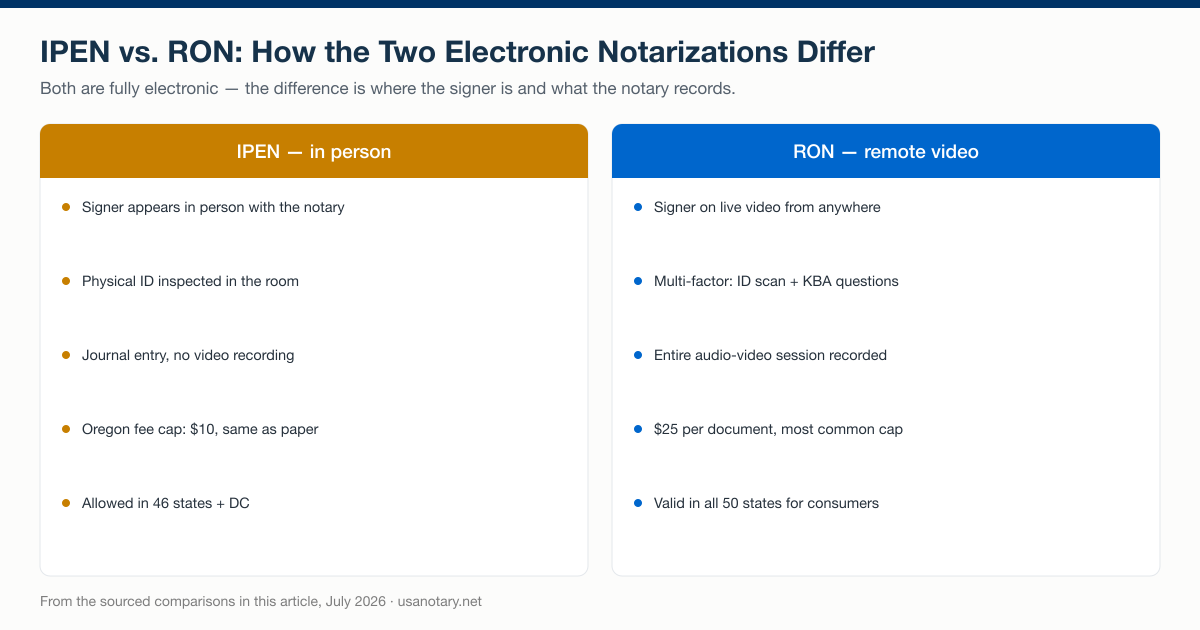
How IPEN and RON differ on location, ID checks, records, cost, and availability — from the sourced comparisons in this article, July 2026.
The four ways to get a document notarized
Every notarization in the United States falls into one of four buckets, defined by two questions: is the document paper or electronic? and is the signer in the room or remote?
| Traditional | IPEN | RIN | RON | |
|---|---|---|---|---|
| Documents | Paper | Electronic | Paper | Electronic |
| Signature | Ink | Electronic | Ink | Electronic |
| Signer location | In person | In person | Remote (live video) | Remote (live video) |
| Identity check | Physical ID in hand | Physical ID in hand | ID shown on video | Multi-factor (ID + KBA) on video |
| Session recording | None | None | Audio-video recording | Audio-video recording |
| Seal | Physical stamp | Electronic | Physical stamp (applied later) | Electronic |
| Turnaround | Immediate | Immediate | Delayed — document mailed to notary | Immediate |
The progression is straightforward: traditional is paper-and-ink in person; IPEN keeps the in-person meeting but goes digital; RIN goes remote but stays on paper; RON goes digital and remote. Understanding what “notarized” actually certifies helps here — the notary’s underlying job (confirm identity, witness the signing, complete a valid certificate) is identical across all four; only the medium and the location change.
What is IPEN, exactly?
IPEN modernizes the paperwork without changing the meeting. You still sit down with a commissioned notary — at a bank, a title office, a law firm, a car dealership — and the notary still inspects your physical government ID the same way they would for a paper signing. The difference is what happens next: instead of signing a printout with a pen, you sign an electronic document on a tablet, computer, or signature pad, and the notary applies an electronic seal and electronic signature rather than an ink stamp.
One naming wrinkle trips people up. “Electronic notarization” and “eNotarization” were the original terms for what is now called IPEN — but several states also use “electronic notarization” in their statutes to describe remote notarization, which caused enough confusion that the industry added “in-person” to the name. The National Notary Association’s IPEN guidance is explicit that the two terms are not interchangeable: an IPEN always involves physical appearance before the notary.
State law governs the details. Most states with IPEN laws regulate the notary’s electronic signature and seal, set qualifications for performing electronic notarial acts, and approve the technology providers a notary may use. Montana, for instance, has allowed IPEN since 2015 — four years before it authorized RON.
IPEN’s practical appeal is speed and error reduction at in-person closings: no printing, no missed signature lines, no paper journal, and the finished document is a digital file that can be transmitted the moment the seal is applied.
What is RON, exactly?
RON removes the room. The signer appears on live video before a commissioned online notary, and the entire notarization — upload, identity verification, signing, sealing — happens on a secure platform. While state laws vary, the National Notary Association describes the common core of every RON law: electronic documents and seals, multi-factor identity verification, an audio-visual recording of the session, and tamper-evident technology (usually a digital certificate) binding the notary’s signature to the document.
A typical RON session runs in four steps:
- Upload — you send the document to the platform as a digital file.
- Identity verification — you pass credential analysis and knowledge-based authentication (more on both below).
- Live video session — you and the notary meet on camera; you sign electronically while the notary watches in real time.
- Sealing and delivery — the notary applies an electronic signature and seal with tamper-evident technology, and you download the completed document.
A dedicated RON platform is not just a video call. Oregon’s Secretary of State states plainly that “standard videoconferencing applications do not meet Secretary of State requirements for RON” — approved platforms must provide secure audio-video recording and identity-proofing tools that Zoom or FaceTime do not. For notaries choosing a platform, our RON platform comparison sets fees and payouts side by side. If you want to see the full flow in practice, here is how a remote session runs from upload to sealed document.
How identity verification differs
Identity verification is where IPEN and RON diverge most, and it follows directly from location. In an IPEN, you present a physical government-issued ID and the notary inspects it in the room — the same method used for a traditional notarization. In a RON, the signer instead appears on live video, and because no one can hand over an ID card through a screen, the process substitutes technology:
- Credential analysis — your government ID is scanned and checked for security features.
- Knowledge-based authentication (KBA) — you answer identity questions drawn from public records.
- Live visual comparison — the notary compares your face on the video feed to the photo on your ID.
Montana’s Secretary of State captures the RON standard plainly: the communications technology “must provide simultaneous visual and audio transmission,” the “signal must be live, real-time,” and the platform must “record the entire communication between signer(s) and notary.” Montana’s rules also preserve the human judgment at the center of the act: “the notary has final authority to accept or deny the identification for any remote or RON transaction.” Technology screens the ID; the notary still decides.
Neither method is loosely verified — but they verify differently. IPEN relies on one strong check (a trained notary holding your ID). RON stacks multiple independent checks and then records the whole encounter.
Session records: what the notary keeps
Record-keeping is the second big operational difference, and it matters if a notarization is ever challenged.
- IPEN generally produces a journal entry — increasingly an electronic journal — but no audio-video recording. The in-person meeting itself is the safeguard, just as it is for a paper notarization.
- RON produces a journal entry plus a recording of the entire audio-video session, retained under state law. Oregon, for example, requires RON notaries to keep an electronic journal and retain records for 10 years from the date of the last transaction.
That recording, which IPEN does not generate, is a core reason online notarization holds up as a legally valid act: if anyone later disputes who signed or whether they were willing, the whole session exists as evidence. A paper or IPEN notarization rests on the notary’s journal and testimony; a RON rests on those plus the video record.
Where each method is allowed in 2026
Availability, not preference, is often the deciding factor — and the two methods are authorized on separate timelines. According to the National Notary Association’s IPEN guidance, in-person electronic notarization is allowed in 46 U.S. states and the District of Columbia, with only Alaska, Georgia, Hawaii, and Massachusetts not permitting IPEN. RON is governed by its own set of state statutes — many modeled on the Uniform Law Commission’s Revised Uniform Law on Notarial Acts (RULONA), whose 2021 version “permits remote online notarization and remote ink notarization through the use of audio-visual recording and identity-proofing technology” — so a state may authorize one method, both, or neither.
The RON map still has real gaps and quirks on the commissioning side. Per the NNA’s state-by-state tracking, as of mid-2026:
| State | Status wrinkle |
|---|---|
| Georgia, Mississippi, South Carolina | No law authorizing their notaries to perform RON |
| California | RON law enacted, but notaries cannot perform RON until the Secretary of State certifies its technology project or January 1, 2030, whichever is earlier (unless the Secretary notifies the Legislature and Governor in writing by January 1, 2029 that the project will not be completed) |
| Massachusetts | Remote notarization law on the books, but required training and application procedures are not yet available, so its notaries cannot perform it |
| Alabama, Connecticut | Remote notarization authorized for paper documents only (RIN-style) |
| North Carolina | Permanent Remote Electronic Notarization statute not yet implemented; an Emergency Video Notarization statute fills the gap until July 1, 2027 or the first platform is licensed |
| Alaska, Georgia, Hawaii, Massachusetts | Do not allow IPEN |
For the consumer, this patchwork matters less than it sounds. RON is legally valid in all 50 states as a consumer service, because the signer can connect to a notary commissioned in a RON-authorizing state and the resulting record is recognized across state lines. What is per-state is notary commissioning law — the rules a notary must follow to be authorized to perform RON in the first place. The distinction, and the interstate-recognition rules behind it, are covered in depth in whether online notarization is legal in your state.
What each method costs
Notary fees are capped by state law, and electronic methods are priced differently from remote ones. Oregon’s fee schedule shows the typical pattern: an IPEN is capped at the same $10 maximum as a traditional notarial act (the electronic format doesn’t change the price), while a RON is capped at $25 per transaction — the premium reflects the platform, identity-proofing, and recording infrastructure the law requires. The National Notary Association reports that in states that cap RON fees, $25 is the most common maximum notaries may charge.
That is also the flat consumer price on USA Notary: online notarization costs $25 per document, with no travel fees, no appointment windows, and no per-mile charges — the costs that typically push a mobile-notary visit far above the base notarial fee.
The legal framework: ESIGN, UETA, RULONA
Both IPEN and RON stand on the same federal and state legal foundations.
ESIGN and UETA. The federal ESIGN Act, at 15 U.S.C. § 7001(a), provides that a signature or record “may not be denied legal effect, validity, or enforceability solely because it is in electronic form.” Less quoted but directly on point for notarization: Section 7001(g) says that when a law requires a signature or record to be notarized, acknowledged, or verified, that requirement “is satisfied if the electronic signature of the person authorized to perform those acts” is attached to or logically associated with the record. Federal law, in other words, expressly contemplates electronic notarization. State UETA statutes mirror these rules at the state level. If your real question is whether a typed or drawn signature carries the same weight as pen on paper, our breakdown of electronic versus wet-ink signatures covers that footing in detail.
RULONA. The Uniform Law Commission’s Revised Uniform Law on Notarial Acts is the model statute many states used to authorize both methods — it allows electronic notarization using state-approved technologies and permits remote online and remote ink notarization with audio-visual recording and identity proofing.
No federal RON law — yet. The SECURE Notarization Act (H.R.1777), which would set nationwide minimum standards for remote notarization and require interstate recognition, has been introduced in Congress but not enacted. Until that changes, RON authorization remains a state-by-state matter for notaries — even though the notarizations themselves are already recognized across state lines.
Where RIN fits in
RIN — remote ink-signed notarization — is the third method people bump into, and it’s easy to confuse with RON. In a RIN, the signer still appears over live video, but signs a paper document with a wet-ink pen and mails or otherwise delivers it to the notary, who applies a physical stamp after the document arrives. It sits between the two: remote like RON, but paper-based like a traditional signing — and slower than both, because the notarization isn’t complete until the paper reaches the notary.
A few states use paper-only remote notarization as their framework — Alabama and Connecticut have enacted remote notarization laws for paper documents only, per the NNA, and Montana’s rules likewise include a paper-based “remote notarization” option limited to acknowledgments. For most signers, RIN is a fallback: useful when a specific recipient insists on a wet-ink original but the signer cannot appear in person.
Which one is right for you?
- Choose RON if you want to avoid an in-person visit — you sign from home over live video, the full session is recorded for your protection, and the completed document is delivered digitally in minutes.
- IPEN fits when you’re meeting the notary in person anyway — at a bank, dealership, or title office — but the documents are electronic and you’d rather skip paper.
- Consider RIN only when a specific recipient insists on a wet-ink original but the signer can’t appear in person, and you can tolerate the mailing delay.
- Stay traditional if the receiving party — a county recorder, a foreign consulate, certain courts — specifically requires a paper original with an ink seal. Acceptance of electronic records is broad, but confirm with the recipient before choosing a method for high-stakes documents.
- Either way, the notary’s core duties are the same: verify your identity, witness the signing, and complete a valid notarial certificate — whether you’re acknowledging that you signed or swearing under a jurat that the contents are true and signing in front of the notary.
Real estate and mortgage closings are where the choice comes up most often — a signer traveling for work, deployed overseas, or living in another state can complete a RON session from anywhere, while a buyer already sitting in a title office may finish the same paperwork by IPEN on a tablet. Estate-planning documents, powers of attorney, business contracts, and vehicle paperwork are the other common candidates.
Getting started with RON
RON is the fully online option, and on USA Notary online notarization over live video is $25 per document in all 50 states. You upload the document, verify your identity, and appear on live video with a commissioned notary — most sessions take only a few minutes once your ID clears. See exactly how a remote session runs from upload to sealed document.