
Mobile vs. online vs. in-person notary: what’s the difference?
All three are ways to get the same thing — a document notarized by a commissioned notary who verifies your identity and completes the notarial act. A notary public is a state-appointed official who witnesses signatures and deters fraud; that role is identical whether you meet across a desk, at your kitchen table, or over live video. What changes is how you meet the notary:
- In-person notary — you go to the notary (a bank, shipping store, or office); see where to get something notarized for every option and what it costs.
- Mobile notary — the notary travels to you, for a travel fee.
- Online notary (RON) — you appear over a live audio-video session; no one travels.
One rule holds across all three: the signer must personally appear. That requirement is why a notary cannot notarize a document you simply mail in. The California Notary Public Handbook is explicit: an acknowledgment “cannot be affixed to a document mailed or otherwise delivered to a notary public whereby the signer did not personally appear before the notary public, even if the signer is known by the notary public.” In remote online notarization, that appearance happens over live video instead of in person — the requirement is met, not waived. The National Association of Secretaries of State (NASS) describes it the same way: “the personal appearance requirement for notarial acts could be met through the use of audio/video technology, with the notary and signer in different geographic locations.”
Side-by-side comparison
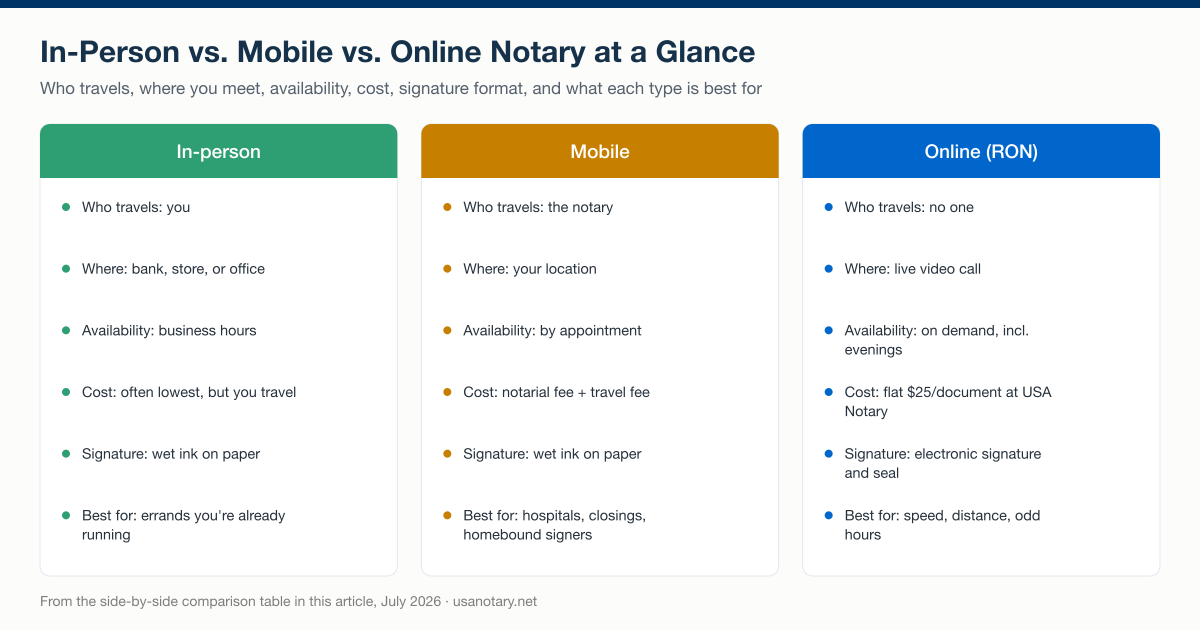
How in-person, mobile, and online notarization differ, from the sourced comparison table in this article, July 2026.
| In-person | Mobile | Online (RON) | |
|---|---|---|---|
| Who travels | You | The notary | No one |
| Where it happens | Bank, store, office | Your location | Live video call |
| Identity check | ID inspected in person | ID inspected in person | Credential analysis + KBA + live video |
| Signature format | Wet ink on paper | Wet ink on paper | Electronic signature and seal |
| Typical availability | Business hours | By appointment | On demand, incl. evenings |
| Scheduling | You work around their hours | Book a visit window | Connect in minutes |
| Cost pattern | Often lowest, but you travel | Notarial fee + travel fee | Flat $25/document at USA Notary |
| Record kept | Notary journal | Notary journal | Electronic journal + recorded session |
| Best for | Errands you’re already running | Hospitals, closings, homebound signers | Speed, distance, odd hours |
In-person notary: you go to the notary
An in-person notary is the traditional format — a commissioned notary working at a fixed location during set hours. Banks, credit unions, shipping stores, law offices, real-estate offices, and some libraries and government offices commonly staff one. The appeal is cost: a bank that offers notary service will often notarize for account holders at no charge, and state law caps what a notary may charge for the notarial act itself.
The trade-offs are logistical. You travel to them, during their business hours, and availability isn’t guaranteed — the notary may be out, the branch may limit the service to customers, or the location may decline certain document types. If you’re comparing every walk-in option, from banks to UPS Store, FedEx Office, and courthouses, the full guide to where to get something notarized covers each one.
Choose in-person when the errand is easy, the timing is flexible, and free or near-free matters more than convenience.
Mobile notary: the notary comes to you
A mobile notary (also called a traveling notary) is a commissioned notary who drives to your home, office, hospital room, or closing table and performs a standard in-person notarization there. The notarial act is identical to what happens at a bank — ID inspected in person, wet-ink signatures, a journal entry — only the location changes.
Mobile service exists for situations where the signer can’t come to the notary:
- Hospital or care-facility signings — a patient or resident who needs a power of attorney or advance directive notarized at the bedside.
- Homebound signers — mobility or health limits make travel impractical.
- Real-estate and loan closings — large document packages where the signing agent brings everything to one table.
- Group signings — several signers and witnesses who need to appear together in one place.
The convenience is priced in: expect the state-capped notarial fee plus a travel fee that varies with distance, urgency, and time of day. Our mobile notary guide explains how the service works and what drives the quote, and the state-by-state breakdown of what a notary costs shows how notarial fees and travel charges differ by location.
Online notary (RON): you appear on live video
Remote online notarization flips the geography question entirely: instead of deciding who travels, no one does. The signer appears on live video with a commissioned notary from a phone, tablet, or computer, and the document, signatures, and seal are all electronic. On USA Notary, the process runs in five steps:
- Upload the document — a PDF or scan of what needs notarizing.
- Verify your identity — credential analysis validates your government-issued ID, and a knowledge-based authentication quiz drawn from public records confirms you are its owner.
- Join the live video session — the signer appears on live video with the commissioned notary, who compares your face to your ID.
- Sign electronically — an acknowledgment means you acknowledge signing; a jurat means you swear the contents are true and sign in front of the notary, on camera.
- Receive the notarized document — sealed electronically and delivered digitally, with the session recorded.
That last step is a real difference in kind, not just convenience. A remote online notarization produces a recorded audio-video session kept alongside the electronic journal entry — a more detailed audit trail than a paper journal alone, and a durable record of who appeared, what was verified, and what was signed. You can notarize online on USA Notary for a flat $25 per document, and see how the session works before you start.
How each type verifies your identity
The notarial act is fundamentally an identity check: the notary confirms that the person signing is who they claim to be, then certifies it. How that check happens is the clearest line between the three formats.
For an in-person or mobile notarization, the notary inspects a government-issued ID directly and watches you sign. The two most common acts show what the notary is certifying. In an acknowledgment, the signer acknowledges signing the document. In a jurat, the signer swears the contents are true and signs in front of the notary after taking an oath. The California handbook is equally strict about the jurat’s appearance rule: a jurat “cannot be affixed to a document mailed or otherwise delivered to a notary public whereby the signer did not personally appear, take an oath, and sign in the presence of the notary public, even if the signer is known by the notary public.” The full comparison of the two certificates is in our jurat vs. acknowledgment guide.
For an online notarization, the notary and signer aren’t in the same room, so identity is verified in layers rather than with a single glance at an ID. National standards from NASS call for “multiple means of verifying the signer’s identity (e.g. Knowledge Based Authentication and credential analysis),” plus measures to secure the audio-video session. In practice that means credential analysis of your ID, a KBA quiz, and a live visual comparison of your face to your ID — all captured in the recorded session. Layered verification plus a recording is why RON’s identity check is often described as more rigorous than a walk-in glance at a driver’s license, not less.
The five notarization methods professionals recognize
Consumers usually sort notaries into three buckets — in-person, mobile, online — but the National Notary Association (NNA) breaks notarization itself into five distinct methods. Knowing the vocabulary helps when a lender, court, or title company names a specific one:
| Method | Where the signer appears | Signature format |
|---|---|---|
| Traditional wet-ink notarization (TWIN) | In the notary’s physical presence | Ink on paper |
| In-person electronic notarization (IPEN) | In the notary’s physical presence | Electronic |
| Remote ink-signed notarization (RIN) | Remote, by video conference | Ink on paper |
| Paper remote online notarization (PRON) | Remote, by audio-video technology | Ink on paper, electronic verification |
| Remote online notarization (RON) | Remote, by audio-video technology | Electronic |
Two of these cause most of the confusion. An e-notary performing IPEN uses electronic signatures and an electronic seal, but the signer still stands in the same room — it is an in-person format, not an online one. RON is the only method where both the appearance and the document are fully digital. If a closing instruction sheet says “IPEN” or “eClosing,” our IPEN vs. RON comparison untangles which is which. Per the NNA, RON also carries the strictest record-keeping of the five: usually an electronic journal is required, and the notarization must be recorded using audio-visual technology.
Is an online notarization legally valid everywhere?
Two distinct questions hide inside “is it legal,” and keeping them separate avoids a common misread:
- Commissioning law is per-state. Whether a notary may hold a RON commission depends on the state that commissions them. According to NASS, 47 states and the District of Columbia have a law that allows for remote e-notarization — a wave that started when Virginia became the first state to authorize it in 2011, followed by Montana in 2015 and Nevada and Texas in 2017. Most state statutes draw on the Revised Uniform Law on Notarial Acts (RULONA), the Uniform Law Commission model that “authorizes remote online notarization and remote ink notarization through the use of audio-visual recording and identity-proofing technology.”
- The consumer service is available to signers in all 50 states. A remote online notarization performed by a properly commissioned notary is a valid notarial act. The federal ESIGN Act provides that an electronic signature or record “may not be denied legal effect, validity, or enforceability solely because it is in electronic form” in any transaction affecting interstate commerce — and its notarization provision, 15 U.S.C. § 7001(g), says a legal requirement that a record be notarized is satisfied when the authorized notary’s electronic signature, together with all other required information, is attached to or logically associated with the record.
One more layer is often misreported: the federal SECURE Notarization Act (H.R.1777), which would require courts and states to recognize remote notarizations nationwide, has been introduced but not enacted — it remains a proposal, not law. Interstate recognition today rests on state recognition statutes and the ESIGN/UETA framework, not on that bill.
The practical caveat is document-specific, not geographic: some document types (certain wills, some real-estate instruments in specific jurisdictions) may require traditional in-person notarization or wet ink, and the receiving party — a lender, court, or foreign consulate — sets its own acceptance rules. Confirm those two things before choosing RON over a desk visit.
California and the holdout states
The NASS count of 47 states plus DC means a handful of states have not yet put their own RON commissioning law into effect — and California is the highest-profile example, with a statutory backstop date on the books. The 2026 California Notary Public Handbook lays out the timeline: the Online Notarization Act (SB 696, Chapter 291, Statutes of 2023) was signed on September 30, 2023 and is operative in stages. Provisions recognizing out-of-state notarial acts became operative January 1, 2024, and security requirements for remote notarizations followed on January 1, 2025. The handbook states that “once effective on or by January 1, 2030, approved California notaries will be allowed to perform remote online notarizations using audio-video communication and online notarization platforms” — the RON provisions switch on when the Secretary of State completes its Notary Automation Project 2.0, or by January 1, 2030, whichever is earlier, unless the Secretary of State notifies the Legislature and Governor in writing by January 1, 2029 that the project will not be completed.
Note what that timeline governs: who may hold a California RON commission. It is the commissioning layer, not the consumer layer — RON as a consumer service is legally valid in all 50 states, because the notarization is performed by a notary properly commissioned in a state that authorizes RON.
Cost: mobile vs. online vs. in-person
Cost usually tracks convenience. An in-person notary at a bank that offers notary service to account holders can be free, but you travel and go on their hours, and state-capped walk-in fees apply elsewhere. A mobile notary charges the state notarial fee plus a travel fee, which varies widely by distance and time of day — the travel component is where quotes diverge most. Online notarization on USA Notary is a flat $25 per document with no travel and on-demand availability.
Because state-capped notarial fees and mobile travel fees differ so much by location, it’s worth comparing what a notary actually costs in your state before assuming the in-person route is cheapest once travel and time are counted. A “free” bank notarization that costs an hour of driving and waiting — or a second trip because the notary was out — is not free in any practical sense.
Speed and availability
The three formats sort cleanly by how fast you can realistically get in front of a notary:
- In-person runs on business hours. If your bank’s notary is at lunch or the branch requires an appointment, the errand slips a day.
- Mobile runs on the notary’s calendar plus drive time. Same-day service exists, but urgency is usually priced into the travel fee.
- Online runs on demand. The signer appears on live video within minutes, from anywhere with a connection — which is why RON is the default answer for evenings, weekends, and deadlines. If it’s 9 p.m. and a document is due tomorrow, your realistic options are an after-hours notary or an online session.
Distance amplifies the gap. A signer overseas, a parent in another state, or a document needed by a title company three time zones away makes the “who travels” question moot — video is the only format where geography drops out entirely.
When to use each: a decision framework
- Choose in-person when it’s convenient and free or low-cost — for example, if your bank notarizes for account holders and you’re already going in, and the document has no special format requirements.
- Choose mobile when the signer physically can’t travel or the signing involves many documents or people — a hospital bedside, a real-estate closing table, a homebound parent — and the travel fee is worth the convenience.
- Choose online when you want speed and no travel, the document type is eligible for remote notarization, and the receiving party accepts it. Online notarization is available in all 50 states on USA Notary.
Three quick screening questions settle most cases:
- Does the receiving party accept RON? Lenders, courts, county recorders, and foreign consulates set their own rules. If yes — online is usually fastest and cheapest.
- Can the signer use the technology? RON needs a device with a camera, a connection, and an ID that passes credential analysis. If not — mobile brings the notarization to them.
- Does the document demand wet ink? Certain wills and jurisdiction-specific instruments may require paper. If so — in-person or mobile, whichever travel direction is easier.
Getting started
If online is the right fit, notarize online on USA Notary for $25 per document in all 50 states — see how it works, check pricing, or estimate your cost. If you’ve never done this before, the step-by-step guide to notarizing a document walks through what to bring and what the notary will ask, and what “notarized” actually means covers the basics.