
What is a wet signature?
A wet signature is the traditional one: your name written by hand, in ink, on paper. The name comes from the ink literally being wet at the moment you sign. For centuries it has been the default proof that a specific person agreed to the contents of a document, and for a small set of records it is still the only form the law will accept.
A wet signature does not have to be a cursive rendering of your legal name. As contract attorneys point out, a valid wet signature can take many forms — a trade name, a word, a mark, or a symbol the signer has chosen, applied with a pen, a thumbprint, a personal seal, or a stamp. What the mark looks like matters far less than the fact that the signer adopted it as their signature on that physical page.
A wet signature carries weight because it is hard to fake convincingly and it physically ties a mark to a page. Its weaknesses are practical rather than legal: paper has to be printed, physically routed to each signer, stored, and — when a notary is involved — signed in person. Those steps are exactly what electronic signing removes.
Wet signature vs. live signature
“Wet signature” and “live signature” get used interchangeably, but they describe different things. A live signature is made in front of the person requesting it — the requester watches you sign. A wet signature only requires ink on paper; you can print a document at home, sign it alone at your kitchen table, scan it, and email it back. That returned document carries a wet signature, but it was never signed “live.” The distinction matters most in notarization, where the whole point is that a commissioned notary personally witnesses the signing — either physically in the room or, in remote online notarization, while the signer appears on live video.
What is an electronic signature?
An electronic signature achieves the same purpose digitally. Federal law defines it precisely. Under the ESIGN Act’s definitions, an electronic signature is “an electronic sound, symbol, or process, attached to or logically associated with a contract or other record and executed or adopted by a person with the intent to sign the record.”
The load-bearing phrase in that definition is intent to sign. A typed name, a signature drawn with a finger or a mouse, or a click on a “sign here” button can all be electronic signatures — as long as the person means the mark to serve as their signature. The definition is deliberately technology-neutral; what the law cares about is the person’s intent and the record the signature is attached to.
Within that broad legal definition, the e-signing industry commonly distinguishes three tiers of electronic signature by how much identity assurance sits behind them, a framework described by OneSpan among others:
- Simple electronic signature — no built-in verification at all. A .jpg image of your handwritten signature pasted into a Word document is the classic example. It is legally an electronic signature, but the weakest form to defend, because nothing proves who applied it.
- Advanced electronic signature — adds authentication and security standards that help verify the signer’s identity and the signature’s authenticity. Most commercial e-signing platforms operate at this level.
- Qualified electronic signature — layers on a digital certificate from a qualified trust service provider. This tier comes from the European Union’s eIDAS framework; U.S. federal law does not create formal tiers, but the underlying idea — more identity assurance means a stronger signature — applies everywhere.
That breadth is also why an electronic signature is not automatically a secure signature. The signing method says nothing, on its own, about how strongly the signer’s identity was verified. That verification is a separate layer — and it is exactly what notarization adds.
Electronic signature vs. digital signature
These two terms are routinely swapped, and they should not be. An electronic signature is the legal act: a sound, symbol, or process adopted with intent to sign a record. A digital signature, in the technical sense, is not a signature type at all — it is the cryptographic encryption and decryption technology that secures an electronic signature and the record it sits on, making any later tampering detectable.
In practice, the two work together. When you sign through a reputable e-signing or online notarization platform, your electronic signature (the legal act) is protected by digital-signature technology (the cryptography), which seals the document so that any alteration after signing breaks the seal. So when someone asks “is DocuSign a wet signature?” the answer is no on both counts: signing through an e-signing platform produces an electronic signature — often one protected by digital-signature cryptography — not ink on paper.
Are electronic signatures legally valid?
For most transactions, yes. The ESIGN Act’s general rule of validity is direct: a signature, contract, or record “may not be denied legal effect, validity, or enforceability solely because it is in electronic form,” and a contract “may not be denied legal effect … solely because an electronic signature or electronic record was used in its formation.” ESIGN is a federal law, so it reaches any transaction in interstate or foreign commerce, and it has been on the books since 2000.
State law runs in parallel. Most states enacted the Uniform Electronic Transactions Act (UETA), drafted by the Uniform Law Commission, which in the Commission’s words “establishes the legal equivalence of electronic records and signatures with paper writings and manually-signed signatures.” Adoption is now nearly universal: according to DLA Piper’s analysis of UETA adoption, Illinois became the 49th state to adopt UETA on June 25, 2021, leaving New York as the only state that has not adopted it. New York instead recognizes electronic signatures through its own Electronic Signatures and Records Act, which provides that “an electronic signature may be used by a person in lieu of a signature affixed by hand” and “shall have the same validity and effect as the use of a signature affixed by hand.” Between ESIGN at the federal level and UETA (or a state equivalent) at the state level, electronic signatures have broad, well-settled legal standing. If you have wondered whether signing online holds up, that same framework is why online notarization is legally recognized across the country.
One consumer-facing condition is worth knowing. For records that go to consumers, ESIGN’s § 7001(c) requires the consumer to affirmatively consent to receiving electronic records, after getting a clear statement of their right to a paper copy and of the hardware and software needed to access and keep the electronic version. The consumer must also confirm consent electronically, in a way that demonstrates they can actually open the format being used. It is a disclosure rule, not a barrier — but it is why legitimate e-signing platforms ask you to accept an electronic-records agreement before you start.
Electronic vs. wet signature: side-by-side
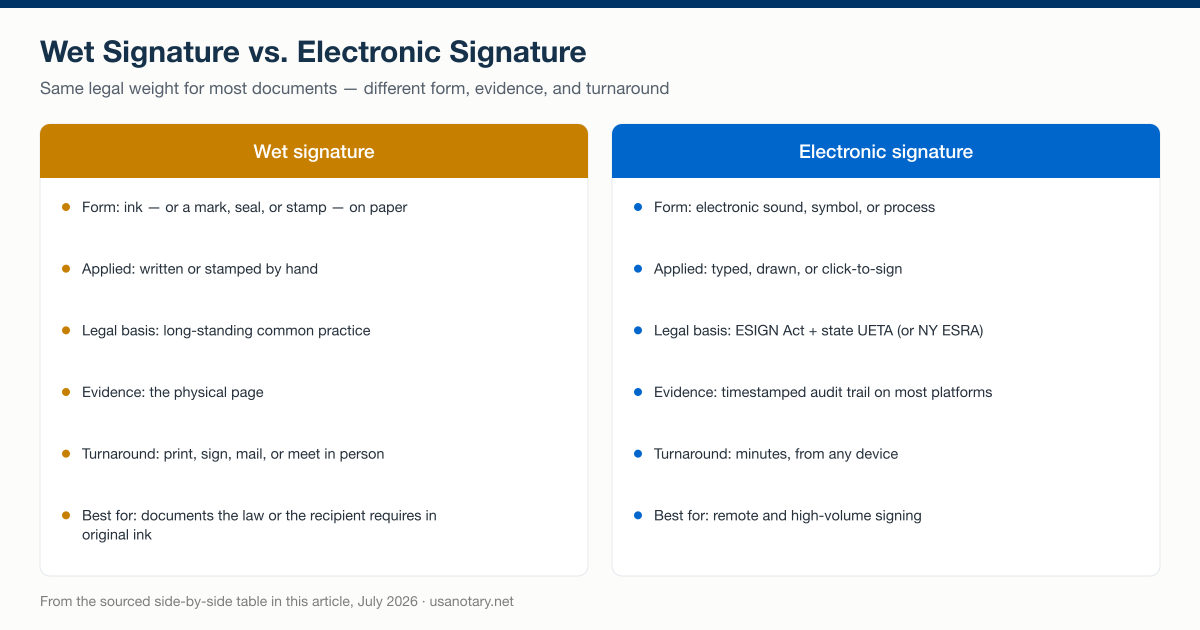
How wet and electronic signatures differ across six dimensions, from the sourced comparison table in this article, July 2026.
| Wet signature | Electronic signature | |
|---|---|---|
| Form | Ink (or a mark, seal, or stamp) on paper | Electronic sound, symbol, or process |
| How it’s applied | Written or stamped by hand | Typed, drawn, or click-to-sign |
| Legal basis | Long-standing common practice | ESIGN Act + state UETA (or NY ESRA) |
| Legal effect | Valid | Valid — cannot be denied effect solely for being electronic |
| Identity proof built in | None beyond the mark itself | None on its own; added by notarization or platform verification |
| Evidence of the signing | The physical page | Timestamped audit trail on most platforms |
| Turnaround | Print, sign, mail, or meet in person | Minutes, from any device |
| Cost profile | Paper, printing, postage, storage | Platform fee; no physical handling |
| Best for | Documents the law or the recipient requires in original ink | Remote and high-volume signing |
When you still need a wet signature
The ESIGN Act does not cover everything. Certain categories are excluded from its general rule under 15 U.S.C. § 7003, which means an electronic signature may not be sufficient on its own. The excluded categories are more specific than most summaries let on:
- Wills, codicils, and testamentary trusts — the rules governing how these are created and executed sit outside ESIGN entirely.
- Family-law matters — state laws governing adoption, divorce, and other family-law matters.
- Most of the Uniform Commercial Code — other than a few specified sections (UCC §§ 1-107 and 1-206 and Articles 2 and 2A, which cover sales and leases of goods).
- Court documents — orders, notices, briefs, pleadings, and other official writings executed in connection with court proceedings.
- Critical consumer notices — cancellation or termination of utility service (water, heat, power); default, acceleration, repossession, foreclosure, or eviction tied to a person’s primary residence; and cancellation or termination of health or life insurance benefits.
- Product recalls — notices of a recall or material failure of a product that risks endangering health or safety.
- Hazardous-materials documents — any document required to accompany the transportation or handling of hazardous materials, pesticides, or other toxic or dangerous materials.
There is also a second, less official reason wet ink survives: requester discretion. Even where an electronic signature is perfectly valid, government entities and private businesses retain discretion to insist on wet signatures for their own paperwork — a point contract attorneys routinely flag. A county recorder, a bank, a foreign consulate, or an overseas counterparty can simply say “original ink only,” and the fact that federal law would have accepted an e-signature does not change their internal policy. When you are doing business with such an entity, you produce the type of signature they request.
Two practical checks before you rely on an electronic signature:
- Confirm the document type is eligible. Most everyday agreements are; the excluded categories above are the exception, and a will is the one most people encounter.
- If notarization is required, meet those rules too. An e-signature and a notarization are separate requirements — clearing one does not clear the other. State notary law also decides how a document may be notarized, and some states are more restrictive about will-related and real-estate documents. (For real estate specifically, see which mortgage papers require a notary.)
Can a scanned signature count as an electronic signature?
A scanned signature sits in both worlds, which is why it confuses people. The original page you signed in ink carries a genuine wet signature — scanning it does not undo that. But the scan itself is just an image. If you paste that image into a new digital document as your way of signing it, the image functions as a simple electronic signature: legally recognized, but the weakest tier, because nothing about a pasted image verifies who placed it there or whether the document changed afterward.
Two practical consequences follow. First, if a recipient requires an original wet signature, an emailed scan usually will not satisfy them — they want the physical ink-on-paper page. Second, if you are going to sign electronically anyway, a platform-generated signature with an audit trail is stronger evidence than a pasted image of your handwriting, because the platform records when, where, and by whom the signature was applied.
Does an electronic signature hold up in court?
Legal effect and courtroom persuasiveness are two different questions. On legal effect, § 7001 answers it: an electronic signature “may not be denied legal effect, validity, or enforceability solely because it is in electronic form.” A court cannot toss your contract just because it was signed electronically.
What a court can still ask is the same thing it asks about any signature: did this person actually sign, did they intend to sign, and is the document intact? That is where the evidence surrounding the signature matters more than the signature’s format. A wet signature is backed by the physical page and, if challenged, handwriting comparison. An electronic signature on a serious platform is backed by a tamper-evident audit trail — a timestamped log of who accessed the document, how they were authenticated, and what they did. And when the stakes justify it, notarization adds the strongest layer for either format: a commissioned notary independently verifies the signer’s identity and witnesses the act, which is precisely what getting a document notarized means.
Which signature does your document need?
Use the document type, not personal preference, to decide. This decision table covers the situations people actually search for:
| Your situation | Use | Why |
|---|---|---|
| Everyday contract, NDA, lease, sales or service agreement | Electronic signature | Valid under ESIGN + UETA; faster and better documented |
| Will, codicil, or testamentary trust | Wet ink (per state execution rules) | Excluded from ESIGN under § 7003; state wills law governs |
| Adoption, divorce, or other family-law document | Follow state family-law rules | Excluded from ESIGN under § 7003 |
| Court filing or court-ordered document | Follow the court’s rules | Excluded from ESIGN under § 7003 |
| Utility shutoff, foreclosure, eviction, or insurance-cancellation notice | Paper notice | Excluded from ESIGN under § 7003 |
| Document that must be notarized (POA, deed, affidavit) | Either — but notarization rules apply | E-signature alone never substitutes for notarization |
| Recipient explicitly demands original ink | Wet ink | Requester discretion controls, even when e-signature is legal |
The middle rows all share one lesson: an electronic signature answers “how do I sign?” — it never answers “what else does this document require?” Notarization, witnesses, and execution formalities are separate boxes to check.
Electronic signature vs. electronic notarization
These two are constantly confused, so it is worth pinning the difference. An electronic signature is how you sign. Notarization is a commissioned notary confirming who you are and witnessing the signing — the step that turns your signature into one a bank, court, or county recorder will trust. A document can be electronically signed without ever being notarized, and a paper document can be notarized without a single electronic signature.
The notarial act itself also comes in more than one flavor: in an acknowledgment, the signer acknowledges signing the document; in a jurat, the signer swears the contents are true and signs in front of the notary. Our guide to the difference between a jurat and an acknowledgment covers which notarial act your document calls for.
Electronic notarization itself splits into two paths worth knowing. In-person electronic notarization (IPEN) keeps the signer and notary in the same room but replaces paper with electronic documents and seals. Remote online notarization (RON) moves the whole session onto live audio-video. The IPEN vs. RON comparison walks through when each applies — but for most individual signers, RON is the practical option, because it removes the trip entirely.
How electronic signing and notarization come together
When a document needs both, remote online notarization combines them in one session. You notarize the document online for $25 per document: you appear on live video, a commissioned notary verifies your identity — typically by checking your ID and asking knowledge-based authentication questions — you sign electronically, and the notary applies an electronic notarial seal. The result is a single record that is both electronically signed and notarized, backed by a tamper-evident audit trail that logs the whole session. Lenders looking to apply the same pairing at scale have a dedicated page on digital mortgage notarization workflows.
The legal scaffolding behind this is real and specific. Most state RON statutes are modeled on the Revised Uniform Law on Notarial Acts (RULONA), whose 2021 revision authorizes remote online notarization through audio-visual recording and identity-proofing technology. At the federal level, the SECURE Notarization Act (H.R.1777) would require nationwide recognition of remote notarizations — but as of 2026 it remains only a proposed bill, introduced in April 2023 and referred to committee, never enacted. RON’s legal footing today rests on state law plus the interstate-recognition principles states already apply.
Remote online notarization is legally valid in all 50 states as a consumer service, though notary commissioning law is per-state — some states do not yet authorize their own notaries to perform RON. USA Notary provides notary services through commissioned online notaries; if you want to see the flow before you start, walk through how an online notarization session works. For most people, that means a wet signature — and a trip to find a notary — is no longer the only way to get an important document signed and notarized.
The bottom line
A wet signature and an electronic signature do the same legal job for the overwhelming majority of documents, and federal law — ESIGN’s § 7001 — guarantees the electronic version cannot be rejected merely for being electronic. Choose based on the document: wills, family-law matters, court documents, and the other § 7003 exclusions still call for ink and their own execution rules; a recipient who demands original ink gets original ink; and anything that requires notarization needs a notary regardless of how you sign. For everything else, electronic signing is faster, cheaper, and — with an audit trail behind it — often easier to defend than a scrawl on paper.