
Bond vs. E&O insurance: they protect different people
A surety bond and errors-and-omissions (E&O) insurance sound interchangeable, but they protect opposite parties — and that single fact drives every other difference between them.
- A surety bond protects the public. If your mistake or misconduct harms someone, the bond pays them — and then you repay the surety company.
- E&O insurance protects the notary. It helps cover your own legal defense and unintentional errors, with no repayment obligation.
A bond is a legal requirement in some states; E&O is a personal choice for a standard commission (with one growing exception for online notaries, covered below). The National Notary Association (NNA) puts the distinction bluntly: a notary bond “is not insurance protection for Notaries”. Confuse the two and you can end up thinking you’re covered when the only thing you’ve bought is a promise to pay other people back.
This guide walks through what each instrument actually does, how a bond claim plays out step by step, what bonds cost in each state (from $500 to $50,000), and the 2026 law changes — in Louisiana and Pennsylvania — that shifted the numbers.
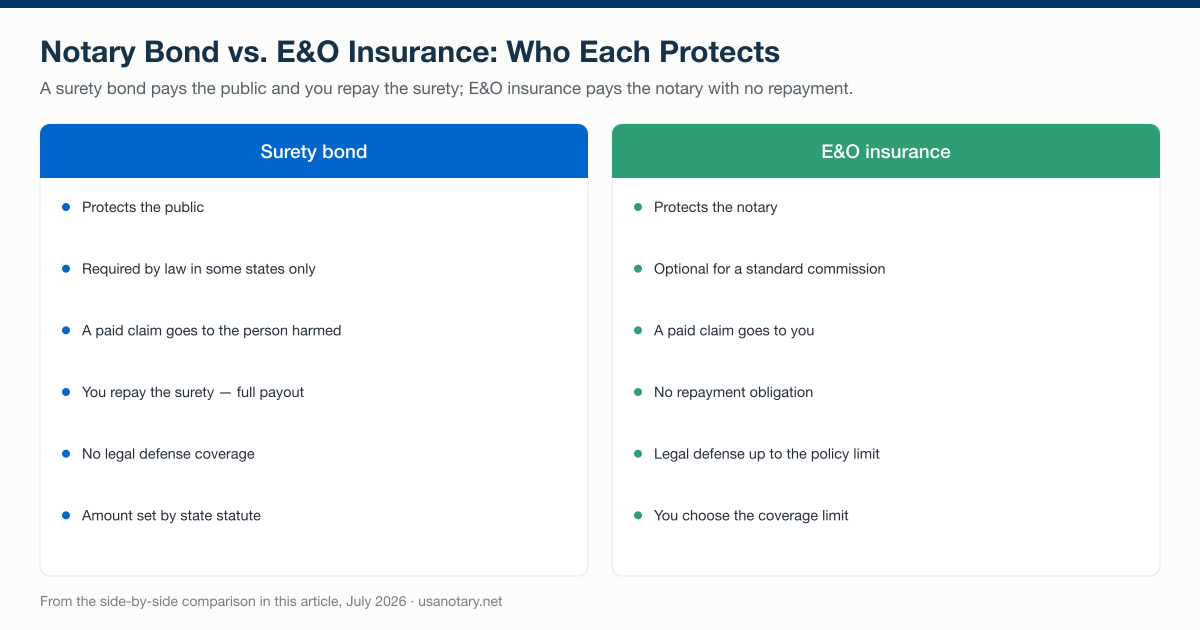
The core differences between a surety bond and E&O insurance, from the sourced comparison in this article, July 2026.
What a notary surety bond actually does
A surety bond is a three-party promise. You (the principal) buy it from a surety company, and it exists for the benefit of the public. Florida’s statute is a clear example of how the law frames it: a notary must “give bond, payable to any individual harmed as a result of a breach of duty by the notary public acting in his or her official capacity … in the amount of $7,500.” Note who the bond is payable to — the injured member of the public, not you.
The bond’s scope is also broader than most notaries expect. The NNA describes it as designed “to protect the public from financial harm that results in any negligent mistake or intentional misconduct committed by a Notary while performing a notarization.” An E&O policy responds only to unintentional errors; the bond stands behind your official acts even when the harm was deliberate — the public gets paid either way, and the notary must repay the surety either way.
Because the bond is a condition of holding the office, letting it lapse has commission consequences. Florida lists “failure to maintain the bond required by this section” among the statutory grounds for suspending a notary — the bond isn’t paperwork you file once and forget; it must stay in force for the entire term.
Mechanics vary by state:
- Florida requires the $7,500 bond for its four-year commission, filed with the Department of State through an approved bonding agency.
- California requires a $15,000 bond executed by “an admitted surety insurer and not a deposit in lieu of bond” (Cal. Gov. Code § 8212), filed with your county clerk within 30 days of the commission start date.
- New York requires no bond at all — its official application requirements list a $15 exam, a $60 application fee and an oath, but no surety bond.
That spread is why the first step in any bond-vs-E&O decision is checking your own state’s rule. Our state-by-state notary guides list the required amount, filing office and term for each state.
What notary E&O insurance covers
Where a bond backs the public, E&O insurance backs the notary. It’s professional-liability coverage that pays your defense and losses when a notarization goes wrong — or when someone merely claims it did. According to the NNA, a notary E&O policy typically responds to:
- Financial damages from a notarization mistake or omission filed against your notary bond.
- Unintentionally violating a law while notarizing.
- Being named in a lawsuit even if you did nothing wrong — defense costs still apply.
- An imposter counterfeiting your seal and forging your signature on a document without your knowledge.
The Hartford frames the same coverage in insurance terms: notary E&O can help cover claims of negligence, errors or omissions in services provided, misrepresentation, violation of good faith and fair dealing, and inaccurate advice.
Crucially, an NNA policy pays your expert legal defense in addition to the claim, legal fees and court costs, up to your policy limit — with “no deductible and no repayment of losses”. You also choose the coverage limit, so you can size the policy to the value and volume of documents you handle — a light-volume general notary and a high-volume loan signing agent have very different exposure.
What E&O does not cover: the NNA consistently describes the policy as protection for an unintentional mistake or omission, or a false claim filed against you. Deliberate fraud sits outside that scope. If a notary knowingly participates in a fraudulent notarization, the bond can still pay the harmed party — and the notary then owes the surety every dollar of it, with no insurance backstop.
Side-by-side comparison
| Surety bond | E&O insurance | |
|---|---|---|
| Who it protects | The public | The notary |
| Required by law? | In some states only | Optional for a standard commission (Florida requires it for online notaries) |
| Who receives a paid claim | The person harmed | You |
| Do you repay it? | Yes — you reimburse the surety | No repayment |
| Covers your legal defense? | No | Yes, up to the policy limit |
| Covers intentional misconduct? | Pays the public for it — you repay | No — unintentional errors and false claims only |
| Who sets the amount | State statute | You choose the limit |
| Deductible | N/A (you owe the full payout back) | Often none (varies by insurer) |
| What lapsing means | Grounds for suspension in bond states | You lose optional protection, not your commission |
How a bond claim actually plays out
The repayment mechanic is abstract until you trace a claim end to end. Using Florida’s statute and the NNA’s description of the process, here is the sequence:
- A notarization causes financial harm. A signer, lender or other party loses money because of a breach of the notary’s duty — anything from a skipped identification step to outright misconduct.
- The harmed person claims against the bond. Florida’s bond is expressly “payable to any individual harmed as a result of a breach of duty by the notary public acting in his or her official capacity” — the claimant deals with the surety, not with you directly.
- The surety investigates and pays a valid claim, up to the bond amount.
- The state hears about it. In Florida, the bond issuer “shall notify the Governor of the payment and the circumstances which led to the claim” (Fla. Stat. § 117.01(8)) — a paid bond claim is not a private event, and it can put your commission under review.
- You repay the surety. Per the NNA, “if a claim is made against your Notary bond, you’re required by law to pay it back.” The Hartford describes the same step from the surety’s side: after a claim, you “reimburse the bond company or buy a replacement bond.”
- Your exposure can exceed the bond. You can also “be held personally responsible for any additional costs above the amount of your bond, which might include court costs, legal fees and other expenses.”
Read that sequence again from the notary’s seat: the bond satisfied the state, made the signer whole — and left you with a repayment bill, possible extra costs, and a commission flagged to the Governor’s office. The bond did its job; its job was never to protect you.
Can E&O insurance cover the bond claim itself?
This is the part most comparisons skip. The two products aren’t only parallel — they can interlock. The NNA notes that if you hold both a bond and an NNA E&O policy, your “insurance policy could protect losses on your Notary bond that you would otherwise be required to repay”. In other words, when the surety pays an injured signer and comes to you for reimbursement, an E&O policy can be what actually foots that bill.
That reframes the decision. The bond isn’t a substitute for E&O and E&O isn’t a substitute for the bond; the bond is the state-mandated payout to the public, and E&O is the backstop that keeps that payout — plus your own legal defense — from landing on you personally. For a notary in a bond-required state, carrying both is less “belt and suspenders” than it looks: one instrument creates the liability, the other absorbs it.
Louisiana’s 2026 rule change underscores that the two are legally distinct: the state raised its non-attorney bond to $50,000 effective February 1, 2026, and no longer accepts E&O insurance in lieu of the bond. A state can decline to treat your insurance as public protection precisely because E&O protects the notary, not the public.
Notary bond amounts by state: $500 to $50,000
Bond amounts are set by each state’s statute, and the spread is wider than most guides suggest. Across the states covered in our notary commissioning guides, required bonds run from $500 to $50,000 — and more than 20 states require no bond at all, including New York, Georgia, Ohio, North Carolina, New Jersey, Virginia, Massachusetts, Colorado, Maryland, Oregon and Connecticut. A sample of the range:
| State | Required bond | Notes |
|---|---|---|
| Wisconsin | $500 | Smallest required bond in our tracking |
| Hawaii | $1,000 | Approved by a circuit court judge and filed with the circuit court clerk |
| Alaska | $2,500 | Submitted with the application |
| Illinois | $5,000 | Rises to $30,000 for electronic/remote notaries |
| Florida | $7,500 | Fla. Stat. § 117.01; four-year term |
| Arkansas | $7,500 | Covers a full ten-year commission |
| Michigan | $10,000 | Filed with your county clerk |
| Kansas | $12,000 | Required for all applicants since January 1, 2022 |
| California | $15,000 | Cal. Gov. Code § 8212; filed with the county clerk |
| Indiana | $25,000 | Covers the full eight-year commission term |
| Pennsylvania | $25,000 | Raised from $10,000 for notaries appointed or reappointed on or after March 28, 2026 |
| Alabama | $50,000 | Raised from $25,000 by Act 2023-548, effective September 1, 2023 |
| Louisiana | $50,000 | Non-attorney notaries, effective February 1, 2026 (up from $10,000); attorneys exempt |
The trend runs in both directions. Several states have recently eliminated their bond requirement outright — South Dakota dropped its $5,000 bond effective July 1, 2025 (HB 1133), Wyoming eliminated its bond effective July 1, 2021, and West Virginia scrapped its $1,000 bond back in 2018 (HB 4207). Others have sharply raised theirs, as Alabama, Louisiana and Pennsylvania show. Whatever your state required when you were first commissioned may not be what it requires at renewal — check the current figure before you renew your notary commission, because a new bond for the new term is part of the renewal in every bond state.
When E&O stops being optional: the online notarization exception
“E&O is never required by law” is the standard line — and for a traditional commission it holds. Remote online notarization changed it. Florida’s online notary statute, Fla. Stat. § 117.225, requires anyone registering as an online notary public to provide evidence of both a $25,000 bond (payable, like the traditional bond, to any individual harmed by a breach of duty) and “an errors and omissions insurance policy … in the minimum amount of $25,000” from an insurer authorized in the state.
That’s a legislature concluding that when signers appear on live video instead of in person, the public deserves a bigger bond and the notary needs mandatory insurance. Illinois takes a related approach on the bond side: its standard $5,000 bond jumps to $30,000 for electronic and remote notaries.
For working notaries, the practical takeaway is that going online usually means re-doing the coverage math — a bigger bond, possibly mandatory E&O, and higher document values flowing through your seal. It also means new income: once registered, commissioned online notaries can take assigned, paid remote signings through USA Notary rather than hunting for clients themselves.
What each one costs
The two instruments are priced completely differently, which trips up new notaries comparing quotes.
A bond premium is a small flat fee for the term. You never pay the bond amount itself — you pay a surety company a one-time premium to issue it. Across our state guides the premiums are modest: Indiana bonding companies commonly charge about $50–$75 for the $25,000 bond covering the entire eight-year term, and Montana bonds typically cost about $50–$70 for four years. The premium is small precisely because the surety expects you to repay any claim — it’s underwriting your promise, not absorbing your risk.
An E&O premium is a recurring insurance cost you size yourself. The Hartford lists the main pricing factors as your location, coverage limits, years in business and claims history. The NNA advertises policies that “start at just pennies a day.” The variable that matters most is the limit you choose: a $25,000 policy and a $100,000 policy protect very different books of business, and a loan signing agent handling six-figure closings has more to lose than an occasional acknowledgment-only notary.
For the full startup math — bond, commission, seal, exam, education and more — see how much it costs to become a notary. And if you plan to earn through our platform, the costs and fees page for notaries shows what you’ll pay and keep on each signing, so you can weigh coverage costs against real revenue.
Do you need one, both, or neither?
Work through it in order:
- Check whether your state requires a bond, and for how much. Florida ($7,500), California ($15,000) and Alabama ($50,000) do; New York and more than 20 other states don’t. Start with your state’s notary commissioning requirements.
- Buy the required bond through an authorized surety if your state mandates one — you generally can’t be commissioned without it, and letting it lapse can cost you the commission.
- Decide on E&O insurance based on your risk, not the law. Match the coverage limit to the documents and volume you handle, and remember that the right E&O policy can also absorb the repayment a bond claim would otherwise leave with you.
- Re-run the math if you go online. Online registration can raise the bond (Illinois: $30,000) and can make E&O mandatory (Florida: $25,000 minimum) — and it changes your earning side too.
The quick heuristic: the bond is for the state and the signers, the E&O policy is for you. If your state requires a bond, that part isn’t a decision. E&O is the one you choose — and the interlock between the two is the strongest argument for carrying it: without E&O, every dollar your bond pays out is a dollar you owe back.