
Who can legally notarize a document?
Any commissioned notary public can notarize a document, as long as they follow their state’s requirements. The National Notary Association (NNA) defines the office: “A Notary Public is an official appointed by a state government to serve the public as an impartial witness… The duties and responsibilities of Notaries are expressly dictated by state law.” A commission “may be obtained in any state by meeting that state’s eligibility requirements and completing its commissioning process” — so almost any adult who qualifies can become the person who signs and seals your document, which is why our explainer on what a notary public is and does treats the role as a state office serving a shared national purpose.
Because the authority comes from a state commission, the notary must follow the rules of the state that commissioned them. Being commissioned is only the entry ticket, though. Two further limits decide whether this notary can notarize this document: the notary can’t have a personal stake in it, and can’t notarize their own signature. The sections below work through each limit — including the state statutes that turn “shouldn’t” into “voidable” — then cover where to actually get the notarization done.
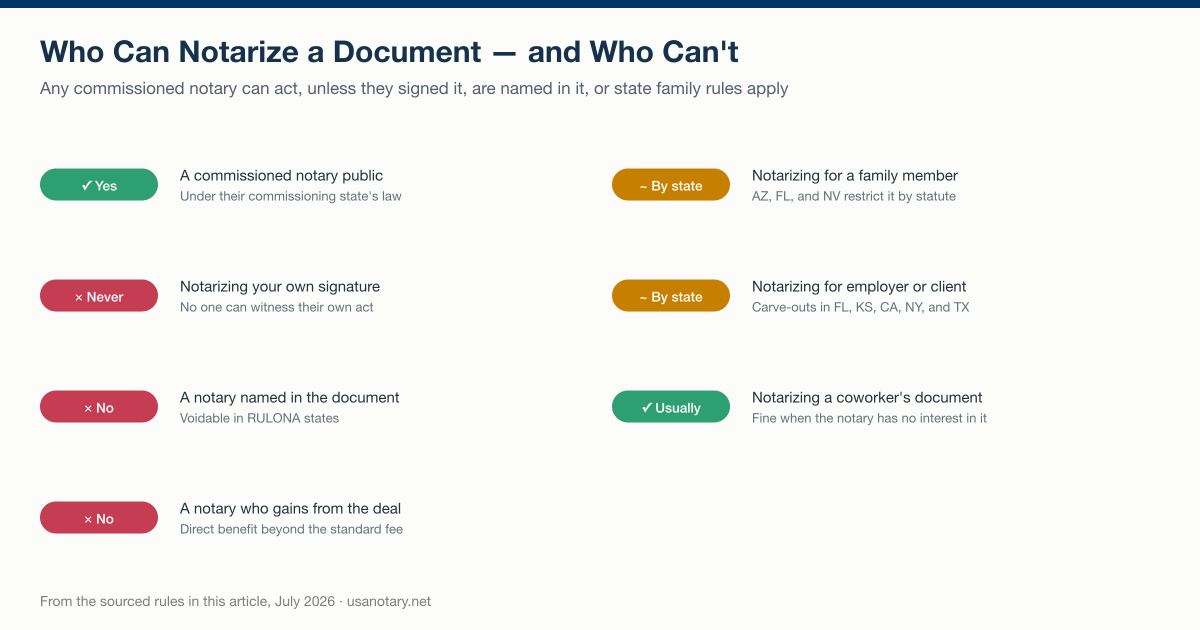
The who-can and who-can’t verdicts from this article’s sourced state rules, July 2026.
What qualifies someone to become a notary?
A notary’s qualification is the state commission itself, not a profession or a job title. Per the NNA, the commissioning process varies by state but generally involves five steps:
- Submitting an application to the commissioning authority (usually the Secretary of State),
- Paying the required fee,
- Completing any mandated training or examination,
- Filing a bond and oath of office, and
- Getting the necessary notary supplies (seal, journal).
That is why the bank teller, the escrow officer, the accountant at your tax office, and the clerk at a shipping store can all notarize your document: each of them holds an individual state commission and performs notarizations as one part of their job. The NNA calls this an employee notary — a notary “who qualifies for a Notary commission in their state and primarily notarizes documents for an employer as one part of their employee-related duties.” The commission belongs to the person, not the business; a bank as an institution cannot notarize anything. For how that plays out at a real bank, see our look at Bank of America’s notary service.
Once commissioned, every notary carries the same four core responsibilities: verify that the signer is who they claim to be (typically against a photo ID such as a driver’s license or passport), confirm the signer’s willingness and mental awareness, administer oaths and affirmations, and oversee or witness the signing. On the oath point, the NNA draws a distinction worth knowing: “An oath invokes a higher power, while an affirmation, its legal equivalent, is made on one’s personal honor when a person chooses not to invoke a supreme being” — you can always ask for the affirmation instead. Those duties don’t change whether the notary sits behind a bank counter or a webcam.
The scope of what any commissioned notary can do for you is spelled out in state law, and in states that follow the model statute it covers the same set of acts: the Revised Uniform Law on Notarial Acts “governs actions by a notary public, including taking an acknowledgment, administering an oath or affirmation, witnessing or attesting a signature, and certifying a copy of a document.” Whoever you pick, in other words, the menu is the same — what varies is where and how they meet you.
What kinds of notaries can notarize your document?
“Who can notarize a document” also has a practical answer: several kinds of notaries can, and they differ mainly in where they meet you and whether the document is paper or electronic. Every one of them holds the same underlying commission and owes the same duty of impartiality — the National Notary Association’s 2023 Notary Survey found that 51.1% of surveyed notaries were self-employed mobile notaries or notary signing agents, so a traveling or online notary is now as common as the one at your bank.
| Notary type | Document format | Where they work |
|---|---|---|
| Employee notary | Paper or electronic | At their workplace (bank, office), in person or virtual |
| Mobile notary | Paper | Travels to your home, office, or hospital |
| Remote online notary | Electronic | Live video, signer appears remotely |
| Notary signing agent | Paper or electronic | In person, for mortgage loan signings |
All four can notarize an ordinary document for you. The distinctions matter only when your document is specialized — a mortgage closing typically calls for a notary signing agent, a notary specifically trained and background-screened for loan signings, while a fully electronic document handled without travel calls for a remote online notary. The NNA also notes a hybrid: an in-person electronic notarization (IPEN), where the document is electronic but the signer still meets the notary face to face. If you are weighing the format rather than the person, our guide to what “notarized” actually means explains what the finished stamp certifies.
Can you notarize your own documents?
No — you cannot notarize your own signature, even if you hold a commission. The NNA is blunt: “a Notary must never notarize his or her own signature — there’s no way a Notary can be an impartial witness in such a situation.” The entire purpose of notarization is a neutral third party, and no one is neutral about their own signing.
This is narrower than it first sounds. You can take a document you personally signed to another notary. The prohibition is on the notary witnessing their own act — not on your document being notarized at all. A notary who is also a translator hits the same wall: they may translate a document, but they cannot notarize their own certification that the translation is accurate; a separate notary has to do that. The same trap appears with witnessing: if a document requires the witnesses’ signatures to be notarized, the notary cannot double as one of those witnesses, because they would end up notarizing their own signature.
Can a notary notarize for a family member?
Here the answer genuinely depends on your state. The NNA explains: “State laws vary widely on the issue of notarizing for family members. Most states are silent on the matter, thus permitting Notaries to notarize for any relative, provided there is no other disqualifying conflict of interest. Others prohibit notarizing for specific relatives.”
| State approach | Rule | Example (statute) |
|---|---|---|
| Silent (most states) | Permitted if no other disqualifying interest | Majority of states |
| Spouse-interest bar | Notarization is voidable if the notary or the notary’s spouse is a party or has a direct beneficial interest | Arizona (Ariz. Rev. Stat. § 41-252) |
| Prohibits immediate family | Cannot notarize for a spouse, son, daughter, mother, or father | Florida (Fla. Stat. § 117.107) |
| Broadly prohibits relatives | Cannot notarize for relatives by blood or marriage, including step- and adopted family and domestic partners | Nevada (Nev. Rev. Stat. § 240.065) |
The penalties are not symbolic. Florida treats notarizing an immediate family member’s signature as a civil infraction punishable by up to $5,000 — and the statute specifies that acting “without intent to defraud” is no defense. Arizona goes at the document itself: under § 41-252(B), “a notarial act performed in violation of this subsection is voidable,” meaning the notarization on your deed or power of attorney can be undone. Nevada has arguably the most restrictive statute, defining “relative” to reach spouses and domestic partners, parents and stepparents, natural-born, step-, and adopted children, half- and step-siblings, and even in-laws of the notary’s spouse or domestic partner.
Because the rule turns on your state — and on whether the notary also benefits from the transaction — the safe practice whenever family is involved is to use a different, uninvolved notary. Rules on notarizing for family or your own paperwork vary state by state, so confirm your own state’s law before relying on any general rule here.
Can a notary notarize for an employer, client, or coworker?
Employer and professional relationships get more latitude than family ones, but again by state statute rather than a national rule. The NNA’s guidance on disqualifying interest catalogs the main carve-outs:
- Florida permits an employee to notarize an employer’s signature, provided the notary receives no benefit beyond their normal salary and the authorized notary fee.
- Kansas and California broadly permit a notary who is an agent, employee, insurer, attorney, escrow officer, or lender for a person with a financial or beneficial interest in a document to notarize transactions involving that client.
- Nevada allows attorneys licensed in the state to notarize signatures on an instrument even if they received a legal fee for work related to it.
- New York permits attorneys admitted in the state to notarize for their clients.
- Texas permits employees to notarize an acknowledgment of an instrument in which their company has an interest, with separate limits for notaries who are shareholders of the corporation involved.
- Pennsylvania, going the other direction, bars a notary from taking an acknowledgment on a power of attorney if the notary is named as the agent in it or witnessed its signing.
Coworkers are the easy case: nothing in the general rule prevents notarizing a coworker’s personal document, because the test is the notary’s interest in the transaction, not where the two of you work. The document simply has to be one in which the notary is not named and from which they gain nothing.
What is a disqualifying interest?
A disqualifying interest is the deeper principle behind every limit above. Per the NNA: “As a general rule, it’s inappropriate to notarize a signature on any transaction in which the Notary is named in a document or would receive a direct benefit from the transaction.” Many states write this into law through the Revised Uniform Law on Notarial Acts (RULONA), the model notarial statute. Enacting states adopt its language nearly verbatim — Kentucky’s version, KRS 423.310(4), provides that “a notarial officer shall not perform a notarial act with respect to a record to which the notarial officer … is a party, or in which … [he or she] has a direct beneficial interest. A notarial act performed in violation of this subsection is voidable,” and Arizona’s § 41-252(B) extends the same bar to the officer’s spouse. In practice, a notary should decline when they:
- are named in the document being notarized,
- would receive a direct financial benefit from the transaction, or
- have a relationship (in some states) that their state treats as a conflict.
The stakes are real, not theoretical. The NNA cites Galloway v. Cinello, in which the West Virginia Supreme Court ruled that a notary who notarized a deed of trust naming himself as trustee had negligently notarized it; after the deed of trust was invalidated in a later bankruptcy, the property owner lost $19,000, and the court held the notary could be liable. That is what “impartiality” protects against — if the notary’s own interest could influence the act, they should step aside and let an uninvolved notary handle it.
Checklist: can this notary notarize your document?
Run any would-be notary — a relative, a coworker, the officer at your bank — through six questions before they stamp anything:
- Do they hold an active commission? Only a commissioned notary public can notarize; the commission belongs to a person, never a business.
- Are they acting under the law of the state that commissioned them? A notary’s authority is created and bounded by state law.
- Are they named in the document, or a party to it? If yes, they must decline — in RULONA states the notarization would be voidable.
- Would they gain anything from the transaction beyond the standard notary fee (or, for employee notaries in states like Florida, their normal salary)? If yes, find another notary.
- Is the signer a relative in a state that restricts family notarizations? Check your state’s rule — Arizona, Florida, and Nevada all restrict it by statute.
- Can the signer personally appear — in person, or on live video for a remote online notarization — with acceptable ID?
Six yeses (and two nos, on questions three through five) mean the notarization can proceed. Any doubt on impartiality has one universal fix: a different, uninvolved notary.
Where can you get a document notarized?
Once you know a notary can act, finding one is straightforward. Notaries are commonly available at banks, law offices, UPS stores, and local government offices, as the notarization guide published by Conga notes; a mobile notary can also travel to your home, workplace, or hospital. For a full rundown of options and what each typically costs, see everywhere you can get a document notarized.
Cost is set by law more than by venue: per the NNA, most states cap the maximum fee a notary may charge per notarial act, though mobile notaries may separately charge for travel and extra services such as copying or couriering documents. Our roundup of places offering free notarization covers the no-cost options. Availability is the practical constraint with walk-in options: the notary on duty may be out, may cap how many signatures they’ll take, or may decline documents their employer’s policy excludes — so call ahead. The one option that removes travel and scheduling entirely is doing it over the internet, covered next.
Can a document be notarized online?
Yes. A remote online notarization (RON) is, per the NNA, “the act of performing a notarization remotely using two-way audio-visual technology.” It is handled by a commissioned notary who has met their state’s additional requirements to notarize online, and it comes with safeguards an in-person stamp doesn’t: the notary verifies the signer’s identity through multi-factor checks — including knowledge-based authentication (KBA) and credential analysis — and must make and maintain an audio-visual recording of the session, with the finished document sealed by a tamper-evident digital certificate. Federal law backs the electronic format itself: under the ESIGN Act, 15 U.S.C. § 7001, a signature or record “may not be denied legal effect, validity, or enforceability solely because it is in electronic form.”
Don’t confuse RON with its in-person cousin. In an electronic notarization (IPEN), the document is digital but, per the NNA, “the Notary and signer are in each other’s physical presence”; in a remote online notarization, the notary and signer are in two different locations. Only the second lets you skip the trip entirely.
Two things stay distinct. For you as a signer, the service is available in all 50 states. But whether a notary in a given state can be commissioned to perform RON is set state by state, and some states have not yet authorized it — as of the NNA’s current state tracker, Georgia, Mississippi, and South Carolina do not authorize their notaries to perform RON, and California has enacted a RON law whose online-notary provisions become operative when the Secretary of State completes its technology project or on January 1, 2030, whichever is earlier (unless the Secretary notifies the Legislature and the Governor in writing by January 1, 2029 that the project will not be completed). There is still no federal RON statute: the SECURE Notarization Act (H.R.1777, 119th Congress) has been introduced but not enacted, so commissioning remains purely a state matter. Availability and eligible document types change over time, so check whether online notarization is recognized in your state. Already commissioned and thinking about offering it yourself? See what it takes to add online notary work.
Getting your document notarized
If you need a notary who is impartial, available, and won’t run into a conflict of interest, online notarization removes most of the friction: you appear on live video with a commissioned, uninvolved notary, and most sessions take 15–30 minutes. USA Notary provides online general notary work for a flat $25 per document. When you can’t use a family member and shouldn’t notarize your own paperwork, a neutral online notary is often the simplest way to get it done.