
Does a will need to be notarized?
For most people, in most states, no — a last will and testament does not need to be notarized to be legally valid. What a will actually requires is that the testator (the person making the will) sign it in front of two competent witnesses, who then sign it too. Notarization is a separate, optional step. This is the single most common misunderstanding about wills: people search “notarize a will” assuming the notary makes it official, when in most states the witnesses do.
The misunderstanding is so common that when the Uniform Law Commission amended the model probate law in 2008, its comment noted the change responded in part to the widespread mistaken belief that notarization alone validates a will. The confusion is worth clearing up before you spend a trip to a notary you may not need — and before you skip the one notarized step that actually helps your family later.
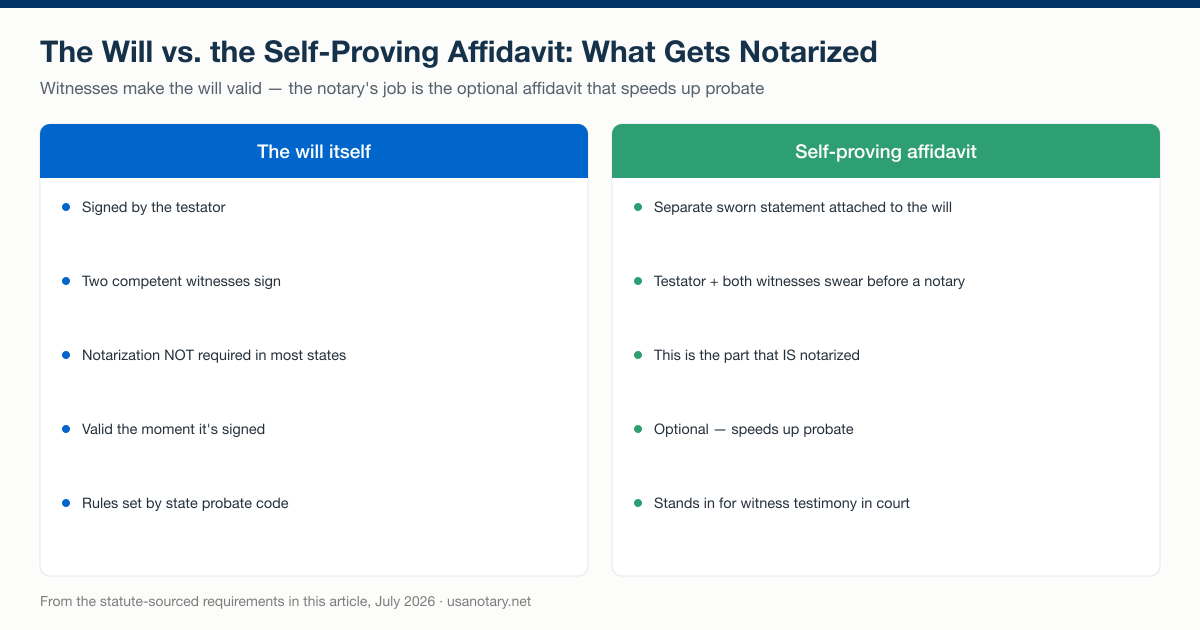
What makes the will valid versus what the notary actually notarizes, from the statutes cited in this article, July 2026.
What actually makes a will valid
A will becomes valid through execution formalities — signing rules set by state statute — not through a notary’s seal. Note first that a last will is different from a living will, the advance healthcare directive that operates while you are alive and often does get notarized. This page is about the last will and testament that distributes your estate after death.
| Requirement | Needed for a valid will? |
|---|---|
| Testator’s signature | Yes — the will must be signed by the testator (or by someone at the testator’s direction, in their presence) |
| Two witnesses’ signatures | Yes — in most states, two competent witnesses must sign |
| Notarization of the will itself | No — not required in most states |
| Self-proving affidavit (notarized) | Optional — speeds up probate, not required for validity |
If your state follows this pattern, a will you signed before two witnesses is valid the moment it’s signed — no notary required. The witnesses are the load-bearing formality, which is why the rules on who can serve as a witness matter far more than whether a notary was in the room. Witness eligibility varies by state, but a disinterested adult — someone who inherits nothing under the will — is the safe choice everywhere.
Will execution rules in six states, straight from the statutes
State probate codes say this plainly, and reading a few side by side shows how consistent the pattern is. Every statute below was checked against the current official or published text; none of them requires notarization for a will to be valid.
| State | Statute | Core execution rule | Notarization required? |
|---|---|---|---|
| California | Probate Code §6110 | Signed by the testator; witnessed by at least two persons “being present at the same time” | No |
| New York | EPTL §3-2.1 | “Signed at the end thereof by the testator”; at least two attesting witnesses, who must attest within one thirty-day period | No — the statute doesn’t mention notarization at all |
| Texas | Estates Code §251.051 | In writing, signed by the testator, and “attested by two or more credible witnesses who are at least 14 years of age” who sign in the testator’s presence | No |
| Arizona | ARS §14-2504 | Two-witness execution; separate self-proving procedure before “an officer authorized to administer oaths” | No — notary appears only in the optional self-proving affidavit |
| Virginia | Code §64.2-452 | Two-witness execution; self-proving acknowledgment and affidavits “made before an officer authorized to administer oaths” | No — notary appears only in the optional self-proving affidavit |
| Colorado | CRS §15-11-502 | Signed by two individuals or “acknowledged by the testator before a notary public” | No — but Colorado uniquely accepts notarization as an alternative to witnesses |
Two details in these statutes are worth pausing on:
- California’s harmless-error rule. Probate Code §6110 lets a court treat a defectively witnessed will as valid if the proponent proves “by clear and convincing evidence” that the testator intended the document as their will. That is a safety valve for botched witnessing — not permission to skip it.
- New York’s 30-day window. EPTL §3-2.1 requires both attesting witnesses to attest “within one thirty day period.” Execution formalities have real deadlines, and a notary stamp does not cure a missed one.
Notarization vs. witnessing: two different jobs
Notarization and witnessing get conflated because both involve someone else watching you sign. Legally they do different work, and one cannot stand in for the other unless a statute says so.
Witnessing a will is a probate-law formality: the witnesses observe the testator sign (or acknowledge the signature) and then sign themselves, creating the evidence a probate court later relies on. The witness requirement comes from the state’s probate or estates code — §6110, §3-2.1, §251.051 and their counterparts.
Notarization is a notarial act governed by a different body of law entirely — notary statutes, many of them drawing on the Uniform Law Commission’s Revised Uniform Law on Notarial Acts (RULONA), which governs acts like taking an acknowledgment and administering an oath. In an acknowledgment, the signer acknowledges signing the document. In a jurat, the signer swears the contents are true and signs in front of the notary. The self-proving affidavit is oath-based: the notary administers the oath and certifies it.
The practical consequence: in a state whose probate code demands two attesting witnesses, a will that was notarized instead of witnessed does not satisfy the statute. The notary’s certificate proves who signed and that they swore — it does not replace the witnessing formality the probate code requires.
Can you write your own will and just have it notarized?
You can write your own will — no state requires an attorney to draft it — but having it notarized is not what makes it valid. A do-it-yourself will lives or dies on the same execution formalities as an attorney-drafted one: the testator’s signature plus two witnesses’ signatures in the states surveyed above. Skip the witnesses and add a notary instead, and in a two-witness state you have an invalid will with an impressive-looking seal on it.
If you’re going the DIY route, three points keep you on solid ground:
- Execute it like the statute says. Sign before two adult witnesses who watch you sign (in California, both “present at the same time” under §6110; in Texas, witnesses “at least 14 years of age” under §251.051). Choose witnesses who inherit nothing under the will.
- Then add the notarized self-proving affidavit. A DIY will benefits from it just as much as an attorney’s — arguably more, since a homemade will is likelier to face scrutiny in probate.
- Handwriting is its own category. A fully handwritten will can be valid without witnesses in states with holographic-will statutes like California’s §6111 — but only if it meets that statute’s handwriting requirements. Mixing formats is where DIY wills go wrong.
The larger caution: drafting mistakes, not signing mistakes, are what usually sink homemade wills — unclear gifts, forgotten assets, no residuary clause. A notary cannot fix any of that, and neither can witnesses. For anything beyond a simple estate, attorney review is cheap insurance.
The self-proving affidavit — the part that IS notarized
Here’s where the notary legitimately comes in. A self-proving affidavit is a short sworn statement, usually attached to the end of the will, in which the testator and both witnesses swear before a notary that the will was signed properly. The affidavit is notarized; the will itself is not.
Its job is to make probate faster. Without it, a court may have to locate the witnesses years later and have them testify that they saw the will signed. With it, the notarized affidavit stands in for that testimony. Under state statutes such as Arizona’s §14-2504 and Virginia’s §64.2-452 — both in the Uniform Probate Code’s self-proved-will tradition — the affidavit is executed before a notary public or, in the statutes’ words, “an officer authorized to administer oaths.” Arizona’s statute adds that the acknowledgment and affidavits are “evidenced by the officer’s certificate, under official seal.” Virginia’s is notably forgiving on formality: a court may accept the witness affidavits “notwithstanding that the officer did not attach or affix his official seal thereto.”
So when someone says they had their will “notarized,” they almost always mean they added a self-proving affidavit. The signing session looks like this:
- The testator and both witnesses appear together before the notary.
- The notary confirms their identities.
- The testator swears the document is their will and that they signed it willingly; the witnesses swear they watched it signed.
- The notary administers the oath, then completes and seals the affidavit certificate.
One session, three signers, one notarial act — and your executor is spared a witness hunt during probate. If the witnesses have moved, died, or become unreachable by the time the will is probated, the affidavit is what keeps the process moving.
What happens in probate if the will was never notarized?
Nothing bad happens to the will itself — an un-notarized will that was properly witnessed is exactly as valid as a notarized one. The difference shows up in how the court proves it. A will offered for probate must be shown to have been properly executed, and without a self-proving affidavit, that proof typically comes from the attesting witnesses themselves.
That is precisely the gap the affidavit fills. Virginia’s statute spells out the substitution: witness affidavits taken under §64.2-452 “shall be accepted by the court as if it had been taken ore tenus before such court” — legal Latin for live, in-person testimony. The notarized affidavit is the witness testimony, banked in advance.
So the practical stakes of skipping the notary are about your executor’s workload, not your will’s validity:
| Scenario | Will valid? | What probate needs |
|---|---|---|
| Witnessed will + self-proving affidavit | Yes | The affidavit — witnesses usually never contacted |
| Witnessed will, no affidavit | Yes | Witness testimony or state-specific alternative proof, which takes time if witnesses have moved or died |
| Notarized but not witnessed (two-witness state) | At risk | Notarization is not a substitute for the required witnesses |
If your will is already signed and witnessed but has no self-proving affidavit, some states allow one to be added later — Virginia’s statute, for instance, accepts witness affidavits “whenever made.” Ask an estate-planning attorney whether your state permits an after-the-fact affidavit and which form to use.
The states where a notary can replace your witnesses
There is a genuine exception to the “witnesses, not notary” rule — and it points the other direction. In 2008, Uniform Probate Code §2-502 — the model provision titled “Execution; Witnessed or Notarized Wills” — was amended to allow a will to be validated when it is either “signed by at least two individuals” who witnessed the signing or “acknowledged by the testator before a notary public or other individual authorized by law to take acknowledgements.” A minority of states adopted that alternative.
Colorado is the clearest example. Colorado Revised Statutes §15-11-502 — a section titled “Execution — witnessed or notarized wills” — requires a will to be signed and then either “signed by at least two individuals” who witnessed it or “acknowledged by the testator before a notary public or other individual authorized by law to take acknowledgments.” In Colorado, a notarized will can stand on its own without witnesses.
This remains the minority rule. Most states never adopted the notarized-will alternative and still require two witnesses regardless of notarization — so never assume your state allows it. Check the statute or ask an estate-planning attorney before relying on a notary in place of witnesses.
When notarizing a will can backfire
Adding a notary is not always harmless, because a will is a tightly regulated document and notarization is not part of most states’ execution formula.
The first trap is substitution: treating notarization as if it satisfied the witnessing requirement. In New York, EPTL §3-2.1 requires two attesting witnesses and contains no notarization option — a will executed before a notary but without the required witnesses simply does not meet the statute. The notary seal adds nothing; the missing witnesses take everything.
The second trap involves handwritten (holographic) wills. In states that recognize them, a holographic will draws its validity from the testator’s own handwriting: California Probate Code §6111 makes a will valid “whether or not witnessed” when “the signature and the material provisions are in the handwriting of the testator.” A holographic will doesn’t need a notary any more than a witnessed will does — and bolting printed notarial certificates onto a document whose legal theory is “entirely handwritten” invites challenges rather than preventing them. If you’re considering a handwritten will, get attorney direction before adding anything to it.
The lesson generalizes: notarization is not a bonus you sprinkle on for extra strength. Follow your state’s execution rules exactly, and let an attorney direct how the will is signed.
Louisiana: the civil-law exception
One state breaks the pattern the opposite way. Louisiana, the country’s only civil-law state, has distinct will-execution rules in which a notary plays a central role rather than the witness-only model used elsewhere. If you’re in Louisiana, confirm the exact requirements with a Louisiana attorney — notarization there is not the optional add-on it is in other states. Everywhere else, a notary is either an optional convenience (the self-proving affidavit) or, in the handful of Uniform Probate Code states above, an alternative to witnesses.
A quick guide: do you actually need a notary?
Use this to decide what the notary is for in your situation:
- Just making the will valid? In most states, no notary is needed — sign before two disinterested witnesses and you’re done.
- Want to speed up probate for your family? Add a self-proving affidavit and have it notarized. Optional, but it spares your executor a witness hunt.
- In Louisiana? Will-execution rules differ (a notary is central) — confirm with a Louisiana attorney.
- In a Uniform Probate Code “notarized will” state such as Colorado? You may acknowledge the will before a notary instead of using two witnesses — check the statute.
- Writing a handwritten will? Be cautious about notarizing at all; get attorney direction first.
- Not sure which bucket you’re in? Read your state’s execution statute (the table above links six of them) or ask a local estate-planning attorney — this is one document where “close enough” is not enough.
Can you notarize a will or affidavit online?
Where your state authorizes remote online notarization and allows it for estate documents, the self-proving affidavit can be notarized online — the testator and witnesses appear on live video before the notary, who verifies identity, administers the oath, and completes the certificate electronically. Online notarization rests on established digital-signature law: under the federal ESIGN Act, 15 U.S.C. §7001, an electronic record or signature “may not be denied legal effect, validity, or enforceability solely because it is in electronic form,” and many states’ notary laws draw on the Revised Uniform Law on Notarial Acts (RULONA), which authorizes remote online notarization through audio-visual and identity-proofing technology.
Wills deserve extra caution here, and the caution is written into federal law itself. 15 U.S.C. §7003(a)(1) expressly excludes from ESIGN’s coverage “a statute, regulation, or other rule of law governing the creation and execution of wills, codicils, or testamentary trusts” — meaning electronic-signature validity for wills is left entirely to state law. That is why some states exclude wills and testamentary documents from RON even while allowing it for nearly everything else. Confirm your state permits it before relying on an online notarization for anything will-related. For trust documents, see how a trust gets notarized.
For the will-specific rules, see can you notarize a will online?, and check whether online notarization is legal in your state first. For documents your state does allow — including many self-proving affidavits and most other estate-adjacent paperwork — online notarization costs $25 per document on USA Notary, and the signer appears on live video with a commissioned notary.
This is general information, not legal advice. Will execution rules — witnesses, notarization, and self-proving affidavits — vary by state, and a mistake can invalidate a will. For your situation, consult a licensed estate-planning attorney and follow your state’s law.