
How do you get a mobile notary to a hospital?
Book one directly — don’t assume the hospital will provide one. Notary availability inside hospitals varies widely: some facilities keep staff notaries on call for patients, many don’t, and policies differ even between hospitals in the same city. Ask the hospital’s social work or patient advocacy office first; if the answer is no — or not soon enough — you bring the notary to the bedside yourself.
A mobile notary is a commissioned notary who travels to the signer. Bedside work is routine enough that the National Notary Association publishes dedicated guidance for medical-facility signings, warning that “Notarizing for vulnerable signers involves unique challenges that go far beyond what is covered in most Notary handbooks.” The typical flow looks like this:
- Ask the hospital first. Check with social work or patient advocacy whether a notary is available in-house, whether outside notaries may visit, and whether the document needs any facility-specific witness.
- Book the mobile notary and agree on fees up front. The notarization fee is capped by state law in most states, but the travel fee usually isn’t — the NNA’s guidance is to inform the customer of the travel fee in advance, separately from the notarial fee.
- Prepare the bedside. Have the document complete (no blank required fields), the signer’s photo ID in the room, and any witnesses arranged with their own ID.
- The notary screens the signer. At the bedside, the notary screens the signer for identity, willingness, and awareness — the same screening as in an office, applied with extra care.
- The certificate is completed. The notary completes the notarial certificate, records the act in a journal, and the document is notarized.
If travel, scheduling, or facility access is the obstacle, remote online notarization reaches the same bedside through a phone or tablet — $25 per document, with round-the-clock notary availability. And if you’re facility staff coordinating signings for patients or residents regularly, our healthcare and senior-care notarization page covers staff-initiated workflows that let your team start sessions for patients instead of chasing outside notaries visit by visit.
Two ways to bring notarization to a homebound or hospitalized signer
When a person is homebound, hospitalized, or in a care facility, a trip to a bank or shipping-store notary isn’t realistic. Two options bring the notarization to them instead:
- A mobile notary travels to the home, hospital room, or facility and notarizes in person.
- Remote online notarization (RON) happens over live video on a bedside phone, tablet, or computer — you can notarize online over live video without anyone traveling.
Both accomplish the same notarial act. The difference is whether the notary physically comes to the signer or meets them through a camera. The right call turns on the signer’s condition, how quickly the document is needed, and whether the signer can operate a device and be positively identified.
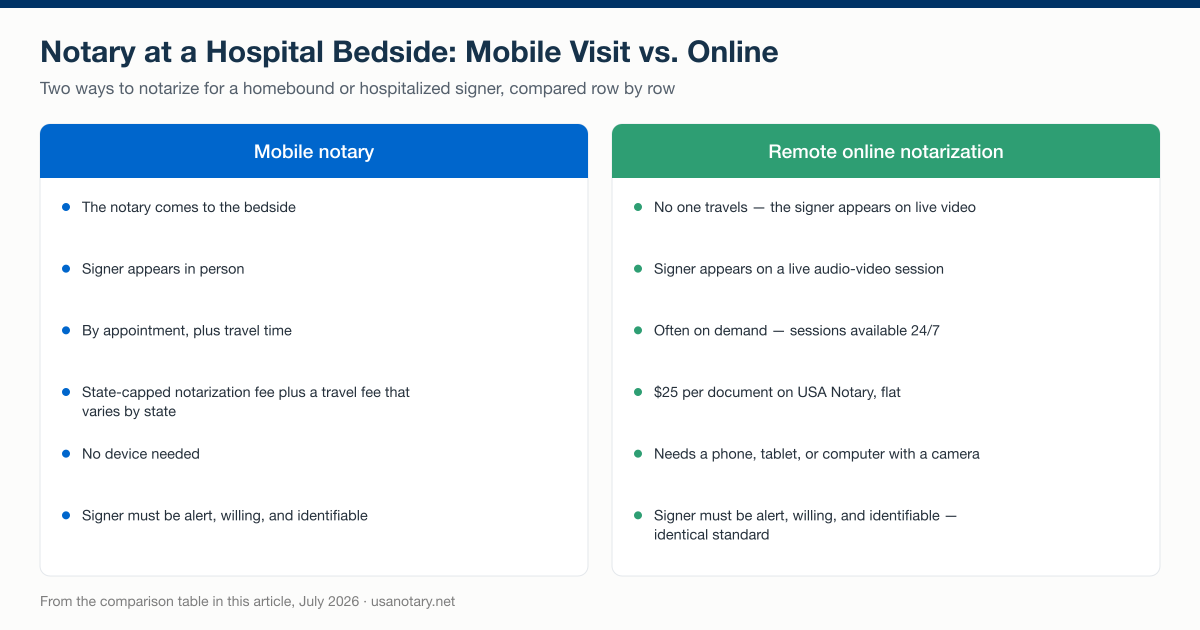
The two ways to notarize at a bedside, side by side — from the comparison table in this article, July 2026.
Mobile notary vs. remote online notarization: which fits the bedside?
Each route has a clear best case. Use this comparison to match the method to the situation:
| Factor | Mobile notary | Remote online notarization |
|---|---|---|
| Who travels | The notary comes to the bedside | No one — the signer appears on live video |
| How the signer appears | In person | On a live audio-video session |
| Typical speed | By appointment, plus travel time | Often on demand — sessions available 24/7 |
| Cost structure | State-capped notarization fee plus a travel fee that varies by state | $25 per document on USA Notary, flat |
| Device needed | None | A phone, tablet, or computer with a camera |
| Signer requirements | Alert, willing, and identifiable | Alert, willing, and identifiable — identical standard |
| Best when | The signer can’t use a device, or a facility bars outside video | The document is time-sensitive and the signer can use a device |
Note the row both columns share: the signer must be alert, willing, and identifiable either way — neither option relaxes that. For a broader breakdown across settings, see mobile vs. online vs. in-person notary. If you’re unsure a device session will work, ask the facility whether tablets and video calls are permitted at the bedside before committing to RON.
What a bedside mobile notary visit costs
The bill for a hospital visit has two parts: the notarization fee, which most states cap by statute, and the travel fee, which is genuinely unpredictable across the country. The NNA’s state-by-state guide to notary travel fees (updated October 2025) groups the rules into four categories:
| Travel-fee rule | How many states | Examples |
|---|---|---|
| State sets the travel fee by law | 5 states + D.C. | Connecticut, Idaho, Nevada, New Hampshire, Virginia |
| Fee tied to federal or state mileage rates | 9 states | Rates change year to year with the authorized mileage rate |
| State publishes only general guidelines | 14 states | “Reasonable” fee expectations, no fixed amount |
| Notary sets their own travel fee | 22 states | Includes Florida, Illinois, New York, Texas |
Two details from that guide matter at a hospital. First, D.C., Idaho, and Virginia only allow a travel fee that does not exceed the notary’s actual travel expenses. Second, several states — Montana, Utah, and Wyoming among them — require the notary to inform the customer of the travel fee in advance and make clear it is separate from the notarization fee. Even where that’s not required, agreeing on the total before the notary drives to the hospital is the single most useful step you can take. For what the notarization itself may cost in your state, see our state-by-state notary cost guide.
Online notarization prices differently: on USA Notary it costs $25 per document, with no travel component, whatever state the signer is in.
The notarial requirements don’t relax at the bedside
Whichever route you choose, the core rules still apply — and they matter most in a health setting, where the risk of fraud or undue influence is higher. A notary screens every signer on three points:
- Identity must be established — a government photo ID, or, where the state allows it, credible witnesses if the signer has no acceptable ID.
- The signer must appear — in person for a mobile notary, or over live video for RON.
- The signer must be aware and willing — the signer cannot be under the pressure or direction of a third party.
The National Notary Association frames this screening as the heart of the job: “The central value of notarization lies in the Notary’s impartial screening of a signer for identity, willingness and awareness. This screening detects and deters document fraud, and helps protect the personal rights and property of private citizens from forgers, identity thieves and exploiters of the vulnerable.” (National Notary Association).
Hospital patients meet that screening under harder conditions — reduced alertness, medication effects, difficulty communicating, and pressure from family or staff are all on the NNA’s list of what makes medical-facility notarizations different. Its guidance to notaries is blunt: “You should always make sure your signer is alert and aware of what’s going on before completing the notarization.” Timing helps: schedule the visit or video session for the patient’s most lucid window, and some mobile notaries report coordinating with the family so medication that could affect alertness isn’t administered right before the appointment. Expect interruptions too — the NNA notes that vitals checks, IV changes, and other staff routines can break up a bedside signing, so build in extra time.
On the cognitive side: a notary confirms willingness, not medical capacity. There are no laws that outright prohibit notarizing for someone with a cognitive impairment, but the notary must refuse if the signer appears unaware of the act or is being directed by someone else. If a signer is heavily medicated, disoriented, or confused, the safest step is to pause and involve their attorney or care team — a notarization is not the place to resolve a question of legal capacity.
When the signer has no acceptable photo ID
A hospitalized person’s wallet and ID are often somewhere other than the bedside — the NNA notes that many patients do not have their ID with them at the hospital. Identity still has to be proven, but a photo ID isn’t the only path. Many states accept credible witnesses who vouch for who the signer is and are themselves identified.
California’s rules are a concrete example. Under the California Notary Public Handbook, a notary can establish identity through “satisfactory evidence,” which may be an identification document, the oath of a single credible witness personally known to the notary, or the oaths of two credible witnesses under penalty of perjury (Civil Code § 1185). A credible witness must swear, among other things, that the signer does not possess any of the identification documents authorized by law and would find it very difficult or impossible to obtain one — and the witness cannot be named in, or have a financial interest in, the document. Other states set their own list, so confirm what your state — and the notary’s platform — accepts before the appointment, and have any witnesses ready with their own ID.
When the patient physically can’t sign their name
Illness sometimes takes the signature before it takes the signer’s judgment — a stroke, tremor, or IV line can make a normal signature impossible even when the person fully understands the document. State law provides accommodations, and the notary applies the state’s rules rather than improvising:
- Signature by mark. The NNA’s medical-patient guidance notes that, with witnesses present and available, a patient may be able to sign with a mark such as an “X” — or even a thumbprint. California spells the procedure out: the mark must be witnessed by two persons who subscribe their own names on the document, one of whom writes the signer’s name next to the mark (Civil Code § 14, per the state handbook).
- Signature by direction. Some states allow the patient to direct another person to sign the patient’s name for them, again under specific statutory conditions.
If neither accommodation fits, ask the signer’s attorney about the document’s options before the appointment — a refused signing wastes the patient’s best hours.
Documents families most often need notarized in a care setting
Care-setting notarizations tend to cluster around a handful of legal documents. The National Notary Association’s guidance on documents family caregivers need to have notarized highlights three:
- Power of attorney — grants authority for a person to act as attorney-in-fact for another; once notarized, the agent can handle matters such as real estate, banking, taxes, and government benefits. A durable POA is the common bedside form — see our guide to notarizing a power of attorney.
- Advance medical directive — enables the agent to make medical decisions — medication, hospitalization, medical orders such as a do-not-resuscitate order — once the principal no longer can. Our walkthrough on notarizing a living will covers how these end-of-life documents are executed.
- Living trust — records how the principal wants assets and property handled or distributed, naming beneficiaries and controlling distribution.
Other documents that commonly come up at the bedside include a health care proxy, a HIPAA release granting named individuals access to medical information, and guardianship or conservatorship papers. Whatever the document, confirm which notarial act it needs. An acknowledgment is where the signer acknowledges signing a document; a jurat is where the signer swears the contents are true and signs in front of the notary. The NNA notes that acknowledgments are typical for real property deeds, powers of attorney, and trusts, while jurats apply to evidentiary documents and sworn statements.
Witnesses for wills and POAs at a hospital bedside
Notarization and witnessing are separate requirements, and hospital signings frequently need both. Many states require a will or power of attorney to be signed in front of witnesses in addition to — or instead of — a notary, and the witness rules follow the document’s governing state law, not the hospital’s location preferences. Our guide to whether you need a witness to notarize breaks down when witnesses are required and who can serve.
Two bedside-specific cautions from the NNA’s medical-facility guidance. First, facility rules can add a witness state law doesn’t mention: in California, an advance health care directive signed in a nursing home or long-term care facility must be witnessed by a patient advocate called an ombudsman — without that special witness, the directive will not be honored at the facility and could be challenged at another one. Second, don’t count on hospital staff to serve as witnesses; many facilities bar medical staff from witnessing patient documents, so arrange your own witnesses in advance and confirm the facility will admit them.
Can a relative who happens to be a notary handle it?
Tempting when a commissioned notary is already in the family — but check the state’s conflict-of-interest rules before letting a relative notarize. California’s handbook allows a notary to notarize for relatives unless doing so gives the notary a direct financial or beneficial interest — for example, being named individually as a principal to a financial transaction, or as a grantee, beneficiary, or trustee of a real property document (Government Code § 8224, per the California Notary Public Handbook). The handbook adds a specific caution about notarizing for a spouse or domestic partner because of California’s community property law. Since a bedside POA or trust often names the very family members standing in the room, the cleanest path is usually an uninvolved notary — mobile or online.
What if the signer can’t personally appear at all?
Personal appearance is the default: the signer has to be in front of the notary, in person or on live video. But a signer who is unconscious, non-verbal, or otherwise unable to appear cannot be notarized directly — and this is where families sometimes hit a wall.
A narrow exception exists in some states. In a proof of execution by subscribing witness, the signer signs the document in front of a witness, and then the witness — not the signer — appears before the notary. As the NNA explains, the notary identifies and administers an oath to the witness, the witness signs, and the notary performs the notarization based on the witness’s oath. States that permit it impose strict and widely varying criteria:
| State | Rule for proof of execution by subscribing witness (per NNA) |
|---|---|
| California | Subscribing witness must be identified by a credible identifying witness personally known to the notary |
| North Carolina | Subscribing witness cannot be a grantee or beneficiary of the document |
| Pennsylvania | Subscribing witness must be an attorney licensed in Pennsylvania |
| Tennessee | Two subscribing witnesses are required |
| Texas | Subscribing witness must be personally known to the notary or identified by a credible witness |
| Georgia, Washington | Proofs of execution are not authorized at all |
Treat this as a last resort to discuss with an attorney, not a routine substitute for the signer appearing. If the person still has capacity but simply can’t travel, a video session solves the appearance problem far more cleanly.
Is online notarization legal for a hospital bedside?
Yes — and it’s often the fastest way to reach a homebound signer. Remote online notarization is legally valid in all 50 states as a consumer service. The foundation for the electronic paperwork is federal: under ESIGN, 15 U.S.C. § 7001, a signature or record may not be denied legal effect solely because it is electronic. Most state RON statutes are modeled on the Revised Uniform Law on Notarial Acts (RULONA), and a federal bill to standardize interstate recognition — the SECURE Notarization Act (H.R.1777) — has been introduced in Congress but not enacted.
Two distinctions matter for a bedside signing. First, notary commissioning law is per-state — some states do not yet authorize their own notaries to perform RON. California is the clearest example: its handbook states that “a video image or other form of non-physical representation is not considered as personal appearance in front of the notary public under current California law,” and its Online Notarization Act (SB 696) is not operative until the Secretary of State certifies the technology project behind it or January 1, 2030, whichever is earlier (unless the Secretary notifies the Legislature and Governor in writing by January 1, 2029 that the project will not be completed). The signer isn’t limited by their own location, though; the notarization is performed by a notary commissioned in a state that permits RON. Second, RON is not the same as e-signing without a notary. In a session, the signer proves their identity, the signer appears on live video, and the notary applies a digital seal — you can see how a bedside video session works step by step. On USA Notary, online notarization costs $25 per document.
How to prepare for a bedside notarization
A little prep prevents a refused or wasted appointment. Whether the notary travels in or joins by video, do the following:
- Pick a lucid window. Schedule for a time of day when the signer is most alert and cognitively aware — and, where possible, before rather than after sedating medication.
- Have identification ready — the signer’s photo ID, or arrange credible witnesses (with their own ID) if the signer has none.
- Confirm the notarial act. Check with the attorney or the document’s recipient whether each document needs an acknowledgment or a jurat.
- Leave nothing blank. A notary will refuse to notarize a document with blank required fields or missing dates.
- Line up witnesses independently. If the document needs witnesses, bring your own — don’t count on staff — and confirm the facility will admit them.
- Allow for privacy. The notary may ask family or visitors to step out momentarily to confirm the signing is willing and free of third-party pressure.
Coordinating documents for a patient or aging relative is a common workflow — for families it’s usually a one-off, but hospitals, senior-living communities, and home-health agencies handle it weekly. Our healthcare and senior-care notarization page walks through how facility staff initiate sessions for patients and residents, and whether a witness is required in addition to the notary depends on the document and your state.