
Do you need a notarized consent letter for a child to travel?
A child travel consent letter is a signed statement from a parent or guardian who is not traveling, authorizing a minor’s trip. The United States itself does not demand one: the U.S. Department of State’s Travel with Minors guidance (last updated August 11, 2025) states plainly that “the United States does not require evidence of both parents’ permission for a minor to travel internationally, but some countries do.” The same page warns that “in some countries, if you travel alone with your child, you may need a signed and notarized letter from the other parent, or you must provide proof of sole legal custody.”
The requirement, in other words, comes from the destination country and sometimes your airline — not from a single U.S. rule. USA.gov’s guidance on international travel documents for children adds that “it is preferred that the letter of consent is in English and notarized.” Because you cannot predict which border officer, airline agent, or foreign immigration official will ask, a notarized letter is the safer default: it travels well and is hard to dispute at a border.
What a consent letter actually is
A consent letter is a written record that every parent or person with decision-making responsibility who stays home agrees to the trip. It is not a court order and it does not transfer custody. Notarization does not make it legally binding either — it authenticates the signature, confirming to a border officer or airline agent that the named parent genuinely signed the letter and had their identity verified. That authentication is the whole point: an official who has never met your family can trust a notarized letter far more than an unwitnessed note.
The Government of Canada publishes the most detailed public guidance on these letters and describes the document plainly: a consent letter is a written statement showing that a child has permission to travel abroad from any parent or guardian who is not traveling with them. That framing applies to U.S. families too — the letter proves consent, nothing more.
When a consent letter is recommended
A consent letter is unnecessary when a child travels with both parents. It becomes important the moment a parent or guardian is missing from the trip. The situations below follow the Government of Canada’s published guidance, which is the clearest official checklist available; a U.S. family’s destination country may set stricter rules, so verify those separately.
| Travel situation | Is a consent letter recommended? |
|---|---|
| Child travels with both parents | No consent letter needed |
| Child travels with one parent only | Yes — a letter from the other parent |
| Child travels with a grandparent, relative, or friend | Yes — a letter from the parent(s) not traveling |
| Child travels alone | Yes — a letter from the parent(s) |
| Child travels with a group (school, sports, religious) | Yes — a letter for each child from the parent(s) |
Schools and group organizers that collect a letter for every traveler can route them through our education organization notary services.
Age is not a reliable shortcut. The Government of Canada advises that any child under 19 carry a consent letter when traveling abroad without both parents or guardians, and notes that even a 16- or 17-year-old holding an adult passport may still be asked for one. The State Department’s framing is broader still: “laws and regulations vary,” and in some places “it is not possible for a minor to depart without a legal parent or guardian.” When the child travels alone or with someone who is not a parent or legal guardian, the State Department notes that “some countries require that parents or legal guardians provide a notarized, written permission letter.”
What to put in the letter
There is no official format, but a complete letter leaves an officer with no follow-up questions. Based on the Government of Canada’s guidance, include:
- The child’s full name (and date of birth is useful).
- The names and contact details of the parents or guardians with decision-making responsibility.
- The accompanying adult’s full name, address, contact information, and relationship to the child.
- Where the child is traveling and for how long — including specific travel dates.
USA.gov offers a one-sentence core you can build the letter around: “I acknowledge that my child is traveling outside the country with [the name of the adult] with my permission.” Keep the wording simple and factual — the notary certifies your signature, not the contents, so there is no special legal phrasing to get right. If you want a fill-in starting point, the Government of Canada publishes a free template that adapts easily to a U.S. trip.
Who has to sign it
The signer is any parent or person with decision-making responsibility who is not traveling with the child — whether the parents are married, separated, or divorced. USA.gov’s guidance splits the cases cleanly: “if the child is traveling with one custodial parent, the letter should be from the other parent,” and “if the child is traveling with a guardian or alone, both parents should sign the letter.” Children from the same family traveling together can be listed on a single letter, though separate letters are recommended when the children will split off and travel apart.
Sole custody changes the picture. The State Department notes that some countries will accept “proof of sole legal custody” in place of the other parent’s notarized letter — so if a court order gives you sole decision-making authority, carry a certified copy of it alongside (or instead of) a consent letter, depending on the destination’s rules.
One caution the Canadian guidance stresses: if getting the other parent’s consent is not possible or could be unsafe, seek legal advice rather than proceeding on your own. A consent letter is a travel document, not a substitute for a custody order.
Does the letter need to be notarized?
Technically, any adult can witness a consent-letter signature. In practice, the Government of Canada’s guidance is direct: it is “strongly recommended that a notary public witness sign it.” A notarized letter carries more weight because the notary has verified the signer’s identity and recorded the act, so a border official is far less likely to question it. This is also where people mix up two roles — a notary is not the same as a personal witness, and understanding when a document needs an independent witness versus a notary helps you prepare the right version.
The notarial act itself comes in two forms, and consent letters can take either:
| Acknowledgment | Jurat | |
|---|---|---|
| What the signer does | Acknowledges signing the document | Swears the contents are true |
| When to sign | May sign beforehand, then acknowledge before the notary | Signs in front of the notary, after taking an oath |
| Typical consent-letter use | A plain permission letter with no sworn language | A letter that includes “I swear/affirm” wording |
| Practical rule | Bring the letter signed or unsigned | Do not sign until you are with the notary |
Most consent letters are notarized as an acknowledgment, where the signer acknowledges signing the document. If your letter includes a sworn statement — language where you swear the contents are true — it becomes a jurat, and you must sign in front of the notary rather than beforehand. When in doubt, do not sign until you are with the notary.
How to notarize a consent letter online
A parent staying home does not need to find a notary in person. Remote online notarization lets the consenting parent appear on live video, verify their identity, and sign — from anywhere. On USA Notary, the minor travel consent letter service costs $25 per document, and the service provides notary services in all 50 states.
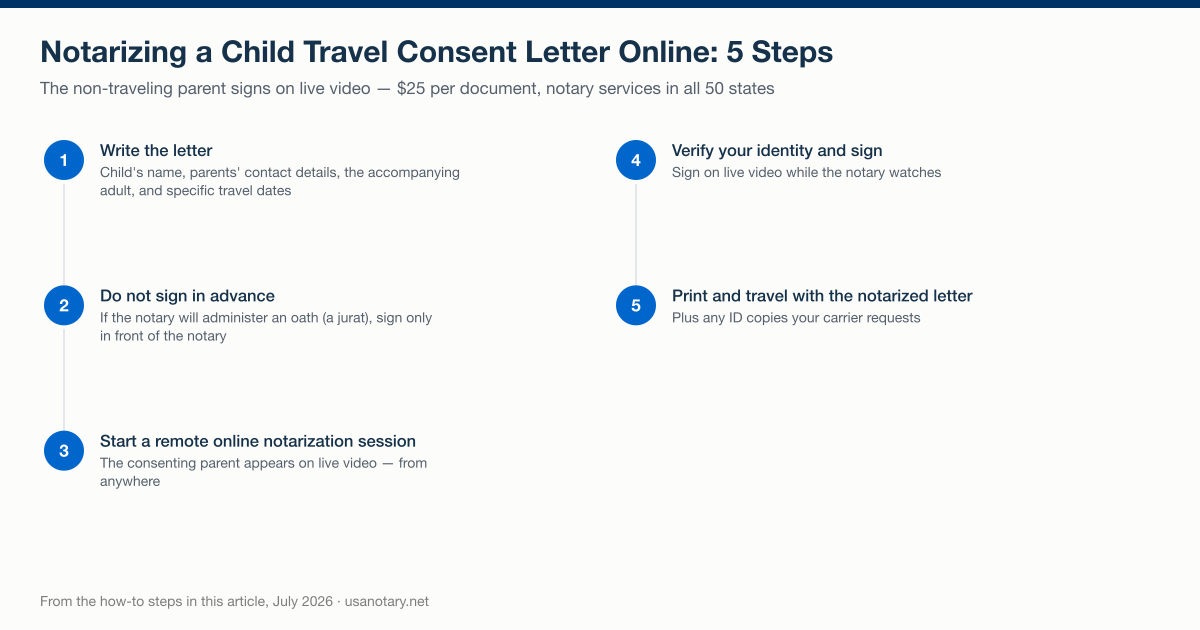
The five online-notarization steps described in this guide, July 2026.
- Write the letter using the details above; adapt a template if you like.
- Do not sign it in advance if the notary will administer an oath (a jurat).
- Start a remote online notarization session — you can see how the live video session works before you book.
- Verify your identity and sign on live video while the notary watches.
- Print and travel with the notarized letter, plus any ID copies your carrier requests.
The legal footing is solid on the U.S. side. A document notarized online in a state that authorizes RON is legally valid in all 50 states, and many states’ notarial statutes — including their RON provisions — are modeled on the Revised Uniform Law on Notarial Acts (RULONA). Federal law reinforces the electronic layer: under the ESIGN Act, 15 U.S.C. § 7001, electronic signatures and records may not be denied legal effect solely because they are electronic. A uniform federal RON standard — the SECURE Notarization Act of 2025 (H.R. 1777) — has been introduced in the 119th Congress but has not been enacted, so state law still governs which notaries may perform RON.
Online notarization also solves the hardest version of this problem: a non-traveling parent who is out of the country. A parent working or living abroad can notarize a document from overseas in the same live video session, without hunting for a U.S. embassy appointment.
Will border officials accept a printed or online-notarized letter?
Acceptance is decided at the border, by the destination. The Government of Canada’s guidance is candid about paper: “original signed letters are best. Border officials may not accept photocopies or digital versions.” A remotely notarized letter is typically delivered as an electronically sealed PDF that you print, so plan for that reality:
- Print the cleanest possible copy — full color, single-sided, with the notarial certificate and electronic seal fully legible.
- Carry a wet-ink original if you can get one. For high-scrutiny destinations, a traditionally notarized paper original is the most conservative choice.
- Confirm with your airline and the destination’s embassy or consulate before you fly. USA.gov’s advice is explicit: “contact the embassy or consulate of the country your child will be visiting and ask about letters of consent and other entry and exit requirements for that country.”
This is the honest trade-off of online notarization for travel documents: it is the fastest way to get a valid notarized letter — especially with parents in different cities or countries — but a foreign border officer applies their own country’s rules, and no U.S. statute obligates them to accept any particular format.
Consent letter, DS-3053, or something else?
Parents preparing a child’s first international trip often juggle several documents at once. They are not interchangeable:
| Document | What it is for | Who signs it | When you need it |
|---|---|---|---|
| Travel consent letter | Shows an absent parent approved this specific trip | The non-traveling parent(s) or guardian(s) | Carried during travel; requested by border officials or airlines |
| Form DS-3053 (Statement of Consent) | Lets one parent apply for a child’s U.S. passport when the other cannot appear | The non-applying parent, before a notary | At passport application time — not during travel |
| Birth certificate copy | Proves your legal relationship to the child | No signature needed — carry a copy | The State Department advises always bringing a copy of each child’s birth certificate or other evidence of your legal relationship |
The passport form trips people up most. A non-applying parent signs Form DS-3053, the passport Statement of Consent, so the applying parent can get the child’s passport issued; the travel consent letter is a separate document the child carries on the trip itself. Both are notarized parental-consent forms, which is why they get confused — but a DS-3053 in the passport file does nothing for you at a foreign border.
Two more State Department reminders round out the paperwork. If your child may hold dual nationality — one parent is a citizen of another country — contact that country’s embassy or consulate about its passport requirements and any entry and exit laws for minors. And every child needs their own U.S. passport for air travel abroad; USA.gov notes that children under 16 crossing to Canada or Mexico by land or sea may instead present a birth certificate (original or certified copy), a Certificate of Naturalization, or a Consular Report of Birth Abroad.
How long does it take, and when should you get it done?
Getting the letter notarized is the fast part; coordinating the signers is what takes time. Plan around three practical questions:
How fast is the notarization itself? An online session is a single live video appointment: the signer appears on live video, verifies identity, signs, and receives the sealed PDF — no travel, no office hours. The in-person route depends on finding a commissioned notary near the non-traveling parent (who may not live near you), matching their availability, and repeating the trip if anything on the letter changes. When parents live in different cities — or one is abroad — the online route is usually the only way to get the letter done in a day. If departure is even sooner than that, see the round-the-clock notary options.
When should both parents sign? If the destination expects both parents’ signatures — USA.gov’s rule when a child travels with a guardian or alone — each signer’s signature must be notarized, so each parent appears before the notary. Online, that can happen in one session or in two separate sessions from two locations; the notarization is per document either way.
Does a consent letter expire? No official expiry appears in the U.S. or Canadian guidance. But because the recommended contents include specific travel dates, a consent letter is effectively trip-specific: a letter written for last summer’s itinerary does not document permission for this summer’s. Write a fresh letter for each trip, dated close to departure, rather than reusing an old one — a border officer reading a letter with matching, current dates has nothing left to question.
The safe sequencing: draft the letter once flights are booked and dates are fixed, notarize it in the final weeks before departure, and leave buffer time to confirm format requirements with your airline and the destination’s embassy or consulate.
What a consent letter does not do
Set expectations honestly. A consent letter helps show permission for travel, but as the Government of Canada warns, it “does not guarantee” that a child will not be taken abroad without permission or returned — it is an important precaution, not a complete safeguard against abduction. It also does not override a destination country’s own entry rules: an immigration authority is not obligated to accept your letter, which is why checking the destination’s embassy or consulate before you fly matters more than any single template.
If you fear the opposite problem — that someone may take your child abroad without your consent — the State Department’s Travel with Minors page lists concrete steps: call the Office of Children’s Issues Prevention Team at 1-888-407-4747, enroll the child in the Children’s Passport Issuance Alert Program (CPIAP) so you are contacted before a passport is issued, obtain a court order preventing the child’s removal from the United States, and contact local law enforcement. A notarized consent letter strengthens a legitimate trip; these tools exist for the trips that are not.