
What is Form DS-3053?
Form DS-3053, the Statement of Consent: U.S. Passport Issuance to a Child, is the U.S. Department of State form a legal parent or guardian signs when a child under 16 applies for a U.S. passport and that parent cannot appear in person with the child. The default rule is stricter than most families expect: per the State Department’s guidance for a child’s passport under 16, both parents or guardians must be present with the child at the application appointment, or give documented approval, before a passport can be issued. That two-parent consent requirement comes from federal law — Public Law 106-113, Section 236, cited on the form itself alongside 22 C.F.R. parts 50 and 51 — and DS-3053 is how the absent parent supplies the approval.
The current edition is Form DS-3053 10-2024 (OMB Control No. 1405-0129, approved through October 31, 2027), and the State Department’s own Paperwork Reduction Act estimate says the form takes an average of 20 minutes to complete. Three uses are printed on page one: the standard case where one or both parents can’t appear; authorizing a third party — a grandparent, for example — to apply for the child’s passport on both parents’ behalf; and a substitute path where a separate notarized written statement containing all the same details is submitted in lieu of the form.
DS-3053 applies to children under 16. For applicants who are 16 or 17, the State Department requires parental awareness from one parent or guardian rather than two-parent consent — the passport authorizing officer can often confirm awareness at the appointment, though the officer keeps discretion to request written consent. The form carries a checkbox in Section 1 for 16- and 17-year-old applicants for exactly that situation.
Does Form DS-3053 have to be notarized?
Yes — DS-3053 is invalid without notarization (or execution before a passport authorizing officer). Section 4 of the form is an oath or affirmation: the non-applying parent, whom the form calls the “affiant,” swears the contents are true and signs in front of the notary. The printed oath reads, “I solemnly swear (or affirm) that the above information given by me is true and correct to the best of my knowledge and belief.” That makes DS-3053 a sworn statement, not a simple signature witnessing — and it is why the form warns that false statements are punishable under 18 U.S.C. 1001, 18 U.S.C. 1542, and 18 U.S.C. 1621.
The form’s instructions attach four conditions to the notarization that trip up signers:
- The dates must match. The affiant’s signed date and the notary’s signed date must be the same day.
- The notary must not be related to you. A spouse, parent, or sibling who happens to hold a notary commission cannot notarize your DS-3053.
- The notary records your ID on the form. Section 4 captures the ID type, number, place of issue, and dates — and you must attach a photocopy of the front and back of that exact ID.
- You wait to sign. Section 4 says, in the form’s own capitals, “STOP HERE! Do not sign this form until requested to do so by a Passport Authorizing Officer or Notary.”
If notarization itself is new territory, our walkthrough of what a notary checks before certifying any document covers identity verification, willingness, and certificate types in plain language.
Can you notarize Form DS-3053 online?
Yes — where your state authorizes it, and this is the detail many parents miss. The State Department’s guidance states plainly: “We accept electronically notarized statements of consent if it is allowed under state law. You must provide a printed copy when applying for the child’s passport.” (Travel.state.gov, child’s passport under 16). A parent in another city, another state, or on a tight schedule can notarize the form online over live video, then print the finished DS-3053 and hand it in with the child’s application.
The legal scaffolding behind that acceptance is worth naming. The federal ESIGN Act, 15 U.S.C. § 7001, provides that a signature or record “may not be denied legal effect, validity, or enforceability solely because it is in electronic form.” At the state level, most remote-notarization statutes follow the Uniform Law Commission’s Revised Uniform Law on Notarial Acts (2021), which authorizes remote online notarization “through the use of audio-visual recording and identity-proofing technology.” A federal overlay — the SECURE Notarization Act of 2025 (H.R.1777) — has been introduced in the 119th Congress but is not yet law, so notary authority still comes from each state.
Two facts sit side by side here and it is worth keeping them straight. Remote online notarization is a legally valid way to notarize a consumer document in all 50 states for the signer. Whether a notary is commissioned to perform online notarization, however, is governed per state — some states have not yet authorized their notaries to conduct RON. Our plain-English review of where online notarization stands legally unpacks that distinction. On USA Notary, the signer appears on live video with a commissioned online notary, and each online notarization costs $25 per document. If you want to see the mechanics first, read how an online notarization session works before you book.
DS-3053 at a glance
| Item | Requirement |
|---|---|
| Who signs | The non-applying legal parent or guardian (the “affiant”) |
| Notarial act | Oath/affirmation — signed and sworn before a notary or passport authorizing officer |
| Online option | Accepted where state law allows; submit a printed copy |
| Validity | 90 days from the notary’s signed date |
| Also submit | Photocopy of the front and back of the photo ID shown to the notary |
| Filling it out | Black ink or typed; an error means starting a new form — no corrections |
| Who can’t notarize | Anyone related to the affiant |
| Book vs. card | Consent covers both unless Section 3 says “issue passport book only” or “issue passport card only” |
| Estimated time | 20 minutes (State Department estimate) |
| Where to get it | eforms.state.gov (Form DS-3053, edition 10-2024) |
How to fill out Form DS-3053, section by section
The form is two pages, but only page two collects information. Print legibly or type using black ink only — and if you make an error, complete a new form; the instructions say “Do not correct.”
- Section 1 — the child. Print the child’s name exactly as it appears on the passport application (Form DS-11), plus the child’s birthdate. Check the box only if the child is 16 or 17.
- Section 2 — the applying adult. Name the adult who will appear in person with the child, and check their relationship: legal parent, legal guardian, or third party.
- Section 3 — the consent itself. Print the full name(s) of the parent(s) or guardian(s) who cannot appear, plus address, phone, and email. The consent is unconditional regarding passport validity and travel, and it covers both the passport book and card unless you write “issue passport book only” or “issue passport card only” in the blank provided.
- Section 4 — stop. Do not sign. The affiant signs and dates this oath section only in front of the notary, who records the ID presented, signs, dates, and seals. If both non-applying parents are consenting (the third-party scenario), both complete and sign.
Steps to notarize DS-3053 online
- Download Form DS-3053 from eforms.state.gov and complete Sections 1-3 — but leave Section 4 untouched.
- Start a remote online notarization session with a notary commissioned to perform RON, and verify your identity. You appear on live video for the entire act.
- Take the oath, then sign and date the form in front of the notary so the signature date and the notary’s date match.
- Print the notarized form — the State Department requires a printed copy, not an electronic file — and photocopy the front and back of the photo ID you showed the notary.
- Hand both to the applying parent, who submits them with the child’s DS-11 at a passport acceptance facility.
- File within 90 days of the notary’s signed date. The consent expires after that, and an expired consent means redoing the notarization.
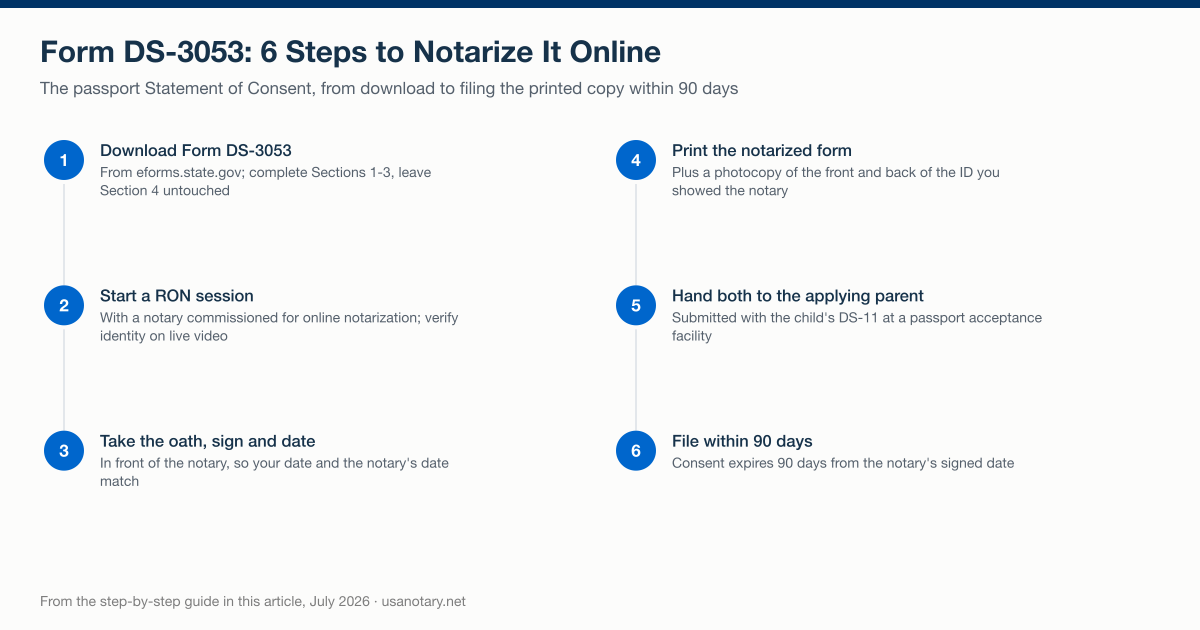
The six steps to notarize Form DS-3053 online, as described in this guide, July 2026.
Because the clock starts at notarization, don’t notarize DS-3053 weeks before you’re ready to file. Time the session against the acceptance-facility appointment, not against when the form happens to be filled out.
Online, in person, or embassy: which route fits
| Route | Best for | What happens | What you submit |
|---|---|---|---|
| Online (RON) | A parent in another city or state, tight schedules | You appear on live video; identity verified electronically; costs $25 per document on USA Notary | A printed copy of the notarized form + ID photocopy |
| In-person notary | A parent near a bank, shipping store, or mobile notary | You sign and swear before the notary, who seals the paper form | The original notarized form + ID photocopy |
| U.S. embassy or consulate | A parent in one of the 54 listed countries where local notaries can’t notarize DS-3053 | A consular officer administers the oath and notarizes | The consular-notarized form + ID photocopy |
Whichever route the absent parent uses, the applying parent still appears in person with the child at an acceptance facility — DS-3053 replaces the absent parent’s appearance, not the application appointment itself. There is a mirror-image oath on that end, too: the acceptance agent verifies the applying parent’s ID, administers an oath, and only then has them sign the child’s DS-11.
Common mistakes that get a DS-3053 rejected
Every rule below comes straight from the form’s instructions or the State Department’s application page — and each one forces a redo:
- Signing early. The affiant signature belongs in front of the notary, full stop. A pre-signed form can’t be notarized as an oath.
- Mismatched dates. The affiant’s date and the notary’s date must be the same day.
- Corrections on the form. Crossed-out or overwritten entries invalidate it; the instructions require completing a fresh form.
- A related notary. The notary “must not be related to the affiant(s).”
- Missing ID photocopy. The photocopy must show the front and back of the exact ID the notary recorded in Section 4.
- An expired consent. Filed more than 90 days after the notary’s signed date, the consent is void and the acceptance facility will ask for a new one.
- Submitting the electronic file. For an online notarization, the State Department wants a printed copy with the application, not a PDF.
When you don’t need DS-3053: sole custody and other alternatives
Consent from the second parent isn’t required when there legally isn’t a second parent to ask. The State Department’s under-16 application page maps each family situation to a specific document:
| Situation | Submit instead of (or with) DS-3053 |
|---|---|
| Sole legal custody | Court order granting you sole custody, or giving only you permission to apply |
| Only parent on record | Certified copy of the child’s birth certificate or adoption decree listing you as the only parent or guardian |
| Other parent deceased | Certified copy of the death certificate |
| Other parent legally incompetent | Certified copy of the judicial declaration of incompetence |
| Other parent can’t be located (both still have custody) | Form DS-5525, Statement of Special Family Circumstances — the Department may ask for more evidence, such as a custody, incarceration, or restraining order |
| Neither parent can appear | DS-3053 or a notarized statement from both parents, filed within 90 days, with photocopies of both parents’ photo IDs |
The DS-5525 route deserves emphasis because it is the one non-notarized path: it’s a statement made under penalty of perjury explaining, in detail, why the second parent cannot be reached. It is weighed at the Department’s discretion — it is not a rubber stamp.
Special situations: overseas, military, and guardianship institutions
A parent outside the United States may need to notarize Form DS-3053 at a U.S. embassy or consulate rather than with a local notary. The State Department currently lists 54 countries where a local notary public cannot notarize DS-3053 at all: Afghanistan, Algeria, Angola, Bangladesh, Bulgaria, Cambodia, Cameroon, Central African Republic, Cote d’Ivoire, Dominican Republic, Egypt, Equatorial Guinea, Ethiopia, Gabon, Guatemala, Guinea, Haiti, Honduras, Indonesia, Iran, Iraq, Jamaica, Kenya, Kuwait, Laos, Lebanon, Liberia, Libya, Mali, Mauritania, Mauritius, Moldova, Nepal, Nicaragua, Nigeria, North Korea, Pakistan, Panama, Philippines, Saudi Arabia, Senegal, Sierra Leone, Somalia, Sudan, Syria, Tajikistan, Tanzania, Trinidad and Tobago, Uganda, Ukraine, United Arab Emirates, Venezuela, Vietnam, and Yemen. The list changes, so check the current version on Travel.state.gov before booking anything.
A military-deployed parent should provide a notarized DS-3053 in most cases — deployment on its own does not waive the consent requirement.
A child in foster care or pending adoption, under guardianship of a state children-services office or private institution, needs a heavier packet: a certified court order naming the institution as guardian with no restrictions on passport issuance, a letter on the institution’s letterhead authorizing the person applying with the child, and employee IDs showing the letter-writer and the applying person work for the institution.
If the trip that’s driving the passport also involves the child traveling without both parents, look at a notarized child travel consent letter as a separate document — border officers ask for it even after the passport is issued.
Fees and timelines after the DS-3053 is notarized
A notarized DS-3053 is one input into the child’s DS-11 application, and the rest of the process has its own numbers, per the State Department’s current fee and processing tables:
| Item | Current figure |
|---|---|
| Child’s passport book (under 16) | $100 application fee + $35 acceptance fee |
| Child’s passport card | $15 application fee + $35 acceptance fee |
| Book and card together | $115 + $35 acceptance fee |
| Routine processing | 4-6 weeks |
| Expedited processing | 2-3 weeks (extra $60) |
| Child passport validity | 5 years — and a child’s passport cannot be renewed; each application is in person |
Those timelines interact with the 90-day consent window: routine processing plus mailing fits comfortably inside it as long as the DS-3053 is notarized close to the filing date, which is one more reason to schedule the notarization last, not first.
Two packing notes while you’re assembling the rest of the application: the State Department accepts only physical evidence of the child’s U.S. citizenship — a mobile or electronic birth certificate will be turned away — and photocopies must be on single-sided 8.5 x 11 paper. Questions about a specific case go to the National Passport Information Center at 1-877-487-2778, the contact printed on the DS-3053 itself.
Get it done
If you can’t make it to your child’s passport appointment, online notarization lets you handle DS-3053 from anywhere your state’s law allows. On USA Notary it costs $25 per document and the notary appears with you on live video — notarize your DS-3053 online and print the finished form to file. As a final check, confirm your acceptance facility processes a printed, remotely notarized DS-3053 for your situation, since state RON authority and local practice both vary.