
How do you sign over a car title?
Signing over a car title means the seller completes the assignment section of the title — the block that transfers ownership to a named buyer. On most state titles that section is on the back: the New York DMV’s instructions are typical — “As seller, you must complete the ‘Transfer by Owner’ section on the back of the title. Do not write on or mark the front.” The assignment asks for the buyer’s name and address, the date of transfer, the sale price (on many states’ forms), an odometer reading where federal rules require one, and the seller’s signature.
The stakes are higher than most form-filling because a title is a single, unforgiving document. New York’s rule is blunt: “The DMV will not accept titles with cross-outs, alterations, or erasures of any kind,” and “if the title is voided, even if by error, you must get a duplicate title before you can transfer ownership.” Read every field label before your pen touches the paper.
Step-by-step: completing the seller’s section
Field names vary state to state, but the sequence is consistent. The Texas DMV sums up what the buyer must walk away with: “a properly signed title, including the date of sale and odometer reading.”
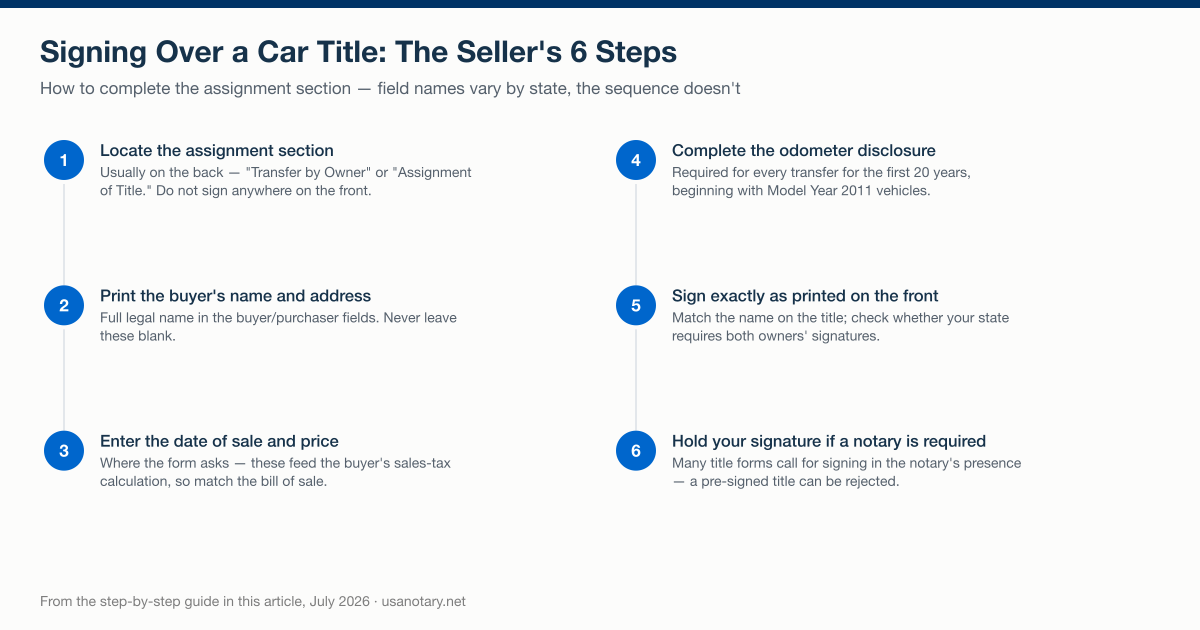
The seller’s six-step title sign-over sequence described in this guide, July 2026.
- Locate the assignment section — usually on the back, labeled “Transfer by Owner,” “Assignment of Title,” or similar. Do not sign anywhere on the front.
- Print the buyer’s full legal name and address in the buyer/purchaser fields. Never leave these blank (see title jumping below).
- Enter the date of sale and, where the form asks, the sale price. These feed the buyer’s sales-tax calculation, so they should match any bill of sale.
- Complete the odometer disclosure if your vehicle requires one. Under federal rules announced by NHTSA, odometer disclosures “will be required for every transfer of ownership for the first 20 years, beginning with Model Year 2011 vehicles”; Model Year 2010 and older vehicles remain exempt from the extended federal requirement. Our odometer guide walks through the federal odometer exemptions that decide whether you disclose at all, and how to complete the field when you do.
- Sign exactly as your name appears on the front of the title. If the title says “Jonathan A. Smith,” don’t sign “Jon Smith.” If two owners are printed on the front, check whether your state requires both signatures.
- Hold your signature if a notary is required. Some states require the seller’s signature on the assignment to be notarized — and many title forms call for signing in the notary’s presence, so a pre-signed title can be rejected. More on this below.
One timing note worth copying from New York’s instructions: “Do not fill in any information until you actually make the transfer to the new owner.” A title completed in advance for a buyer who backs out becomes a correction problem — or a voided title.
What the buyer completes
The buyer’s part is shorter but not optional. On most titles the buyer signs to accept the transfer and, where an odometer disclosure applies, signs to acknowledge the mileage the seller disclosed. The buyer then carries the assigned title to the state’s titling agency to apply for a new title in their own name — in Texas, for example, vehicles must be titled in the buyer’s name within 30 days of the sale date.
That last step protects the seller too. The Texas DMV warns that “failing to properly transfer a vehicle into the buyer’s name could result in the seller being held responsible for tickets, toll violations or even crimes committed with the vehicle.” A signed-over title that never gets retitled is a liability that still points at you. If the sale also uses a separate sales document, our guide to notarizing a bill of sale covers when that document needs its own notarization.
Mistakes that can void a car title
Title mistakes divide into two groups: ones your state lets you correct, and ones that force a new title. Which group a given error falls into depends on your state — Georgia publishes an unusually clear list in its Corrections to Titles guidance, while New York accepts no cross-outs, alterations, or erasures of any kind.
| Mistake | Why it’s a problem | The fix |
|---|---|---|
| White-out or correction tape | Georgia lists “use of correction fluid or tape” as an unacceptable correction requiring a new title | Obtain a duplicate/replacement title |
| Erasing or blocking out information | Also on Georgia’s unacceptable list; NY rejects erasures outright | Obtain a duplicate/replacement title |
| Signing in the wrong spot | An alteration or a stray signature can void the assignment — NY: “if the title is voided, even if by error, you must get a duplicate title” | Ask your title agency; often a duplicate title |
| Wrong info in a correctable field | Some states allow a documented fix — Georgia: lightly line through, write the correct information above it, and complete Form T-11, Affidavit of Correction | Follow your state’s correction procedure exactly |
| Signature doesn’t match the printed name | The agency can’t confirm the person on the front released ownership | Re-execute correctly, or correct per state procedure |
| Leaving the buyer fields blank | An open title enables title jumping (next section) | Complete buyer information at the time of sale |
The pattern across states: pen mistakes are state-specific; concealment-style corrections are rejected everywhere. When in doubt, call your title office before you attempt a fix — an unauthorized correction converts a small problem into a duplicate-title errand.
Leaving the buyer blank: title jumping
An “open title” — signed by the seller with the buyer fields left blank — is how a vehicle gets passed along without ever being retitled. State agencies treat this as a fraud flag, not a convenience. The Wisconsin DMV describes the practice among unlicensed dealers: they “don’t have vehicles titled in their name before selling them. This is called ‘title jumping,’ and it makes it easier for the unlicensed dealer to commit fraud without being caught.” Wisconsin also notes that any person selling more than five vehicles per year needs a dealer license — flipping cars on open titles is exactly what that licensing regime exists to police.
For a buyer, a jumped title is a real cost even when no fraud is involved. The Kansas Highway Patrol’s guidance is that if your seller never titled the vehicle in their own name, “you have a ‘jumped title’” that must be corrected before the vehicle can complete its VIN inspection — by returning to the seller, contacting the state revenue department, or filing a quiet title action in court. New York states the underlying rule directly: “You cannot transfer a title certificate to a new owner if the reverse side of the title is already signed over to you. You must first get a title in your own name, then transfer it to the new owner.” The penalties and enforcement mechanics vary by state, but the practical rule doesn’t: complete the buyer’s name at the time of sale, every time.
What if there’s a lien on the title?
A lien means a lender still holds a security interest in the vehicle, and the paperwork reflects it — in Texas, “if there is a lien on the vehicle, the lienholder will receive the title,” so a seller with an active loan may not even hold the certificate. You generally can’t complete a clean sign-over until the lien is resolved.
Once the loan is paid, the lienholder must provide a lien release. New York’s DMV tells owners to keep that release and “give it to a buyer, along with your title certificate, when you transfer ownership” — the state will accept only the signed original, and you aren’t required to have the lien formally removed from the title first as long as the release accompanies it. Buyers should treat this as a checklist item: if a lienholder appears on the front of the title, don’t complete the purchase without the original release in hand. And if the titled owner can’t be present to sign at all — a deployed family member, an out-of-state co-owner — a vehicle power of attorney lets an authorized agent complete the assignment on the owner’s behalf.
Lost the title? The duplicate-title path
You can’t sign over a title you don’t physically have, so a lost, stolen, or damaged certificate means a duplicate title application before the sale. Using New York as the worked example: submit an Application for Duplicate Certificate of Title (MV-902) with proof of identity and address and a $20 fee, online or at a motor-vehicle office.
One consequence matters for sellers: per the NY DMV, “as soon as a duplicate title is processed, the original title and any prior duplicates are no longer valid and cannot be used to transfer your vehicle.” If the old title turns up in a drawer after the duplicate issues, it’s a piece of scrap paper — the sign-over must happen on the newest certificate. Every state runs its own version of this process with its own form and fee, so check your motor-vehicle agency’s duplicate-title page before you list the car.
Does signing over a title need a notary?
In some states, yes: the seller’s signature on the title assignment must be notarized before the transfer is valid, and a few states extend the requirement to the buyer. In most states, no notary is involved at all. Which camp your state falls into — and whose signature the notary block covers — is a state-by-state question we keep current in our guide to whether a vehicle title needs to be notarized, including the notarial act your form calls for and a 2025 rule change that dropped one state’s requirement.
Where notarization is required, the mechanics matter: many motor-vehicle forms are worded as sworn statements, which means you complete the signature in the notary’s presence — so don’t pre-sign the title. The notary verifies your identity against government photo ID and completes the notarial certificate; the notary does not verify the odometer reading or the sale price.
You can complete this step without finding a notary desk. Through remote online notarization, you appear on live video, the notary verifies your identity, and the session produces a tamper-evident notarized PDF and a digital audit trail — available 24/7, $25 per document, with signers in all 50 states. Before you rely on it for a title, confirm your state’s title office accepts a remotely notarized assignment; acceptance, not validity, is the variable that trips people up.
Selling to a dealer instead
Trading in or selling to a licensed dealer changes the mechanics: you assign the title to the dealership, and the dealer handles the downstream paperwork. Note one wrinkle from the Texas DMV: “a dealer is not required to title in the dealership’s name if you sell or trade-in your vehicle to a licensed motor vehicle dealer” — the vehicle can stay in your name until the dealer resells it, which is why Texas offers sellers a Vehicle Transfer Notification to cut off liability. Dealerships, title processors, and auto lenders that handle these assignments at volume — including notarized title work, lien releases, and powers of attorney — can run them through our automotive notary services, with staff-initiated workflows and multi-signer sessions built for the titling desk.