
What is an odometer disclosure statement?
An odometer disclosure statement is the written mileage disclosure federal law requires when a motor vehicle changes ownership. The rule lives in 49 CFR Part 580, issued under the Motor Vehicle Information and Cost Savings Act (49 U.S.C. 32705): the transferor — the seller — discloses the vehicle’s mileage to the transferee, and the regulation’s stated purpose is to help buyers judge a vehicle’s condition and value “by making the disclosure of a vehicle’s mileage a condition of title.”
The stakes behind that paperwork are not theoretical. NHTSA estimates that more than 450,000 vehicles are sold each year with false odometer readings, and the disclosure statement is the paper trail that lets a buyer — and later, an investigator — compare the mileage a seller certified against what the odometer shows. Unless the vehicle falls under an exemption (covered below), every ownership transfer requires it.
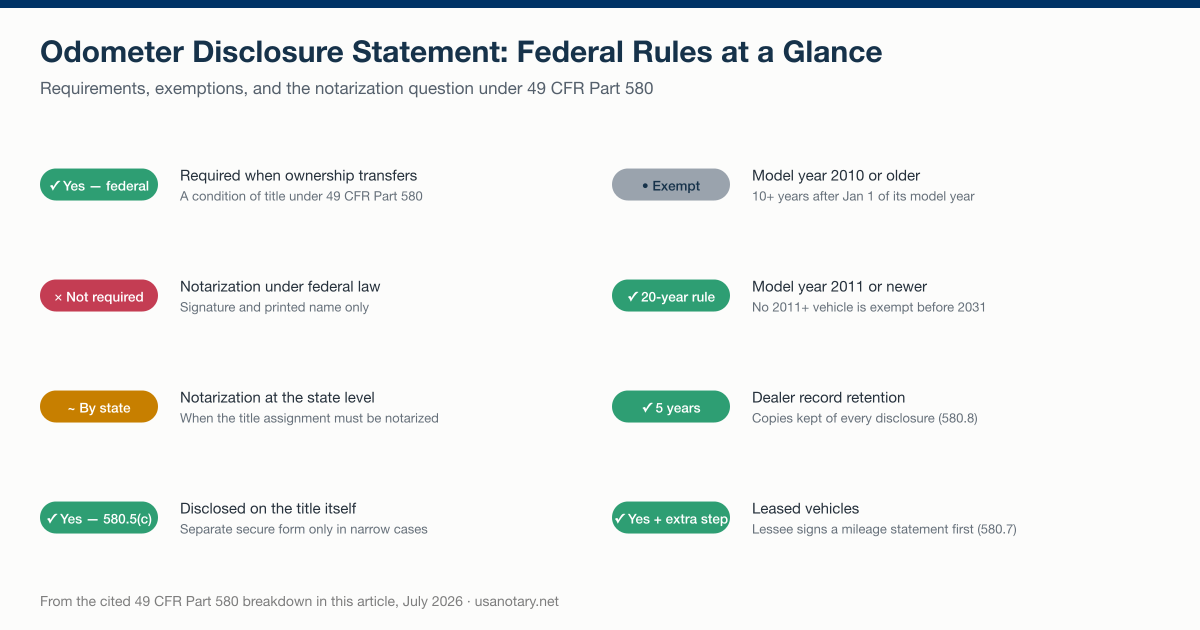
The federal odometer disclosure rules covered in this guide — requirement, notarization, exemptions, and retention under 49 CFR Part 580, July 2026.
What the federal disclosure must include
49 CFR 580.5(c) sets the exact contents. The transferor signs the disclosure and prints their name, and the statement must contain:
- The odometer reading at the time of transfer (not including tenths of miles)
- The date of transfer
- The transferor’s printed name and current address
- The transferee’s printed name and current address
- The identity of the vehicle — make, model, year, body type, and vehicle identification number (VIN)
Two more pieces complete the statement. First, a certification: the transferor certifies the reading reflects the actual mileage — or, if it doesn’t, states that the mileage exceeds the odometer’s mechanical limits or that the reading is not the actual mileage and should not be relied upon, with a warning to the buyer that a discrepancy exists (580.5(e)). Second, the form itself must carry a statement referencing federal law and warning that failure to complete the disclosure, or providing false information, may result in fines and/or imprisonment (580.5(d)). The transferee then signs the completed disclosure, prints their name, and makes a copy available to the transferor (580.5(f)) — both parties sign, which surprises sellers who expect a one-signature form.
The three mileage certifications
Every odometer disclosure statement carries exactly one of three certifications, and 49 CFR 580.5(e) defines when each applies. The transferor picks the box; the choice is a statement about what the transferor knows, not about what the odometer displays.
| Certification | 580.5(e) applies it when | What the transferor is saying |
|---|---|---|
| Actual mileage | (e)(1) — the default | The transferor certifies “that to the best of their knowledge the odometer reading reflects the actual mileage” |
| Exceeds mechanical limits | (e)(2) — the transferor knows the reading “reflects the amount of mileage in excess of the designed mechanical odometer limit” | The odometer rolled past its maximum and restarted; the true mileage is the displayed figure plus a full cycle |
| Not actual mileage | (e)(3) — the transferor knows the reading “does not reflect a valid mileage display” or differs from the mileage by more than calibration error | The reading is unreliable “and should not be relied upon”; this statement must also carry a warning notice alerting the transferee that a discrepancy exists |
Two signature rules sit alongside those certifications and settle most of the questions sellers ask. When a vehicle has more than one owner, 580.5(c) provides that “only one transferor need sign the disclosure” — co-owners do not each need to appear. And under 580.5(h), no person may sign as both transferor and transferee in the same transaction, unless §§ 580.13 or 580.14 permit it, which is the rule that stops a dealer or middleman from executing both halves of a transfer alone.
Which vehicles are exempt from odometer disclosure
49 CFR 580.17 lists the exemptions, and the age-based one changed shape when NHTSA amended Part 580 in 2019 (84 FR 52704): vehicles from model year 2011 onward stay subject to disclosure for 20 years, twice as long as the 10-year window that still governs model year 2010 and older. The regulation’s own example spells out the effect: “For vehicle transfers occurring during calendar year 2031, model year 2011 or older vehicles are exempt” — meaning no model year 2011-or-newer vehicle reaches exemption before 2031.
| Exemption (49 CFR 580.17) | Detail |
|---|---|
| Age — model year 2010 or older | Exempt when transferred at least 10 years after January 1 of its model year |
| Age — model year 2011 or newer | Exempt only when transferred at least 20 years after January 1 of its model year |
| Weight | Gross Vehicle Weight Rating over 16,000 pounds |
| Not self-propelled | Trailers and other towed vehicles |
| Government sale | Sold by the manufacturer directly to a U.S. government agency per contract specifications |
| New vehicle | Transfer of a new vehicle prior to its first retail transfer |
NHTSA states the practical rule for today’s transfers plainly: a vehicle is exempt from the written disclosure requirement if it’s 20 years old or older, or a model year 2010 vehicle or older. Everything newer needs the disclosure completed at transfer.
The exemption test, in the order the regulation applies it
49 CFR 580.17 exempts a vehicle on any one of six grounds — the tests are alternatives, not conditions that must all be met. Work down this list and stop at the first line that describes your vehicle. If none of them does, the transferor discloses the mileage.
- Is the Gross Vehicle Weight Rating over 16,000 pounds? The regulation exempts “a vehicle having a Gross Vehicle Weight Rating, as defined in § 571.3 of this title, of more than 16,000 pounds.” GVWR is printed on the door-jamb certification label — it is the rated maximum loaded weight, not what the vehicle weighs today. Exempt → stop.
- Is the vehicle self-propelled? 580.17(a)(2) exempts “a vehicle that is not self-propelled.” Travel trailers, boat trailers, utility trailers and any other towed unit fall here. Not self-propelled → exempt, stop.
- Does the model year clear the age threshold? Two different windows apply, split at model year 2011 — see the sub-section below. Past the threshold → exempt, stop.
- Did the manufacturer sell it directly to a U.S. government agency? 580.17(a)(5) exempts “a vehicle sold directly by the manufacturer to any agency of the United States in conformity with contractual specifications.” Exempt → stop.
- Is this a new vehicle’s first transfer? Under 580.17(b), a transferor of a new vehicle “prior to its first transfer for purposes other than resale” need not disclose the mileage — which is why a dealer’s first retail sale of a new car carries no odometer statement. Exempt → stop.
- None of the above? The transferor discloses the mileage and certifies it, on the title, at transfer.
One consequence is easy to miss: 580.17(c) also releases the lessor of any vehicle in that list from having to notify its lessee of the disclosure requirements of § 580.7. Exemption travels through the lease, not just the sale.
“Mileage exempt” and “odometer exempt” mean the same thing
Neither phrase appears in federal law. 49 CFR 580.17 uses one formulation — a transferor “need not disclose the vehicle’s odometer mileage” — and every shorthand in circulation points at that same rule. “Mileage exempt,” “odometer exempt,” “exempt from odometer disclosure” and a title annotated simply “EXEMPT” all describe a vehicle that satisfies one of the six grounds above.
The practical reading matters more than the wording. Exempt does not mean the mileage is unknown, disputed, or rolled back, and it is not a warning about the vehicle. Exempt means the federal disclosure requirement does not attach to this transfer, so the seller is not obliged to certify a figure. A seller may still write the mileage in voluntarily, and a buyer who wants the number should ask for it and confirm it against service records — the exemption removes the paperwork, not the odometer.
The model-year test: 2010-and-earlier vs 2011-and-later
The age exemption splits into two windows, and NHTSA doubled the newer one when it amended Part 580 in 2019 (84 FR 52704, Oct. 2, 2019):
| Model year | Exempt when transferred | The regulation’s own example |
|---|---|---|
| 2010 or earlier | At least 10 years after January 1 of the calendar year matching its model year | “For vehicle transfers occurring during calendar year 2020, model year 2010 or older vehicles are exempt” (580.17(a)(3)(ii)) |
| 2011 or later | At least 20 years after January 1 of the calendar year matching its model year | “For vehicle transfers occurring during calendar year 2031, model year 2011 or older vehicles are exempt” (580.17(a)(4)(ii)) |
Read together, the two examples describe a threshold that stopped moving. Every model year 2010-and-earlier vehicle passed its 10-year mark by 2020, so the entire pre-2011 fleet is exempt today. No model year 2011-or-newer vehicle reaches its 20-year mark before 2031. For any transfer happening now, the test collapses to a single question — model year 2010 or older, or not? — and every 2011-and-newer vehicle needs the disclosure regardless of its age or mileage.
Is the disclosure on the title or a separate form?
On the title, in almost every case. When the transferor is the person the vehicle is titled to, 580.5(c) requires the mileage to be disclosed on the physical or electronic title itself — not on a reassignment document. That’s why most states print the odometer disclosure section directly into the title’s assignment area: the federal design makes mileage a condition of the title, so the disclosure travels with it.
A separate document applies only in narrow situations the regulation itself defines:
- The vehicle has never been titled — the disclosure is executed on a separate document and incorporated when the first title issues (580.5(g)).
- The title is held by a lienholder or is lost — the transferor may disclose the mileage on a state-issued, secure power of attorney form appointing the transferee as attorney-in-fact for mileage disclosure (580.13).
- The vehicle is leased — the lessee furnishes a signed mileage statement to the lessor before the ownership transfer, and if the lessor transfers the vehicle without obtaining possession of it, the lessor may indicate that figure on the title unless the lessor has reason to believe it does not reflect the actual mileage (580.7(d)).
Those separate forms are state-issued secure documents — jurisdictions must produce them by a secure printing process that makes alteration visible (580.4). Get them from your state’s motor-vehicle agency, not from a downloaded template. If you’re working through the broader transfer, our walkthrough of how to sign over a car title covers where the odometer section sits in the signing sequence.
Does an odometer disclosure statement need to be notarized?
Federal law does not require it. The current text of 49 CFR Part 580 asks for the transferor’s signature and printed name — the regulation contains no notarization requirement anywhere in its text. If a website or form template tells you the federal odometer statement must be notarized, it is conflating two different rules.
The conflation comes from the state layer, and the precision matters:
- The federal disclosure itself: signature and printed name. No notary.
- Some states’ title assignments: a number of states require the seller’s signature on the title assignment to be notarized. Because the odometer disclosure is printed within that assignment, the disclosure ends up signed before a notary — not because federal odometer law demands it, but because the assignment does. Our guide to whether your state requires the title to be notarized covers which act applies and who must appear.
At the appointment itself, the notary verifies the signer’s identity and performs the notarial act the form calls for; the notary does not verify the odometer reading — the mileage certification is the transferor’s responsibility alone. Where a state requires the notarization and its motor-vehicle agency accepts a remotely notarized title, a signer completes the notarization online: notarize a document online for $25 per document, in a session that produces a tamper-evident notarized PDF and a digital audit trail — a useful record to sit alongside a disclosure whose entire purpose is documentation. Private sellers often handle the bill of sale in the same session.
Penalties for odometer fraud
Odometer fraud — which NHTSA defines as the disconnection, resetting, or alteration of a vehicle’s odometer with the intent to change the number of miles indicated — is a federal crime, and the disclosure statement is often the document that proves it. The form’s own required warning (fines and/or imprisonment for false information) is backed by real enforcement: NHTSA’s Office of Odometer Fraud Investigation reports its investigations resulted in more than 250 criminal convictions in more than 30 states, with prison sentences ranging from one month to 10 years, criminal fines totaling more than $2.8 million, and court-ordered restitution totaling more than $15 million.
For a buyer, the same page offers the practical defense: compare the mileage on the title with the odometer before you sign, check maintenance stickers and records, and order a vehicle history report by VIN. Suspect a large-scale scheme? NHTSA’s Vehicle Safety Hotline is 888-327-4236; individual cases go to your state’s enforcement agency.
Odometer disclosures for dealerships
Dealers execute odometer disclosures on every used-vehicle transaction that isn’t exempt — trade-ins coming in, retail units going out, and auction and wholesale transfers in between. Federal law also gives dealers two obligations private sellers don’t carry:
- Retention: dealers and distributors retain a copy of every odometer disclosure statement they issue and receive for five years, at their primary place of business, in an order that permits systematic retrieval; electronic copies must be kept in a format that cannot be altered and that indicates any attempt to alter it (580.8).
- Power-of-attorney handling: when a customer’s title sits with a lienholder — the normal case for a financed trade-in — the disclosure runs through the state’s secure power-of-attorney form (580.13), and the dealer retains those POAs for five years as well.
That volume is why dealerships treat notarization as a workflow rather than an errand. Where title paperwork requires a notary, USA Notary’s dealership workflows let staff initiate sessions for customers, handle multi-signer transactions, and run 24/7 — most sessions take 15–30 minutes, and each produces a tamper-evident notarized PDF and a digital audit trail that slots into the same five-year retention file the odometer rules already require.
This article is general information, not legal advice. Odometer disclosure and title requirements vary by state — confirm current rules with your state’s motor-vehicle agency.