
Does a car title need a notary?
Can you notarize a car title online? Sometimes. Two conditions must both hold: the notary is authorized to perform remote online notarization (RON), and the agency that processes your title accepts a remotely notarized one. On October 1, 2026 we re-read the agency pages for all 12 states that require or conditionally require a notary, and none says whether it accepts a remotely notarized title. Ask your title office before you book a session; the acceptance column in the table below shows what each agency page does and does not say.
Most states don’t require a notary at all, but seven do, and five more sometimes. We checked the titling rules of all 50 states plus Washington DC against each state’s DMV pages and statutes (July 2026), then re-verified the 12 notary-requiring rows and Montana against the agency pages on October 1, 2026, and re-read every state row against its agency pages again on October 2, 2026. The split is: 7 states require a notary for a car title transfer (Kentucky, Louisiana, North Carolina, Ohio, Oklahoma, Pennsylvania, Wyoming), 5 more require one only in specific situations (Delaware, Idaho, Rhode Island, Tennessee, Washington), and 39 jurisdictions do not require one for the title assignment itself. Titling is handled by each state’s motor-vehicle agency, so the requirement, and exactly whose signature must be notarized, is set at the state level, not federally.
The full state-by-state table is below, with each row linked to the state source it came from. Per-state citations are in the table itself; the source list at the end of this post carries the most load-bearing ones.
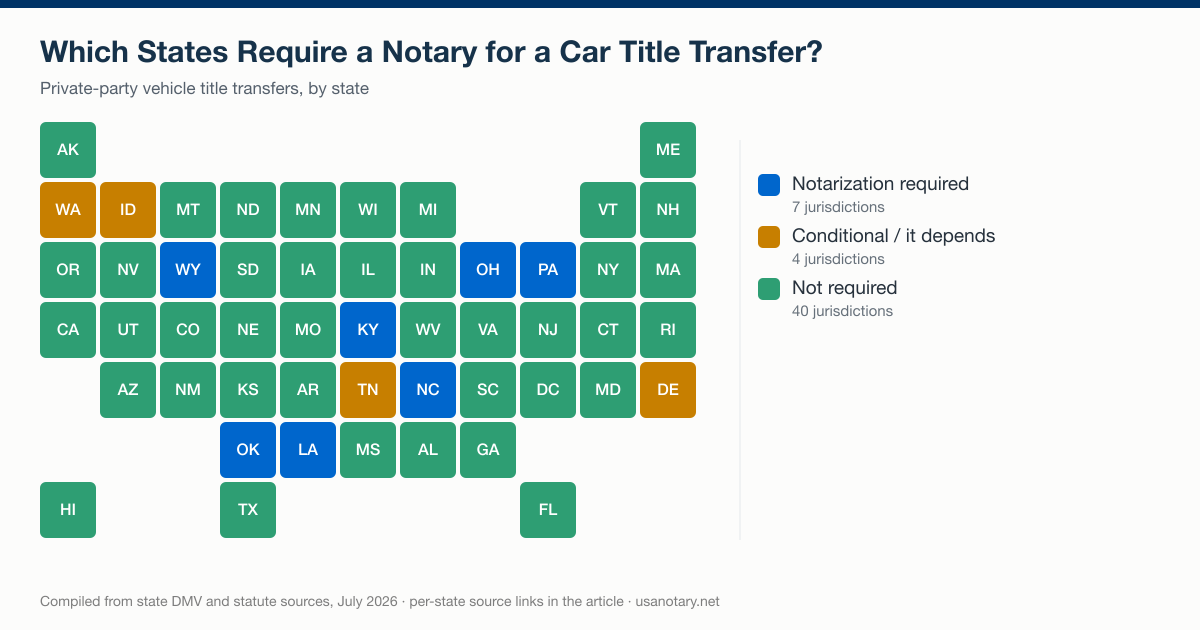
Compiled from state DMV and statute sources, July 2026; notary-requiring states re-verified October 1, 2026. 7 require a notary, 5 require one only in specific situations, 39 do not.
States that require a notary for a car title
These twelve states either require notarization of the title transfer outright or impose it in specific, common situations. If your state is here, read the detail column carefully: whose signature gets notarized varies. The last column answers the online question: does the agency say it accepts a remotely notarized title? Every entry in the table was checked on October 1, 2026; each one names the page we read, and “Agency page does not say” means exactly that, not a yes or a no.
| State | Notarization required? | Detail | Online notarization accepted? | Source |
|---|---|---|---|---|
| Delaware | Conditional | Delaware’s own titles “do not require notary.” But an out-of-state title being titled in Delaware must be notarized if the issuing state’s title form calls for a notary seal (DMV checklist MV558: “Out-of-state titles must be notarized if stated notary seal required”). | Agency page does not say (DMV title-transfer page) | state DMV |
| Idaho | Conditional | For the ordinary title assignment, ITD asks for “proper signatures releasing interest” and its page names no notary step. But the lost-title and duplicate-title forms do: ITD 3367 (duplicate only; “cannot be used to transfer ownership to a new buyer”) and ITD 3371 (affidavit of lost title) each say the form “will NOT be processed unless the applicant’s signature has been NOTARIZED,” and ITD 3369 (duplicate with ownership transfer, usable only for 2010-or-older vehicles, vehicles with no odometer, vehicles over 16,000 lb and vessels) requires the owner of record’s signature to be notarized. All three say the signature must be “either notarized or witnessed by an assessor or deputy assessor,” or the application will not be processed. ITD 3367’s instructions add that a power of attorney “must be signed by the grantor with the grantor’s signature notarized.” | Agency page does not say (ITD vehicle titles) | state DMV |
| Kentucky | Yes | “In the sale of a vehicle, the seller must sign the back of the title in the presence of a notary,” and the title-application checklist says “signatures must be notarized” (plural). | Agency page does not say (KYTC titling page) | state DMV |
| Louisiana | Yes | In a private sale, the OMV says the title must be “assigned before a notary by seller to purchaser” (see La. R.S. 32:705(B)(1)). The statute and OMV Policy 2.00 also allow the seller to sign before two witnesses, but only if the title’s Acknowledgement of Witness section is completed. Narrow exception: an authorized agent of a federally insured financial institution may witness instead of a notary when the seller is present and a lien is recorded at transfer. An Act of Donation must be signed before two witnesses and a notary. | Agency page does not say (OMV used-title page). See note 1 on 2026 Act 454. | state OMV, La. R.S. § 32:705, Louisiana OMV policy, Sec. 4 |
| North Carolina | Yes | By statute (G.S. 20-72(b)) the seller/owner’s assignment on the back of the title must be executed either in front of a person authorized to administer oaths or “in a manner that conforms to Article 40 of Chapter 66” (the NCDMV titles page does not describe that electronic route). NCDMV says the back of the title “must be completed by both the original owner and the recipient” and that a North Carolina title “must also be notarized,” without saying whose signature; the Title Application (MVR-1) also carries a notary block. Out-of-state titles follow the issuing state’s requirements. Co-owned vehicles: all signatures on required documents must be notarized. | Agency page does not say (NCDMV titles page). See note 2. | state DMV, N.C.G.S. § 20-72, NCDMV Form MVR-1 |
| Ohio | Yes | Paper title: the seller completes the assignment of ownership and has their signature(s) notarized. Electronic title (casual sale, form BMV 3770): both seller and buyer signatures must be notarized, and the form’s notary block reads “Sworn to and subscribed in my presence,” so it is a sworn statement you sign in front of the notary. Titles are issued by county Clerk of Courts offices. Dealer exception: when a licensed Ohio motor vehicle dealer is a party to the transfer, no notarization is required on the titling documents the dealer is required to provide to the clerk (R.C. 4505.063), though a clerk may still request a notarized affidavit to make corrections. | Agency page does not say (BMV titles page). See note 3. | state BMV, R.C. 4505.063 |
| Oklahoma | Yes | Paper title: a transfer generally requires “a properly assigned and notarized Oklahoma certificate of title”; 47 O.S. 1107(A) (text read on Justia’s reproduction of the Oklahoma Statutes, a secondary copy — verify against the official text) has the certificate holder’s assignment “sworn to before a notary public or some other person authorized by law to take acknowledgments,” which puts the notarized assignment on the seller (a transfer to an insurer after a total-loss settlement needs no notarized signature on the title). Titles issue electronically by default since July 1, 2025, though owners without an active lien may now request a paper title (Service Oklahoma, July 30, 2025). An electronic title transfers via Form 718 (Electronic Title Bill of Sale), which must be notarized. Service Oklahoma confirms the notary requirement was not eliminated. | Agency page does not say (electronic titles FAQ) | Service Oklahoma, Okla. Stat. tit. 47, § 1107, Service Oklahoma, e-titles |
| Pennsylvania | Yes | “The seller’s signature is required to be notarized or verified” on a Pennsylvania title. PennDOT advises the buyer and seller to “meet at a notary, tag service, or motor vehicle dealer to ensure the title application is completed correctly.” | Agency page does not say (PennDOT page) | state DMV |
| Rhode Island | Conditional | The RI DMV FAQ has the seller sign the back of the title as “seller” and the buyer as “buyer,” with the mileage recorded, and mentions no notary for the title assignment. The notary condition is on the registration application: if two owners are on the title and one is absent at registration, “signature of the absent party must be notarized on Application for Registration” (RI DMV New Registration page), and the TR-1 form itself says the owner’s signature must be notarized if not present during the transaction (Rhode Island also uses the TR-1 to issue the title). | Agency page does not say (DMV new-registration page) | state DMV, RI DMV FAQ, RI Form TR-1, RI DMV, titles |
| Tennessee | Conditional | For a current resident’s used-vehicle title, Tennessee’s Revenue Dept. lists “A valid certificate of title properly assigned” and lists no notary (VT-1), but Tennessee “complies with the notary requirements for out of state titles”: an incoming title from a notary state (e.g., Pennsylvania) must be notarized to title in TN. The sole exception is Kentucky. (Revenue article VT-2, dated April 29, 2021.) | Agency page does not say (Revenue article VT-2) | state DOR |
| Washington | Conditional | The notary falls on the buyer’s side: all new registered owners must sign the Vehicle Title Application either before a notary public or in person before a licensing agent at a vehicle licensing office, who can certify the signature (the form says no notary is needed in that case). The seller signs over the current title (“signed by all owners”) with no notary stated. If the title is lost, the seller’s Affidavit of Loss/Release of Interest must be notarized or certified by a licensing agent. | Agency page does not say (DOL buy-and-register page) | state DOL |
| Wyoming | Yes | Seller(s): W.S. 31-2-104(a) (Wyoming Legislature’s compiled statutes) says the owner’s assignment is signed “before a notarial officer.” Laramie County: all persons named on a Wyoming title “must sign in the presence of a notary to sell a vehicle,” and for titles issued on or after Jan 1, 2020 one notarized signature suffices when owners are joined by “or” (non-JTWROS); Teton County says the Wyoming title “needs to be signed in front of a notary” and, for a purchase from an individual, at least one buyer must sign the purchaser’s application before a notary, so confirm with your county clerk. Titling is county-run, dealer MSO assignments must also be notarized, and a notarized bill of sale may also be required for titling (Sweetwater County Treasurer FAQ: “a notarized bill of sale maybe required” for “titling and other purposes”). SF0025 (2025) will let owners sign electronically instead, but “this act is effective July 1, 2027.” | Agency page does not say (Laramie County clerk) | county clerk · Natrona Co., Teton County, WY title page, Sweetwater Co. motor vehicle FAQ, Park County Treasurer, Wyo. Enrolled Act SF0025 |
Notes on the acceptance column.
- Louisiana. Act 454 of the 2026 Regular Session (Senate Bill 72) provides that the Office of Motor Vehicles “shall accept electronic records and electronic signatures for the documents and records identified” in the Act, which include titling documents and odometer disclosure forms. The enrolled text makes that section effective on January 1, 2028, or earlier on the date OMV certifies a fully operational statewide electronic lien, titling and registration system. The enrolled passages we read do not say that OMV accepts a remotely notarized title, and the only remote-notarization reference we found concerns powers of attorney. The OMV used-title page still says the title is “assigned before a notary by seller to purchaser.”
- North Carolina. The NCDMV page is silent. Separately, the North Carolina Secretary of State’s notary FAQ says Emergency Video Notarizations “have been extended to 12:01 AM on July 1, 2027 or until the first license is issued for Remote Electronic Notarizations,” and our state-by-state RON review classifies North Carolina as not yet operational under its own law.
- Ohio. The BMV page does not say whether Clerk of Courts title offices accept an online notarization of a title or of form BMV 3770. A related statute, R.C. 147.591(B)(2), says clerks of courts of record and deputy registrars must accept a digital copy of a document sworn before a notary, “including an online notarization,” “for purposes of approval, transfer, and recording.” It does not name vehicle titles, so confirm with your county title office. R.C. 4505.06 separately says a title application “shall be sworn to before a notary public or other officer empowered to administer oaths” and that in a casual sale the buyer fills out and swears the application; the BMV page does not state whether a paper-title buyer’s oath is taken at the title office or beforehand.
States where a car title doesn’t need a notary
The remaining 39 jurisdictions — 38 states plus Washington DC — do not require notarization of the title assignment for a standard private-party transfer. Signatures alone complete the assignment. The detail column notes the adjacent documents that do take a notary in each state (gift affidavits, lien releases, out-of-state edge cases), because those are the situations that catch people off guard.
| State | Detail | Source |
|---|---|---|
| Alabama | The Department of Revenue states flatly that assignment of an MSO or title need not be notarized (the FAQ’s page metadata shows a last update of May 16, 2022). Rebuilt vehicles only: ALDOR’s rebuilt-inspection FAQ says “major components require a notarized bill of sale” for replaced parts. | Alabama DOR · rebuilt-inspection FAQ |
| Alaska | Seller(s) sign the title assignment; a bill of sale is not valid for ownership transfer, though the DMV says it is a good idea to have one for your records. A notarized power of attorney (Alaska DMV Form 847) is required when someone signs on the owner’s behalf. | Alaska DMV, Alaska DMV, new vehicle, Alaska DMV Form 847 |
| Arizona | The MVD checklist requires “A signed vehicle title or Title Transfer Bill of Sale” (Arizona vehicles only), and ADOT’s seller instructions say to sign the back of the title and give it to the buyer, without mentioning a notary. The Form 38-1306 bill of sale, the alternative to the signed title, carries an “Acknowledged before me” block for a notary or MVD agent, and a 2022 ADOT notice says that if a title transfer bill of sale is provided it should be “signed and notarized.” A 2021 ADOT notice adds that for a vehicle previously titled out of state, the seller can sign the back of the title and have the signature notarized.* | Arizona DOT · Form 38-1306, ADOT MVD, selling a vehicle, ADOT MVD, used vehicle 2022, ADOT MVD, be prepared |
| Arkansas | DFA says “the seller and buyer must sign and print their names in the appropriate sections of the title assignment,” and its registration checklist (title or MSO, bill of sale, lien contract, odometer statement, proof of assessment, proof of property taxes paid, proof of insurance) lists no notarized item; its bill of sale/odometer disclosure, vehicle registration application and title-assignment authorization forms have signature and printed-name fields but no notary block, though its Affidavit of Alteration does. DFA publishes no explicit “no notary” statement, and A.C.A. 27-14-705(a)(2) mentions an acknowledgment that appears limited to an applicant who signs with a mark, so confirm with a Revenue Office if in doubt. | Arkansas DFA, Ark. DFA, law changes, Ark. DFA, MV forms, Arkansas odometer statement, Arkansas DFA registration form, Arkansas Form ACI-7416, Arkansas alteration affidavit, Ark. Code § 27-14-705 |
| California | For a standard private sale, the DMV’s title-transfer page lists “Buyer and seller/lienholder signatures” and no notary; its registration manual says a bill of sale is “not required to be notarized or witnessed” and can even substitute for the owner’s release signature. Lost title: section 5 of the REG 227 needs a notary if the vehicle has a legal owner/lienholder. | California DMV, California DMV, title transfers |
| Colorado | Seller and buyer sign and print in the assignment on the back of the title (all owners must sign if multiple); the DMV’s private-sale and title-endorsement instructions do not mention notarization, and Gilpin County says new Colorado titles do not require a notary. Older titles may require one: the state’s form DR 2445 “exempts notarization requirement ONLY,” and Gilpin County accepts that Statement of Transfer in lieu of notarization. Exception: titling an off-highway vehicle 25+ years old with no proof of ownership requires a notarized bill of sale and certified VIN inspection.* | Colorado DMV, Colorado DMV, title guide, Colorado Form DR 2445, Gilpin County, buying a vehicle |
| Connecticut | Seller completes and signs the reverse of the title and gives the buyer a bill of sale (Form H-31, which has a seller signature line, or self-drafted — the DMV’s pages differ on whether a self-drafted one also needs the buyer’s signature); the DMV pages and Form H-31 mention no notary. A title is not required for a vehicle older than 20 model years (CGS 14-166(b)), though the owner may request one. | Connecticut DMV, CT DMV, bill of sale, CT Form H-31, Conn. Gen. Stat. § 14-166 |
| District of Columbia | The DC DMV titling checklist (title/MCO, application “complete with appropriate signatures,” bill of sale, odometer verification) lists no notarization anywhere. A bill of sale is required; the checklist does not call for it to be notarized. | DC DMV, DC DMV, vehicle titles |
| Florida | The seller completes the Transfer of Title by Seller section; the buyer’s application (HSMV 82040) is signed under penalties of perjury, and FLHSMV’s seller checklist lists no notarization step. A Florida notary may perform the VIN and odometer verification FLHSMV requires when the vehicle was not previously titled in Florida (a licensed Florida dealer, law enforcement officer or FLHSMV compliance examiner may also do it). FLHSMV recommends notarizing the bill of sale you keep as a receipt but does not say it is required; the Notice of Sale (HSMV 82050) has no notary block. Electronic titles require buyer and seller in person at a service center with photo ID. | Florida HSMV, FLHSMV Form 82040, Florida Form 82050 |
| Georgia | Seller(s) and buyer print and sign the title assignment in blue or black ink (O.C.G.A. 40-3-32(a), read on a Justia copy, has the owner execute the assignment); no notary or witness in the DOR’s instructions. Delivering or accepting a title assigned in blank is a misdemeanor (O.C.G.A. 40-3-91(c)). | Georgia DOR |
| Hawaii | Honolulu County: notarizing the seller’s title signature is optional, but the city says it “will prevent rejection for irregular signature(s)”; Hawaii County recommends completing Section A before a notary (or accompanying the buyer), and the Maui and Kauai seller pages direct owners to sign Section A. In Honolulu, for out-of-county and out-of-state transfers, a notarized bill of sale must be provided when the title isn’t released by the recorded owner, and a duplicate-title application submitted by mail needs notarization. Titling is county-run — confirm with your county.* | Honolulu County, Honolulu DCS, title info, Hawaii County VRL, transfer, Maui County, seller page, Kauai MVL, ownership transfer |
| Illinois | The Secretary of State’s FAQ answers “Is the Illinois title required to be notarized? No.” The seller signs the title over on the back, and the buyer files the VSD 190 application and tax form RUT-50. ILSOS’s buying-and-selling guide advises sellers to prepare a bill of sale with the date of sale and price paid and keep a copy; neither that guide nor the FAQ mentions notarizing it. | Illinois SOS, Illinois SOS, used vehicle guide |
| Indiana | The seller completes both the seller and purchaser sections of the title in their entirety; the BMV’s buying-and-selling page and seller FAQ list no notary step for the title. The bill of sale (State Form 44237) “is not required to be notarized or signed under penalties for perjury.” (IC 9-17-2-4 uses the phrase “sworn bill of sale” for a vehicle brought into Indiana from another state for which no certificate of title has previously been issued, but the BMV bill-of-sale page says notarization is not required.) | Indiana BMV, Indiana BMV, buying/selling, Indiana BMV FAQ, seller title, Ind. Code § 9-17-2-4 |
| Iowa | Seller assigns the title by “signing the reverse side as seller” with odometer and damage disclosures; no notary step in the DOT checklist, though the county treasurer may accept a notarized affidavit of correction for an error or alteration (Iowa Code § 321.23A, which excludes odometer certification statements; Iowa Admin. Code 761-400.3(3)). DOT says a bill of sale is still required when the title lacks a Transfer/Sale Date section; the county treasurers’ template DOT links has a “For notary use if applicable” block and says errors or alterations “may require this form to be notarized.” | Iowa DOT, Iowa bill of sale form, Iowa Admin. Code 761—400.3, Iowa Code § 321.23A |
| Kansas | Explicit: Kansas “does not require most title assignments, title applications and bills of sale completed within Kansas to be notarized” (the Division reserves the right in unusual circumstances). Lien releases, Kansas lienholder consents and the lienholder’s TR-42 portion DO require notarization. A required bill of sale (TR-12, page 2) is a price affidavit under penalty of perjury, not a notarized form; for vehicles sold by or purchased from a Kansas resident, only antique vehicles (35+ years) and trailers of 2,000 lb or less (operating weight) can be sold on a bill of sale instead of an assigned title. | Kansas DOR, Kansas Form TR-12 |
| Maine | A private sale requires a signed title (vehicles 25 model years and newer) and a signed bill of sale; the official bill-of-sale form has no notary block. | Maine BMV |
| Maryland | The MVA tells sellers to complete the back of the title with the buyer’s name and address, sale price, odometer reading, date of sale, and the owner’s signature (all owners unless the title shows “OR”); a bill of sale is a suggested extra that some buyers may need. HB 251 repealed, effective October 1, 2026, the statutory notarized-bill-of-sale route tied to a purchase price $500 or more below retail value, and the MVA’s excise-tax page does not describe a notarized VR-181. The MVA’s vehicle-after-death page still says estate administrators/executors and buyers must sign and notarize VR-181 (see the Maryland paragraph below).* | Maryland MVA · excise tax · estate sales |
| Massachusetts | Buyer(s) and seller(s) sign, hand-print their names and date the transfer document; the RMV’s instructions list no notarization step. Separately, the registration and title application is completed, stamped, and signed by a licensed MA insurance agent. | Massachusetts RMV, Mass. RMV private sale checklist, Mass.gov private party sales |
| Michigan | Title is “filled out and signed by the purchasers and sellers”; the Secretary of State’s title-transfer page does not mention notarization. Michigan also offers an online transfer for one individual seller and one individual buyer: the seller completes and signs the seller’s portion and the buyer uploads the front and back of the filled-out title. | Michigan SOS |
| Minnesota | Sellers and buyers complete and sign the title’s assignment of ownership section (including the sale date, odometer and damage disclosures), and buyers complete and sign the application area. The only notarization DVS mentions for an ordinary titled-vehicle sale is on a lien release: a lien release card or notarized lien release must accompany the transfer when a lien is listed on the title. | Minnesota DVS, Minnesota DVS, title transfer |
| Mississippi | Seller completes all title-assignment sections except the buyer’s printed name and signature; buyer prints and signs. The Department of Revenue lists a notarized bill of sale among the documents required to title an imported vehicle; its transfer instructions do not mention notarization. | Mississippi DOR, Mississippi DOR motor vehicle FAQ |
| Missouri | Explicit: title signatures “do not need to be notarized.” Titling a rebuilt (prior-salvage) vehicle requires notarized bills of sale for its major component parts (Form 4698). | Missouri DOR, Missouri Form 1957, Missouri DOR, notice of sale |
| Montana | Requirement eliminated effective October 1, 2025: HB 165 struck MCA 61-3-220(2), which had required the transferor’s title signature to be acknowledged before a notary. MVD says titles produced before October 1 are accepted without the notary section completed. Sources published before late 2025 saying Montana requires a notarized title are outdated. One bill-of-sale trigger remains: the current MV24 says a notary is required when it is used with an Electronic Records Transfer or an MV10 bond title.* | Montana SOS · MVD FAQ · MV24 |
| Nebraska | All owners on the title sign the seller’s section; buyer signs the purchaser’s section. The seller must give the buyer a bill of sale or Revenue Form 6; no Nebraska agency page we found says either must be notarized, but the DMV’s optional downloadable Bill of Sale form (rev. 1/2014) carries notary or county-official blocks. The only form the DMV transfer page text says must be notarized is the decedent’s-vehicle transfer affidavit. | Nebraska DMV, Nebraska bill of sale, Nebraska purchaser’s affidavit, Nebraska salvage affidavit, Nebraska Form 6 |
| Nevada | DMV tells the seller to “Sign the title exactly as your name appears now”; the Seller’s Guide has the seller complete a bill of sale (VP-104) “for your records,” and DMV says a bill of sale by itself is “not an acceptable proof of ownership for registration.” A notary (or an authorized DMV representative) appears on side documents such as the VP-136 power of attorney and the duplicate-title application (VP-012); NRS 482.426 requires the details of an out-of-state title that are missing from the endorsed title to be in a statement “signed and acknowledged by the seller and the buyer.” | Nevada DMV, Nevada DMV seller’s guide, Form VP-104, Form VP-012, Form VP-136, NRS 482.426 |
| New Hampshire | The title “shall be signed over to the buyer at the time of the sale” unless the vehicle is title exempt (chiefly model year 1999 or older, plus other listed categories such as boats and trailers under 3,001 pounds); title-exempt vehicles use a bill of sale whose statutory contents (RSA 261:148, III) include no notarization element. A notary comes up in two documented title situations: a notarized translation of a non-English out-of-state title (RSA 261:4, III(a)) and a notarized statement asking that the new title be mailed to a third party instead of the owner or lienholder. | New Hampshire DMV, N.H. RSA 261:148, N.H. RSA 261:4, NH DMV, apply for title, NH DMV, exempt vehicles |
| New Jersey | Seller signs the seller’s section of the title and gives it to the buyer with a bill of sale; buyer signs the buyer’s section. A notarized Power of Attorney is needed when someone signs for another person. Titling a vehicle from a state that doesn’t issue titles requires a notarized seller-to-buyer statement signed by both parties first. | New Jersey MVC |
| New Mexico | The former owner signs the Assignment of Title; MVD’s used-vehicle document list does not call for a notary on it. Notarization appears elsewhere: a Power of Attorney, an optional notarized lien release on lienholder letterhead (MVD manual, rev. 2018), and the Affidavit of Gift for a gifted vehicle, notarized by both donor and recipient.* | New Mexico MVD, NM MVD, used vehicles, NM MVD, vehicle titles |
| New York | Buyer and seller complete the transfer section on the back of the title in most sales (VTL 2113(a) has the owner execute the assignment on the certificate). DMV has the seller complete and sign that section and sign a bill of sale (MV-912), or provide other acceptable proofs of ownership; the buyer signs the MV-912 too. An acceptable bill of sale lists the year and make, VIN, sale date, price and the buyer’s and seller’s names and signatures, and the MV-912 form has no notary block. | New York DMV, NY DMV Form MV-912, N.Y. VTL § 2113 |
| North Dakota | The title assignment (SFN 2875) carries no notary block — the seller’s signature and, for model year 2011 or newer, the buyer’s, plus dates, price and odometer. Titling an untitled vehicle uses a notarized SFN 2888 and a notarized SFN 2903 Vehicle Statement of Ownership; for vehicles over 40 years old NDDOT’s current process accepts a notarized SFN 62624 Affidavit of Ownership, or a notarized bill of sale together with SFN 62624. | North Dakota DOT, NDDOT SFN 2888, NDDOT SFN 2903, NDDOT registration manual, NDDOT 40+ year title process, SFN 62624 |
| Oregon | The seller simply signs and dates “either the back of the title or a Bill of Sale” (the buyer signs the odometer disclosure where one is required); the DMV’s sale and titling pages name no notary for an ordinary sale. | Oregon DMV, Oregon DMV titling |
| South Carolina | The title assignment lists what’s needed — buyer’s name and address, signatures, price, odometer, date — with no notary mentioned. SCDMV’s two pages differ on whether a bill of sale is always needed or only when the title has no sales-price field; neither mentions a notary, and SCDMV’s bill-of-sale Form 4031 has signature lines and no notary block. | South Carolina DMV, SCDMV titles, SCDMV Form 4031 |
| South Dakota | Ownership transfers “by an assignment on the reverse side of the certificate of title”; the DOR procedures manual (8-30-2016) has no notary step for the transfer (its one notarization mention is a name-change affidavit). A separate bill of sale will not be accepted in place of the assigned title, but SDCL 32-5B-4(3) has the purchaser and seller of a used vehicle (non-dealer sale) submit a bill of sale approved and supplied by the secretary; no notarization is stated. | South Dakota DOR, SDCL § 32-5B-4 |
| Texas | A properly signed title plus signed Form 130-U — no notary. The Gift Affidavit (Form 14-317) must be sworn before a notary public or a county tax office official or employee (its instructions also mention an online notary authorized by the Texas Secretary of State); the heirship affidavit (VTR-262) must always be notarized.* | Texas DMV · Form 14-317 |
| Utah | The seller signs where necessary to release ownership; no notary is needed to sign off on a title, and most person-to-person transfers of Utah titles can be started online. | Utah DMV, Utah DMV, buyer/seller duties, Utah DMV, UPP transfers |
| Vermont | For a previously titled vehicle, the DMV title guide lists the assigned title (liens released), form VD-119 and, for model year 2011+, an odometer statement; it lists no notary. The one document it says must be signed before a notary: the VT-025 Affidavit of Non-Titled Vehicle, for vehicles with no NMVTIS record. A signed bill of sale (VT-005, no notary block) is needed in several cases. | Vermont DMV, Form VT-025, Vermont Form VT-005, Form VD-119i, Form VT-020 |
| Virginia | Seller(s) and buyer sign Section A of the title with odometer, date, and price; DMV’s steps list no notary. The exception: for a vehicle less than 5 years old (by model year), DMV requires a notarized SUT-1A affidavit when the price is not within $1,500 of the NADA trade-in value. Virginia offers online e-title transfer between individual residents for eligible passenger vehicles with no liens.* | Virginia DMV, Virginia DMV, sales and use tax, Form SUT 1A, Virginia DMV, e-titling |
| West Virginia | Both parties sign the back of the title; the DMV lists no notary step for the title itself. A notarized bill of sale (DMV-7-TR) must accompany the application when the price is below 50% of NADA Clean Loan value (otherwise tax is assessed on the full book value; private-sale vehicles two years old or newer are taxed on book value regardless), and the gift affidavit (DMV-5-TR) is sworn before a notary unless a WV-titled vehicle moves strictly between parent and child or between spouses.* | West Virginia DMV, WV Form DMV-7-TR, WV Form DMV-5-TR |
| Wisconsin | Seller(s) sign and date the title with odometer, brand, and price disclosures; the bill of sale form (MV2928) “is provided for your convenience, it is not a required form.” | Wisconsin DOT |
The asterisks above mark rows with a nuance worth knowing:
- Arizona. The notary block is on the Form 38-1306 title-transfer bill of sale, which is used in place of a signed title; the signed title itself needs no notary.
- Colorado. Form DR 2445 (dated 2005) is the state’s statement in lieu of notarizing a legacy title; the current DMV private-sale and title pages do not mention it, so confirm with your county office if your title stock shows a notary block.
- Hawaii. Titling is county-run; the row reflects the City & County of Honolulu, with the Hawaii County, Maui and Kauai seller pages as cross-checks.
- Maryland. The notarized-bill-of-sale rule changed on October 1, 2026. The MVA’s excise-tax page does not describe a notarized VR-181, but its vehicle-after-death page still does for estate sales, so confirm with the MVA before relying on either version.
- Montana. The title change is recent enough that most older guides still get it wrong, and the MV24 bill of sale keeps a notary condition for electronic-record and bond-title transfers.
- New Mexico. Gifts use a notarized affidavit even though the sale itself needs no notary.
- Texas. Gift and heirship transfers use notarized affidavits even though the sale itself needs no notary; those affidavits are among the most common car-related notarizations we see.
- Virginia. The DMV’s sales-and-use-tax page calls for a notarized SUT-1A affidavit when a vehicle less than five model years old sells for a price that is not within $1,500 of its NADA trade-in value; the page’s wording is ambiguous, so confirm with the DMV. The signatures on the title assignment itself are not notarized in the DMV’s steps.
- West Virginia. The gift affidavit is always sworn before a notary except for WV-titled parent/child and spouse transfers.
Montana’s 2025 change: a live example of why you check
Montana is a useful reminder that these rules are not fixed. The 69th Montana Legislature passed House Bill 165, amending 61-3-220(2), MCA, which had required a transferor’s title signature to be “acknowledged before the county treasurer… an employee or authorized agent of the department, or a notary public.” Per the Montana Secretary of State, that subsection “has been stricken, subsequently eliminating the need to notarize a title transfer,” effective October 1, 2025. A guide that assumed Montana still required a notary would now be wrong — which is exactly why this table cites the current state source in every row, not a copy of last year’s advice. We re-read the Secretary of State’s page on October 1, 2026, and it still carries the same notice.
The staleness problem is not hypothetical. As of September 30, 2026, the car-title page of a major online-notarization platform still lists Montana — and even Arizona, whose MVD checklist asks only for “a signed vehicle title” — among the states that require title notarization. Checking your own state’s current DMV page (or the linked row above) beats trusting any aggregated list, including this one, a year from now.
Maryland is a second 2026 example, and it touches the bill of sale rather than the title. House Bill 251 (Chapter 118, approved April 14, 2026) amends Transportation Article § 13-809, strikes the clause that let a buyer prove a purchase price $500 or more below retail value with a notarized bill of sale, and strikes the matching notarized-bill-of-sale submission requirement; the Act “shall take effect October 1, 2026,” per the enrolled chapter on the Maryland General Assembly site. The MVA’s excise-tax page, which we re-read on October 2, 2026, does not describe a notarized Bill of Sale (VR-181); it says that if the reported price is $500 lower than the valuation in the national used-car publication, “additional documentation may be required.” The agency’s other pages can lag, though: the MVA’s vehicle-after-death page still says “All estate administrators/executors and buyers must sign and notarize a Bill of Sale (VR-181)” when an estate sells a vehicle, so confirm with the MVA before relying on the revised form for an estate sale.
Who signs, and what the notary actually does
Where notarization is required, it’s usually the seller (the person releasing the title) — that’s the rule in Kentucky, Louisiana, Pennsylvania, Wyoming, and on Ohio paper titles. Ohio’s electronic-title form (BMV 3770) involves both parties, North Carolina’s rules are less clear about whose signature (the statute names the seller, and the buyer’s title application carries a notary block), and Washington runs the other direction entirely: it’s the buyer’s title application that gets notarized there. Everyone whose signature is being notarized must personally appear before the notary — there is no notarizing a title for someone who isn’t there. If another person will sign on an owner’s behalf, start with our vehicle power of attorney guide.
The notary’s job is narrow but important: confirm the identity of each signer and perform the notarial act the form calls for. The notary does not verify the odometer reading, the sale price, or that the vehicle is as described. Those facts are the signer’s responsibility; the notary certifies the act of signing, not the truth of the sale. That still leaves the seller to fill the mileage box correctly before anyone signs — and if the vehicle has aged past the federal disclosure window, the entry changes: our guide covers what goes in the mileage box when the odometer is exempt.
Can you notarize a title without the buyer there?
Usually, yes — the notary requirement attaches to specific signatures, not to the transaction as a whole. In Kentucky, Pennsylvania, and Wyoming, and on Ohio paper titles, the notarized signature is the seller’s assignment, so the buyer has no role at the notarization at all. Even where both parties’ signatures are notarized, the sessions can be separate: on Ohio’s electronic-title form BMV 3770, the seller completes and notarizes page 1, then hands both pages to the buyer, who has page 2 notarized before presenting the form at a Clerk of Courts title office. Washington runs the opposite direction — it’s the buyer’s title application that gets notarized, not the seller’s title. Louisiana is the one to double-check: the title is “assigned before a notary by seller to purchaser,” so ask your notary or the OMV whether both parties must attend your specific transfer. And when buyer and seller are in different cities, an online notarization session sidesteps the scheduling problem entirely — each signer appears on live video from wherever they are, where the state’s title office accepts an online-notarized transfer.
Will the DMV notarize your title?
Generally no — the motor-vehicle agency is where you file a title, not where you get it notarized, and the states covered above expect the notarization to be done before you arrive at the counter. Ohio is the clearest illustration: on electronic-title form BMV 3770 the seller notarizes page 1 and the buyer notarizes page 2, and only then is the completed form presented at a Clerk of Courts title office. PennDOT likewise points buyers and sellers to “a notary, tag service, or motor vehicle dealer” rather than to a PennDOT counter.
The useful exception is different from what people expect: in two states an official at the counter can take the signature that would otherwise need an outside notary, so you do not have to find one first.
| State | What the counter can do | Effect |
|---|---|---|
| Washington | The buyer signs the title application in front of a licensing agent at a vehicle licensing office (DOL: an agent “who can notarize it”) | No separate notary needed — a notary is required only if the application is signed elsewhere |
| Idaho | A duplicate-title applicant has an assessor or deputy assessor witness the signature (ITD directs applicants to their county assessor’s motor vehicle office) | An assessor or deputy assessor’s witnessing is accepted in place of a notary on the duplicate-title application |
| Ohio | Clerk of Courts title offices issue the title | Does not notarize — both BMV 3770 pages are notarized before you present them |
| Pennsylvania | PennDOT directs you to a notary, tag service, or dealer | Tag services combine the notarization and the filing in one stop |
So the practical question is not “does my DMV have a notary” but “does my state offer a counter signature that saves me the outside notary.” Where it does not — and in the seven states that require notarization outright — you still need a notary before you file, which is why the tag-service and online notarization routes exist. Call ahead either way: staffing and appointment rules are set locally, and no state guarantees a notary is available at a title counter.
How much does it cost to notarize a car title?
The stamp itself is cheap — many states cap what a notary may charge per notarial act. The National Notary Association’s 2026 fees-by-state chart lists maximum acknowledgment fees of $15 in California and Colorado, $10 in Connecticut, and $5 in Delaware, and among the states with a set maximum, only Rhode Island ($25) is above $15; 11 states, including Kentucky, Louisiana, and Tennessee, list no set fee. What varies is everything around the stamp: travel fees for a mobile notary, service fees at tag agencies, and your time finding someone during business hours.
| Option | Typical cost | When it fits |
|---|---|---|
| Walk-in notary | Capped in many states (e.g., $15 maximum in California, per the NNA chart) | You’re near one during business hours and the required signer can attend |
| Tag service / titling agent (common in PA, LA, OK) | Notary fee plus the agency’s own service fees | You want the notarization and the whole transfer filed in one stop |
| State counter (WA licensing office; ID assessor or deputy assessor) | Ask the office; the pages we read do not publish a fee | Washington buyers signing the title application; Idaho duplicate-title applicants whose signature an assessor or deputy assessor witnesses |
| Online notarization (RON) | $25 per document on USA Notary | Signers in different places, evenings and weekends, or no notary nearby — where your title office accepts it |
Acknowledgment vs. verification: which act your title uses
This is the detail most guides skip, and it changes what happens at the appointment. There are two common notarial acts on title paperwork:
- Acknowledgment — the signer acknowledges signing the title. You can sign beforehand and then confirm to the notary that the signature is yours.
- Verification on oath or affirmation (a jurat) — the signer swears the contents are true and signs in front of the notary. You cannot pre-sign; you sign during the session, under oath.
Which one applies is set by the wording on the form. The Pennsylvania Association of Notaries reports that “the notarial act required most often on motor vehicle forms is the verification on oath or affirmation,” because the transfer and title-application statements are written as sworn statements. Its guidance: the customer “must appear in person, be properly identified, swear or affirm that the statement he or she is signing is true, and sign the statement in your presence.” Practical upshot — don’t sign the title until the notary tells you to, because a jurat requires signing in the notary’s presence.
Can you notarize a car title online?
Two things both have to be true. Your notary must be able to perform a remote online notarization (RON) for your signature, and your titling agency must accept a remotely notarized title. The first condition is a notary-law question. Consumer-side, remote online notarization is available to signers in all 50 states, and the electronic format has federal backing: under the ESIGN Act (15 U.S.C. § 7001), for a transaction in or affecting interstate commerce, “a signature, contract, or other record relating to such transaction may not be denied legal effect, validity, or enforceability solely because it is in electronic form.” The Revised Uniform Law on Notarial Acts model act likewise “authorizes remote online notarization and remote ink notarization through the use of audio-visual recording and identity-proofing technology”; each state’s own statute sets the details.
The second condition is the one that decides the answer, and it is acceptance, not validity. A title office can decline a format even when the notarization itself is valid. For the 12 states in the table above, we looked for an agency page or statute that says yes or no, and on October 1, 2026 the result was the same in every state: the agency page does not say. In Louisiana, Ohio and North Carolina there is adjacent law or a notice (notes 1 to 3 under the table), but none of it names a remotely notarized title. Absence of a statement is not a refusal, and it is not a promise. It means a signer cannot rely on a published rule in either direction.
| If your title falls under… | Ask the title office this before you book |
|---|---|
| A state that requires a notary (KY, LA, NC, OH, OK, PA, WY) | “Do you accept the title assignment, or form BMV 3770 / Form 718 where they apply, notarized remotely?” Get the answer in writing. |
| A conditional state (DE, ID, RI, TN, WA) | Ask whether the document that needs the notary (an out-of-state title, a duplicate-title application, the buyer’s title application, or an absent co-owner’s registration application) can be notarized remotely. |
| One of the 39 jurisdictions with no notary requirement | Nothing to notarize on the title assignment itself; check the adjacent documents in the detail column (gift affidavits, lien releases). |
If the office confirms, you can notarize your title over live video instead of driving to an office. Sessions run $25 per document, typically take 15–30 minutes, and are available 24/7. If you’re unsure it’s permitted, our is online notarization legal explainer walks through the state-by-state picture. Dealerships, fleet operators, and title services handling transfer volume can use our automotive notary services instead of sending customers to hunt for a notary.
What you need to notarize a title
- Check your state’s row in the tables above — is notarization required, and for whose signature?
- Identify the act — acknowledgment or verification? If it’s a verification, don’t pre-sign.
- Bring a valid government photo ID — the notary must positively identify every signer.
- Have the title ready (unsigned if the notary will witness the signature).
- Confirm online acceptance with your titling office first if you plan to use RON (the table above shows no state agency page that says it accepts one), then have a camera-equipped device.
New to notarization generally? The steps to get any document notarized apply to titles too, and how the online process works covers the video session step-by-step. Selling privately? A bill of sale for a used vehicle is often signed alongside the title — several states in the tables above notarize the bill of sale rather than the title — and if the transaction also moves real estate, the same appear-in-person rules apply when you notarize a property deed.
This page covers who must notarize a title and whether the notarization can be online. For the signing steps themselves, see how to sign over a car title; for dealer paperwork, the dealer reassignment form guide; and for what happens when a car is resold without ever being titled, title jumping.