
Does a bill of sale for a car need to be notarized?
In most states, no — a bill of sale for a car with notary involvement is the exception, not the rule. We checked all 50 states plus DC against their DMV pages and statutes (July 2026): no state requires a notarized bill of sale in every private car sale, 14 states require one in specific situations, and 37 jurisdictions never require it. (Maryland moved into the second group on October 1, 2026; see below.) The conditional triggers are narrow but real — Louisiana wants a notarized bill of sale or notarized title assignment in used-vehicle titling, West Virginia demands one when the price falls below half of book value, Oklahoma notarizes the bill of sale that transfers its electronic titles, Tennessee requires a notarized seller signature when a bill of sale replaces the title assignment on a lien-held title, and Montana’s MV24 calls for a notary on its electronic-records-transfer and bond-title routes.
So the honest answer has two parts: check your state in the table below to see whether notarization is required, and consider notarizing regardless for a higher-value sale — a notarized bill of sale proves the signature is genuine even where no agency demands it. Each row links to the DMV or statute source it came from.
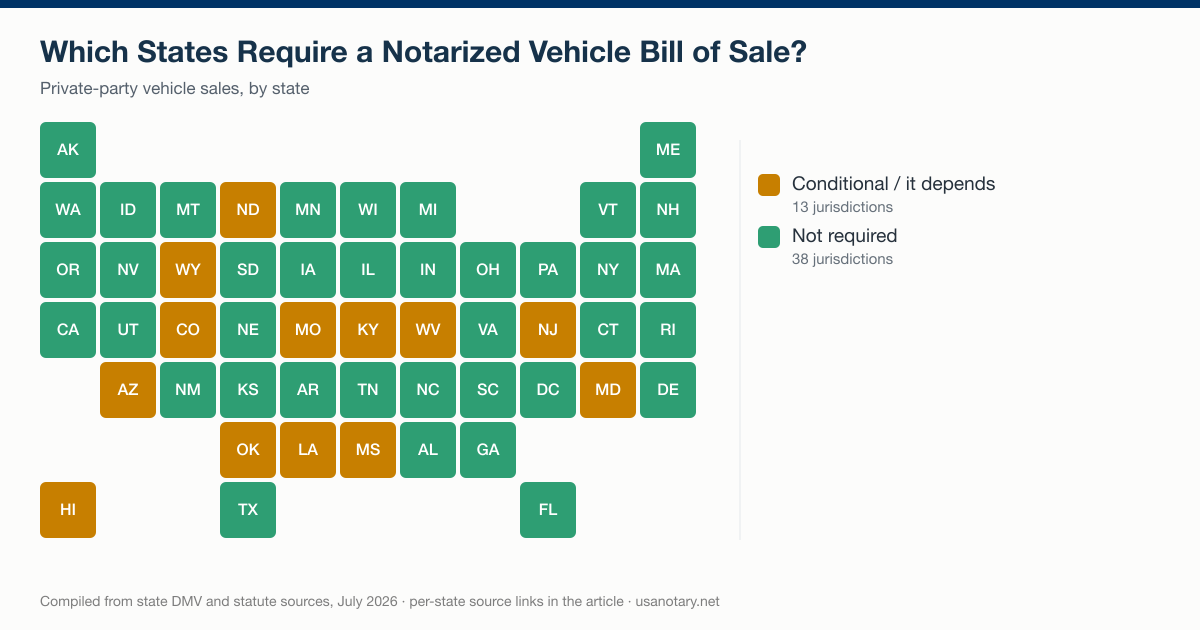
Compiled from state DMV and statute sources, July 2026, and rechecked October 1 and October 2, 2026: 14 states require a notarized bill of sale in specific situations; 37 jurisdictions never do. Maryland repealed its notarized-bill-of-sale rule effective October 1, 2026, after the July review.
On this page
- Which states require a notarized bill of sale for a car?
- States that never require vehicle bill-of-sale notarization
- What a vehicle bill of sale should include
- When notarization is required vs merely smart
- Acknowledgment or jurat: which notarial act your form needs
- What the notary verifies (and what it can’t prove)
- Why notarize even when it’s optional
- How to notarize a bill of sale online
Which states require a notarized bill of sale for a car?
Fourteen states attach a notarization requirement to a vehicle bill of sale in at least one scenario. None of them notarize every private sale — each rule has a trigger, listed in the Detail column. South Carolina also appears in this table, but its condition is on the bill-of-sale document (SCDMV’s pages differ on when one is required), never on notarization. Maryland used to be in this table and is not any more: its notarized-bill-of-sale rule was repealed effective October 1, 2026, and its row is in the next section. Per-state sources are linked in each table row.
| State | Notarization required? | Detail | Source |
|---|---|---|---|
| Arizona | Conditional | Only when the Title Transfer Bill of Sale (Form 38-1306, Arizona-titled vehicles only) is used in place of the signed title. The form carries an “Acknowledged before me” block for a “Notary Signature or MVD Agent,” and an ADOT consumer notice (September 2022) says to “make sure” a provided title transfer bill of sale is “signed and notarized.” No bill of sale is needed when the signed title itself is presented. | Arizona MVD · ADOT notice |
| Colorado | Conditional | The state DMV’s title and private-sale pages do not call for notarizing the bill of sale in a normal private sale: a bill of sale is recommended, and required for the title transfer if the sale price is not on the title. The state DMV’s title page names a notarized bill of sale for one situation: titling an off-highway vehicle 25 years or older with no proof of ownership (“a certified VIN inspection and notarized BOS within 24 months of purchase”). Counties add nuance at the margins: Douglas County’s temporary-permit paperwork accepts a bill of sale “notarized or signed under penalty of perjury” as an alternative to a copy of the title, so a notary is optional there. | Colorado DMV · Douglas County, Colorado DMV private sale |
| Hawaii (Honolulu) | Conditional | A notarized bill of sale must be provided when the Certificate of Title is not released (signed off) by the recorded owner. Honolulu’s page states this under out-of-county and out-of-state transfers and does not list a bill of sale for a standard transfer with a properly released title. Vehicle titling is county-run; the Maui, Kauai, and Hawaii County bill-of-sale rules were not confirmed, so check with the county where you register. | Honolulu CSD |
| Kentucky | Conditional | In an ordinary Kentucky sale the seller signs the back of the title before a notary; the page lists no bill of sale for an in-state transfer. If the vehicle comes from a state that only issues a registration or bill of sale, those are brought in place of the signed-over title, and the page says signatures must be notarized. | drive.ky.gov |
| Louisiana | Conditional | An original notarized bill of sale or invoice stating the actual price is a listed titling requirement — but a separate bill of sale is not required if the selling price is included on the notarized title assignment. OMV accepts the file if the bill of sale, invoice, or title is notarized. For sales in Louisiana on or after January 1, 2023 to or from a Louisiana-licensed dealer, OMV Policy 2.00 says notarization is not required on the bill of sale. | Louisiana OMV · OMV Policy 2.00 |
| Mississippi | Conditional | The Department of Revenue’s transfer steps for an in-state private sale call for an assigned title and do not list a bill of sale. A notarized bill of sale is a required document when titling a vehicle imported from a foreign country; a bill of sale accompanies a title bond when no title can be obtained. | Mississippi DOR, Mississippi DOR, titles |
| Missouri | Conditional | A bill of sale or Notice of Sale does not have to be notarized to claim the vehicle sales tax credit, but notarized bills of sale in the applicant’s name are required for all major component parts when titling a rebuilt (prior-salvage) vehicle. | Missouri DOR, Missouri titling manual, Missouri Form 1957, Missouri DOR, selling a vehicle, Missouri DOR, notice of sale |
| Montana | Conditional | An ordinary sale with a properly signed title needs no bill of sale — MVD offers the Bill of Sale (MV24) as the seller’s record of sale — and Montana’s title-notarization requirement was eliminated effective October 1, 2025 (HB 165 struck MCA 61-3-220(2); most older sources are now wrong). The exception is the bill of sale itself: the current MV24 (rev. 8/26) says “If this Bill of Sale is used in conjunction with a MV10 Break/Bond Title Application or an Electronic Records Transfer, a Notary is required” — the two lost-title routes — and has a Section 3 “Notary Use Only” block. The form post-dates HB 165 and MVD’s web pages are silent on the point, so confirm with MVD before relying on either reading. | Montana MVD, MV24 · Montana SOS |
| New Jersey | Conditional | In a standard sale the seller gives the buyer a bill of sale with the signed title, and MVC’s transfer guide lists no notarization for it. Notarization is required when titling a used vehicle from a state that does not issue titles (a notarized seller-to-buyer statement, signed by both parties before notarization, per MVC) and for the bill of sale of a non-titled vehicle bought at auction (MVC). | NJ MVC |
| North Dakota | Conditional | NDDOT’s title checklist lists a bill of sale as required for purchases from a dealership and does not list one for a private sale with a title. In NDDOT’s untitled-vehicle process (North Dakota residents only), a notarized Seller’s Certificate and Vehicle Bill of Sale (SFN 2888) is required, and the seller signs that form before a Notary Public or Authorized Officer. For a North Dakota resident’s vehicle more than 40 years old with no title, MCO or signed bill of sale, a separate NDDOT process (dated July 20, 2026) accepts either a notarized SFN 62624 Affidavit of Ownership or a notarized bill of sale together with SFN 62624. NDDOT’s Private Party Vehicle Bill of Sale (SFN 62502, 4-2026) has signature lines and no notary block. | NDDOT — title checklist · NDDOT — SFN 2888 · NDDOT — vehicles over 40 years old · SFN 62624, NDDOT untitled vehicles, NDDOT SFN 62502 |
| Oklahoma | Conditional | Since July 1, 2025 all Oklahoma titles issue electronically by default (paper titles are issued with limited exceptions), and the Form 718 Electronic Title Bill of Sale that transfers an e-title must be notarized (“Is the notary requirement eliminated due to the changes? No.”). Paper-title transfers use a notarized title. For price documentation on a paper title, no notarization is stated for a bill of sale or purchase contract, but Form 722-1 (the declaration of purchase price) has its own notary block, and Form 777 (transfer after loss of an assigned title) asks for confirming documentation such as a “notarized bill of sale; canceled check.” Form 718 also says a declaration of purchase price “will be required” when the vehicle was bought from an individual — confirm with Service Oklahoma whether that is in addition to the notarized Form 718. On the form itself, the seller’s affirmation and signature are followed by a single notary block (“Subscribed and sworn to before me”), and the form has no separate buyer signature line. | Service Oklahoma |
| South Carolina | Conditional (document, not notary) | Neither SCDMV page lists notarization of the bill of sale or title assignment. Whether a bill of sale is required depends on which SCDMV page you read: the Buying a Car page says “If assignment on title does not have section for sales price, a bill of sale must accompany paperwork,” while the Titles page says a signed Bill of Sale/Buyer’s Order “is required for all title transactions” and that the buyer’s signature is required on it. | SCDMV — Buying a Car · SCDMV — Titles |
| Tennessee | Conditional | In a standard private sale where the seller holds the title, the owner transfers title by endorsing an assignment and warranty of title on the certificate of title (T.C.A. § 55-3-118(a)), and the Department of Revenue says “A notarized bill of sale is not sufficient proof of ownership.” Exception: when a lienholder holds the title, T.C.A. § 55-3-118(b) lets the owner deliver a separate bill of sale in place of the title assignment, and that bill of sale is signed by the seller “whose signature shall be acknowledged before a notary public.” Separately, § 55-3-103(e)(1)(C) lists “a notarized bill of sale from the last registered owner or a notarized statement from the seller” among the supporting documents for titling a vehicle with a fair market value of $3,000 or less that lacks proper documentation (a licensed dealer appraisal is accepted in the absence of that documentation, § 55-3-103(e)(1)(D)). (Statute text read on Justia’s reproduction of the Tennessee Code, a secondary copy — verify against the official code.) Tennessee also enforces the notary block printed on incoming out-of-state titles, except Kentucky’s (a Department of Revenue help-center article dated April 29, 2021). | TN DOR · T.C.A. § 55-3-118 (Justia copy) · TN DOR — out-of-state titles, Tenn. Code § 55-3-103 |
| West Virginia | Conditional | A notarized bill of sale (DMV-7-TR) is required when a vehicle bought from an individual has a purchase price below 50% of the current NADA Clean Loan Book value — otherwise tax is assessed on book value. For vehicles two years old or newer, tax is on book value and “notarized bills of sale will not be accepted to lower this valuation.” Also required, notarized, for ATVs/UTVs that predate titling and were never titled; all notarized bills of sale or DMV-7-TR forms must be accompanied by copies of both parties’ driver’s licenses. | WV DMV |
| Wyoming | Conditional | Titling is county-run and practice varies by county. Sweetwater County’s Treasurer says a notarized bill of sale is not needed for registration and sales tax but may be required for titling, and that a buyer can drive on a notarized bill of sale for 60 days while a lienholder holds the title; Teton County requires “a notarized bill of sale or notarized affidavit of gift” for private-party purchases. Wyoming’s statute for lien-held titles, W.S. 31-2-104(h)(i), separately describes a signed bill of sale in a statutory form rather than a notarized one (read on Justia’s copy of the statute, a secondary source). Ask your county treasurer or clerk before paying for a notary. | Sweetwater County Treasurer · Teton County |
Four of these states — Kentucky, Louisiana, Oklahoma, and Wyoming — plus North Carolina, Ohio, Pennsylvania, and Montana-before-October-2025 put their notary requirement on the title assignment rather than (or as well as) the bill of sale. If you’re transferring a title, read our companion state guide on whether a vehicle title needs to be notarized — the two documents carry separate rules.
States that never require vehicle bill-of-sale notarization
Thirty-seven jurisdictions — 36 states plus the District of Columbia — do not require notarization of a vehicle bill of sale in any standard private-sale scenario, per each jurisdiction’s DMV, titling agency or statute. Thirty-six are in the table below; the 37th, South Carolina, is listed in the conditional table above because SCDMV conditionally requires the bill-of-sale document itself (its pages differ on when), though never its notarization. Important distinction: many of these states still require a signed bill of sale as a document; they just never ask for it to be notarized. A few carry narrow exceptions noted in their rows — rebuilt-vehicle titling in Alabama and Washington, title errors or alterations in Iowa, and estate sales in Maryland.
| State | Notarization required? | Detail | Source |
|---|---|---|---|
| Alabama | No | ALDOR says the assignment of an MSO or title does not have to be notarized. For rebuilt vehicles, ALDOR’s rebuilt-inspection FAQ asks for “All bills of sale for component parts replaced,” and older text on that same page still adds that “major components require a notarized bill of sale,” so confirm the current requirement with ALDOR. | ALDOR · ALDOR — rebuilt inspection, Ala. Admin. Code r. 810-5-1-.246 |
| Alaska | No | A bill of sale is not valid for ownership transfer — the DMV recommends one for the seller’s protection, signed by both parties. Neither the DMV’s selling nor its new-vehicle page requires a notary for the title transfer; the only notarization it names is a power of attorney when someone signs for the owner. | Alaska DMV, Alaska DMV, new vehicle |
| Arkansas | No | A bill of sale is a listed registration document (and both parties must sign it to claim the used-vehicle sales-tax credit), but DFA’s Bill of Sale (Credit for Vehicle Sold) and its Vehicle Bill of Sale / Odometer Disclosure Statement have signature lines and no notary block. | Arkansas DFA |
| California | No | The DMV registration manual states a bill of sale is “Not required to be notarized or witnessed” — it’s even acceptable un-notarized in lieu of the owner’s release signature on the title. | California DMV |
| Connecticut | No | CT DMV tells the seller to give the buyer a bill of sale (Form H-31, or a self-drafted one listing the purchaser’s and seller’s names and addresses, a vehicle description with VIN, the sales price, the date of sale, and the seller’s signature). Form H-31 carries a declaration under penalty of false statement and no notary block. | CT DMV |
| Delaware | No | Delaware titles do not require a notary. A private-sale transfer must be accompanied by a bill of sale or an affidavit (2 Del. Admin. Code 2266 § 11.3); with neither, the document fee is based on the NADA average trade-in value (the owner may elect a licensed Delaware dealer appraisal). | Delaware DMV |
| District of Columbia | No | A bill of sale is a required titling document in DC, but nothing on the DMV’s required-documents checklist calls for notarization. | DC DMV |
| Florida | No | A bill of sale is not on FLHSMV’s standard private-sale title-transfer checklist, but one signed by seller and purchaser is required if the title lacks the purchaser’s name or the price, or shows an altered price. Sellers must notify FLHSMV of the sale within 30 days with a Notice of Sale (the section on the back of the title or HSMV 82050), and HSMV 82050 can also serve as a bill of sale when the purchaser signs. HSMV 82050 is signed under penalties of perjury and the form has no notary block. FLHSMV recommends having the bill of sale notarized; notarization is not required in the title’s Transfer of Title by Seller section. | FLHSMV · HSMV 82050, FLHSMV TL-11 |
| Georgia | No | DOR’s casual-sale checklist lists a bill of sale for a vehicle that is 1985 or older and does not require a title, and lists no notarization requirement; DOR’s “Sell a Car” page also tells sellers to complete Bill of Sale Form T-7, whose instructions ask for a certification (Section E) and do not mention a notary. | Georgia DOR · DOR — Sell a Car, Georgia Form T-7, Georgia DOR, Form T-7 |
| Idaho | No | A bill of sale (ITD 3738) is not a required document when the title is properly assigned; no notarization requirement is stated for it. (Idaho’s duplicate-title application, ITD 3367, is a different story: the applicant’s signature must be notarized or witnessed by an assessor or deputy assessor.) | Idaho ITD |
| Illinois | No | ILSOS’s FAQ lists the signed title, VSD 190, the title fee and the applicable tax form (RUT-50) as the application documents — no bill of sale — and its “Buying or Selling a Vehicle in Illinois” publication only advises sellers to “Prepare a bill of sale for the buyer” (date of sale and price paid), with no notary. ILSOS also answers the title question explicitly: “Is the Illinois title required to be notarized? No.” | ILSOS |
| Indiana | No | Explicit: the bill of sale (State Form 44237) “is not required to be notarized or signed under penalties for perjury.” A bill of sale cannot be used to transfer ownership of a vehicle that requires a certificate of title by law. (The statute, IC 9-17-2-4(c)(2)(A), uses the phrase “sworn bill of sale or dealer’s invoice” for a vehicle brought from another state for which no certificate of title has previously been issued; the BMV’s page says no notarization is required.) | Indiana BMV, Ind. Code § 9-17-2-4 |
| Iowa | No | Iowa DOT tells sellers to give the buyer a bill of sale and says one is still required when the title lacks the Transfer/Sale Date section; some county treasurers (Polk County, since January 1, 2022) require one on every private-party transfer. The Iowa State County Treasurers Association template that DOT links carries a “For notary use if applicable” block and states that errors or alterations on the title or other transfer documents “may require this form to be notarized.” A notary is not needed for an ordinary, error-free sale. | Iowa DOT · Treasurers Association template · Polk County Treasurer |
| Kansas | No | Explicit: the Division of Vehicles “does not require most” bills of sale completed within Kansas to be notarized, though it “reserves the right to require notarized documentation in unusual circumstances.” A bill of sale (page 2 of TR-12) is required when the title assignment has no purchase-price space; the stand-alone Bill of Sale, TR-312, carries the same price affidavit. Even then no notary is built in — it is a sworn statement of price signed under penalty of perjury, with no notary block, and the form itself says only antique vehicles (35 years or older) can have ownership transferred by bill of sale. | Kansas DOR · TR-312, Kansas Form TR-12, Kansas DOV forms |
| Maine | No | A signed bill of sale is required to register a private-sale vehicle, but the official form contains only seller and buyer signature lines — no notary block. | Maine BMV |
| Maryland | No (since October 1, 2026) | House Bill 251 (Chapter 118, approved April 14, 2026, effective October 1, 2026) repealed the notarized bill of sale that a buyer could submit to the MVA to prove a private-sale price $500 or more below retail value for the 6.5% excise tax; that purchase now takes the valuation shown in the national publication of used car values. A bill of sale is not always required for a private sale — the MVA says it is “not always required, but it is strongly recommended,” and its private-party titling checklist lists “[p]roof of purchase price, and a bill of sale if applicable.” The MVA’s excise-tax page, retrieved October 2, 2026, does not mention a notarized VR-181 (it says additional documentation may be required to support a reported price $500 lower than the valuation), and the text of the current Bill of Sale (VR-181) shows signature lines and a penalty-of-perjury statement but no notary block. One MVA page still says otherwise: its page for families of a recently deceased owner says “All estate administrators/executors and buyers must sign and notarize a Bill of Sale (VR-181)” when an estate sells a vehicle, so confirm with the MVA before skipping the notary for an estate sale. | Maryland HB 251, Chapter 118 · MVA — buying a vehicle · MVA — vehicle after death, Maryland MVA, private purchase, Maryland MVA bill of sale |
| Massachusetts | No | The RMV asks for a bill of sale only for age-exempt vehicles (with the previous registration) or to show the price when the previous title has no sales-price field; the RMV page does not mention notarizing it. | Mass. RMV, Mass. RMV private sale checklist, Mass.gov private party sales |
| Michigan | No | A bill of sale is not listed among the requirements on Michigan SOS’s title-transfer and registration service page, and MCL 257.233 has no bill-of-sale element — the owner indorses the assignment on the title, and the seller’s portion carries the odometer disclosure. | Michigan SOS, MCL § 257.233, Michigan SOS, buying/selling |
| Minnesota | No | A bill of sale is not one of the DVS steps for transferring a titled vehicle, and DVS’s transfer guide mentions no notarization of one. For a vehicle that isn’t titled (non-titled light trailers, for example), ownership may be assigned on the back of the registration card, on a registration application (PS2000) or on a bill of sale that identifies the vehicle, the date of sale, and the buyer. | Minnesota DVS |
| Nebraska | No | The seller must give the buyer a bill of sale or a completed Nebraska Department of Revenue Form 6, and Neb. Rev. Stat. 60-1417 calls for a written sale instrument signed by buyer and seller; no Nebraska agency page we found states that notarization is required. The DMV’s own optional Bill of Sale form (Revised 1/2014) does print “Subscribed and sworn before me” blocks for a Notary Public or designated county official, but the form says individuals are “NOT, however, required to use this Bill of Sale form,” and Form 6 has no notary block — confirm with your county treasurer if you use the DMV form. | Nebraska DMV · DMV Bill of Sale form |
| Nevada | No | A Bill of Sale (VP-104) is a record the DMV tells parties to complete for their own records; the form has no notary block and requires original signatures. A bill of sale by itself is not acceptable proof of ownership for registration. | Nevada DMV |
| New Hampshire | No | For title-exempt vehicles (New Hampshire does not title vehicles of model year 1999 or older, with listed exceptions) the seller must provide a “properly executed Bill of Sale”; RSA 261:148, III requires the purchaser’s name and address and the seller’s signature and address, with no notarization element, and NH DMV’s bill-of-sale page also asks for the purchaser’s signature and a legal address (no PO Box). | NH DMV · NH DMV — bill of sale · RSA 261:148 |
| New Mexico | No | A bill of sale (Form 10009) is only required when the Assignment of Title or Dealer Assignment isn’t on the back of the title (or is incomplete); it takes the signatures of both seller and buyer, and the form has no notary section. For a gifted vehicle, an Affidavit of Gift is required, which both donor and recipient must sign and have notarized. | New Mexico MVD, Form MVD-10009, NM MVD, used vehicles |
| New York | No | DMV asks the seller to sign a Vehicle Bill of Sale (MV-912) unless the seller provides other acceptable proofs; an acceptable bill of sale shows the vehicle details, sale date, price, and the names and signatures of buyer and seller, and the new owner gives the original to DMV. MV-912 has no notary block, and the Tax Department’s DTF-802 sales-tax statement is signed, not notarized. | NY DMV |
| North Carolina | No | NCDMV’s required-document list for a purchase from an individual includes no bill of sale; the transfer is completed on the back of the title by both seller and buyer, and the notary requirement is on the North Carolina title and the title application (MVR-1), not on a bill of sale. | NCDMV, NCDMV title forms |
| Ohio | No | The Ohio BMV lists a bill of sale for purchases from an out-of-state dealer (new vehicles and out-of-state title conversions) and does not call for it to be notarized. Ohio’s notarization happens on the title assignment (and on both pages of the e-title form BMV 3770). | Ohio BMV |
| Oregon | No | A bill of sale (form 501) is used when the seller’s name isn’t on the title; it needs at least the VIN, a release-of-interest statement, the seller’s printed name, signature, and date — the DMV form has no notary block. | Oregon DMV, Oregon Form 735-501 |
| Pennsylvania | No | PennDOT’s buying/selling fact sheet lists no bill of sale in its seller or buyer checklists, though its registration page lists a bill of sale among private-sale documents and says to keep one; the transfer itself runs through the notarized/verified title assignment completed before an authorized PennDOT agent, tag service, notary, or dealer. | PennDOT, PennDOT, register a vehicle, PennDOT buy/sell fact sheet |
| Rhode Island | No | A bill of sale is required (“You must also give the new owner a bill of sale”) — year, make, model, VIN, color, price, seller signature and address — and RI DMV’s new-registration page does not ask for it to be notarized; RI DMV’s sample form (rev. 11-3-2023) has seller and buyer signature lines and an odometer disclosure, and no notary block. RI’s notarization requirements sit elsewhere: a gift letter from a non-immediate family member (with a Gift Affidavit, SU 87-65, which has its own notary block) and an absent co-owner’s signature on the Application for Registration. | RI DMV · RI DMV — new registration, RI DMV bill of sale, RI gift affidavit |
| South Dakota | No | A separate bill of sale “will not be accepted in addition to or in place of a South Dakota certificate of title or a required assignment,” but SDCL 32-5B-4(3) says the purchaser and seller of a private-party used vehicle “shall submit to the county treasurer a bill of sale, approved and supplied by the secretary”; if none is submitted, excise tax is assessed on the retail value in a nationally recognized dealers’ guide. DOR provides Bill of Sale Form 1025. No notarization of a bill of sale is stated. | SD DOR Procedures Manual · SDCL 32-5B-4 |
| Texas | No | TxDMV’s seller checklist lists only the signed title and Form 130-U and does not mention a bill of sale, but the Montgomery County Tax Office’s checklist calls for a signed bill of sale for trailers and vehicles 25 years old or older, with no notarization stated. Gifts to a relative or a qualifying 501(c)(3) also need Form 14-317, which must be sworn before a notary or a county tax office employee. | TxDMV, Montgomery Co. Tax Office, titles, Texas Form 14-317 |
| Utah | No | A bill of sale (Form TC-843) records the sale price, which sales tax is based on, and the odometer reading; the DMV’s bill-of-sale and title-transfer pages list no notarization requirement, and the TC-843 form contains no notary block. | Utah DMV, Utah DMV, bill of sale, Utah Form TC-843 |
| Vermont | No | A signed bill of sale (VT-005, which also carries the odometer disclosure) is required in several scenarios: to show the chain of ownership when a vehicle was not previously titled, and when selling a 2009-or-older Vermont-registered vehicle that is still title-exempt (the buyer then titles it at registration). The DMV’s content list (“including” make, year, VIN, purchase price, mileage, seller’s signature, and date) is non-exhaustive, and VT-005 also requires the buyer’s signature. VT-005 has no notary block, but a used vehicle that has not been registered in Vermont and has no NMVTIS record also needs the Affidavit of Non-Titled Vehicle (VT-025), which must be signed in the presence of a notary. | Vermont DMV, Vermont Form VT-005 |
| Virginia | No | Expressly informal: the bill of sale “can be a handwritten statement signed by the seller and purchaser.” | Virginia DMV |
| Washington | No | Both parties must sign a Bill of Sale unless the price and date are on the title — signed, not notarized. DOL’s Vehicle/Vessel Bill of Sale (TD-420-065, R/4/24) has buyer and seller signature lines and no notary block. The exceptions are outside an ordinary sale: when a destroyed or wrecked vehicle is rebuilt, “Bills of sale from owners shown on department records must be notarized or certified” (WAC 308-56A-460, amended effective August 20, 2026), while bills of sale from insurers and wreckers do not need to be notarized; and for an assembled or homemade vehicle, the bills of sale for the vehicles or major component parts used to build it “must be notarized unless purchased from an auto dealer or business licensed to sell auto parts” (WAC 308-56A-455). (Washington’s notary step falls on the buyer’s Vehicle Title Application instead: it is signed in front of a licensing agent who can notarize it, or, if signed beforehand, in front of a notary.) | WA DOL · WAC 308-56A-460, Washington DOL, sell a vehicle, Form TD-420-065 |
| Wisconsin | No | Explicitly optional: the Bill of Sale (MV2928) “is provided for your convenience, it is not a required form.” | WisDOT |
What a vehicle bill of sale should include
The contents matter more than the notarization in most states — an incomplete bill of sale gets rejected regardless of whether a notary signed it. New York’s DMV, whose form MV-912 is typical of state bill-of-sale forms, lists what an acceptable vehicle bill of sale must show:
- The year and make of the vehicle (boat, snowmobile, or ATV included).
- The vehicle identification number (VIN) — or hull identification number for a boat.
- The date of the sale.
- The purchase price.
- The names and signatures of both the buyer and the seller.
Two additions worth making even where they aren’t listed: the odometer reading (federal odometer disclosure runs through the title, but repeating it on the bill of sale keeps the records consistent) and both parties’ addresses, which several state forms require. And if your state notarizes the document, check for companion requirements — West Virginia, for example, requires that every notarized bill of sale be accompanied by a copy of both the buyer’s and seller’s driver’s licenses.
The notary does not supply any of this. A notary provides notary services — identity verification and the notarial certificate — not document drafting, so arrive with the form completed except for the signatures a jurat requires you to make in the notary’s presence. Most state motor-vehicle agencies publish free official forms; each state row in the tables above links to the agency page where its form lives.
When notarization is required vs merely smart
There is no single national rule. A sale of goods is generally enforceable without notarization, but registration and titling agencies set their own documentation rules, and — as the tables above show — the requirement turns on the type of transaction, the price, and where the vehicle will be titled.
Louisiana is the strongest example of “required”: the Office of Motor Vehicles lists an original notarized bill of sale or invoice among its used-vehicle titling requirements, accepting the file only if the bill of sale, invoice, or title is notarized (Louisiana OMV). West Virginia shows the price-trigger pattern: a notarized bill of sale must accompany the title application when a private-party price is below 50% of the NADA Clean Loan Book value, or the tax is assessed on book value instead (WV DMV). And Nebraska shows the trap of judging by the form alone: the Nebraska DMV bill-of-sale form prints “Subscribed and sworn before me” notary blocks for both the seller and the buyer, yet no Nebraska agency page we found requires notarization of the bill of sale, and the form itself says individuals are “NOT, however, required to use” it — if you do use it, ask your county treasurer whether the notary blocks must be completed. Because the details shift by state and can change over time (Montana dropped its title-notary rule in October 2025, yet its current MV24 bill of sale still says a notary is required on the electronic-records-transfer and MV10 bond-title routes), confirm the current rule with the agency where the vehicle will be registered.
| Situation | Notarize? | Why |
|---|---|---|
| State or DMV requires it (Louisiana titling; Oklahoma e-title Form 718) | Yes — required | The agency won’t process the transfer without it |
| Price reported below book value (West Virginia) | Required in that scenario | The state uses a notarized document to verify the true price |
| High-value private sale | Recommended | Adds third-party proof of who signed |
| Low-value everyday sale of goods | Usually optional | The sale is generally enforceable without it |
Even when it’s optional, the benefit is the same as any notarization: a neutral official verified who signed, which makes the signature much harder to dispute later.
Acknowledgment or jurat: which notarial act your form needs
Not all notarizations are the same, and a bill of sale can call for either of two acts — a distinction most guides skip but one that determines whether you can sign ahead of time.
- Acknowledgment. The signer appears before the notary and acknowledges signing the document. Because the signer is confirming a signature they already made, an acknowledgment can be taken on a document that was signed earlier — you just have to personally appear and acknowledge it. Arizona’s Form 38-1306 works this way: “Acknowledged before me… Notary Signature or MVD Agent.”
- Jurat. The signer swears the contents are true and signs in front of the notary. A jurat can’t be added after the fact, because the signing itself has to happen in the notary’s presence. Nebraska’s DMV form uses jurat language (“Subscribed and sworn before me”), which is why that form is built for signing in front of the notary rather than beforehand.
The Revised Uniform Law on Notarial Acts — the model statute many states follow — defines a notarial act to include “taking an acknowledgment” and “witnessing or attesting a signature,” among others (RULONA, Uniform Law Commission). Which act your bill of sale needs is set by the form or your state’s instructions, so read them before you sign — and if you plan to notarize the document online, have that answer ready.
What the notary verifies (and what it can’t prove)
The notary verifies the signer’s identity and witnesses (or takes the acknowledgment of) the signature. The notary does not verify the item’s condition, the sale price, or that the seller actually owns the item — a notarization confirms who signed, not that the deal’s terms are true. That limit is worth understanding before you assume a notarized bill of sale guarantees anything about the transaction itself: it authenticates the signature, and nothing more. Tennessee’s Department of Revenue makes the same point from the agency side: a notarized bill of sale “is not sufficient proof of ownership” — only a properly endorsed title is. The California Secretary of State’s Notary Public Handbook frames the notary’s role the same way — identity verification of the signer, not vetting of the document’s contents.
That’s also why a notarized bill of sale pairs well with the underlying ownership document. On a vehicle sale, the bill of sale records the deal while the title proves ownership, and the two carry separate notarization rules — see our guide on whether a vehicle title needs to be notarized. The same principle applies to other signed documents you might send someone: notarization proves the signature, which is exactly why people also choose to notarize a letter or authorization when a signature could later be challenged.
Why notarize even when it’s optional
For a private sale between strangers, the value is proof. A notarized bill of sale creates a clean, third-party-verified record of who signed and when, which:
- Deters disputes. It’s much harder for either party to later claim they never signed or never agreed.
- Verifies identity up front. The notary checks a government-issued photo ID, reducing the risk of a forged or false signature.
- Smooths the paperwork. Some title offices and boating authorities ask for notarized documents in certain transactions; doing it in advance avoids a rejected transfer later.
For higher-value items, out-of-state buyers, or a county office that turns out to want more than the statute demands (Wyoming buyers know this well), that small extra step is often worth it even when no law requires it. Dealerships and automotive businesses that handle this paperwork at volume can set up a standing workflow through our automotive notary services.
How to notarize a bill of sale online
Online notarization on USA Notary is $25 per document, and the signer appears on live video — see how the online process works. Here’s the sequence:
- Confirm whether your state or the item’s title requires notarization (check the tables above), and which act (acknowledgment or jurat) the form calls for.
- Prepare the bill of sale — leave it unsigned if the notary will witness the signature (required for a jurat).
- Have a valid photo ID ready for identity verification.
- Start an online session in a state that authorizes remote online notarization; the notary verifies your identity, watches you sign where required, and completes the notarial certificate.
The electronic format holds up under federal law. Under the Electronic Signatures in Global and National Commerce Act, a signature, contract, or record “may not be denied legal effect, validity, or enforceability solely because it is in electronic form” (15 U.S.C. § 7001). Remote online notarization is available to signers in all 50 states as a consumer service, though notary commissioning is governed state by state and some states have not yet authorized it. USA Notary provides notary services; it does not verify the terms of your sale.
Selling a vehicle? Also check whether you need to notarize the title itself — several states (Kentucky, Louisiana, North Carolina, Ohio, Oklahoma, Pennsylvania, Wyoming) put their notary requirement on the title assignment rather than the bill of sale — and confirm your motor-vehicle agency accepts a remotely notarized document before you rely on it.