
What is a vehicle power of attorney?
A vehicle power of attorney — sometimes called a motor vehicle POA or a POA for a car title — is a limited power of attorney scoped to title and registration acts for one specific vehicle. The California DMV’s registration manual defines the underlying instrument plainly: a POA is “a written document whereby one person (the principal) conveys to another the right to act for that person as attorney-in-fact”, and notes that in the vehicle context a POA “generally refers to a DMV form which is limited to vehicle/vessel transactions.” That’s the defining feature: unlike a broad instrument covering all your affairs, a vehicle POA typically identifies the vehicle by its VIN and authorizes nothing beyond it.
What the agent can do under it is consistent across states. New York’s DMV lists the usual grants — buy, sell, or register a vehicle, record liens, and apply for a duplicate title certificate. Florida’s HSMV 82053 uses nearly identical language: the owner appoints an attorney-in-fact “in applying for an original or duplicate certificate of title, to register, transfer title, or record a lien” to the vehicle described on the form.
This guide covers the vehicle-specific form only. For the broader instrument — general, limited, and durable POAs and how they differ — see our explainer on what a power of attorney is. This article is general information, not legal advice; consult an attorney about your specific situation.
When do you need a vehicle power of attorney?
A vehicle power of attorney solves one problem: the owner can’t — or doesn’t want to — appear in person to sign title and registration paperwork. The common situations:
- A dealer is handling your title work. When you buy or trade in a vehicle, the dealership completes the title transfer and registration on your behalf — and the POA you sign in the finance office is what authorizes it. This is one of the most common places drivers encounter a vehicle POA.
- You’re selling or buying across state lines. An out-of-state party appoints a local agent to sign transfer paperwork at the motor-vehicle agency so nobody has to travel for a signature.
- You’re deployed or living abroad. A service member or expat appoints a spouse or family member to sell, register, or retitle the vehicle at home.
- A lienholder holds your title. When the physical or electronic title sits with a lender, federal rules let the seller grant the buyer a power of attorney for mileage disclosure under 49 CFR 580.13 — the “secure POA” scenario covered below.
- The title is lost. The same federal provision applies when the title can’t be accessed, letting the transfer proceed while a duplicate is obtained.
One situation where you may not need one: New York’s DMV notes you don’t need a POA to register a vehicle for someone else if you can show the applicant’s proof of identity and date of birth at a DMV office. Rules like that vary, so check your state’s guidance before drafting a form you don’t need.
Does a vehicle power of attorney have to be notarized?
Notarization of a vehicle power of attorney is a state-by-state requirement, set by each motor-vehicle agency’s form or acceptance rules — there is no single national answer. Here is what four states’ official forms and manuals actually say:
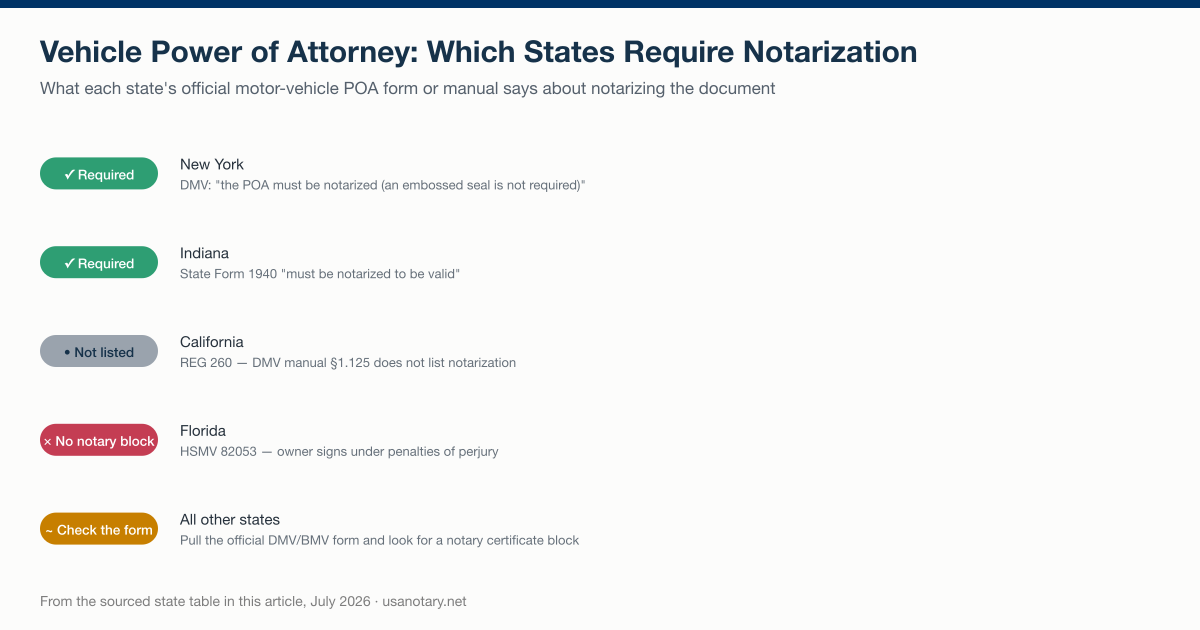
Whether each state’s official vehicle POA form requires notarization, from the sourced state table below, July 2026.
| State | Official form / guidance | Notarization requirement |
|---|---|---|
| New York | No state-issued form; DMV acceptance rules | Required — “the POA must be notarized (an embossed seal is not required)“ |
| Indiana | State Form 1940, Limited Power of Attorney | Required — “The Limited Power of Attorney form must be notarized to be valid” |
| California | REG 260, per DMV manual §1.125 | Not listed — the manual requires the VIN, the agent’s name, and the principal’s signature, and does not list notarization |
| Florida | HSMV 82053 | No notary section on the form — the owner signs “under penalties of perjury” |
If your state isn’t in the table, the rule of thumb is simple: pull the official POA form from your state’s DMV, BMV, or tax collector site and look for a notary certificate block. If the form contains one — as Indiana’s does, with a full notary section including seal and commission-expiration fields — the notarization is part of validity, not decoration. And notarization can also be demanded by the recipient even where the form doesn’t require it, the same acceptance dynamic that applies to any notarized document.
Note the distinction from the title itself: whether the title signature must be notarized is a separate state rule with its own list of states — covered in our guide to notarizing a vehicle title.
Power of attorney to sell a car: what it authorizes — and what it can’t
A power of attorney to sell a car gives the agent real signing authority: Florida’s form binds the owner “in as sufficient a manner as I/we … could do, were I/we personally present and signing the same.” The agent can execute the transfer, apply for the title, and record a lien for the vehicle listed on the form.
The hard limit is odometer disclosure. Federal law treats mileage disclosure as a personal certification, so a POA can stand in only under narrow conditions. Under 49 CFR 580.13, a seller may grant the buyer a power of attorney for mileage disclosure only when the physical title is held by a lienholder or lost, or the electronic title is held by a lienholder or cannot be accessed — and the disclosure must be made “on the physical or electronic power of attorney form issued by the jurisdiction in which the transfer occurs.” That state-issued document is the secure power of attorney: New York describes it as a form “printed with security features and used for mileage disclosure purposes,” and issues it to New York dealers only. States can be stricter than the federal floor — California’s manual states flatly that a POA cannot be used to disclose odometer mileage at all.
So when you hand someone a power of attorney to sell your car, assume it covers the transfer paperwork — and check your state’s rules before assuming it covers the odometer statement.
How dealerships use vehicle POAs to process title work
Car-sales businesses run on vehicle powers of attorney. Every deal where the dealership files the title transfer, registration, or lien recording rests on a POA collected from the buyer — and often a second one from the seller or trade-in customer. The states build for this volume: California includes a POA section directly on its dealer reassignment form (REG 262) “for convenience”, Florida’s form treats a licensed dealer and its employees as a single entity, and New York restricts dealers specifically — an automobile dealer cannot use a general POA to transfer a vehicle, which is exactly why the limited vehicle form matters.
For a dealership operating in a notarization-required state — or buying and selling across state lines into one — every one of those POAs is a document that needs a notary before the deal can fund. That’s a workflow problem when the customer has already driven off the lot. A staff-initiated online notarization fixes it: your team sends the customer a link, the customer completes the notarization from home in a 15–30 minute video session, and your title clerk gets back a tamper-evident notarized PDF with a digital audit trail. Multi-signer sessions handle owner + co-owner signatures in one sitting. See how notary workflows for automotive businesses work, or review volume pricing if your title desk processes POAs weekly. For the insurance-carrier side of vehicle paperwork — total-loss claims The signing rules for that document are in total-loss power of attorney signing rules. — see our total-loss notarization workflows.
How to notarize a vehicle power of attorney online
Where your state’s form carries a notary block, you can complete the notarization over live video instead of finding a notary near the DMV. According to NASS, 47 states and the District of Columbia have a law that allows for remote e-notarization. The process:
- Download your state’s official form from the DMV/BMV website and fill in the vehicle’s VIN, the agent’s name, and your details — everything except your signature.
- Upload the form and verify your identity. The platform verifies your identity through your government-issued ID before the session begins.
- Meet the notary on live video. You sign, and the notary completes the notarial certificate — typically in a 15–30 minute session, available 24/7.
- Download the notarized PDF. The session produces a tamper-evident notarized PDF and a digital audit trail; hand the document to your agent or the motor-vehicle office.
The cost is $25 per document. If you want the mechanics of the notarial act itself — acknowledgment vs. jurat, witness rules, and the state-specific catches — our walkthrough on how to notarize a power of attorney online covers it, and you can start a remote online notarization whenever your form is ready.