
Why does the insurance company want a power of attorney for your totaled car?
The insurance company wants a power of attorney because a total-loss settlement ends with the carrier owning your vehicle. When the carrier pays you the car’s value, it takes the wrecked vehicle in exchange — and to sell that vehicle at a salvage auction or scrap it, the carrier must transfer the title out of your name. FindLaw’s guide to total-loss claims, updated December 2025, states the mechanics plainly: “To dispose of the car, they must have legal ownership of the vehicle and permission from the original owner to transfer title.” The total loss power of attorney is that permission, packaged as a one-page form inside your settlement packet.
New Jersey publishes the clearest public specimen of what you are actually granting. The Motor Vehicle Commission’s Power of Attorney for Total Loss Vehicle, Form INS-NSPOA, has the owner appoint the insurance company’s representative “as my/our attorney-in-fact to apply for a duplicate certificate of title, and to perform on my/our behalf any necessary act concerning the transfer of such motor vehicle as I/we could do were I/we present.” And because most totaled vehicles end up retitled as salvage, the same form adds a second appointment: “In the event that the vehicle is deemed as salvage, by the insurance company,” the owner further appoints the salvage company’s authorized representatives for the paperwork that follows. An attorney-in-fact is simply the person or company authorized to sign in your place — the POA’s text defines exactly how far that authority reaches, and on a well-drafted total-loss POA it reaches no further than this one vehicle.
The carrier uses the authority for a short list of paperwork. FindLaw catalogs the typical grants: signing title-transfer documents, executing the bill of sale, obtaining a duplicate title, filing DMV paperwork, and transferring title to salvage yards or auction companies. The duplicate-title power earns its place more often than owners expect — when the original title burned with the car, sat in a flooded glovebox, or disappeared two moves ago, the POA is what lets the carrier re-paper the vehicle without waiting weeks on you to chase a replacement.
Mileage is the one disclosure the POA may not cover. New Jersey requires that Form INS-NSPOA “accompany an Odometer Statement, Form OS/SS-2” — a separate document. California goes further: the DMV’s registration manual says a POA cannot be used to “disclose odometer mileage” at all. If your settlement packet includes a mileage form, our guide to the odometer disclosure statement explains who signs it and when — in many states, that signature stays yours even after the POA is signed.
Do you have to sign the total-loss power of attorney?
No statute compels you to sign the total loss power of attorney, but the settlement will not close without it. FindLaw is blunt: “The short answer is yes, you do need to sign the power of attorney to process your claim.” The carrier cannot transfer the title of a vehicle it just paid for until it holds written authority to do so, and an unsigned POA leaves the claim parked — typically with the settlement funds waiting on the same packet the POA came in. Refusing to sign doesn’t preserve leverage; it preserves a wrecked car in your name.
What the POA should — and should not — allow
A properly drafted total-loss POA is narrow. FindLaw’s rule of thumb: “A POA should only give the company the ability to transfer the title and dispose of your car.” The same guide lists what the POA should not do: let the insurance company access your finances or bank accounts, involve any other damaged property, let the company make decisions about other property, or continue indefinitely or give it authority in any matter besides the title transfer. Before signing, check three things against that standard:
- The vehicle is identified. The form should carry the VIN, make, model, and year of the totaled vehicle — New Jersey’s form has dedicated fields for all four. A POA that identifies no vehicle is broader than the settlement needs.
- The authority is limited to title and salvage acts. Applying for a duplicate title, transferring the title, completing the salvage retitling — that is the full job description. Language reaching bank accounts, other vehicles, or “any and all matters” doesn’t belong on this document.
- Nothing is blank. You are signing a grant of authority; every open field is authority someone else fills in later. Complete the form — or have your adjuster complete it — before any signature goes on.
You are certifying facts, not just granting authority
The signature block on a total-loss POA usually carries a certification, and it has teeth. New Jersey’s form states: “By signing below, I/we certify that the information on this form is true and correct. I am aware that the submission of false information of the making of a false statement may subject me to penalty.” Ownership, the vehicle’s identity, your address — the blanks you complete are statements the state and the carrier will rely on to move a title. Treat the form with the same care as the claim forms that preceded it.
Does a total loss power of attorney have to be notarized?
A total loss power of attorney is required to be notarized only where the state’s title rules or the carrier’s form call for a notary — there is no federal requirement, and the states we checked split cleanly into two camps. In states like Kentucky, Louisiana, and Pennsylvania, the title transfer itself is notarized, so a notary sits in the total-loss paperwork path no matter which document carries your signature. In others, the POA is signed with no notary anywhere — New Jersey went furthest and replaced the notary block with an electronic-signature standard.
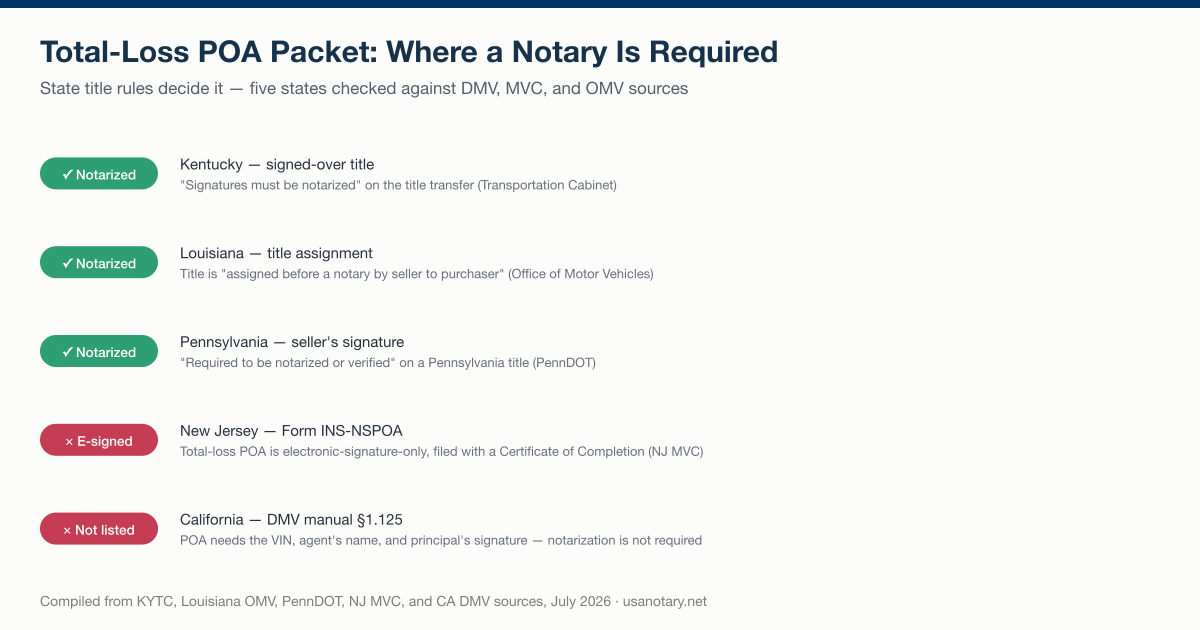
Where a notary is required in the total-loss title path, checked against each state’s motor-vehicle sources, re-checked October 2026.
| State | Notary in the total-loss title path? | What the state source says |
|---|---|---|
| Kentucky | Yes | The Transportation Cabinet’s titling checklist requires a “Signed over Kentucky title” and adds: “signatures must be notarized” |
| Louisiana | Yes | The Office of Motor Vehicles requires the title “assigned before a notary by seller to purchaser.” The same page adds: “A separate bill of sale is not required if the selling price is included on the title assignment.” The statute and OMV Policy 2.00 also allow the seller to sign before two witnesses if the title’s Acknowledgement of Witness section is completed (La. R.S. 32:705(B)(2)), and an authorized agent of a federally insured financial institution may witness the assignment instead when a lien is recorded at transfer |
| Pennsylvania | Yes | PennDOT: “The seller’s signature is required to be notarized or verified on the Pennsylvania title” |
| New Jersey | No — e-signature instead | Form INS-NSPOA is captioned “(for electronic signature only)” and “must be digitally completed, signed, and submitted with a Certificate of Completion” — no notary block appears on the form |
| California | Not listed | DMV manual §1.125 requires the VIN, the attorney-in-fact’s name, and the principal’s signature — notarization is not among the POA requirements |
For the rest of the map, the pattern to remember is that the notary requirement rides on the title, not on the POA: where a state notarizes title assignments, the total-loss packet meets a notary somewhere. Our 50-state guide to car-title notarization checks every jurisdiction’s titling rules against its motor-vehicle agency’s own sources.
Why carriers prefer a notarized POA even where it’s optional
Notarization converts a signature into evidence. Virginia’s power-of-attorney statute states the principle outright: “A signature on a power of attorney is presumed to be genuine if the principal acknowledges the signature before a notary public or other individual authorized by law to take acknowledgments” (Va. Code § 64.2-1603). For a carrier about to transfer a title on the strength of one document, that presumption is the point — if ownership of the salvage is ever disputed, the acknowledged POA is presumed authentic rather than needing proof. The notarial act performed on a POA is an acknowledgment: you confirm to the notary that the signature is yours, with no oath involved. The distinction between the two certificate types — and why it matters which one your form carries — is covered in our comparison of jurats and acknowledgments.
The carrier’s form controls the mechanics
Execution details vary by state, and the safest reading is the form in front of you. FindLaw reports that “California and Nevada both require wet-ink signatures for a valid power of attorney” and that “some states may require notarization or other verification.” California’s own manual softens the picture in one respect: a photocopy or fax copy of a general POA — including the DMV’s REG 260 — is acceptable, but copies of the REG 262, the secure transfer form that includes a POA section, are not. The practical rule that survives all of this: complete the exact form your carrier or state motor-vehicle agency issues, execute it the way its instructions specify, and ask your adjuster before improvising a substitute.
Will the DMV accept a remotely notarized total-loss POA?
A DMV accepts a remotely notarized total-loss POA where state law authorizes remote online notarization and the state’s titling office accepts electronic notarial certificates — and the notary-law half of that equation is now nearly national. The National Association of Secretaries of State reports that “currently, 47 states and the District of Columbia have a law that allows for remote e-notarization”. The variable that remains is the titling half: motor-vehicle agencies set their own document standards, and some processes still expect paper. So ask the carrier’s total-loss or title unit one question before booking anything: will you accept a remotely notarized POA on this claim? Total-loss units move these packets every day and know exactly what their salvage vendors and the state title office will take.
New Jersey shows where this is heading
New Jersey’s total-loss POA skipped the debate entirely. Form INS-NSPOA is captioned “(for electronic signature only),” must be “digitally completed, signed, and submitted with a Certificate of Completion,” and has the owner certify that the POA “was electronically signed by the above-named vehicle owner(s), using a secure authentication system and in accordance with minimum security requirements set forth by the National Highway Traffic Safety Administration under 49 CFR 580.1 et seq. for Assurance Level 2.” Identity assurance didn’t disappear — it moved from a notary’s certificate to a federal authentication standard, with a Certificate of Completion filed for each digital signature. One state’s answer, but a clear signal that total-loss paperwork is going electronic end to end.
Displaced and out-of-state owners
Total losses displace people as often as they total cars: a flood that took the vehicle frequently took the garage behind it, and the owner is signing settlement paperwork from a relative’s house two states away. A remote session solves the geography — you appear before a commissioned notary by video from wherever you are, and the notarial act is governed by the law of the notary’s commissioning state. How that act is recognized across state lines is covered in our guide to whether remote notarization is valid out of state. Sessions on USA Notary run 24/7 for signers in all 50 states, which matters when the adjuster’s follow-up email lands on a Friday evening and the settlement is waiting on one signature.
How do co-owners sign one total-loss power of attorney?
Co-owners each sign the total loss power of attorney, because every owner shown on the title must release ownership. New Jersey’s form is written for exactly this: the grant opens “I/We … owner(s) of the following vehicle,” and the signature section provides two Owner/Grantor blocks, each with its own name, signature, and date lines. Kentucky’s titling guidance points the same direction from the title side — where one party to a transfer is unavailable to sign in person, the Transportation Cabinet lists a notarized power of attorney as an acceptable substitute.
The logistics, not the law, are what stall these claims. The common patterns: a married couple with both names on the title and one spouse deployed or traveling for work; two owners finalizing a separation who no longer share an address; a parent and adult child who co-signed the loan and live in different cities. Where notarization is required, getting two signatures onto one document through in-person visits means two appointments, two trips, and a document physically mailed between them — each step a day or more added to a settlement that is otherwise ready to pay.
A multi-signer remote session collapses that sequence. Both owners join the same video session from wherever they are, each completes identity verification — credential analysis plus knowledge-based authentication, run by a third-party identity-verification service — and the notary handles both signatures in one sitting. Sessions take 15-30 minutes, and the completed document returns to the adjuster the same day instead of after a week of relay mail.
Total-loss POA vs. general vehicle power of attorney
A total loss power of attorney and a vehicle power of attorney are different instruments that happen to share three words. The total-loss POA is carrier-driven: it names the insurance company’s representative — and often its salvage company — as attorney-in-fact, exists for one settlement, and is spent once the title transfers. A vehicle power of attorney runs the other way: it is a state motor-vehicle form the owner initiates to appoint an agent of the owner’s own choosing — a spouse, a family member, a dealer — for title and registration acts the owner defines.
| Total-loss POA | General vehicle POA | |
|---|---|---|
| Who initiates it | The insurance carrier (or a state MVC form like New Jersey’s INS-NSPOA) | The vehicle’s owner |
| Attorney-in-fact | The carrier’s representative and/or its salvage company | An agent the owner chooses |
| Scope | One settlement: duplicate title, title transfer, salvage disposal | Whatever title and registration acts the form grants |
| Typical trigger | The carrier declares the vehicle a total loss | Sales, out-of-state transfers, deployments, dealer paperwork |
California’s DMV manual even provides the taxonomy: the DMV accepts a general POA, or “a restricted POA (limited to a specific type of transaction, such as transfer of ownership).” The total-loss POA is a restricted POA whose appointed agent happens to be your insurer. If what you actually need is to authorize a person you chose to handle a sale, registration, or lien — that’s the general form’s territory, and the vehicle POA guide linked above covers its state-by-state notarization rules.
How to notarize a total loss power of attorney online
When the total-loss POA — or the signed-over title traveling with it — is required to be notarized, the fastest path rarely involves finding a notary near the tow yard. A remote session handles it start to finish:
- Upload the carrier’s form. Use the exact POA your adjuster or state motor-vehicle agency issued, completed but unsigned. The notary notarizes your signature on the document; the notary does not draft or alter the form.
- Verify your identity. Before the notary appears, identity is verified through credential analysis of your government ID plus knowledge-based authentication, run by a third-party identity-verification service.
- Join the video session. A commissioned notary meets you on live video — sessions run 24/7 and take 15-30 minutes. A co-owner joins the same session from a different location when the form needs two signatures.
- Sign, and let the notary complete the certificate. For a POA, the notary completes an acknowledgment and applies an electronic seal. The result is a tamper-evident PDF.
- Return the packet to your adjuster. Alongside the notarized PDF, the session produces a complete audit trail, and the audio-video recording and electronic journal entry are retained for the period the notary’s commissioning state requires — a record that outlasts any later question about who signed.
Pricing is flat: $25 per document, with volume pricing for recurring senders detailed on our pricing page.
For carriers, TPAs, and salvage operations, the same session works at claims-desk scale. Total-loss units that send POA packets daily can run business-initiated sessions — the adjuster uploads the form, invites the owner (or both co-owners), and receives the completed, notarized packet back into the claim file. Our online notarization service for insurance claims teams covers the full run of claim-settlement documents, from the total-loss POA to sworn statements and beneficiary paperwork.
A totaled car is disruption enough without a paperwork chase behind it. Get the POA signed the day it arrives — call 804-767-7500 or reach us through the contact page to set it up.