
Will my bank accept an online notarization?
Usually, yes — but it’s worth understanding why “usually” is the honest answer. A remote online notarization is a legally recognized notarial act when performed under the notary’s state law, and most banks and financial institutions accept documents notarized this way. What no one can promise you is that every recipient will, because acceptance is a policy each institution sets for itself.
Acceptance is still ahead of usage — our RON adoption statistics for 2026 put fully digital closings at just 2.5% of 2022 transactions (ALTA survey of 399 title professionals).
The building block is real: the National Association of Secretaries of State reports that 47 states and the District of Columbia have a law that allows for remote e-notarization. And banks’ own industry has driven much of the growth — an American Land Title Association survey of major vendors found that use of RON increased 547% during 2020 compared with 2019, largely on the strength of mortgage and title closings. Online notarization is the mainstream path, not a fringe one.
So the accurate answer is this: legally valid nearly everywhere it’s authorized, accepted by most recipients — with the smart step being to confirm with your specific bank first. If you want to see the mechanics before you commit, our walkthrough of how a live-video notary session works covers it end to end.
“Accept” means two different things at a bank
“Will my bank accept online notarization” hides two separate questions, and Google’s own related questions show people asking both. Pin down which one you mean before you act:
- Bank as recipient: you had a document notarized online — a power of attorney, a beneficiary form, an account affidavit — and you want the bank to process it. That’s the question this guide answers, and it’s governed by the bank’s acceptance policy.
- Bank as notary provider: you want the bank to perform the notarization for you at a branch. That’s a service question, not an acceptance question. Bank of America, for instance, provides notary services at no cost in many of its financial centers — with all signers and any required witnesses present, state-acceptable ID in hand, and a typical appointment of about 30 minutes. Our guide to notary services at your bank covers what branches will and won’t handle in person, and for a second big-bank example, see our look at Chase’s notary policy.
The two questions intersect in one telling way: even a bank’s own in-person notary reviews your document first “to determine … whether we are able to complete the notarization,” in Bank of America’s words. Banks screen documents in every direction — which is exactly why acceptance of an outside notarization is a policy question too.
Legal validity vs. recipient acceptance
These two ideas get confused constantly, and the difference is the whole answer:
| Legal validity | Recipient acceptance | |
|---|---|---|
| Set by | State notary law | The individual recipient’s own policy |
| Means | The notarial act is proper and recognized | This party will process this format |
| Applies to | The notarization itself | Your specific transaction |
| Who decides | Legislature and Secretary of State | The bank, agency, or counterparty |
| Can it be appealed? | Yes — validity is a legal question | Rarely — a private policy is the recipient’s to set |
A document can be fully valid and still be declined by a recipient that prefers a particular form — that’s a policy choice, not a comment on the notarization. The National Notary Association puts it plainly: there is no master list of who accepts remote notarizations, and “each individual recipient of any document can reject a RON notarization for any reason they wish”. That single sentence is why “confirm first” beats “assume.”
The legal stack: three layers decide what happens to your document
Acceptance questions get much easier once you see that three separate layers of rules sit between your signature and the bank’s file cabinet:
| Layer | What it says | What it does not do |
|---|---|---|
| Federal law — ESIGN | Under 15 U.S.C. § 7001(a), a signature or record “may not be denied legal effect, validity, or enforceability solely because it is in electronic form”; § 7001(g) lets notarization requirements be satisfied electronically when the notary’s electronic signature and required information are attached to the record | Does not order any private institution to accept a given format |
| State notary law | Authorizes the notarial act itself. Many states base their notary laws on the Revised Uniform Law on Notarial Acts (RULONA), the Uniform Law Commission’s model law; NASS’s national standards require multiple identity-verification methods such as knowledge-based authentication and credential analysis | Does not control what a bank in another layer chooses to process |
| Recipient policy | The bank, agency, or counterparty decides what it will process for this transaction | Cannot make a valid notarization invalid — only decline to use it |
Two dates put the stack in perspective. Virginia pioneered remote e-notarization back in 2011, followed by Montana in 2015 and Nevada and Texas in 2017 — this is a fifteen-year-old practice, not an experiment. And as of 2026, the federal SECURE Notarization Act (H.R.1777) — which would set national minimum standards and guarantee interstate recognition — remains introduced but not enacted. Until it is, the third layer stays exactly what it is today: each recipient’s own call.
Which institutions already accept online notarization
Broad acceptance is easy to see once you look for it. The federal National Practitioner Data Bank, a system run by the U.S. Health Resources and Services Administration, states outright: “Yes, we accept electronically notarized documents from all states that allow remote online notarization” — adding only that the notary must have followed that state’s requirements. When a federal data bank accepts a remotely notarized document without a special form, most private recipients are working from the same reality.
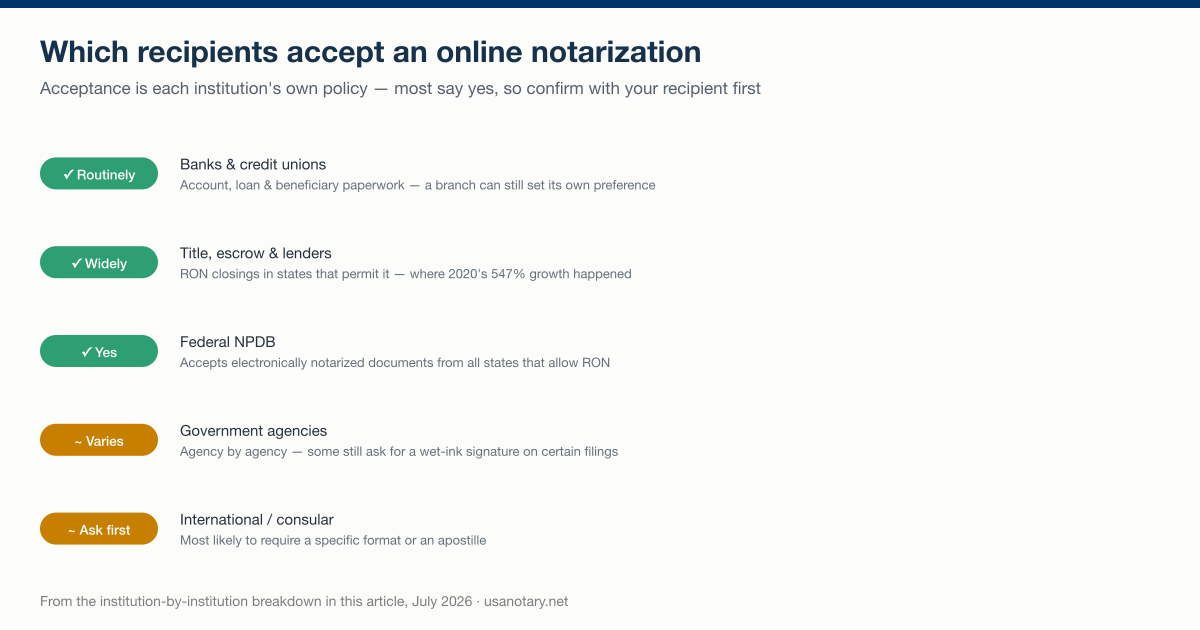
How the recipient types covered in this article treat a remotely notarized document, July 2026.
That said, acceptance is granted institution by institution, so treat the pattern as strong, not universal:
- Banks and credit unions routinely accept remotely notarized documents for account, loan, and beneficiary paperwork, though a branch can still set its own preference.
- Title and escrow companies and lenders widely use remote online notarization for closings in states that permit it — the mortgage and title industry is where the ALTA-measured 547% growth happened, and its trade association actively lobbies for federal RON standards.
- Government agencies vary agency by agency; some accept RON openly, others still ask for a wet-ink signature on certain filings.
- International or consular recipients are the most likely to require a specific format or an apostille, and an apostille for a remotely notarized document is its own state-by-state question.
Whether the receiving party is your bank or a county office, the deciding factor is that recipient’s own rule — not whether online notarization is legal.
Why a valid notarization can still be declined
A notary seal confirms identity and that the signer acknowledged signing — nothing more. It does not make a document acceptable for a given transaction, and it does not override a recipient’s internal policy.
Banks in particular are risk-averse, and their caution has structure. A Florida estate-law firm’s analysis of why banks refuse to notarize estate documents describes the machinery: many institutions have adopted uniform national policies that remove branch-level discretion, they treat estate documents as heightened-liability paperwork exposed to claims of undue influence or defective execution, and their branch notaries — often hourly employees — are not trained to evaluate state-specific witnessing and execution formalities. The default answer becomes a blanket rule. The same instinct that makes a branch refuse to notarize a will can make a back office slow to accept an unfamiliar format.
Two edge cases are worth knowing so you don’t misread a refusal:
- A declined RON is usually about format, not fraud. A wet-ink, in-person notarization can be declined for the very same policy reasons. If you’d like the deeper legal grounding on why RON holds up, we cover whether online notarization is legit and, for out-of-state paperwork, whether a remote notarization is valid across state lines.
- A medallion signature guarantee is not a notarization. Banks list it as a separate signature service used for securities transfers, and no notarization — online or in person — substitutes for it. If a brokerage asks for a “medallion guarantee,” a notary seal of any kind won’t satisfy the request; you’ll need a participating financial institution.
Which documents draw the most acceptance questions
Everyday paperwork is almost never a problem. Friction clusters around high-liability categories where the receiving party has its own execution rules — so budget your confirmation effort accordingly:
| Friction level | Documents | Who sets the rule | What to do |
|---|---|---|---|
| Low | Affidavits, account forms, consent letters, business filings | The recipient, but policies are permissive | Notarize online; keep the audit trail |
| Medium | Powers of attorney, real-estate and closing packages | The receiving bank, DMV, brokerage, lender, title company, or county recorder | Ask the specific recipient before signing |
| High | Wills, trusts, trust certifications, healthcare directives, international/apostille documents | State execution law plus the recipient — some require in-person witnessing regardless | Confirm format, witnesses, and any apostille needs first |
Powers of attorney deserve the extra sentence: acceptance is set by the office receiving the POA, not by the notary. The National Notary Association’s guidance is that there is no comprehensive list of which agencies accept remotely notarized POA forms — the same article that notes any recipient can reject a RON notarization for any reason. The estate-document cluster tracks the list banks most often refuse to notarize in person, too: wills, trusts, durable powers of attorney, healthcare directives, deeds, and probate affidavits.
The pattern is consistent: the higher the stakes and the more parties downstream, the more likely one of them has a format rule. That’s an argument for asking early, not for avoiding online notarization.
Where online notarization is authorized in 2026
RON is available to signers in all 50 states as a consumer service — you can request it from anywhere, because the notarization follows the notary’s commissioning-state law. What varies is notary commissioning law: not every state has authorized its own notaries to perform RON. The current map, per NASS, is 47 states plus the District of Columbia with a remote e-notarization law, and the holdouts are narrower than they look:
- California enacted its RON statute — SB 696, the Online Notarization Act — but the online-notary provisions are not yet operative. Until the Secretary of State completes the required technology platform (or January 1, 2030, whichever is earlier, unless the Secretary of State notifies the Legislature and Governor in writing by January 1, 2029 that the project will not be completed), California-commissioned notaries cannot perform RON.
- Mississippi has not authorized RON for its own notaries, and Miss. Code Ann. § 25-34-23 gives a notarial act performed in another state the same effect as one performed in Mississippi, but the section does not mention remote online notarization.
- Georgia has not enacted a RON law of its own — Georgia-commissioned notaries cannot perform remote online notarization (see our Georgia notary guide) — though a Georgia signer can still use an online notary commissioned in a RON state.
That distinction rarely blocks a signer. The NNA confirms the workaround directly: a California resident may contact a remote notary commissioned in another state to request remote online notarization services. The document’s validity travels with the notary’s commission — the full statutory picture is in our guide to whether online notarization is legal.
What acceptance looks like in practice: three common scenarios
Abstract rules land better as concrete situations. These three cover most of the acceptance questions signers actually hit:
A power of attorney going to your bank. This is the classic medium-friction case — the one behind most “bank rejected my electronically notarized POA” forum threads. The notarization itself is valid; the question is whether the bank’s estate-services or branch-operations team processes that format for that purpose. The NNA’s guidance applies squarely here: there is no comprehensive list of which recipients accept remotely notarized POA forms, so the receiving office’s answer is the only one that counts. Call the department that will file the POA — not the teller line — and ask before you sign.
A mortgage or refinance closing. Here the lender and title company decide, and this is the friendliest territory for online notarization: mortgage and title closings are where the ALTA-measured 547% growth in RON use happened. Lenders that support RON closings will schedule the session as part of the closing package; lenders that don’t will say so up front. The signer rarely needs to arrange anything independently — but if you’re asked to supply your own notarized documents into a closing, confirm the format with the title company first.
A federal filing. The National Practitioner Data Bank scenario shows the ceiling: a federal system that says yes to electronically notarized documents from every state that allows RON, with no special form. Federal acceptance is still agency-by-agency, but where an agency has published an answer like the NPDB’s, you can rely on it — that’s a written policy, not a branch employee’s preference.
Where to get something notarized if you don’t have a bank
Bank branches are only one venue, and not banking anywhere doesn’t limit your options much:
- Online, from any state — a remote notary verifies your identity and completes the act while you appear on live video, for $25 per document on our remote online notarization service.
- Shipping stores such as UPS locations offer walk-in notarization for a fee — about $20 as of 2025, per the estate-law analysis cited above — and can often arrange witnesses.
- Title companies and law offices notarize the documents connected to their own transactions; a title agency handles real-estate signings, and attorneys’ offices commonly notarize estate documents they prepare.
If you do have a bank, its branch notary is usually free for customers — see what bank notaries will and won’t handle — but remember the estate-document blind spot: the wills, trusts, and POAs banks most often refuse to notarize in person are the same documents worth confirming acceptance on in any format.
How to confirm acceptance before your session
Five minutes of confirmation beats a redo every time. Work through this checklist before you book:
- Identify the actual recipient. Not “the bank” — the specific department or office that will process the document (branch operations, estate services, the lienholder’s title unit).
- Ask the acceptance question: “Do you accept a remotely (online) notarized document for this?” Get the answer for your document type, not in general.
- Ask the format question: “Do you require any specific form, wording, witnesses, or original wet-ink signature?” This is where POAs and estate documents reveal their special rules.
- Use a compliant provider. A proper session verifies your identity and records the video call while you appear on live video — the evidentiary trail is what downstream reviewers rely on.
- Keep everything. Save the completed notarized document and its audit trail; if a reviewer months later questions the notarization, the recording and identity-verification record answer it.
When you’re ready, you can notarize a document online for $25 per document in all 50 states.
If your bank says no
A declined online notarization is uncommon for an eligible document type, but the recovery path is short:
- Ask exactly what format the recipient requires — form, wording, witnesses, wet ink — and match it. Most “no” answers are really “not in this format.”
- Use an in-person or mobile notary for that one document. Your own branch may handle routine forms free; for the estate documents banks commonly refuse to touch, a mobile notary or attorney’s office fills the gap.
- Don’t re-litigate validity. A remotely notarized document is generally recognized across states, but a private recipient can still set its own policy — the fastest path is always to confirm acceptance before your session, not after.
One refusal also doesn’t set precedent: the same bank that declines a remotely notarized will may accept a remotely notarized beneficiary form the same afternoon. Policies attach to document types and transactions, not to online notarization as a category.